 Connexion
Découverte de l’épave d’un bateau antique dans la rade d’Alexandrie
8 décembre 2025 à 19:49
La carène de cette embarcation de plus de 35 mètres gisait dans les profondeurs du port d'Antirhod.

La carène de cette embarcation de plus de 35 mètres gisait dans les profondeurs du port d'Antirhod.

Assassin’s Creed Shadows est disponible depuis le 20 Mars 2025 mais nous avons eu l’occasion de tester la nouvelle version Nintendo Switch 2. Ubisoft continue de porter ses AAA sur la dernière console de Nintendo, ce qui ravit les joueurs comme moi. A noter que le jeu est disponible en physique mais seulement en game key card ou sinon en dématérialisé. Cette nouvelle version exige une connexion pour pouvoir utiliser le système de cross-save sans tracas.
Ce portage a nécessité beaucoup de travail de la part des équipes d’Ubisoft et cette nouvelle édition est d’une grande qualité mais souffre des contraintes techniques de la Nintendo Switch 2. Cependant il y’a encore quelques années ce type de jeu était impensable sur la première console. C’est avec plaisir que j’ai redécouvert ce jeu et j’ai pris énormément de plaisir à parcourir ce Japon féodal en mode portable et aussi sur ma TV. Toutefois, il est préférable de jouer sur un écran PC si vous souhaitez jouer en mode docker. Cela permet d’éviter les baisses de framerate que j’ai constaté sur une TV 4K.

Assassin’s Creed Shadows vous permet de découvrir le Japon féodal grâce à une histoire de vengeance à travers 2 points de vue différents. Vous incarnez Yasuke et Naoé, deux personnages très différents mais qui partagent tous les deux une volonté inébranlable. Naoé est une ninja et n’est pas forcément adaptée au combat rapproché. Il vous faudra jouer avec vos outils et vos techniques de furtivité pour tuer vos ennemis et réussir vos missions sans trop mourir. Yasuke est un samurai imposant qui n’hésite pas à utiliser sa force pour vaincre les hordes d’ennemis face à lui. Cependant il n’est pas du tout fait pour la furtivité mais encaisse les coups contrairement à Naoé. Le test plus complet du jeu est disponible sur le blog et vous permet d’avoir plus de détails sur l’un des open-world de cette année.






Assassin’s Creed Shadows Edition Switch 2 ajoute quelques nouveautés : l’écran tactile de la console pour les menus et la carte, un mode portable optimisé avec une résolution plus basse, des bonus et tous les derniers ajouts et contenus gratuits.
Personnellement, je trouve que ce portage est d’excellente qualité et permet aux joueurs Switch de jouer à un très bon AAA. J’ai préféré jouer en mode portable mais le mode docker tourne en 1080p et 30fps en moyenne. La batterie de la console fond comme neige au soleil car le jeu demande beaucoup de ressource à la console. N’hésitez pas à vous munir de votre chargeur si vous souhaitez jouer en mode portable. Je recommande chaudement cette nouvelle version d’Assassin’s Creed Shadows, en espérant avoir d’autres portages de ce genre sur cette nouvelle console.
Test réalisé par Pierre
Cet article TEST de ASSASSIN’S CREED SHADOWS version Switch! est apparu en premier sur Insert Coin.
The first clip of Xreal's Project Aura in use has been revealed.
A concept render was shown at Google I/O earlier this year when Project Aura was first announced as the second Android XR device, set to launch next year.
It's a prism-lens see-through device in a form factor that tries to imitate the basic appearance of sunglasses, as with Xreal's existing products. But while Xreal's current products primarily act as a virtual monitor for your existing devices, via the included cable, Project Aura will come with a tethered compute puck running Google's Android XR on a Qualcomm Snapdragon XR2+ Gen 2 chipset, the same inside Samsung Galaxy XR.
Xreal says Project Aura will have a field of view of 70 degrees diagonal, its widest yet, and have built-in head and hand tracking.
Most features and apps available on Galaxy XR will also run on Project Aura's puck, with some notable exceptions such as the face-tracked Likeness realistic avatars, as Aura doesn't have face tracking.
Today, during The Android Show: XR Edition, Google and Xreal showed off the device in a short clip. They also confirmed that it's still on track to launch in 2026 – just days after internal Meta memos leaked revealing that its headset with a tethered puck is delayed to 2027.
Note that while Xreal devices are designed to look like sunglasses, they sit much further out from your eyes than real glasses, and thus are a markedly different device category than the AR glasses in development at Meta and Apple. Those future AR glasses use a display technology called waveguides to sit as close to your eyes as regular glasses, while Xreal uses a far cheaper but also far bulkier optical approach. They also block out most light, so can't be used as regular indoor prescription glasses.
Essentially, you can think of Project Aura as a lightweight alternative to Samsung Galaxy XR that trades off field of view and opacity for sleekness, rather than competition for future outdoor AR glasses.
The confirmation that Project Aura is still set to ship in 2026 comes one month after Lynx revealed that Google terminated its Android XR deal. After Samsung, Lynx, Xreal, and Sony were the three companies Google had earlier confirmed were working on Android XR products. While declining to comment on the Lynx situation, Google confirmed that it's still working with Sony, though we've yet to see even a tease of a Sony Android XR device, and its SRH-S1 headset runs Sony's own fork of Android.
UploadVRDavid Heaney
The first major update for Google's Android XR on Samsung Galaxy XR is rolling out now.
The update brings a beta release of Google's Persona-like realistic avatar system for video calls, called Likeness, a Travel Mode, and a beta for a built-in PC remote desktop feature for Windows called PC Connect.
UploadVRDavid HeaneyLikeness is Google's realistic avatar system for video calls in Android XR, an equivalent to the original non-spatial mode of Apple Vision Pro's Personas.
Your Likeness replaces the video feed that apps would normally get from a phone's selfie camera, providing a virtual equivalent, and should thus work for any video calling platform without developer implementation.
Android XR's Likeness on Samsung Galaxy XR.
Unlike with Vision Pro, you scan your face for Likeness by holding up your phone, not the headset itself. From here, the data is transferred to and securely stored on the headset. The Likeness app is currently only available on "select Android device models".
In video calls on Android XR, your Likeness is driven by Galaxy XR's eye tracking and face tracking capabilities in real-time, and the feed shows a virtual representation of your hands when you hold them up too.
Android XR now has a Travel Mode, which when enabled, makes the positional tracking work properly on moving vehicles, such as planes and trains.
Apple was the first to launch this feature, alongside Vision Pro, and since then Meta, Pico, and Snap have followed.
Android XR's Travel Mode
Without a Travel Mode, the accelerometer and gyroscope in the headset's IMU will interpret the acceleration, orientation changes, and vibrations of the vehicle as your head movement, causing virtual objects and windows to drift off in the opposite direction.
Travel Mode works by having the headset rely more on computer vision from the cameras, typically incurring a small loss in tracking quality.
PC Connect (beta) is a feature that lets you connect to and control your Windows PC as a virtual screen in Android XR.
PC Connect on Android XR
After installing the streamer app on your PC, you can mirror your entire desktop or one window.
There are already many third-party apps on the Google Play Store that can do this, including Guy Godin's Virtual Desktop, but PC Connect offers a built-in option.
UploadVRDavid HeaneyMeta has a partnership with Microsoft for an officially supported Windows 11 remote desktop system, leveraging the operating system's RDP system, with support for virtual extra monitors and multiple aspect ratios. Android XR's PC Connect doesn't seem to have Microsoft's involvement, and seems more basic for now, at least in beta, lacking these more advanced options.
We'll keep a close eye on Google through 2026 for further Android XR updates, such as whether a spatial version of Likeness arrives or advanced virtual monitor options for PC Connect.
UploadVRDavid Heaney
Manjaro Linux is a fast, user-friendly, desktop-oriented operating system based on Arch Linux. Key features include intuitive installation process, automatic hardware detection, stable rolling-release model, ability to install multiple kernels, special Bash scripts for managing graphics drivers and extensive desktop configurability. Manjaro Linux offers Xfce as the core desktop options, as well as KDE, GNOME and a minimalist Net edition for more advanced users. Community-supported desktop flavours are also available.
Connaître l’état de la population de la bécasse d’Amérique a toujours été un défi pour les scientifiques. Cet oiseau est presque invisible à l'œil nu, alors les chercheurs utilisent le son de sa parade nuptiale pour le repérer. Au Québec, des chasseurs aident aussi les recherches en mettant à profit le nez de leurs chiens pour repérer les nids de ces oiseaux.

Travis Humble is a research leader who’s thinking big, dreaming bold, yet laser-focused on operational delivery. The long-game? To translate advances in fundamental quantum science into a portfolio of enabling technologies that will fast-track the practical deployment of quantum computers for at-scale scientific, industrial and commercial applications.
As director of the Quantum Science Center (QSC) at Oak Ridge National Laboratory (ORNL) in East Tennessee, Humble and his management team are well placed to transform that research vision into scientific, economic and societal upside. Funded to the tune of $115 million through its initial five-year programme (2020–25), QSC is one of five dedicated National Quantum Information Science Research Centers (NQISRC) within the US Department of Energy (DOE) National Laboratory system.
Validation came in spades last month when, despite the current turbulence around US science funding, QSC was given follow-on DOE backing of $125 million over five years (2025–30) to create “a new scientific ecosystem” for fault-tolerant, quantum-accelerated high-performance computing (QHPC). In short, QSC will target the critical research needed to amplify the impact of quantum computing through its convergence with leadership-class exascale HPC systems.
“Our priority in Phase II QSC is the creation of a common software ecosystem to host the compilers, programming libraries, simulators and debuggers needed to develop hybrid-aware algorithms and applications for QHPC,” explains Humble. Equally important, QSC researchers will develop and integrate new techniques in quantum error correction, fault-tolerant computing protocols and hybrid algorithms that combine leading-edge computing capabilities for pre- and post-processing of quantum programs. “These advances will optimize quantum circuit constructions and accelerate the most challenging computational tasks within scientific simulations,” Humble adds.
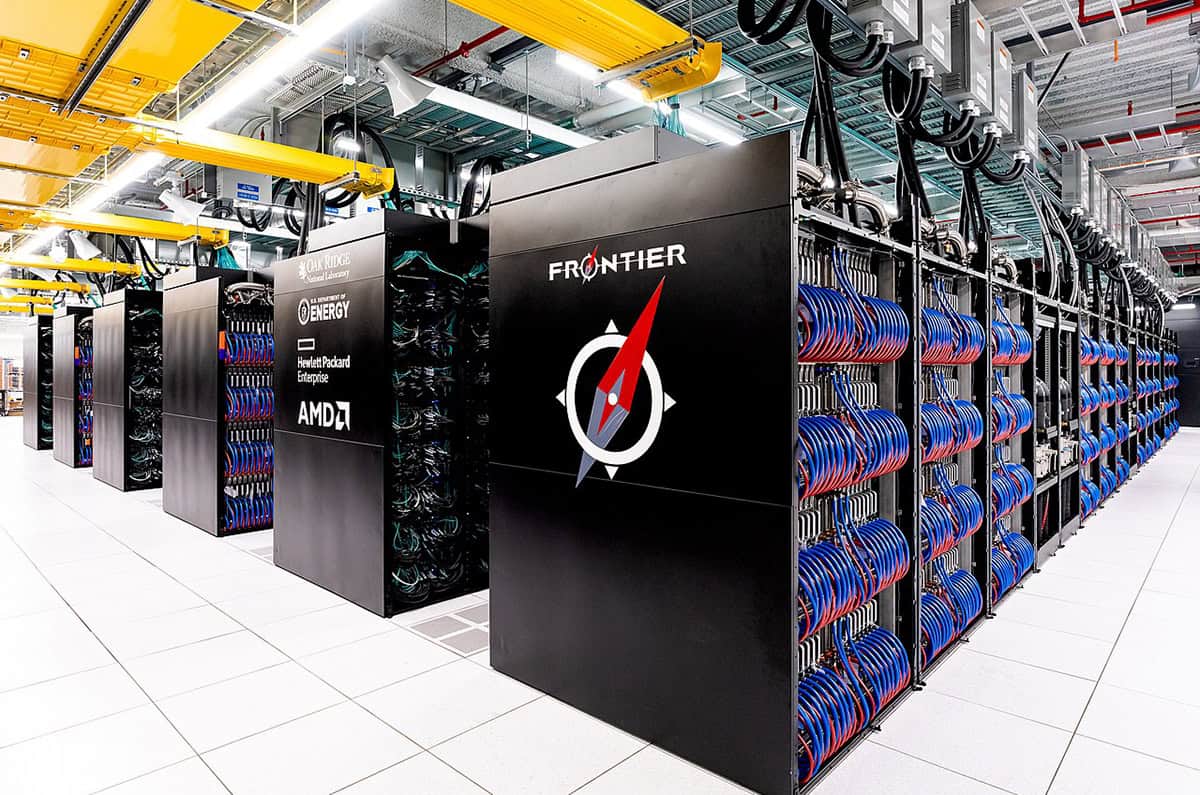
At the heart of the QSC programme sits ORNL’s leading-edge research infrastructure for classical HPC, a capability that includes Frontier, the first supercomputer to break the exascale barrier and still one of the world’s most powerful. On that foundation, QSC is committed to building QHPC architectures that take advantage of both quantum computers and exascale supercomputing to tackle all manner of scientific and industrial problems beyond the reach of today’s HPC systems alone.
“Hybrid classical-quantum computing systems are the future,” says Humble. “With quantum computers connecting both physically and logically to existing HPC systems, we can forge a scalable path to integrate quantum technologies into our scientific infrastructure.”
Industry partnerships are especially important in this regard. Working in collaboration with the likes of IonQ, Infleqtion and QuEra, QSC scientists are translating a range of computationally intensive scientific problems – quantum simulations of exotic matter, for example – onto the vendors’ quantum computing platforms, generating excellent results out the other side.
“With our broad representation of industry partners,” notes Humble, “we will establish a common framework by which scientific end-users, software developers and hardware architects can collaboratively advance these tightly coupled, scalable hybrid computing systems.”
It’s a co-development model that industry values greatly. “Reciprocity is key,” Humble adds. “At QSC, we get to validate that QHPC can address real-world research problems, while our industry partners gather user feedback to inform the ongoing design and optimization of their quantum hardware and software.”
Innovation being what it is, quantum computing systems will continue to trend on an accelerating trajectory, with more qubits, enhanced fidelity, error correction and fault-tolerance key reference points on the development roadmap. Phase II QSC, for its part, will integrate five parallel research thrusts to advance the viability and uptake of QHPC technologies.
The collaborative software effort, led by ORNL’s Vicente Leyton, will develop openQSE, an adaptive, end-to-end software ecosystem for QHPC systems and applications. Yigit Subasi from Los Alamos National Laboratory (LANL) will lead the hybrid algorithms thrust, which will design algorithms that combine conventional and quantum methods to solve challenging problems in the simulation of model materials.
Meanwhile, the QHPC architectures thrust, under the guidance of ORNL’s Chris Zimmer, will co-design hybrid computing systems that integrate quantum computers with leading-edge HPC systems. The scientific applications thrust, led by LANL’s Andrew Sornberger, will develop and validate applications of quantum simulation to be implemented on prototype QHPC systems. Finally, ORNL’s Michael McGuire will lead the thrust to establish experimental baselines for quantum materials that ultimately validate QHPC simulations against real-world measurements.
Longer term, ORNL is well placed to scale up the QHPC model. After all, the laboratory is credited with pioneering the hybrid supercomputing model that uses graphics processing units in addition to conventional central processing units (including the launch in 2012 of Titan, the first supercomputer of this type operating at over 10 petaFLOPS).
“The priority for all the QSC partners,” notes Humble, “is to transition from this still-speculative research phase in quantum computing, while orchestrating the inevitable convergence between quantum technology, existing HPC capabilities and evolving scientific workflows.”
Much like its NQISRC counterparts (which have also been allocated further DOE funding through 2030), QSC provides the “operational umbrella” for a broad-scope collaboration of more than 300 scientists and engineers from 20 partner institutions. With its own distinct set of research priorities, that collective activity cuts across other National Laboratories (Los Alamos and Pacific Northwest), universities (among them Berkeley, Cornell and Purdue) and businesses (including IBM and IQM) to chart an ambitious R&D pathway addressing quantum-state (qubit) resilience, controllability and, ultimately, the scalability of quantum technologies.
“QSC is a multidisciplinary melting pot,” explains Humble, “and I would say, alongside all our scientific and engineering talent, it’s the pooled user facilities that we are able to exploit here at Oak Ridge and across our network of partners that gives us our ‘grand capability’ in quantum science [see box, “Unique user facilities unlock QSC opportunities”]. Certainly, when you have a common research infrastructure, orchestrated as part a unified initiative like QSC, then you can deliver powerful science that translates into real-world impacts.”
Deconstructed, QSC’s Phase I remit (2020–25) spanned three dovetailing and cross-disciplinary research pathways: discovery and development of advanced materials for topological quantum computing (in which quantum information is stored in a stable topological state – or phase – of a physical system rather than the properties of individual particles or atoms); development of next-generation quantum sensors (to characterize topological states and support the search for dark matter); as well as quantum algorithms and simulations (for studies in fundamental physics and quantum chemistry).
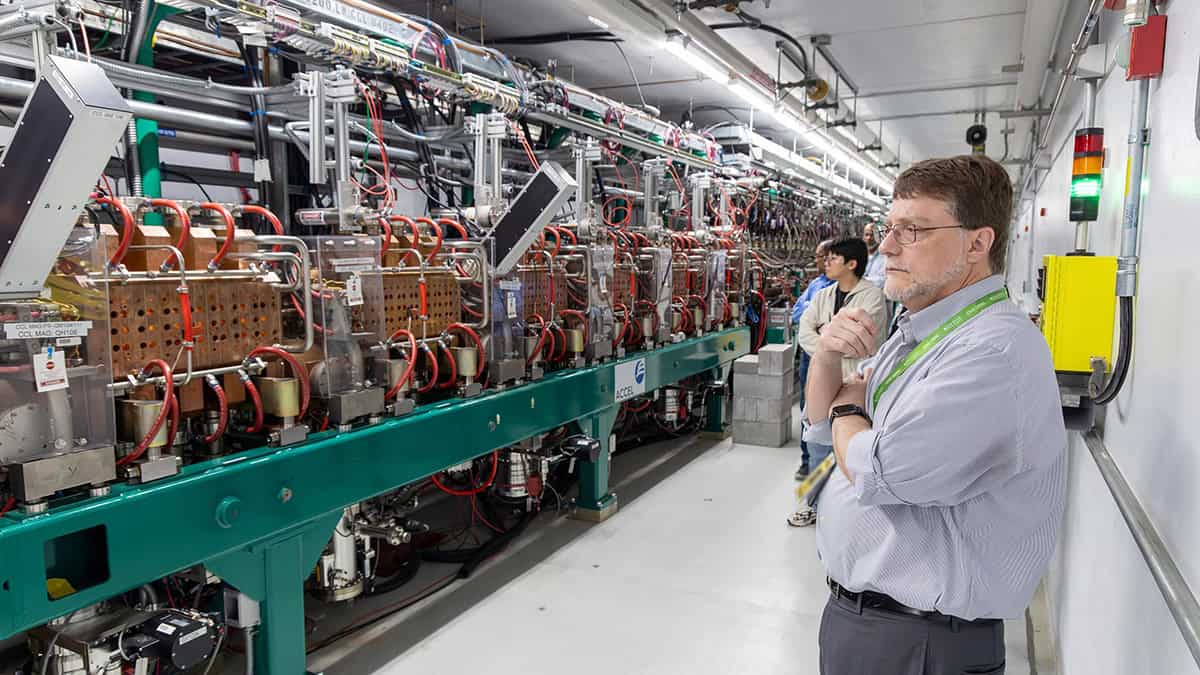
Underpinning that collective effort: ORNL’s unique array of scientific user facilities. A case in point is the Spallation Neutron Source (SNS), an accelerator-based neutron-scattering facility that enables a diverse programme of pure and applied research in the physical sciences, life sciences and engineering. QSC scientists, for example, are using SNS to investigate entirely new classes of strongly correlated materials that demonstrate topological order and quantum entanglement – properties that show great promise for quantum computing and quantum metrology applications.
“The high-brightness neutrons at SNS give us access to this remarkable capability for materials characterization,” says Humble. “Using the SNS neutron beams, we can probe exotic materials, recover the neutrons that scatter off of them and, from the resultant signals, infer whether or not the materials exhibit quantum properties such as entanglement.”
While SNS may be ORNL’s “big-ticket” user facility, the laboratory is also home to another high-end resource for quantum studies: the Center for Nanophase Material Science (CNMS), one of the DOE’s five national Nanoscience Research Centers, which offers QSC scientists access to specialist expertise and equipment for nanomaterials synthesis; materials and device characterization; as well as theory, modelling and simulation in nanoscale science and technology.
Thanks to these co-located capabilities, QSC scientists pioneered another intriguing line of enquiry – one that will now be taken forward elsewhere within ORNL – by harnessing so-called quantum spin liquids, in which electron spins can become entangled with each other to demonstrate correlations over very large distances (relative to the size of individual atoms).
In this way, it is possible to take materials that have been certified as quantum-entangled and use them to design new types of quantum devices with unique geometries – as well as connections to electrodes and other types of control systems – to unlock novel physics and exotic quantum behaviours. The long-term goal? Translation of quantum spin liquids into a novel qubit technology to store and process quantum information.
SNS, CNMS and Oak Ridge Leadership Computing Facility (OLCF) are DOE Office of Science user facilities.
When he’s not overseeing the technical direction of QSC, Humble is acutely attuned to the need for sustained and accessible messaging. The priority? To connect researchers across the collaboration – physicists, chemists, material scientists, quantum information scientists and engineers – as well as key external stakeholders within the DOE, government and industry.
“In my experience,” he concludes, ”the ability of the QSC teams to communicate efficiently – to understand each other’s concepts and reasoning and to translate back and forth across disciplinary boundaries – remains fundamental to the success of our scientific endeavours.”
Listen to the Physics World podcast: Oak Ridge’s Quantum Science Center takes a multidisciplinary approach to developing quantum materials and technologies
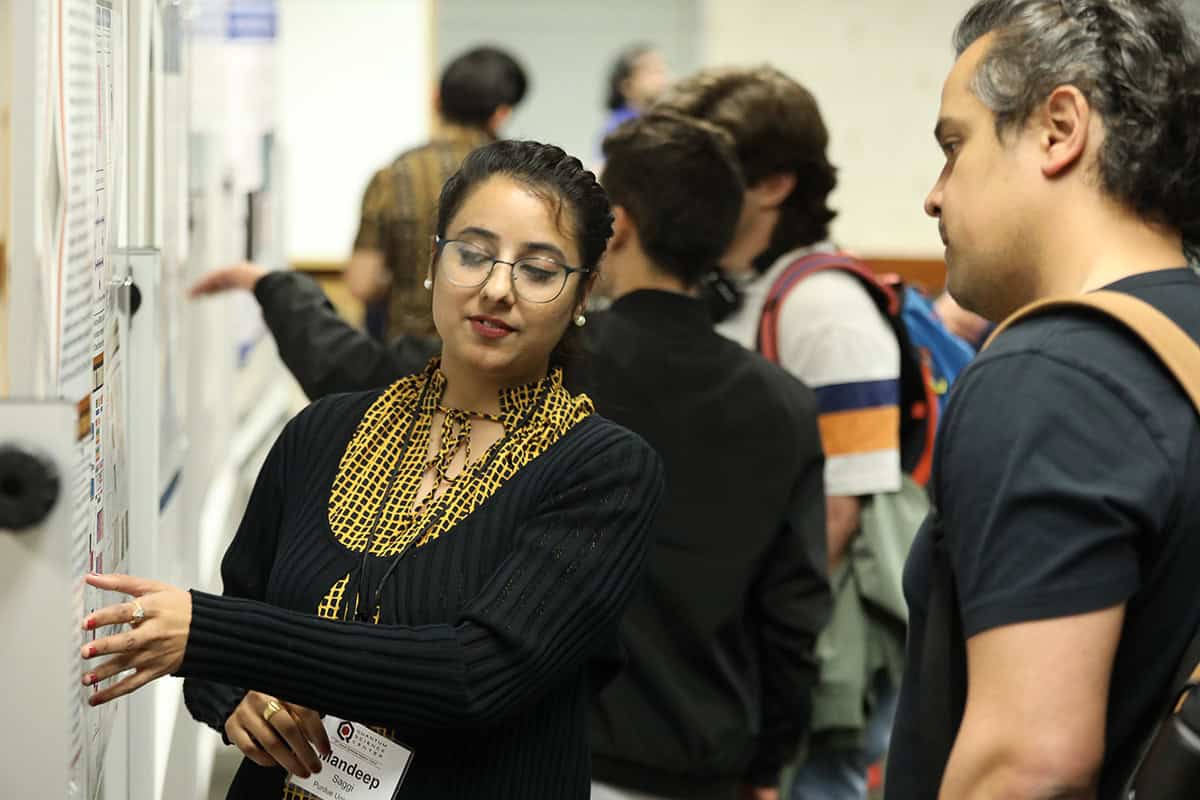
With an acknowledged shortage of skilled workers across the quantum supply chain, QSC is doing its bit to bolster the scientific and industrial workforce. Front-and-centre: the fifth annual QSC Summer School, which was held at Purdue University in April this year, hosting 130 graduate students (the largest cohort to date) through an intensive four-day training programme.
The Summer School sits as part of a long-term QSC initiative to equip ambitious individuals with the specialist domain knowledge and skills needed to thrive in a quantum sector brimming with opportunity – whether that’s in scientific research or out in industry with hardware companies, software companies or, ultimately, the end-users of quantum technologies in key verticals like pharmaceuticals, finance and healthcare.
“While PhD students and postdocs are integral to the QSC research effort, the Summer School exposes them to the fundamental ideas of quantum science elaborated by leading experts in the field,” notes Vivien Zapf, a condensed-matter physicist at Los Alamos National Laboratory who heads up QSC’s advanced characterization efforts.
“It’s all about encouraging the collective conversation,” she adds, “with lots of opportunities for questions and knowledge exchange. Overall, our emphasis is very much on training up scientists and engineers to work across the diversity of disciplines needed to translate quantum technologies out of the lab into practical applications.”
The programme isn’t for the faint-hearted, though. Student delegates kicked off this year’s proceedings with a half-day of introductory presentations on quantum materials, devices and algorithms. Next up: three and a half days of intensive lectures, panel discussions and poster sessions covering everything from entangled quantum networks to quantum simulations of superconducting qubits.
Many of the Summer School’s sessions were also made available virtually on Purdue’s Quantum Coffeehouse Live Stream on YouTube – the streamed content reaching quantum learners across the US and further afield. Lecturers were drawn from the US National Laboratories, leading universities (such as Harvard and Northwestern) and the quantum technology sector (including experts from IBM, PsiQuantum, NVIDIA and JPMorganChase).
The post Oak Ridge Quantum Science Center prioritizes joined-up thinking, multidisciplinary impacts appeared first on Physics World.
As a physicist in industry, I spend my days developing new types of photovoltaic (PV) panels. But I’m also keen to do something for the transition to green energy outside work, which is why I recently installed two PV panels on the balcony of my flat in Munich. Fitting them was great fun – and I can now enjoy sunny days even more knowing that each panel is generating electricity.
However, the panels, which each have a peak power of 440 W, don’t cover all my electricity needs, which prompted me to take an interest in a plan to build six wind turbines in a forest near me on the outskirts of Munich. Curious about the project, I particularly wanted to find out when the turbines will start generating electricity for the grid. So when I heard that a weekend cycle tour of the site was being organized to showcase it to local residents, I grabbed my bike and joined in.
As we cycle, I discover that the project – located in Forstenrieder Park – is the joint effort of four local councils and two “citizen-energy” groups, who’ve worked together for the last five years to plan and start building the six turbines. Each tower will be 166 m high and the rotor blades will be 80 m long, with the plan being for them to start operating in 2027.
I’ve never thought of Munich as a particularly windy city, but at the height at which the blades operate, there’s always a steady, reliable flow of wind
I’ve never thought of Munich as a particularly windy city. But tour leader Dieter Maier, who’s a climate adviser to Neuried council, explains that at the height at which the blades operate, there’s always a steady, reliable flow of wind. In fact, each turbine has a designed power output of 6.5 MW and will deliver a total of 10 GWh in energy over the course of a year.
Cycling around, I’m excited to think that a single turbine could end up providing the entire electricity demand for Neuried. But installing wind turbines involves much more than just the technicalities of generating electricity. How do you connect the turbines to the grid? How do you ensure planes don’t fly into the turbines? What about wildlife conservation and biodiversity?
At one point of our tour, we cycle round a 90-degree bend in the forest and I wonder how a huge, 80 m-long blade will be transported round that kind of tight angle? Trees will almost certainly have to be felled to get the blade in place, which sounds questionable for a supposedly green project. Fortunately, project leaders have been working with the local forest manager and conservationists, finding ways to help improve the local biodiversity despite the loss of trees.
As a representative of BUND (one of Germany’s biggest conservation charities) explains on the tour, a natural, or “unmanaged”, forest consists of a mix of areas with a higher or lower density of trees. But Forstenrieder Park has been a managed forest for well over a century and is mostly thick with trees. Clearing trees for the turbines will therefore allow conservationists to grow more of the bushes and plants that currently struggle to find space to flourish.

To avoid endangering birds and bats native to this forest, meanwhile, the turbines will be turned off when the animals are most active, which coincidentally corresponds to low wind periods in Munich. Insurance costs have to be factored in too. Thankfully, it’s quite unlikely that a turbine will burn down or get ice all over its blades, which means liability insurance costs are low. But vandalism is an ever-present worry.
In fact, at the end of our bike tour, we’re taken to a local wind turbine that is already up and running about 13 km further south of Forstenrieder Park. This turbine, I’m disappointed to discover, was vandalized back in 2024, which led to it being fenced off and video surveillance cameras being installed.
But for all the difficulties, I’m excited by the prospect of the wind turbines supporting the local energy needs. I can’t wait for the day when I’m on my balcony, solar panels at my side, sipping a cup of tea made with water boiled by electricity generated by the rotor blades I can see turning round and round on the horizon.
The post So you want to install a wind turbine? Here’s what you need to know appeared first on Physics World.
Introduite en 2015, l’Apple Watch peut aujourd'hui se vanter, à l’heure de fêter ses 10 bougies, d’être devenue la montre la plus portée au monde.
Je fais partie de ceux qui ont été rapidement convertis. L’Apple Watch fait désormais partie intégrante de mon quotidien. Les usages que j’en fais chaque jour sont multiples et variés : consulter la météo, suivre mes entraînements sportifs (et l’ensemble de mes métriques de santé), payer, déverrouiller mon domicile/mon Mac, consulter discrètement mes notifications/appels… Il m’arrive même parfois d’y lire l’heure !
Cependant, je suis aujourd’hui devant le constat simple que, devenu si dépendant des fonctionnalités qu’elle apporte, je ne porte quasiment plus qu’elle. C’est que ces anneaux ne vont pas se fermer tout seuls !
Et si la montre d’Apple est sans doute la plus pratique des montres, il est plutôt universellement reconnu que ce petit rectangle noir est loin d’être aussi esthétique que peut ne l’être une montre d’horloger. Bien que l’idée de porter une montre à chaque poignet m’ait plusieurs fois effleuré l’esprit, je n’ai jamais franchi le pas ayant plutôt l’habitude de porter un bracelet au poignet droit…
C’est justement dans ce cadre que la société Smartlet propose désormais une solution. Avec son bracelet métallique « Smartlet One » primé au prestigieux Concours Lépine, la société éponyme entend rassembler montre classique et smartwatch sur le même poignet. L’idée est donc d’avoir deux montres montées sur un même bracelet : montre classique à l’extérieur et montre connectée à l’intérieur. Mais dans les faits, parfaitement symétrique et modulaire, il est tout à fait possible de porter son Smartlet One dans l’autre sens. Et, tout comme les femmes ont tendance à retourner leur bague pour éviter la convoitise (dans les transports par exemple), il est possible de retourner son Smartlet One pour plus de discrétion.
Compatible avec la quasi-totalité des montres classiques (des adaptateurs pour différentes tailles d’entre-corne étant disponibles), j’ai pu porter le « Smartlet One » avec une montre d’horloger et avec mon Apple Watch Series 11 42 mm (il est également compatible avec le Fitbit Charge et le Whoop).
Bien qu’emballé par l’idée de pouvoir concilier style d’une montre classique et fonctionnalité d’une montre connectée, j’avoue avoir été initialement sceptique sur le ressenti au poignet au quotidien… Et bien pour faire court : j’ai été bluffé. Car dès les premières heures de port, j’ai tout bonnement oublié que je l’avais au poignet. Les seules piqûres de rappel venaient des notifications de l’Apple Watch. Là, il faut réapprendre à regarder de l’autre côté du poignet (à un angle certes un peu moins optimal mais plus discret). Niveau lecture des données de santé par les capteurs de la montre, je n’ai pas remarqué de différence notable avec un port sur le côté externe du poignet.
Smartlet One Classic à mon poignet
Quel plaisir de pouvoir à nouveau porter une montre classique au quotidien ! Le Smartlet One s’intègre parfaitement dans ma routine… du moins jusqu’au moment de m’entraîner. En effet, il n’est pas vraiment conçu pour accompagner les séances sportives intenses que je peux pratiquer. Lors du test, je repassais donc tout naturellement sur un bracelet Apple Watch type fluoroélastomère/tissu le temps de mes sessions, avant de retrouver le Smartlet One après l’effort.
Le Smartlet One est doté d’un système d’attaches rapides breveté qui fonctionne plutôt très bien (mais pas assez sécurisé vis-à-vis du vol à l’arraché à mon goût).
Système d’attaches sur le Smartlet One Shadow, mon coloris préféré bien qu’intrinsèquement plus fragile
Le bracelet est également livré avec un « bijou » servant de remplacement à l’une des montres, dans le cas où l’on voudrait porter son bracelet avec un unique cadran. Tout est bien pensé et les finitions sont excellentes. Le nombre de maillons est réglable avec un tournevis fourni.
Contenu du coffret Smartlet One avec le « bijou », © Smartlet
Le Smartlet One est disponible à la précommande en 3 coloris. Le « Classic » (349€) est en acier inoxydable, le « Shadow » en acier inoxydable noir sablé mat (449€) et « Titanium » (599€) en titane (là, on aurait pu deviner !). Jusqu’à la fin de l’année, Smartlet met à disposition le code MACBDEC15 pour obtenir -15% sur votre achat.
Et vous, faites-vous vous aussi face à ce dilemme : privilégier l’élégance d’une montre classique ou la praticité d’une montre connectée ?
Le code promotionnel proposé par la marque ne constitue PAS une affiliation.
