MSI MEG Z890 ACE Review


Plus de 150 produits chimiques industriels courants ont un effet toxique sur le microbiome.

![]()
Apparemment plusieurs États Américains voudraient bannir tout VPN pour "protéger les enfants".
Dont le Wisconsin avec une loi absurde demandant de bannir toute connexion depuis le Wisconsin via un VPN.
Les VPN ont plusieurs usages, le premier (historiquement) étant de relier des réseaux privés entre eux, par exemple une agence bancaire à son siège de manière sécurisée (authentifiée, sans accès aux données échangées, ni possibilité de les changer sans déclencher des erreurs).
Les distributeurs de billets, devenus depuis des mini-agences bancaires, utilisent aussi un VPN leur permettant d'échanger de manière sûre. Même quand ils sont sous un OS du XXème siècle.
Les VPN sont aussi utilisés à travers le monde par des opposants politiques appelés "dissidents" par le régime en place, comme en Chine, pour communiquer librement en protégeant leur identité, leurs échanges et idéaux, ainsi que leur vie privée.
Les VPN ne protègent pas que les banques, ils protègent aussi la Liberté et la Démocratie.
Et dans le grand-public, hors le piratage de contenu promu par NordVPN et consorts, ils permettent d'éviter les Black Box en France, protégeant l'anonymat ainsi que la vie privée.
Bien sûr j'utilise des VPN au quotidien pour mon travail, pour garantir la sécurité des échanges, c'est maintenant incontournable professionnellement quand on accès à des plateformes sensibles.
J'ai de plus deux VPN personnels. Un chez moi (Raspberry Pi), l'autre sur une instance Linux.
Petit à petit, avec les reculs sur les libertés, la protection de la vie privée, la protection des échanges privés, bien que tout cela garanti par les Droits de l'Homme et la CEDH, les VPN semblent incontournables pour nous tous...
![]()
Je laisse la parole à Telegram, puis à son créateur, Pavel Durov, en remerciant au passage @snooper pour avoir attiré mon attention.
"Aujourd’hui, l’Union européenne a failli interdire votre droit à la vie privée. Une loi devait être votée, obligeant les applications à scanner tous les messages privés et transformant chaque téléphone en un outil de surveillance.
La France a été le moteur de ce projet autoritaire, avec le soutien des anciens et actuels ministres de l’Intérieur, Bruno Retailleau et Laurent Nuñez. En mars dernier, ils ont déclaré que la police devrait pouvoir consulter les messages privés des citoyens français (détails ici). Les Républicains et Renaissance, le parti de Macron, ont voté en faveur de cette loi.
De telles mesures censées « lutter contre la criminalité » visent en réalité les citoyens ordinaires. Elles n’arrêteraient pas les criminels — qui pourraient simplement utiliser des VPN ou des sites spéciaux pour se cacher. Les messages des autorités et de la police ne seraient pas non plus surveillés, car la loi les en protège. Seuls VOUS — simples citoyens — risqueriez de voir vos photos et messages privés compromis.
Aujourd’hui, nous avons défendu la vie privée : l'Allemagne, par sa prise de position soudaine, a préservé nos droits. Toutefois, la menace qui pèse sur nos libertés demeure. Alors que les dirigeants français réclament un accès total aux messages privés, les droits fondamentaux des Français — et de tous les Européens — restent menacés." - Telegram, le 14 octobre 2025
Plus de détails? Le gouvernement Français a essayé de faire passer une loi pour obliger les messageries chiffrées à introduire une backdoor pour permettre la surveillance de masse, sans contrôle ni information de la Justice, sans intervention d'un Juge des Libertés.
L'assemblée Nationale a retoquée cette loi de surveillance de masse.
"A law requiring messaging apps to implement a backdoor for police access to private messages was passed by the Senate. Luckily, it was shot down by the National Assembly." - Pavel Durov
Merci à l'Assemblée Nationale et à nos députés en France, merci à l'Allemagne en Europe.
Les discussions se poursuivent au niveau Européen, à Huis Clos. On n'en saura rien...
C'est le fameux projet "Chat Control". Où le E signifie Enfants.
A new, microscopic formulation of the second law of thermodynamics for coherently driven quantum systems has been proposed by researchers in Switzerland and Germany. The researchers applied their formulation to several canonical quantum systems, such as a three-level maser. They believe the result provides a tighter definition of entropy in such systems, and could form a basis for further exploration.
In any physical process, the first law of thermodynamics says that the total energy must always be conserved, with some converted to useful work and the remainder dissipated as heat. The second law of thermodynamics says that, in any allowed process, the total amount of heat (the entropy) must always increase.
“I like to think of work being mediated by degrees of freedom that we control and heat being mediated by degrees of freedom that we cannot control,” explains theoretical physicist Patrick Potts of the University of Basel in Switzerland. “In the macroscopic scenario, for example, work would be performed by some piston – we can move it.” The heat, meanwhile, goes into modes such as phonons generated by friction.
This distinction, however, becomes murky at small scales: “Once you go microscopic everything’s microscopic, so it becomes much more difficult to say ‘what is it that that you control – where is the work mediated – and what is it that you cannot control?’,” says Potts.
Potts and colleagues in Basel and at RWTH Aachen University in Germany examined the case of optical cavities driven by laser light, systems that can do work: “If you think of a laser as being able to promote a system from a ground state to an excited state, that’s very important to what’s being done in quantum computers, for example,” says Potts. “If you rotate a qubit, you’re doing exactly that.”
The light interacts with the cavity and makes an arbitrary number of bounces before leaking out. This emergent light is traditionally treated as heat in quantum simulations. However, it can still be partially coherent – if the cavity is empty, it can be just as coherent as the incoming light and can do just as much work.
In 2020, quantum optician Alexia Auffèves of Université Grenoble Alpes in France and colleagues noted that the coherent component of the light exiting a cavity could potentially do work. In the new study, the researchers embedded this in a consistent thermodynamic framework. They studied several examples and formulated physically consistent laws of thermodynamics.
In particular, they looked at the three-level maser, which is a canonical example of a quantum heat engine. However, it has generally been modelled semi-classically by assuming that the cavity contains a macroscopic electromagnetic field.
“The old description will tell you that you put energy into this macroscopic field and that is work,” says Potts, “But once you describe the cavity quantum mechanically using the old framework then – poof! – the work is gone…Putting energy into the light field is no longer considered work, and whatever leaves the cavity is considered heat.”
The researchers new thermodynamic treatment allows them to treat the cavity quantum mechanically and to parametrize the minimum degree of entropy in the radiation that emerges – how much radiation must be converted to uncontrolled degrees of freedom that can do no useful work and how much can remain coherent.
The researchers are now applying their formalism to study thermodynamic uncertainty relations as an extension of the traditional second law of thermodynamics. “It’s actually a trade-off between three things – not just efficiency and power, but fluctuations also play a role,” says Potts. “So the more fluctuations you allow for, the higher you can get the efficiency and the power at the same time. These three things are very interesting to look at with this new formalism because these thermodynamic uncertainty relations hold for classical systems, but not for quantum systems.”
“This [work] fits very well into a question that has been heavily discussed for a long time in the quantum thermodynamics community, which is how to properly define work and how to properly define useful resources,” says quantum theorist Federico Cerisola of the UK’s University of Exeter. “In particular, they very convincingly argue that, in the particular family of experiments they’re describing, there are resources that have been ignored in the past when using more standard approaches that can still be used for something useful.”
Cerisola says that, in his view, the logical next step is to propose a system – ideally one that can be implemented experimentally – in which radiation that would traditionally have been considered waste actually does useful work.
The research is described in Physical Review Letters.
The post Quantum-scale thermodynamics offers a tighter definition of entropy appeared first on Physics World.
![]()
GrapheneOS est un OS open-source, gratuit et libre pour les smartphone Android.
Son objectif est de protéger notre vie privée, ce qui est un peu éloigné des objectifs d'Android de Google! Il marche très bien sur les Google Pixel...
Le Parisien a sorti un article pour le déglinguer, et même un second, prétendant, je cite: qu'il est "la botte secrète des narcotrafiquants", "La nouvelle méthode des narcotrafiquants pour échapper à la justice", "" et autres billevesées !
Le Président Français, Emmanuel Macron, a clairement et publiquement indiqué son choix pour amener des contrôles de nos communications mobiles, y-compris via des messageries "chiffrées", pour "protéger les enfants". Il connait le sujet...
Donc espionner massivement toutes nos communications privées, sans contrôle de la Justice.
GrapheneOS dont la Fondation est au Canada, a choisi de se retirer préventivement du marché Français, car sentant venir le vent du boulet.
Mais vous pourrez toujours continuer à le télécharger et l'installer, si votre smartphone Android n'est pas verrouillé (de plus en plus sont verrouillés!).
Sanchar Saathi? ChatControl? Karamasov!
Vous voulez en savoir plus? C'est ici et en Anglais, par Linus Sebastian, un Canadien!
![]()
Le gouvernement Indien veut que Apple préinstalle son App Sanchar Saathi sur les iPhone.
Cette App est censé augmenter la sécurité de différentes manières, permettant de bloquer un iPhone volé, de vérifier que l'iPhone n'est pas volé, et de rapporter des appels frauduleux (scams), entre autres fonctionnalités. Elle fait aussi du suivi et de la localisation.
Les iPhone ne sont pas les seuls touchés par cette demande, elle s'adresse aussi aux fabricants de smartphone Android. Dans les deux cas avec trop de Permissions.
Si initialement cette App était présentée comme ne pouvant être désinstallée, après quelques échanges et surtout des réseaux asociaux qui se sont enflammés contre elle, elle devrait pouvoir être désinstallée. Ce qui lui enlève tout intérêt en cas de vol de l'appareil!
Apple et le grand-public craignent que cette App soit utilisée pour espionner les utilisateurs de différentes façons ainsi que leurs échanges.
Apple a indiqué au gouvernement Indien qu'il ne préinstallera pas cette App dans les iPhone vendu en Inde.
Il reste environ 3 mois aux différents fabricants de smartphone pour se plier à cette exigence du gouvernement Indien.
Google n'a pas encore publiquement répondu.
Alors que la demande énergétique pour le développement de l’intelligence artificielle et le numérique est en constante croissance, des chercheurs mettent de l’avant la sobriété numérique. Ce choix vise à réduire son empreinte environnementale au quotidien.

When I was five years old, my family moved into a 1930s semi-detached house with a long strip of garden. At the end of the garden was a miniature orchard of eight apple trees the previous owners had planted – and it was there that I, much like another significantly more famous physicist, learned an important lesson about gravity.
As I read in the shade of the trees, an apple would sometimes fall with a satisfying thunk into the soft grass beside me. Less satisfyingly, they sometimes landed on my legs, or even my head – and the big cooking apples really hurt. I soon took to sitting on old wooden pallets crudely wedged among the higher branches. It was not comfortable, but at least I could return indoors without bruises.
The effects of gravity become common sense so early in life that we rarely stop to think about them past childhood. In his new book Crush: Close Encounters with Gravity, James Riordon has decided to take us back to the basics of this most fundamental of forces. Indeed, he explores an impressively wide range of topics – from why we dream of falling and why giraffes should not exist (but do), to how black holes form and the existence of “Planet 9”.
Riordon, a physicist turned science writer, makes for a deeply engaging author. He is not afraid to put himself into the story, introducing difficult concepts through personal experience and explaining them with the help of everything including the kitchen sink, which in his hands becomes an analogue for a black hole.
Gravity as a subject can easily be both too familiar and too challenging. In Riordon’s words, “Things with mass attract each other. That’s really all there is to Newtonian gravity.” While Albert Einstein’s theory of general relativity, by contrast, is so intricate that it takes years of university-level study to truly master. Riordon avoids both pitfalls: he manages to make the simple fascinating again, and the complex understandable.
He provides captivating insights into how gravity has shaped the animal kingdom, a perspective I had never much considered. Did you know that tree snakes have their hearts positioned closer to their heads than their land-based cousins? I certainly didn’t. The higher placement ensures a steady blood flow to the brain, even when the snake is climbing vertically. It is one of many examples that make you look again at the natural world with fresh eyes.
Riordon’s treatment of gravity in Einstein’s abstract space–time is equally impressive, perhaps unsurprisingly, as his previous books include Very Easy Relativity and Relatively Easy Relativity. Riordon takes a careful, patient approach – though I have never before heard general relativity reduced to “space–time is squishy”. But why not? The phrase sticks and gives us a handhold as we scale the complications of the theory. For those who want to extend the challenge, a mathematical background to the theory is provided in an appendix, and every chapter is well referenced and accompanied with suggestions for further reading.
If anything, I found myself wanting more examples of gravity as experienced by humans and animals on Earth, as opposed to in the context of the astronomical realm. I found these down-to-earth chapters the most fascinating: they formed a bridge between the vast and the local, reminding us that the same force that governs the orbits of galaxies also brings an apple to the ground. This may be a reaction only felt by astronomers like me, who already spend their days looking upward. I can easily see how the balance Riordon chose is necessary for someone without that background, and Einstein’s gravity does require galactic scales to appreciate, after all.
Crush is a generally uncomplicated and pleasurable read. The anecdotes can sometimes be a little long-winded and there are parts of the book that are not without challenge. But it is pitched perfectly for the curious general reader and even for those dipping their toes into popular science for the first time. I can imagine an enthusiastic A-level student devouring it; it is exactly the kind of book I would have loved at that age. Even if some of it would have gone over my head, Riordon’s enthusiasm and gift for storytelling would have kept me more than interested, as I sat up on that pallet in my favourite apple tree.
I left that house, and that tree, a long time ago, but just a few miles down the road from where I live now stands another, far more famous apple tree. In the garden of Woolsthorpe Manor near Grantham, Newton is said to have watched an apple fall. From that small event, he began to ask the questions that reshaped his and our understanding of the universe. Whether or not the story is true hardly matters – Newton was constantly inspired by the natural world, so it isn’t improbable, and that apple tree remains a potent symbol of curiosity and insight.
“[Newton] could tell us that an apple falls, and how quickly it will do it. As for the question of why it falls, that took Einstein to answer,” writes Riordon. Crush is a crisp and fresh tour through a continuum from orchards to observatories, showing that every planetary orbit, pulse of starlight and even every apple fall is part of the same wondrous story.
The post Bring gravity back down to Earth: from giraffes and tree snakes to ‘squishy’ space–time appeared first on Physics World.
A new phase of water ice, dubbed ice XXI, has been discovered by researchers working at the European XFEL and PETRA III facilities. The ice, which exists at room temperature and is structurally distinct from all previously observed phases of ice, was produced by rapidly compressing water to high pressures of 2 GPa. The finding could shed light on how different ice phases form at high pressures, including on icy moons and planets.
On Earth, ice can take many forms, and its properties depend strongly on its structure. The main type of naturally-occurring ice is hexagonal ice (Ih), so-called because the water molecules arrange themselves in a hexagonal lattice (this is the reason why snowflakes have six-fold symmetry). However, under certain conditions – usually involving very high pressures and low temperatures – ice can take on other structures. Indeed, 20 different forms of ice have been identified so far, denoted by roman numerals (ice I, II, III and so on up to ice XX).
Researchers from the Korea Research Institute of Standards and Science (KRISS) have now produced a 21st form of ice by applying pressures of up to two gigapascals. Such high pressures are roughly 20 000 times higher than normal air pressure at sea level, and they allow ice to form even at room temperature – albeit only within a device known as a dynamic diamond anvil cell (dDAC) that is capable of producing such extremely high pressures.
“In this special pressure cell, samples are squeezed between the tips of two opposing diamond anvils and can be compressed along a predefined pressure pathway,” explains Cornelius Strohm, a member of the DESY HIBEF team that set up the experiment using the High Energy Density (HED) instrument at the European XFEL.
The structure of ice XXI is different from all previously observed phases of ice because its molecules are much more tightly packed. This gives it the largest unit cell volume of all currently known types of ice, says KRISS scientist Geun Woo Lee. It is also metastable, meaning that it can exist even though another form of ice (in this case ice VI) would be more stable under the conditions in the experiment.
“This rapid compression of water allows it to remain liquid up to higher pressures, where it should have already crystallized to ice VI,” explains Lee. “Ice VI is an especially intriguing phase, thought to be present in the interior of icy moons such as Titan and Ganymede. Its highly distorted structure may allow complex transition pathways that lead to metastable ice phases.”
To study how the new ice sample formed, the researchers rapidly compressed and decompressed it over 1000 times in the diamond anvil cell while imaging it every microsecond using the European XFEL, which produces megahertz frequency X-ray pulses at extremely high rates. They found that the liquid water crystallizes into different structures depending on how supercompressed it is.
The KRISS team then used the P02.2 beamline at PETRA III to determine that the ice XXI has a body-centred tetragonal crystal structure with a large unit cell (a = b = 20.197 Å and c = 7.891 Å) at approximately 1.6 GPa. This unit cell contains 152 water molecules, resulting in a density of 1.413 g cm−3.
The experiments were far from easy, recalls Lee. Upon crystallization, Ice XXI grows upwards (that is, in the vertical direction), which makes it difficult to precisely analyse its crystal structure. “The difficulty for us is to keep it stable for a long enough period to make precise structural measurements in single crystal diffraction study,” he says.
The multiple pathways of ice crystallization unearthed in this work, which is detailed in Nature Materials, imply that many more ice phases may exist. Lee says it is therefore important to analyse the mechanism behind the formation of these phases. “This could, for example, help us better understand the formation and evolution of these phases on icy moons or planets,” he tells Physics World.
The post Ice XXI appears in a diamond anvil cell appeared first on Physics World.


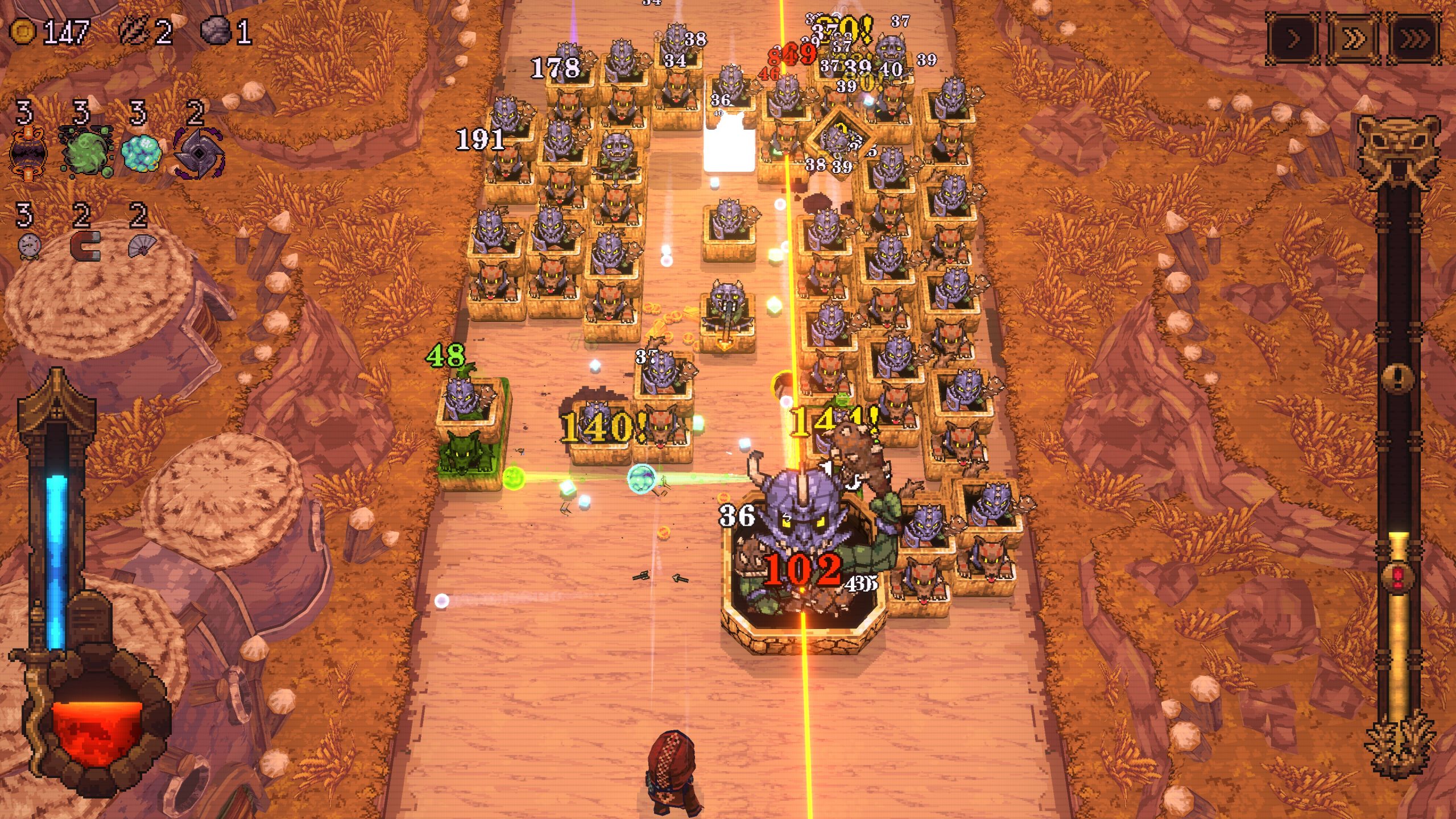
Devolver sait toujours nous concocter des jeux vidéo indés originaux et addictifs, qui sortent des sentiers battus et offre une approche artistique souvent décalée mais aussi des gameplay ingénieux. C’est tout à fait le cas ici avec Ball x Pit (testé sur PS5) qui nous emmène au cœur de Baboulone (non ce n’est pas une faute de frappe)…

Entre le casse-briques, le roguelite, le City builder… Ball x Pit est en effet un jeu à part, mais qui fait mouche.
Notre héros investit les ruines de Baboulone à la recherche de trésors, mais d’infâmes créatures squelettiques sont bien décidées à les défendre…
Le pitch est bref et plutôt convenu, cela dit, c’est le gameplay qui va donner du corps à tout cela puisqu’il va nous falloir reconstruire Baboulone. Ainsi, la phase de jeu principale reste le shoot en scrolling vertical. On tire alors sur les ennemis qui descendent à la manière d’un Space Invader. Et c’est en récoltant suffisamment de trésors qu’on va pouvoir construire des éléments de ville dans une partie différente du jeu…


Vous mourrez souvent dans Ball x Pit, sachez-le. Mais c’est ainsi que vous allez faire évoluer votre personnage et notamment son arsenal. A la manière d’un shoot’em up, nos tirs rebondissent sur les parois et les projectiles sont nombreux. Les tableaux sont alors très chargés visuellement.
Le loot est primordial dans le jeu et c’est ainsi que le héros que vous aurez choisi pourra s’agrémenter d’armes variées selon les besoin. Entre rayons laser et ondes sismiques, il y a de quoi s’amuser et d’arriver au bout des vagues des ennemis. Mais le plus intéressant reste la possibilité de fusionner vos attaques…
Chaque stage a donc son lot de surprises et d’améliorations avec un boss à affronter à chaque fois ce qui clôture alors le niveau. C’est là que vous pourrez alors dépenser vos ressources pour construire des bâtiments mais aussi, pourquoi pas, recruter des persos qui pourront vous épauler dans vos démarches de construction. Ce côté City builder n’est pas gadget comme on pourrait le penser. Il a une vraie dimension intéressante et suffisamment développé pour avoir un intérêt dans le jeu global.
Le mix des genres apportent donc de la consistance au jeu mais aussi une certaine difficulté. Car, même si les phases de shoot semblent être un défouloir casual, il n’en est rien puisque la dimension City builder a une grande importante dans la progression générale.
Avec son approche graphique rétro et son approche assez simple dans les faits, Ball x Pit reste un jeu exigeant dans lequel il faudra s’investir un minimum pour évoluer. Le mélange des gameplay reste une force pour un jeu qui se veut original et novateur. Le pari est plutôt réussi et servi par une réalisation agréable avec une DA affirmée et une ambiance sonore dynamique. Le roguelite et la gestion de ville ne sont pas des genres qu’on aurait vu s’associer. Cependant, ici, ça fonctionne, à condition bien sûr d’apprécier ces deux genres de jeux vidéo disctincts. Ne vous fiez donc pas aux apparences en lançant Ball x Pit mais faites l’effort (si besoin) de vous lancer dans l’aventure. Il mérite le détour.
Pour info, 3 nouveaux contenus arriveront courant 2026 (janvier/avril/juillet). Nouvelles béboules, nouvelles évolutions, nouveaux bâtiments, nouveaux personnages, etc..
Cet article Test de BALL X PIT – Le guerre des genres… est apparu en premier sur Insert Coin.
Attosecond science is undoubtedly one of the fastest growing branches of physics today.
Its popularity was demonstrated by the award of the 2023 Nobel Prize in Physics to Anne L’Huillier, Paul Corkum and Ferenc Krausz for experimental methods that generate attosecond pulses of light for the study of electron dynamics in matter.
One of the most important processes in this field is dephasing. This happens when an electron loses its phase coherence because of interactions with its surroundings.
This loss of coherence can obscure the fine details of electron dynamics, making it harder to capture precise snapshots of these rapid processes.
The most common way to model this process in light-matter interactions is by using the relaxation time approximation. This approach greatly simplifies the picture as it avoids the need to model every single particle in the system.
Its use is fine for dilute gases, but it doesn’t work as well with intense lasers and denser materials, such as solids, because it greatly overestimates ionisation.
This is a significant problem as ionisation is the first step in many processes such as electron acceleration and high-harmonic generation.
To address this problem, a team led by researchers from the University of Ottawa have developed a new method to correct for this problem.
By introducing a heat bath into the model they were able to represent the many-body environment that interacts with electrons, without significantly increasing the complexity.
This new approach should enable the identification of new effects in attosecond science or wherever strong electromagnetic fields interact with matter.
Strong field physics in open quantum systems – IOPscience
N. Boroumand et al, 2025 Rep. Prog. Phys. 88 070501
The post Studying the role of the quantum environment in attosecond science appeared first on Physics World.
Describing the non-classical properties of a complex many-body system (such as entanglement or coherence) is an important part of quantum technologies.
An ideal tool for this task would work well with large systems, be easily computable and easily measurable. Unfortunately, such a tool for every situation does not yet exist.
With this goal in mind a team of researchers – Marcin Płodzień and Maciej Lewenstein (ICFO, Barcelona, Spain) and Jan Chwedeńczuk (University of Warsaw, Poland) – began work on a special type of quantum state used in quantum computing – graph states.
These states can be visualised as graphs or networks where each vertex represents a qubit, and each edge represents an interaction between pairs of qubits.
The team studied four different shapes of graph states using new mathematical tools they developed. They found that one of these in particular, the Turán graph, could be very useful in quantum metrology.
Their method is (relatively) straightforward and does not require many assumptions. This means that it could be applied to any shape of graph beyond the four studied here.
The results will be useful in various quantum technologies wherever precise knowledge of many-body quantum correlations is necessary.
Many-body quantum resources of graph states – IOPscience
M. Płodzień et al, 2025 Rep. Prog. Phys. 88 077601
The post Characterising quantum many-body states appeared first on Physics World.
Après notre test de l’Echo Dot Max le mois dernier, nous revenons pour vous présenter une autre nouveauté signée Amazon, le tout nouveau Echo Show 8 accompagné de son support.
À l’heure où ses lignes sont écrites, notre modèle du jour dispose déjà d’une grosse promotion et est affiché au prix de 179,99 €. Hors promo, il est disponible au prix de 199,99 €. Le support quant à lui est au prix de 39,99 €.
Place au test !
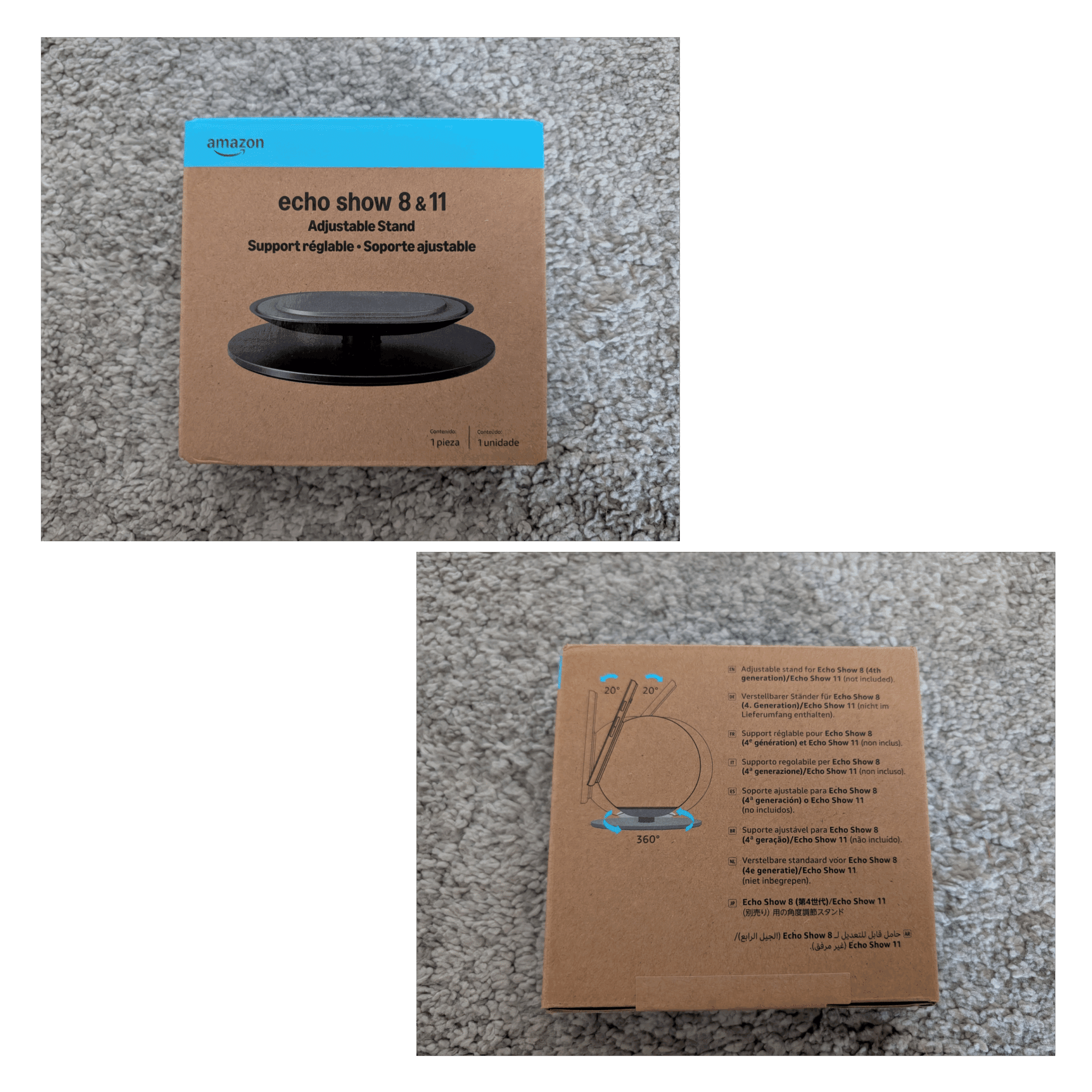
Depuis quelques temps, la sobriété est au rendez-vous pour les emballages de produits signés Amazon, et on adore ça. Ici un retrouvera un bandeau bleu clair sur le haut du paquet où on retrouvera la mention Amazon sur l’avant, avec juste en dessous un visuel de l’appareil et son nom. Le tout est dans une boîte en carton recyclé et recyclable. À gauche, on retrouvera les compatibilités (zigbee, matter et Thread)
À droite, en plusieurs langues, nous découvrirons que notre Echo Show 8 fonctionne à la fois avec Alexa et Alexa + et à l’arrière pour terminer, là aussi en plusieurs langues, on nous indiquera qu’il s’agit d’une enceinte connectée et Alexa, qui inclut un Echo Show 8 graphite et un adaptateur secteur. Bien sûr, on nous rappellera aussi que le Wi-Fi et l’application Amazon Alexa sont requis et que nous aurons ici un écran de 8,7 pouces. Quelques fonctionnalités seront également mises en avant en anglais, mais nous y reviendrons plus en détails juste après.
| Dimensions | 21 x 15 x 13 cm (l x H x P) |
| Poids | 1 kg Le poids et la taille exacts peuvent varier selon le procédé de fabrication. |
| Écran | Écran tactile HD 8,7” avec résolution 1340 x 800 |
| Caméra | 13 Mpx avec cadrage automatique |
| Audio | 1 caisson de basses 71 mm et 2 haut-parleurs large bande |
| Connectivité Wi-Fi | Wi-Fi 6E (802.11 ax) pris en charge. Wi-Fi tribande double antenne (MIMO). Prend en charge les réseaux Wi-Fi 802.11a/b/g/n/ac. Ne prend pas en charge les réseaux Wi-Fi ad-hoc (ou IBSS). |
| Hub connecté intégré | Zigbee + Matter + Thread Border Router |
| Connectivité Bluetooth | Prise en charge du profil Advanced Audio Distribution Profile (A2DP) pour le streaming audio depuis votre appareil mobile vers Echo Show 8 ou depuis Echo Show 8 vers votre enceinte Bluetooth. Prise en charge du profil Audio/Video Remote Control Profile (AVRCP) pour le contrôle vocal des appareils mobiles connectés. Le contrôle vocal n’est pas pris en charge sur les appareils Mac OS X. Les enceintes Bluetooth qui requièrent un code PIN ne sont pas prises en charge. |
| Processeur | AZ3 Pro avec accélérateur d’IA |
| Capteurs | Capteur de température ambiante, détection de présence, caméra |
| Système requis | Echo Show 8 est prêt à être connecté à votre Wi-Fi. L’application Alexa est compatible avec les appareils Fire OS, Android et iOS. Certaines Skills et certains services peuvent nécessiter un abonnement ou d’autres frais. |
| Configuration requise | Amazon Wi-Fi simple setup permet aux clients de connecter facilement des appareils connectés à leur réseau Wi-Fi, en quelques étapes. Wi-Fi simple setup est une autre façon pour Alexa de se perfectionner sans cesse. |
L’Echo Show 8 revient en 2025 nous donne la même impression que l’Echo Dot Max et ce dès l’ouverture de la boîte : moderniser en profondeur l’un des appareils les plus populaires de l’écosystème Alexa. Nouveau design, nouvel écran, meilleure caméra, son retravaillé, capteurs repensés, intelligence embarquée renforcée… Sur le papier, Amazon coche toutes les cases du rafraîchissement sérieux. Nous l’avons installé à la maison, utilisé au quotidien, et voici ce que nous en avons réellement pensé après plusieurs jours d’utilisation.
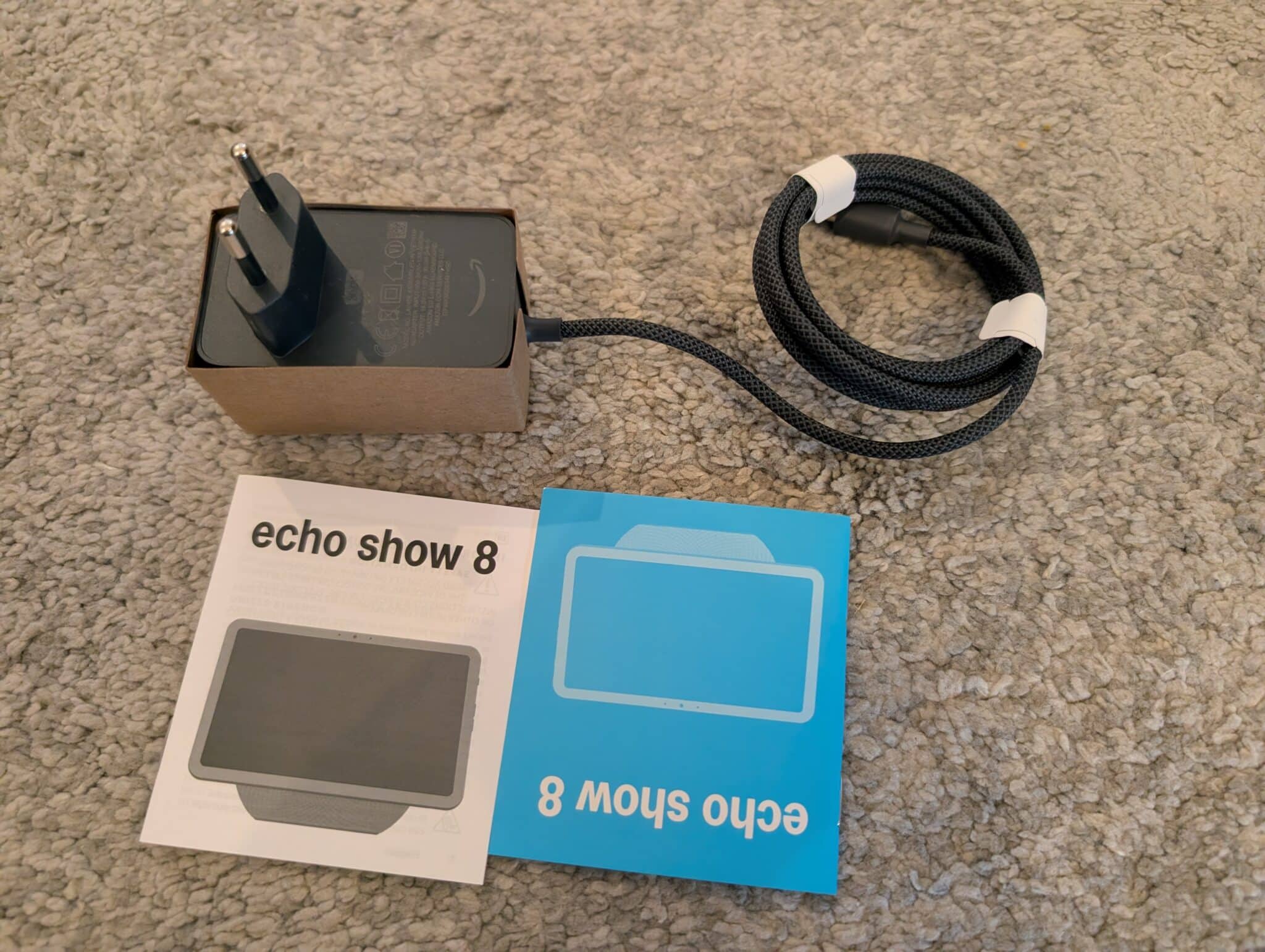
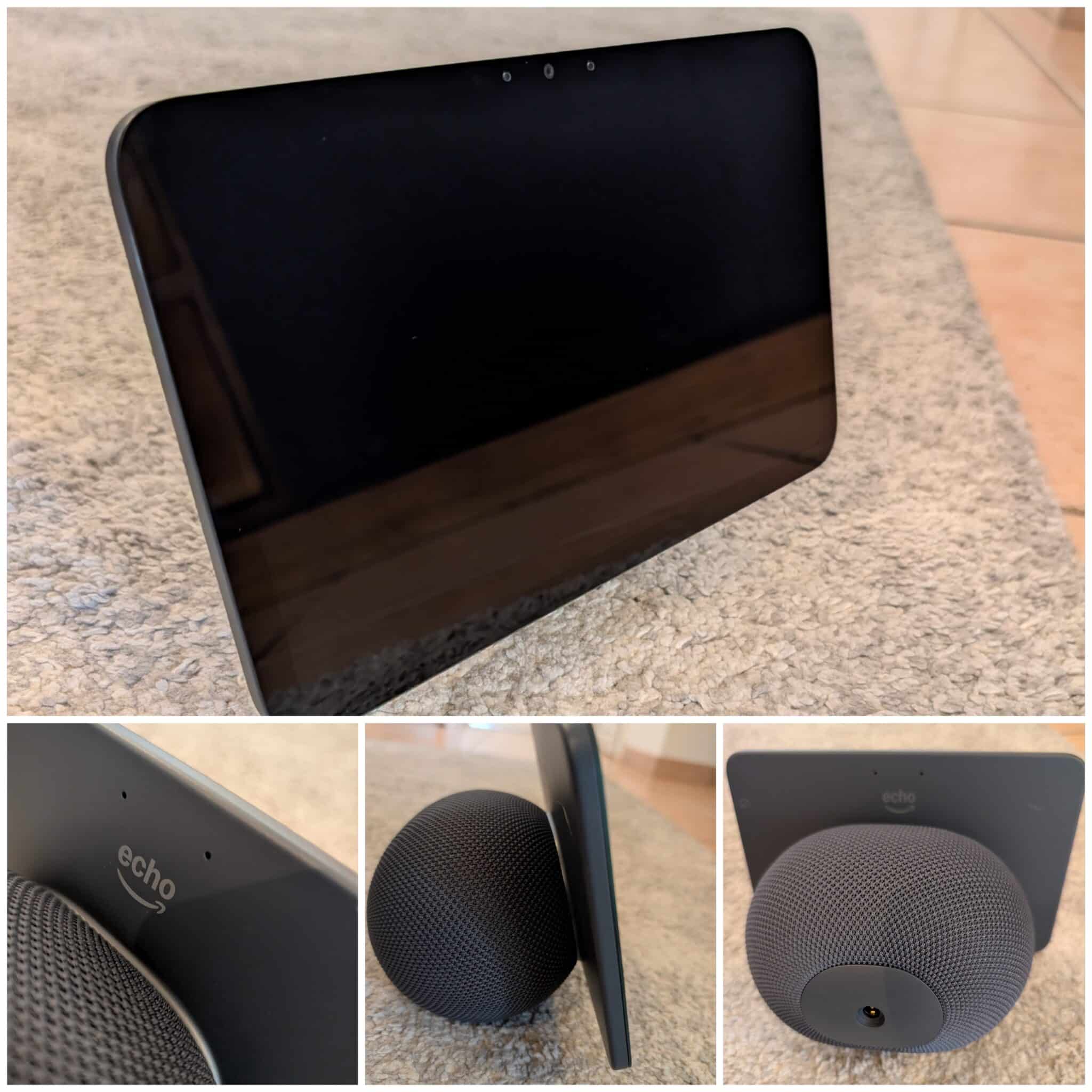
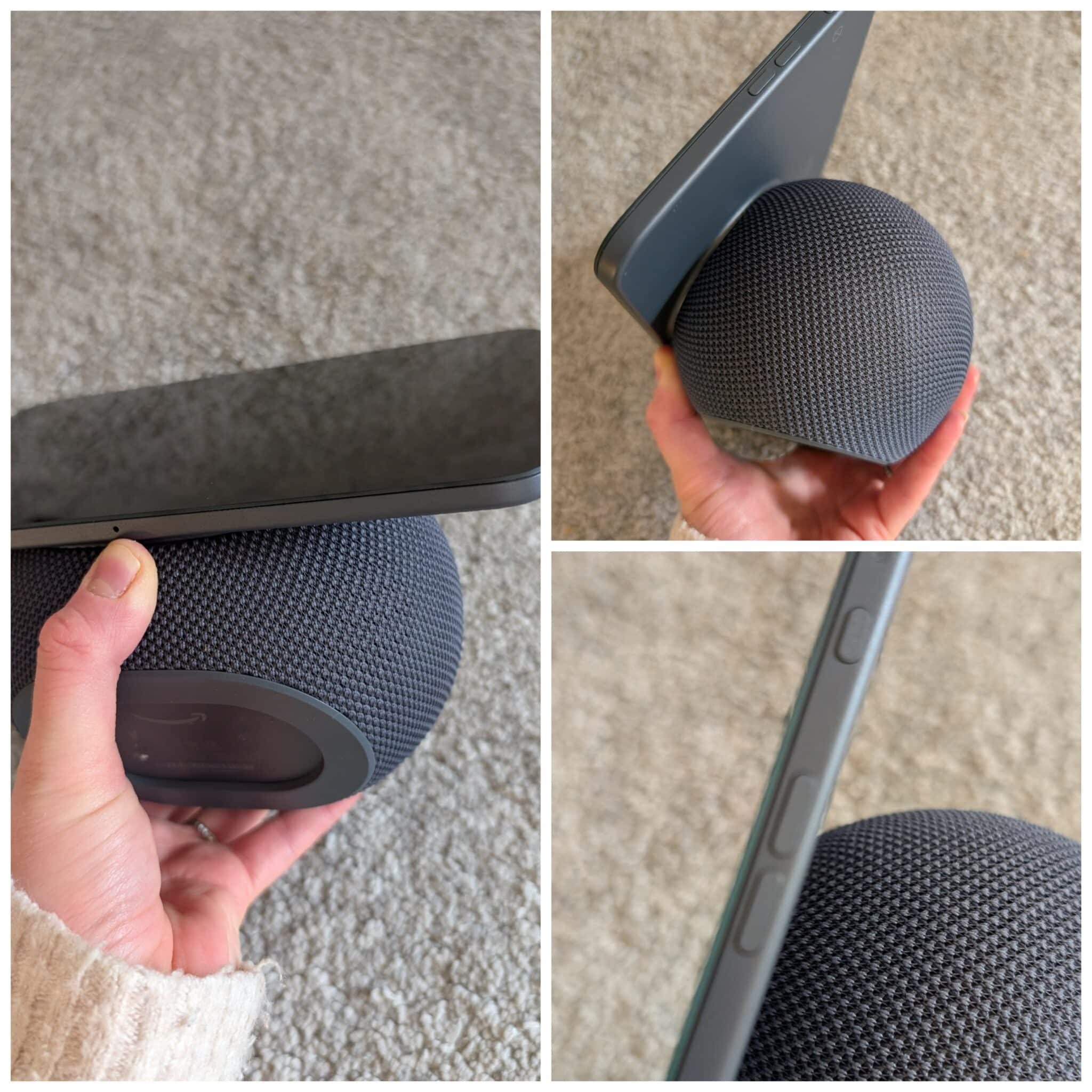
Dès l’ouverture de la boîte, on retrouve l’approche minimaliste chère à Amazon : juste l’appareil, son adaptateur secteur et le guide de démarrage. Rien de superflu, rien qui encombre, on va droit à l’essentiel. Ce qui étonne vraiment, en revanche, c’est ce nouveau design. L’Echo Show 8 abandonne totalement la forme trapézoïdale des générations précédentes pour adopter un écran flottant posé sur une base arrondie. L’ensemble est plus élégant, plus moderne, clairement plus en phase avec ce que l’on peut attendre d’un objet connecté censé trôner dans un salon ou une cuisine. On sent qu’Amazon a voulu en faire un objet esthétique autant qu’un assistant. On notera comme nous l’avons stipulé plus tôt que vous aurez la possibilité d’acheter un support, bien que l’Echo Show 8 soit utilisable sans. Ce dernier est conçu pour Amazon Echo Show 8 et Amazon Echo Show 11.
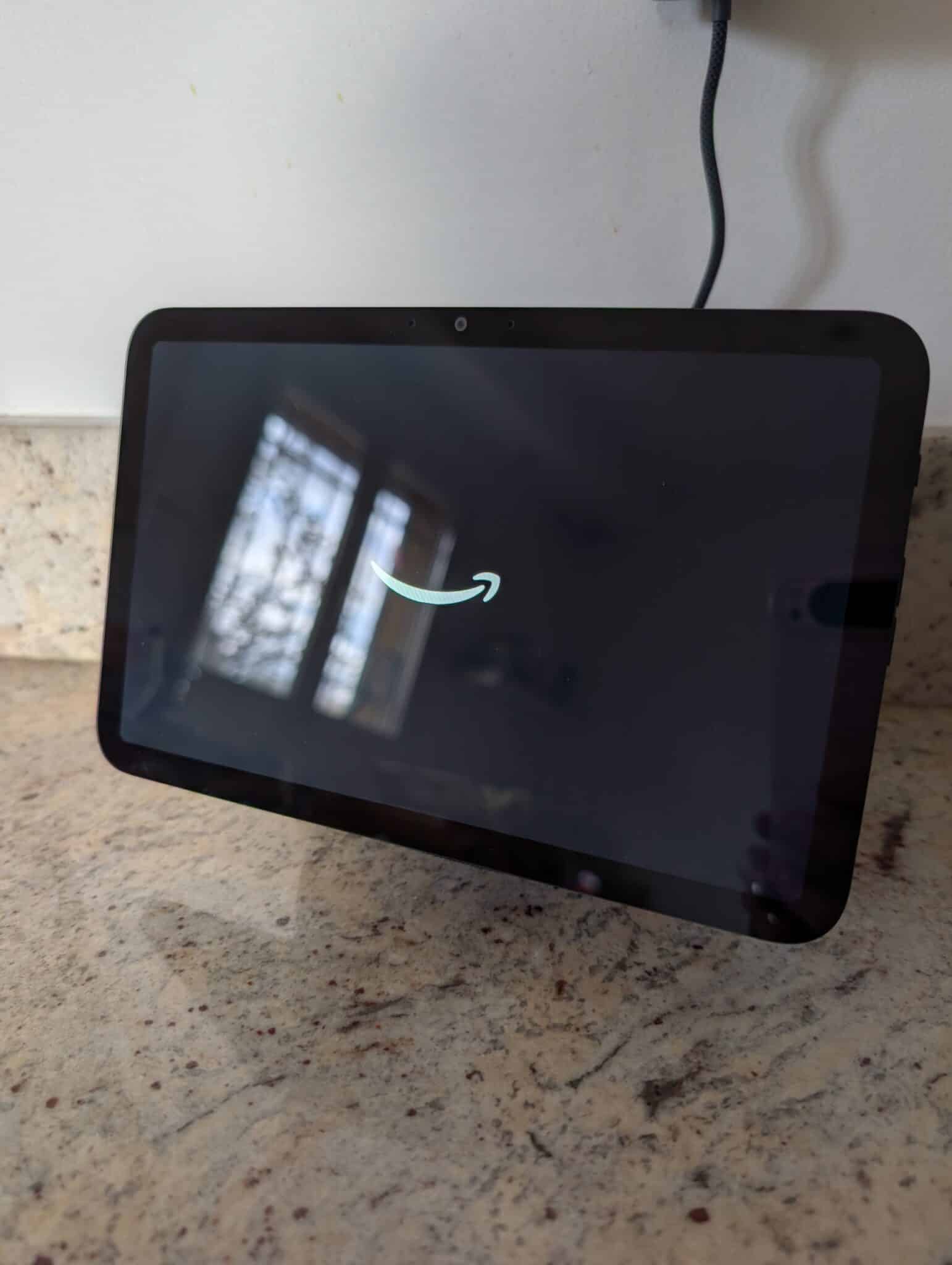
L’écran lui-même s’améliore nettement, et c’est une bonne nouvelle. La dalle de 8,7 pouces est plus lumineuse, plus agréable à regarder, et surtout plus lisible sous différents éclairages. Pour consulter une recette, regarder une vidéo rapide ou juste laisser défiler des photos, l’expérience est plus confortable, plus nette, moins gadget. Le tactile est également plus réactif, encourageant à réellement utiliser l’écran plutôt qu’à tout faire à la voix. C’est un super allié dans la cuisine par exemple. Marmiton, mon amour…
La partie audio connaît elle aussi un vrai regain de qualité. On ne s’attendait pas à des miracles dans un appareil aussi compact, mais le rendu est plus ample, plus chaleureux et globalement plus équilibré qu’avant. Les voix ressortent mieux, les basses sont un peu plus affirmées, et on peut monter le volume sans trop dégrader le son. Dans une cuisine, un bureau ou une chambre, c’est parfaitement suffisant et même surprenant de confort.
On retrouve également une caméra grand angle de 13 mégapixels, toujours capable de suivre automatiquement le visage pendant les appels vidéo. La qualité est réellement meilleure : l’image est plus nette, moins bruitée, plus agréable. Pour les appels familiaux — qui restent l’une des fonctionnalités les plus utilisées sur les Echo Show — c’est un vrai plus au quotidien. « Alexa, appelle Papi et Mamie » est sans doute la commande qu’entende le plus mes Echos.
Mais la plus grosse nouveauté, et celle qui change le plus l’expérience, vient de l’intérieur. L’Echo Show 8 embarque désormais la puce AZ3 Pro, accompagnée de la plateforme sensorielle Omnisense. Dit autrement : l’appareil devient plus intelligent, plus réactif et plus conscient de son environnement. Il détecte la présence, adapte l’écran automatiquement, réagit plus vite à la voix, déclenche les routines avec davantage de pertinence et semble, de manière générale, mieux anticiper les besoins. C’est subtil, on ne va pas se mentir, mais après quelques jours, on s’y habitue très vite, surtout que mon Echo Show 15 dernière génération commence déjà à ramer… oui…
Le Show 8 s’affirme également comme un véritable hub domotique. Avec sa compatibilité Matter, Thread et Zigbee, il peut contrôler directement la plupart des objets connectés récents sans boîtier additionnel. Pour piloter des lampes, volets, thermostats ou capteurs maison, c’est extrêmement pratique et cela réduit drastiquement la complexité d’installation. Pour une famille ou un foyer déjà équipé (ou qui veut s’y mettre), c’est un argument de poids.
Sur l’ensemble des usages quotidiens, l’appareil se montre fluide, réactif et plaisant. L’interface est plus rapide, les vidéos se lancent sans délai particulier, les photos défilent sans saccade et les commandes domotiques exécutent quasiment instantanément. On retrouve la sensation d’un produit enfin mature, capable d’assumer pleinement son rôle d’assistant visuel, de mini média center et de hub de maison connectée.
Bien sûr, tout n’est pas parfait. Le prix est un plus élevé qu’avant, ce qui pourra refroidir les utilisateurs occasionnels. Le son, malgré ses progrès, ne rivalise pas avec une vraie enceinte dédiée mais ça, on le sait déjà. Et certaines fonctionnalités avancées d’IA ne sont pas encore disponibles partout, ce qui crée un léger décalage entre ce qu’Amazon annonce et ce que l’on peut réellement utiliser selon les pays. Enfin, la présence constante de capteurs et d’une caméra pourra déranger les plus soucieux de confidentialité, même si Amazon propose toujours les boutons physiques pour désactiver micro et caméra. On a hâte (hâte !) de découvrir Alexa +.
Il est temps de conclure. L’Echo Show 8 (2025) est incontestablement l’une des meilleures mises à jour de la gamme depuis longtemps. Le design est premium, l’écran est plus agréable, le son gagne en profondeur, la caméra est nettement meilleure, et l’intelligence embarquée donne vraiment l’impression d’un assistant plus abouti, plus fiable et plus cohérent. Pour qui cherche un appareil polyvalent mêlant assistant vocal, mini écran multimédia et centre domotique, c’est probablement le meilleur choix du catalogue Alexa aujourd’hui.
On rappellera qu’à l’heure où ses lignes sont écrites, notre modèle du jour dispose déjà d’une grosse promotion et est affiché au prix de 179,99 €. Hors promo, il est disponible au prix de 199,99 €. Le support quant à lui est au prix de 39,99 €.
Test – Echo Show 8 (nouvelle génération) d’Amazon a lire sur Vonguru.

![]()
22,68 Go de RAM utilisée sans rien faire ou presque?!?
macOS 26.1 est arrivé le 3 novembre 2025, il y a près d'un mois.
Il a des bugs, des Memory Leak: de la mémoire se perd petit à petit lors de son usage, mémoire allouée et jamais récupérée pour d'autres usages quand inutilisée.
Le premier effet est de réduire la RAM disponible pour les applications lancées.
Le second est de réduire la taille du cache "disque", puisque cette mémoire non libérée, ralentissant les accès aux stockages.
Le troisième est de copier ces zones mémoires inutilisées sur le stockage interne "SSD", diminuant l'espace libre disponible.
Constatant une occupation mémoire quasi illicite, mes 32 Go étant squattés avec plus de 10 Go inutiles, je me suis plongé sur ce problème de macOS 26.1 (version finale).
En redémarrant Chrome, j'ai regagné 5 Go de RAM, je me suis dit que Chrome pouvait être le coupable, il restait pourtant une énorme quantité de RAM gâchée.
Et mes 6 onglets réouverts et pourtant chacun économisant plus de 800 Mo de RAM...
Chrome coupable ou pas? Ça faisait près de 1 Go par onglet ouvert sur YouTube. Étrange!
![]()
Moniteur d'activité consomme 2,91 Go de bonne et chère RAM, 90€
Mais que voilà?!?
Le Moniteur d'Activité consommerait autour de 3 Go de RAM??? 90€ les 2.9 Go chez Apple.
Ça n'est pas le code de Google Chrome là, mais le code d'Apple, il consomme 75.6 Mo de RAM sur mon Mac du travail sous macOS 15.7.2 qui fait bien plus de choses, et où seul Docker consomme près de 3 Go!
3 Go de RAM juste pour afficher une liste de processus et leur consommation de ressources?!?
90 € ttc au prix où Apple facture la RAM???
Il y a clairement des Memory Leak, sur du code 100% Apple, je vais suivre ça, mais moi je ne passerais pas de Mac stratégique à macOS 26 avant macOS 26.3 ou 26.4 !


Higher levels of carbon dioxide (CO2) in the Earth’s atmosphere could harm radio communications by enhancing a disruptive effect in the ionosphere. According to researchers at Kyushu University, Japan, who modelled the effect numerically for the first time, this little-known consequence of climate change could have significant impacts on shortwave radio systems such as those employed in broadcasting, air traffic control and navigation.
“While increasing CO2 levels in the atmosphere warm the Earth’s surface, they actually cool the ionosphere,” explains study leader Huixin Liu of Kyushu’s Faculty of Science. “This cooling doesn’t mean it is all good: it decreases the air density in the ionosphere and accelerates wind circulation. These changes affect the orbits and lifespan of satellites and space debris and also disrupt radio communications through localized small-scale plasma irregularities.”
One such irregularity is a dense but transient layer of metal ions that forms between 90‒120 km above the Earth’s surface. This sporadic E-layer (Es), as it is known, is roughly 1‒5 km thick and can stretch from tens to hundreds of kilometres in the horizontal direction. Its density is highest during the day, and it peaks around the time of the summer solstice.
The formation of the Es is hard to predict, and the mechanisms behind it are not fully understood. However, the prevailing “wind shear” theory suggests that vertical shears in horizontal winds, combined with the Earth’s magnetic field, cause metallic ions such as Fe+, Na+ and Ca+ to converge in the ionospheric dynamo region and form thin layers of enhanced ionization. The ions themselves largely come from metals in meteoroids that enter the Earth’s atmosphere and disintegrate at altitudes of around 80‒100 km.
While previous research has shown that increases in CO2 trigger atmospheric changes on a global scale, relatively little is known about how these increases affect smaller-scale ionospheric phenomena like the Es. In the new work, which is published in Geophysical Research Letters, Liu and colleagues used a whole-atmosphere model to simulate the upper atmosphere at two different CO2 concentrations: 315 ppm and 667 ppm.
“The 315 ppm represents the CO2 concentration in 1958, the year in which recordings started at the Mauna Loa observatory, Hawaii,” Liu explains. “The 667 ppm represents the projected CO2 concentration for the year 2100, based on a conservative assumption that the increase in CO2 is constant at a rate of around 2.5 ppm/year since 1958.”
The researchers then evaluated how these different CO2 levels influence a phenomenon known as vertical ion convergence (VIC) which, according to the wind shear theory, drives the Es. The simulations revealed that the higher the atmospheric CO2 levels, the greater the VIC at altitudes of 100–120 km. “What is more, this increase is accompanied by the VIC hotspots shifting downwards by approximately 5 km,” says Liu. “The VIC patterns also change dramatically during the day and these diurnal variability patterns continue into the night.”
According to the researchers, the physical mechanism underlying these changes depends on two factors. The first is reduced collisions between metallic ions and the neutral atmosphere as a direct result of cooling in the ionosphere. The second is changes in the zonal wind shear, which are likely caused by long-term trends in atmosphere tides.
“These results are exciting because they show that the impacts of CO2 increase can extend all the way from Earth’s surface to altitudes at which HF and VHF radio waves propagate and communications satellites orbit,” Liu tells Physics World. “This may be good news for ham radio amateurs, as you will likely receive more signals from faraway countries more often. For radio communications, however, especially at HF and VHF frequencies employed for aviation, ships and rescue operations, it means more noise and frequent disruption in communication and hence safety. The telecommunications industry might therefore need to adjust their frequencies or facility design in the future.”
The post Extra carbon in the atmosphere may disrupt radio communications appeared first on Physics World.

Structural colours – created using nanostructures that scatter and reflect specific wavelengths of light – offer a non-toxic, fade-resistant and environmentally friendly alternative to chemical dyes. Large-scale production of structural colour-based materials, however, has been hindered by fabrication challenges and a lack of effective tuning mechanisms.
In a step towards commercial viability, a team at the University of Central Florida has used vanadium dioxide (VO2) – a material with temperature-sensitive optical and structural properties – to generate tunable structural colour on both rigid and flexible surfaces, without requiring complex nanofabrication.
Senior author Debashis Chanda and colleagues created their structural colour platform by stacking a thin layer of VO2 on top of a thick, reflective layer of aluminium to form a tunable thin-film cavity. At specific combinations of VO2 grain size and layer thickness this structure strongly absorbs certain frequency bands of visible light, producing the appearance of vivid colours.
The key enabler of this approach is the fact that at a critical transition temperature, VO2 reversibly switches from insulator to metal, accompanied by a change in its crystalline structure. This phase change alters the interference conditions in the thin-film cavity, varying the reflectance spectra and changing the perceived colour. Controlling the thickness of the VO2 layer enables the generation of a wide range of structural colours.
The bilayer structures are grown via a combination of magnetron sputtering and electron-beam deposition, techniques compatible with large-scale production. By adjusting the growth parameters during fabrication, the researchers could broaden the colour palette and control the temperature at which the phase transition occurs. To expand the available colour range further, they added a third ultrathin layer of high-refractive index titanium dioxide on top of the bilayer.
The researchers describe a range of applications for their flexible coloration platform, including a colour-tunable maple leaf pattern, a thermal sensing label on a coffee cup and tunable structural coloration on flexible fabrics. They also demonstrated its use on complex shapes, such as a toy gecko with a flexible tunable colour coating and an embedded heater.
“These preliminary demonstrations validate the feasibility of developing thermally responsive sensors, reconfigurable displays and dynamic colouration devices, paving the way for innovative solutions across fields such as wearable electronic, cosmetics, smart textiles and defence technologies,” the team concludes.
The research is described in Proceedings of the National Academy of Sciences.
The post Phase-changing material generates vivid tunable colours appeared first on Physics World.