Même si notre Univers comporte une infinité de trous noirs, certains sortent du lot car ils se comportent comme si nos modèles théoriques n'existaient pas. C'est le cas de IGR J17091-3624, dont la luminosité augmente et diminue de façon régulière : un casse-tête astrophysique.
Même si notre Univers comporte une infinité de trous noirs, certains sortent du lot car ils se comportent comme si nos modèles théoriques n'existaient pas. C'est le cas de IGR J17091-3624, dont la luminosité augmente et diminue de façon régulière : un casse-tête astrophysique.
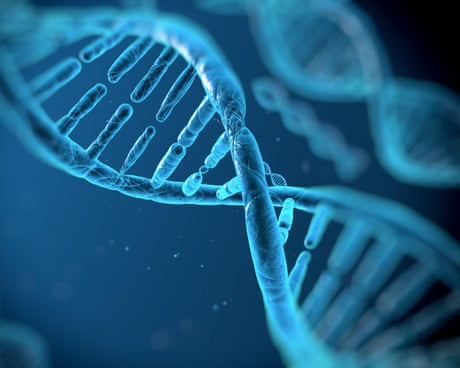
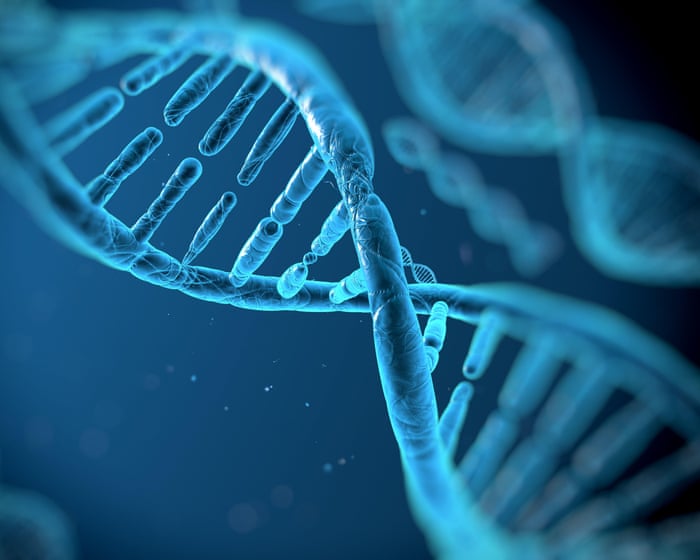
AlphaGenome can analyse up to 1m letters of DNA code at once and could pave way for new treatments
Researchers at Google DeepMind have unveiled their latest artificial intelligence tool and claimed it will help scientists identify the genetic drivers of disease and ultimately pave the way for new treatments.
AlphaGenome predicts how mutations interfere with the way genes are controlled, changing when they are switched on, in which cells of the body, and whether their biological volume controls are set to high or low.
Nous autres, Homo sapiens, sommes les survivants d'un buisson foisonnant d'espèces oubliées. Australopithecus deyiremeda, découverte en 2015, était l'une d'entre elles et elle vivait à la même époque que la célèbre Lucy. Le trône de notre ancêtre unique vacille !
La France dispose d'un réseau de distribution d'eau national assez remarquable, mais tout n'est pas parfait. Est-ce pour autant une bonne raison suffisante de se tourner vers l'eau embouteillée ?
En 1959, le chimiste britannique C. P. Snow a donné une mémorable conférence intitulée Les Deux Cultures (en anglais, The Two Cultures) dans laquelle il avançait la thèse qu'au moins de son temps, trop souvent la vie intellectuelle de l'ensemble de la société occidentale se divisait...
La startup américaine Figure AI vient de franchir une étape majeure dans l’histoire de la robotique humanoïde. Avec son nouveau modèle d’intelligence artificielle Helix 02, l’entreprise parvient à unifier locomotion, manipulation et équilibre au sein d’un même système neuronal, ouvrant ainsi la voie à des robots capables d’évoluer …
Les géants mondiaux des pneumatiques se retrouvent face à la colère d'associations de pêcheurs en Californie. Au cœur du litige : une substance de synthèse indispensable à la longévité des pneus, mais qui se révèle être un poison foudroyant pour les saumons du Pacifique.
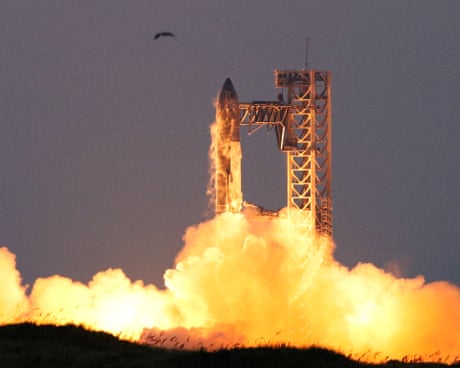
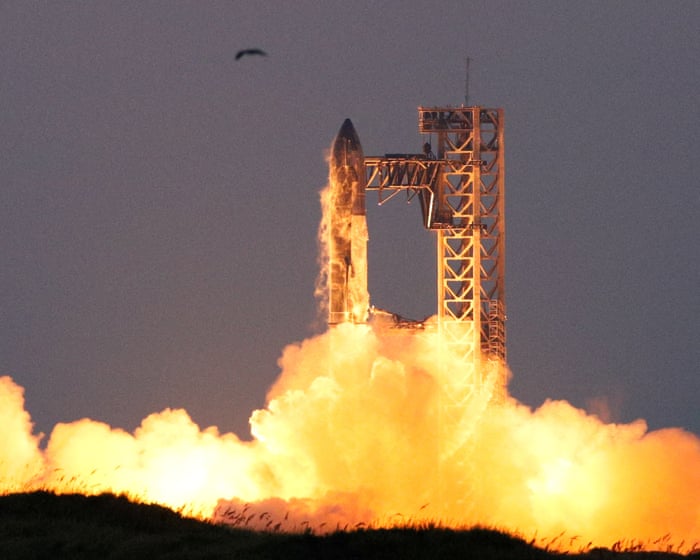
World’s richest person targeting symbolic date in June for flotation of rocket company
Elon Musk’s SpaceX is considering a flotation valuing the rocket company at $1.5tn (£1.1tn) that will reportedly be timed for early summer to coincide with a planetary alignment and the multibillionaire’s birthday.
The world’s richest person is targeting a symbolic date of mid-June for the initial public offering, according to the Financial Times. This would be around the same time as Jupiter and Venus appear in close proximity to each other and shortly before Musk turns 55 on 28 June.
Researchers have documented the births of nearly two dozen North Atlantic right whale calves this season. It’s an encouraging sign for a species whose population is estimated to be below 400.
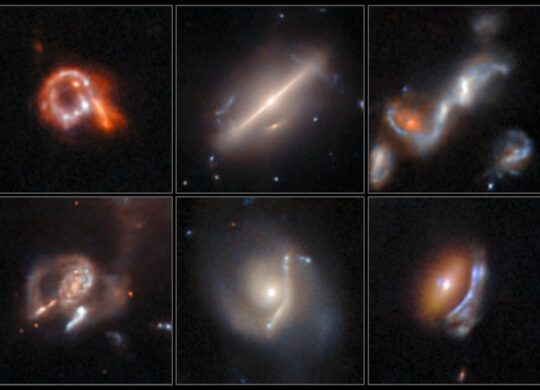
L’intelligence artificielle continue de transformer la recherche scientifique, et l’astronomie en offre une nouvelle démonstration spectaculaire. Deux chercheurs de l’Agence spatiale européenne (ESA) ont ainsi mis au point un outil basé sur un réseau neuronal capable d’explorer automatiquement des volumes massifs d’images spatiales. En moins de trois jours, …
On en a vu passer des théories du complot aberrantes, mais celle-ci mérite au moins une petite médaille de bronze. Heureusement que l'agence américaine est venue remettre les pendules à l'heure pour que leurs aiguilles ne s'envolent pas !
Lors de la mission Artemis II, les quatre astronautes du programme ne seront pas seuls à bord de la capsule Orion : ils seront accompagnés de leurs propres « avatars biologiques ». Une expérience frôlant de près la science-fiction conçue pour assurer l'avenir de la conquête spatiale.
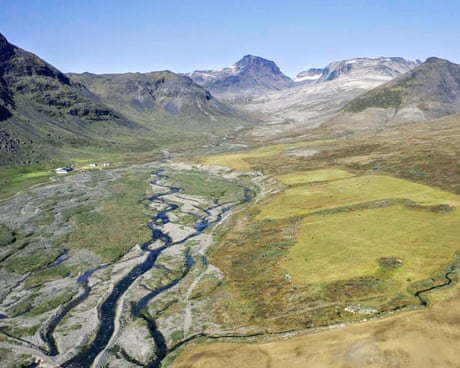
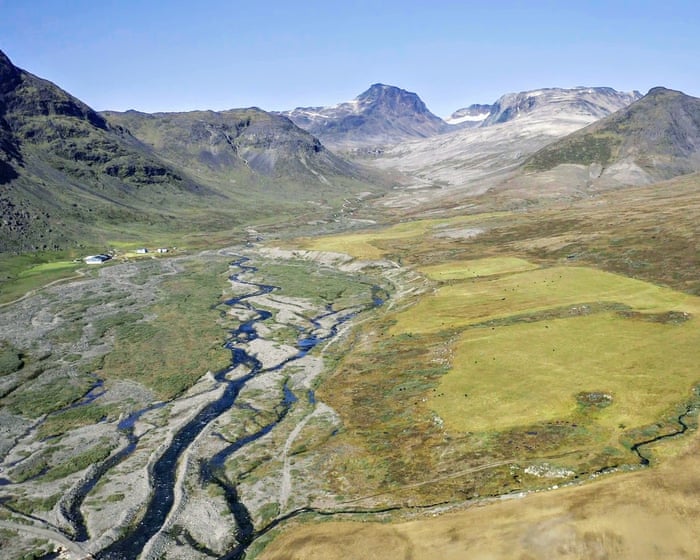
Island’s mineral and resource wealth is result of mountain building, rifting and volcanic activity over 4bn years
As recent manoeuvres over Greenland have made plain, this mostly ice-covered island contains some of the greatest stores of natural resources in the world, with huge volumes of oil and gas, rich deposits of rare-earth elements and rocks bearing gems and gold. So why did all the planetary goodies end up here?
Writing in The Conversation, the geologist Dr Jonathan Paul from Royal Holloway, University of London, explains how this mineral and resource wealth is tied to the country’s geological history over the past 4bn years. Greenland is a bit of a geological anomaly, with land that has been pummelled in three different ways: mountain building, rifting and volcanism.
« Ne jamais juger son livre à sa couverture », nous dit-on, pour éviter de se laisser guider par des stéréotypes. Pourtant, notre cerveau passe son temps à faire exactement le contraire, et vous n'y pouvez absolument rien.
Si vous en avez assez des devis dentaires qui ressemblent à un apport pour un crédit immobilier, l'avenir vous réserve peut-être une très belle surprise. Quand la médecine régénérative et la biotechnologie se marient, le miracle n'est jamais loin !
Our usual picture of Uranus and Neptune as “ice giant” planets may not be entirely correct. According to new work by scientists at the University of Zürich (UZH), Switzerland, the outermost planets in our solar system may in fact be rock-rich worlds with complex internal structures – something that could have major implications for our understanding of how these planets formed and evolved.
Within our solar system, planets fall into three categories based on their internal composition. Mercury, Venus, Earth and Mars are deemed terrestrial rocky planets; Jupiter and Saturn are gas giants; and Uranus and Neptune are ice giants.
An agnostic approach
The new work, which was led by PhD student Luca Morf in UZH’s astrophysics department, challenges this last categorization by numerically simulating the two planets’ interiors as a mixture of rock, water, hydrogen and helium. Morf explains that this modelling framework is initially “agnostic” – meaning unbiased – about what the density profiles of the planets’ interiors should be. “We then calculate the gravitational fields of the planets so that they match with observational measurements to infer a possible composition,” he says.
This process, Morf continues, is then repeated and refined to ensure that each model satisfies several criteria. The first criteria is that the planet should be in hydrostatic equilibrium, meaning that its internal pressure is enough to counteract its gravity and keep it stable. The second is that the planet should have the gravitational moments observed in spacecraft data. These moments describe the gravitational field of a planet, which is complex because planets are not perfect spheres.
The final criteria is that the modelled planets need to be thermodynamically and compositionally consistent with known physics. “For example, a simulation of the planets’ interiors must obey equations of state, which dictate how materials behave under given pressure and temperature conditions,” Morf explains.
After each iteration, the researchers adjust the density profile of each planet and test it to ensure that the model continues to adhere to the three criteria. “We wanted to bridge the gap between existing physics-based models that are overly constrained and empirical approaches that are too simplified,” Morf explains. Avoiding strict initial assumptions about composition, he says, “lets the physics and data guide the solution [and] allows us to probe a larger parameter space.”
A wide range of possible structures
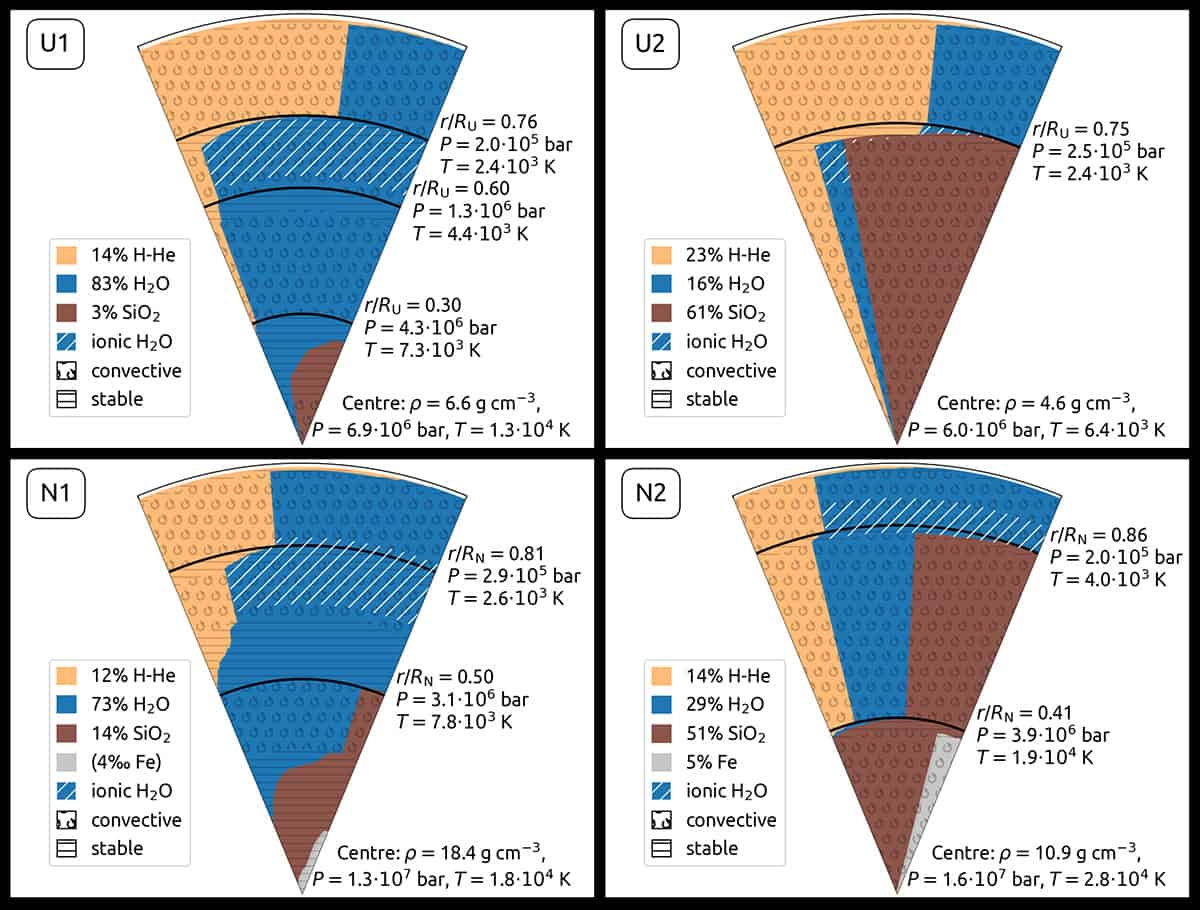
Based on their models, the UZH astrophysicists concluded that the interiors of Uranus and Neptune could have a wide range of possible structures, encompassing both water-rich and rock-rich configurations. More specifically, their calculations yield rock-to-water ratios of between 0.04-3.92 for Uranus and 0.20-1.78 for Neptune.
Slices of different pies: According to models developed with “agnostic” initial assumptions, Uranus (top) and Neptune (bottom) could be composed mainly of water ice (blue areas), but they could also contain substantial amounts of silicon dioxide rock (brown areas). (Courtesy: Luca Morf)
The models, which are detailed in Astronomy and Astrophysics, also contain convective regions with ionic water pockets. The presence of such pockets could explain the fact that Uranus and Neptune, unlike Earth, have more than two magnetic poles, as the pockets would generate their own local magnetic dynamos.
Traditional “ice giant” label may be too simple
Overall, the new findings suggest that the traditional “ice giant” label may oversimplify the true nature of Uranus of Neptune, Morf tells Physics World. Instead, these planets could have complex internal structures with compositional gradients and different heat transport mechanisms. Though much uncertainty remains, Morf stresses that Uranus and Neptune – and, by extension, similar intermediate-class planets that may exist in other solar systems – are so poorly understood that any new information about their internal structure is valuable.
A dedicated space mission to these outer planets would yield more accurate measurements of the planets’ gravitational and magnetic fields, enabling scientists to refine the limited existing observational data. In the meantime, the UZH researchers are looking for more solutions for the possible interiors of Uranus and Neptune and improving their models to account for additional constraints, such as atmospheric conditions. “Our work will also guide laboratory and theoretical studies on the way materials behave in general at high temperatures and pressures,” Morf says.
Des sondes sous-marines dignes de la NASA plongeront bientôt dans les abysses pour confirmer cette hypothèse qui avait ébranlé la communauté scientifique il y a deux ans. Le mystère de l'oxygène noir est sur le point d'être résolu.
 Connexion