 Connexion
Un phénomène optique fascinant qui naît du froid et de l’humidité

L'hiver, qui s'annonce froid, sera propice aux parhélies, un type de halo lumineux autour du soleil.

L'hiver, qui s'annonce froid, sera propice aux parhélies, un type de halo lumineux autour du soleil.
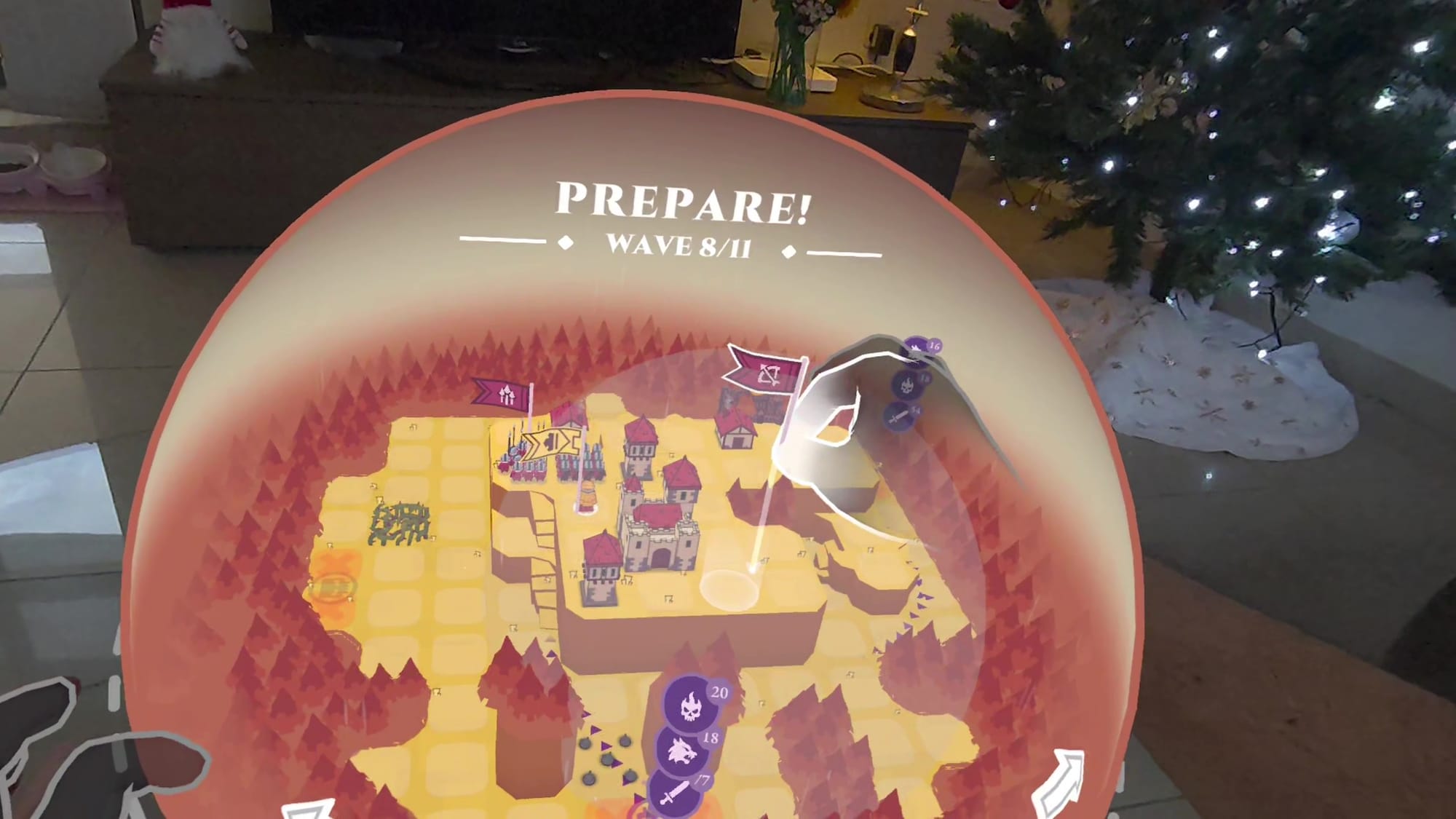
Mixed reality tactical roguelite Banners & Bastions is out now on Quest.
Created by Not Suspicious (Airspace Defender, Tablecraft), Banners & Bastions is a tabletop roguelite with hand-tracking controls that's been available in early access. The recent UploadVR Winter Showcase revealed that it's entering full release on December 15, with the 1.0 Update adding new hero units with unique special abilities, a new bestiary, an autumn battlefield biome, and more.
Version 1.0 follows a continuing series of updates across early access. Following October's addition of controller support, last month's content expansion added a new dragon boss battle and more foes. The latter update introduced a new playable Minefield card and two new enemy types - the Witch (ranged) and the Elite Swordsman (melee).
Battles occur across procedurally generated maps as you defend your kingdom, with tougher foes gradually emerging across fresh waves. You can continue investing in your local economy or fortifications, while your troops range from spearmen, knights, archers, and more.
Banners & Bastions is out now on the Meta Quest platform.
This article was initially published on December 5, 2025. The headline and contents were updated on December 15, 2025, when Banners & Bastions entered full release.


Ces « ouchbetis » étaient des « serviteurs » destinés à accompagner le défunt dans l'au-delà.

L'iPhone avec le meilleur design a été pour moi l'iPhone 5c...
Les iPhone sont tous très biens finis, avec de beaux matériaux, et leur présentation par Apple fait toujours plaisir.
Sauf qu'ils ne sont pas conçus pour être utilisés tels-que !
Le dos est en verre, facilement cassable, pas dans un matériau dur ni encore moins un plastique absorbant l'énergie des chocs. Il faut donc le protéger avec une coque !
Perdant au passage la bataille des arguments sur la légèreté relative et de la finesse, sans parler de celle du look ou du choix des couleurs, excepté avec une coque transparente non proposée par Apple.
La face avant est un grand écran, qui se raye pas mal facilement en sus de se casser, donc qui nécessite une protection là-aussi, et qui dans le cas de l'iPhone 17 fait perdre sa nouvelle qualité: la réflectivité limité de la lumière.
Évidemment l'iPhone Air ne se conçoit pas sans une grosse batterie accolée, lui faisant perdre là aussi tout intérêt.
Intérêt très théorique puisque si vous mettez ça dans une poche, même sans batterie ni protection, vous allez bien sentir la protubérance.
Pourrait-on voir des iPhone adaptés aux usages quotidiens, tels-que: non amochés, non agrandis et non alourdis ?
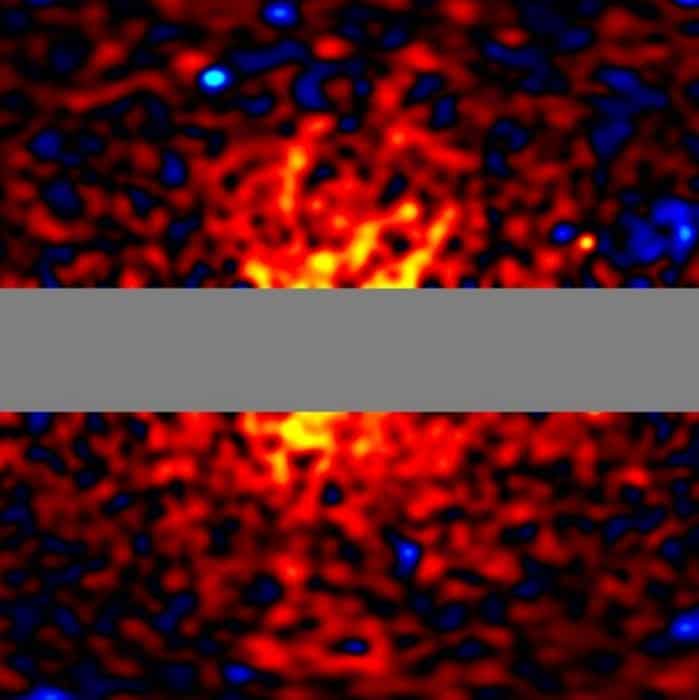
Gamma rays emitted from the halo of the Milky Way could be produced by hypothetical dark-matter particles. That is the conclusion of an astronomer in Japan who has analysed data from NASA’s Fermi Gamma-ray Space Telescope. The energy spectrum of the emission is what would be expected from the annihilation of particles called WIMPs. If this can be verified, it would mark the first observation of dark matter via electromagnetic radiation.
Since the 1930s astronomers have known that there is something odd about galaxies, galaxy clusters and larger structures in the universe. The problem is that there is not nearly enough visible matter in these objects to explain their dynamics and structure. A rotating galaxy, for example, should be flinging out its stars because it does not have enough self-gravitation to hold itself together.
Today, the most popular solution to this conundrum is the existence of a hypothetical substance called dark matter. Dark-matter particles would have mass and interact with each other and normal matter via the gravitational force, gluing rotating galaxies together. However, the fact that we have never observed dark matter directly means that the particles must rarely, if ever, interact via the other three forces.
The weakly interacting massive particle (WIMP) is a dark-matter candidate that interacts via the weak nuclear force (or a similarly weak force). As a result of this interaction, pairs of WIMPs are expected to occasionally annihilate to create high-energy gamma rays and other particles. If this is true, dense areas of the universe such as galaxies should be sources of these gamma rays.
Now, Tomonori Totani of the University of Tokyo has analysed data from the Fermi telescope and identified an excess of gamma rays emanating from the halo of the Milky Way. What is more, Totani’s analysis suggests that the energy spectrum of the excess radiation (from about 10−100 GeV) is consistent with hypothetical WIMP annihilation processes.
“If this is correct, to the extent of my knowledge, it would mark the first time humanity has ‘seen’ dark matter,” says Totani. “This signifies a major development in astronomy and physics,” he adds.
While Totani is confident of his analysis, his conclusion must be verified independently. Furthermore, work will be needed to rule out conventional astrophysical sources of the excess radiation.
Catherine Heymans, who is Astronomer Royal for Scotland told Physics World, “I think it’s a really nice piece of work, and exactly what should be happening with the Fermi data”. The research is described in Journal of Cosmology and Astroparticle Physics. Heymans describes Totani’s paper as “well written and thorough”.
The post Galactic gamma rays could point to dark matter appeared first on Physics World.

[MàJ] Transcend, un autre acteur majeur du marché mémoire s'est fendu d'un communiqué dans lequel la société explique privilégier ses clients historiques sur le long terme et lutter contre une envolée des cours. Nous n'échapperons toutefois pas à des hausses de prix sur les produits électroniques dans les prochaines semaines.
Nous avons toujours été fans de la marque Crucial. Pour rappel, il s'agit d'une marque commerciale de la société Micron spécialisée dans la production de RAM et de puce FLASH Nand. La marque Crucial était orientée grand public.
Micron justifie la fin de cette marque en expliquant que la demande en puces mémoire de tout genre est en grande tension à cause des centres de données dédiés à l'IA qui ne cessent de se monter partout dans le monde. Le marché grand public n'est plus prioritaire.
Ces infrastructures ont des besoins colossaux en RAM et en stockage faisant s'envoler les prix des puces à une vitesse préoccupante.
A ce sujet, il ne serait pas surprenant qu'à très court terme les fabricants d'appareils électroniques dont Apple ne soient obligés de revoir à la hausse le tarif final de leurs produits.
L'explosion de (la bulle sans l'ombre d'un doute) l'IA est en train de chambouler nombre de marchés. Cela concerne aussi bien les mémoires que les processeurs (surtout dans la production TSMC) mais aussi des tensions sur l'énergie, les centres de données étant très énergivores ainsi que sur l'eau. En effet, ils ont aussi besoin de quantités très importantes d'eau pour refroidir les machines.
Pendant longtemps je me demandais (en souriant) si l'IA détruirait notre planète comme SKYNET. Elle risque de rendre la vie des humains très compliquée autrement, en renchérissant le prix de l'eau et de l'énergie.


Researchers in the US have shed new light on the puzzling and complex flight physics of creatures such as hummingbirds, bumblebees and dragonflies that flap their wings to hover in place. According to an interdisciplinary team at the University of Cincinnati, the mechanism these animals deploy can be described by a very simple, computationally basic, stable and natural feedback mechanism that operates in real time. The work could aid the development of hovering robots, including those that could act as artificial pollinators for crops.
If you’ve ever watched a flapping insect or hummingbird hover in place – often while engaged in other activities such as feeding or even mating – you’ll appreciate how remarkable they are. To stay aloft and stable, these animals must constantly sense their position and motion and make corresponding adjustments to their wing flaps.
Biophysicists have previously put forward many highly complex explanations for how they do this, but according to the Cincinnati team of Sameh Eisa and Ahmed Elgohary, some of this complexity is not necessary. Earlier this year, the pair developed their own mathematical and control theory based on a mechanism they call “extremum seeking for vibrational stabilization”.
Eisa describes this mechanism as “very natural” because it relies on just two main components. The first is the wing flapping motion itself, which he says is “naturally built in” for flapping creatures that use it to propel themselves. The second is a simple feedback mechanism involving sensations and measurements related to the altitude at which the creatures aim to stabilize their hovering.
The general principle, he continues, is that a system (in this case an insect or hummingbird) can steer itself towards a stable position by continuously adjusting a high-amplitude, high-frequency input control or signal (in this case, a flapping wing action). “This adjustment is simply based on the feedback of measurement (the insects’ perceptions) and stabilization (hovering) occurs when the system optimizes what it is measuring,” he says.
As well as being relatively easy to describe, Eisa tells Physics World that this mechanism is biologically plausible and computationally basic, dramatically simplifying the physics of hovering. “It is also categorically different from all available results and explanations in the literature for how stable hovering by insects and hummingbirds can be achieved,” he adds.

In the latest study, which is detailed in Physical Review E, the researchers compared their simulation results to reported biological data on a hummingbird and five flapping insects (a bumblebee, a cranefly, a dragonfly, a hawkmoth and a hoverfly). They found that their simulation fit the data very closely. They also ran an experiment on a flapping, light-sensing robot and observed that it behaved like a moth: it elevated itself to the level of the light source and then stabilized its hovering motion.
Eisa says he has always been fascinated by such optimized biological behaviours. “This is especially true for flyers, where mistakes in execution could potentially mean death,” he says. “The physics behind the way they do it is intriguing and it probably needs elegant and sophisticated mathematics to be described. However, the hovering creatures appear to be doing this very simply and I found discovering the secret of this puzzle very interesting and exciting.”
Eisa adds that this element of the work ended up being very interdisciplinary, and both his own PhD in applied mathematics and the aerospace engineering background of Elgohary came in very useful. “We also benefited from lengthy discussions with a biologist colleague who was a reviewer of our paper,” Eisa says. “Luckily, they recognized the value of our proposed technique and ended up providing us with very valuable inputs.”
Eisa thinks the work could open up new lines of research in several areas of science and engineering. “For example, it opens up new ideas in neuroscience and animal sensory mechanisms and could almost certainly be applied to the development of airborne robotics and perhaps even artificial pollinators,” he says. “The latter might come in useful in the future given the high rate of death many species of pollinating insects are encountering today.”
The post Simple feedback mechanism keeps flapping flyers stable when hovering appeared first on Physics World.

Vous le savez chez Vonguru, on adore tout ce qui est domotique et chez eufy, on a toujours le choix de ce côté-là ! Aujourd’hui, c’est la sécurité qui est mise à nouveau en avant en ce mois de décembre avec la caméra eufyCam S4 ! Elle viendra compléter notre installation existante et rejoindra notre réseau HomeBase 3 !
Son prix oscille pas mal en ce moment, mais vous la retrouverez au prix de 299 € à l’heure où ses lignes sont écrites, alors soyez vigilants au promo ! Place au test !
Sur la face avant arborant le fond bleu bien caractéristique de la marque eufy, on retrouvera le nom de la marque, le modèle ainsi 6 principaux arguments marketing, un visuel de la caméra et on nous rappellera également ici qu’il n’y a pas d’abonnement à payer en supplément. À gauche, c’est cette même information qui nous sera détaillé en détails, et ce en anglais.
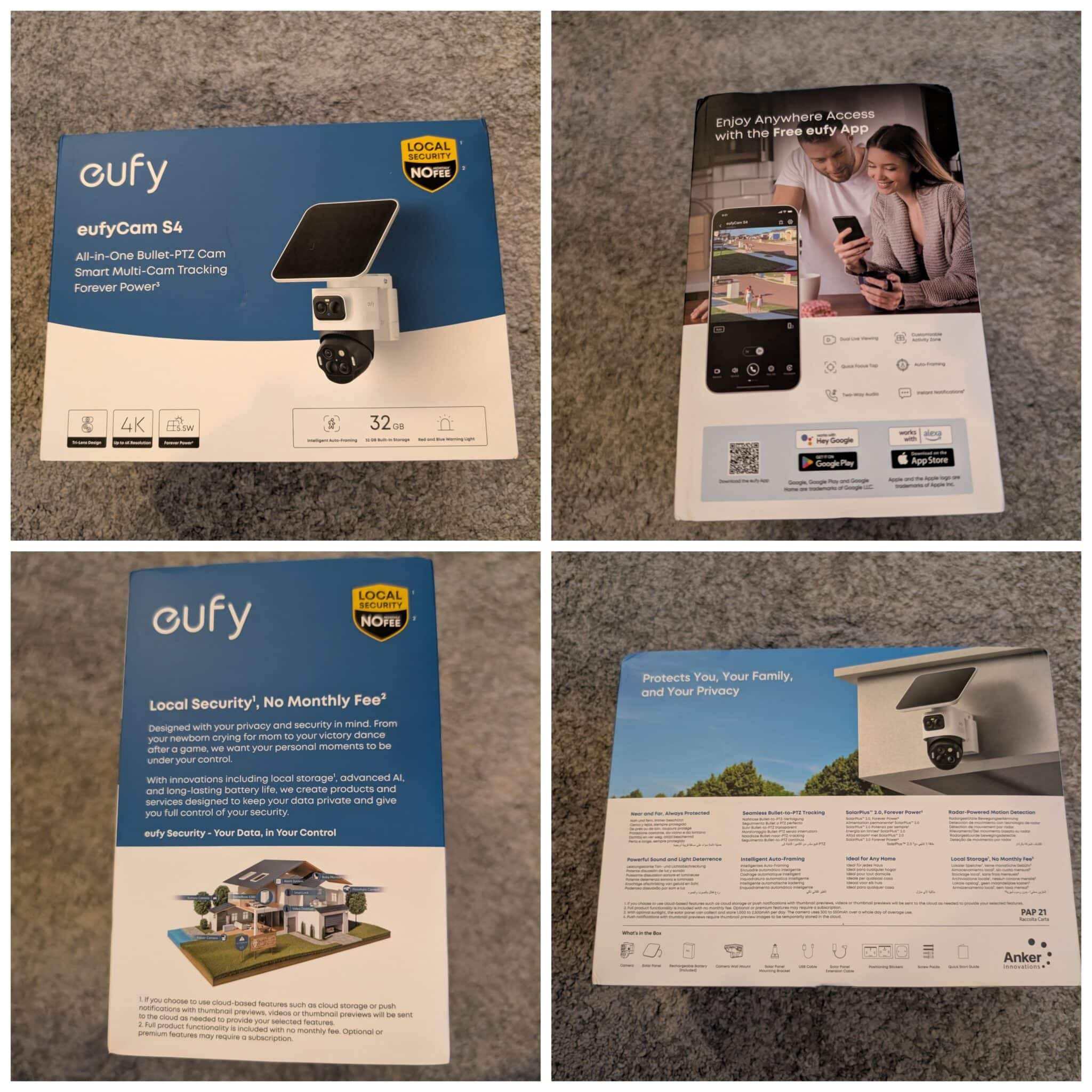
À droite, la marque a décidé de mettre en avant son application gratuite avec deux visuels, à nouveaux une liste non exhaustive des principales fonctionnalités de notre caméra du jour ainsi que les divers compatibilités et lien pour télécharger ladite app. À l’arrière bien sûr et comme toujours, c’est là que nous ferons le plein d’infos avec non seulement le contenu de la boîte mais également à nouveau les principaux arguments de notre S4, cette fois en 8 langues différentes.
| Marque | eufy Security |
|---|---|
| Couleur | Noir et blanc |
| Type d’installation | Murale |
| Modèle | T8172 |
| Résolution vidéo | 4k |
| Dimensions du colis (L x l x h) | 25.9 x 19.2 x 12.7 centimètres |
| Poids du colis | 2,05 Kilogrammes |
| Dimensions du colis (L x l x h) | 30 x 20 x 15 centimètres |
| Pièces incluses | Caméra, guide, visseries |
| Style | S4 |
| Disponibilité des pièces détachées | Information indisponible sur les pièces détachées |
| Mises à jour logicielles garanties jusqu’à | Information non disponible |
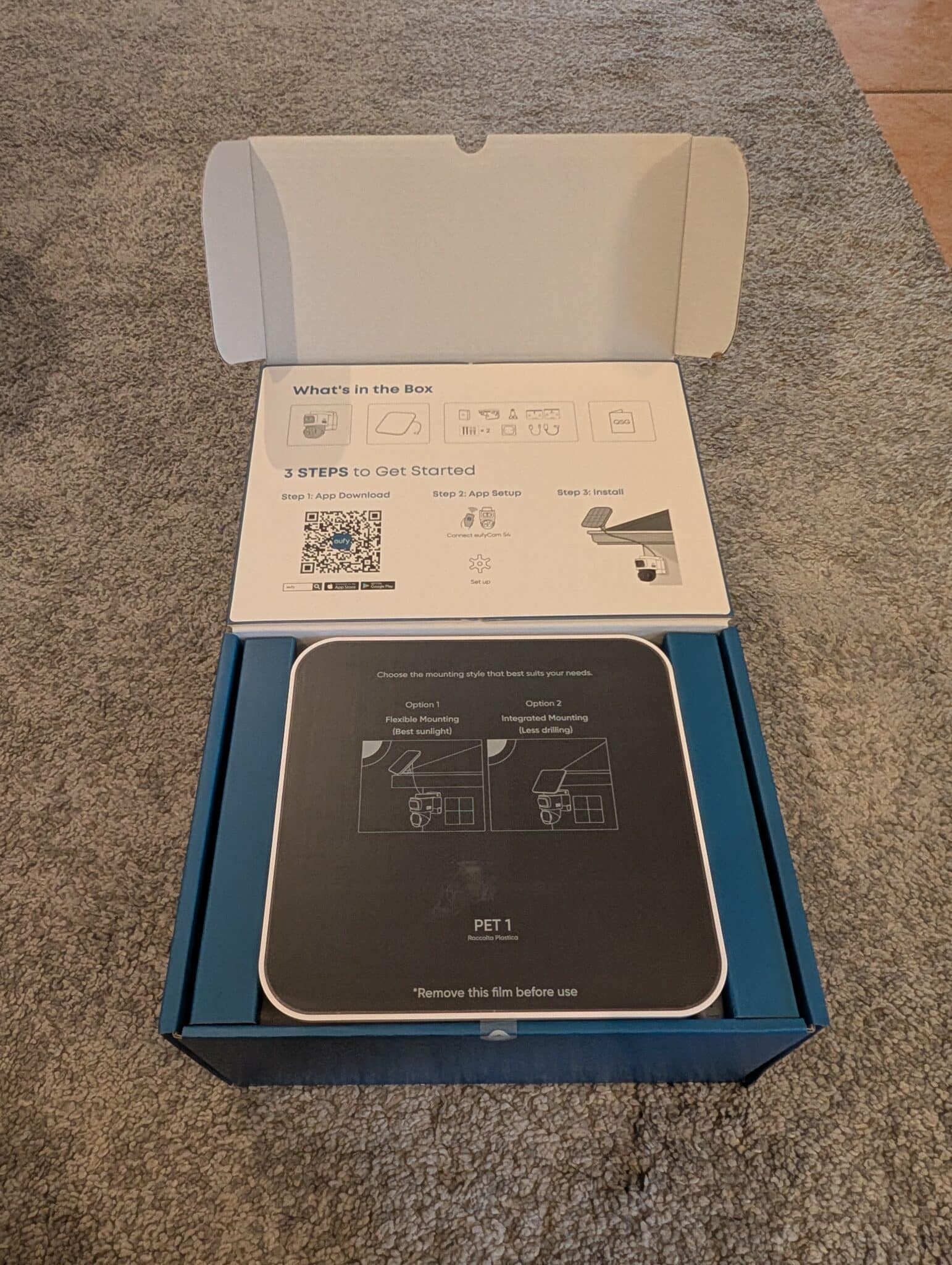
Caméra eufyCam S4
Une batterie rechargeable intégrée, remplaçable, qui alimente la caméra.
Un panneau solaire détachable
Le support de fixation
La visserie / chevilles / accessoires de montage pour fixer le support
Documentation : manuel d’installation / guide de démarrage rapide.
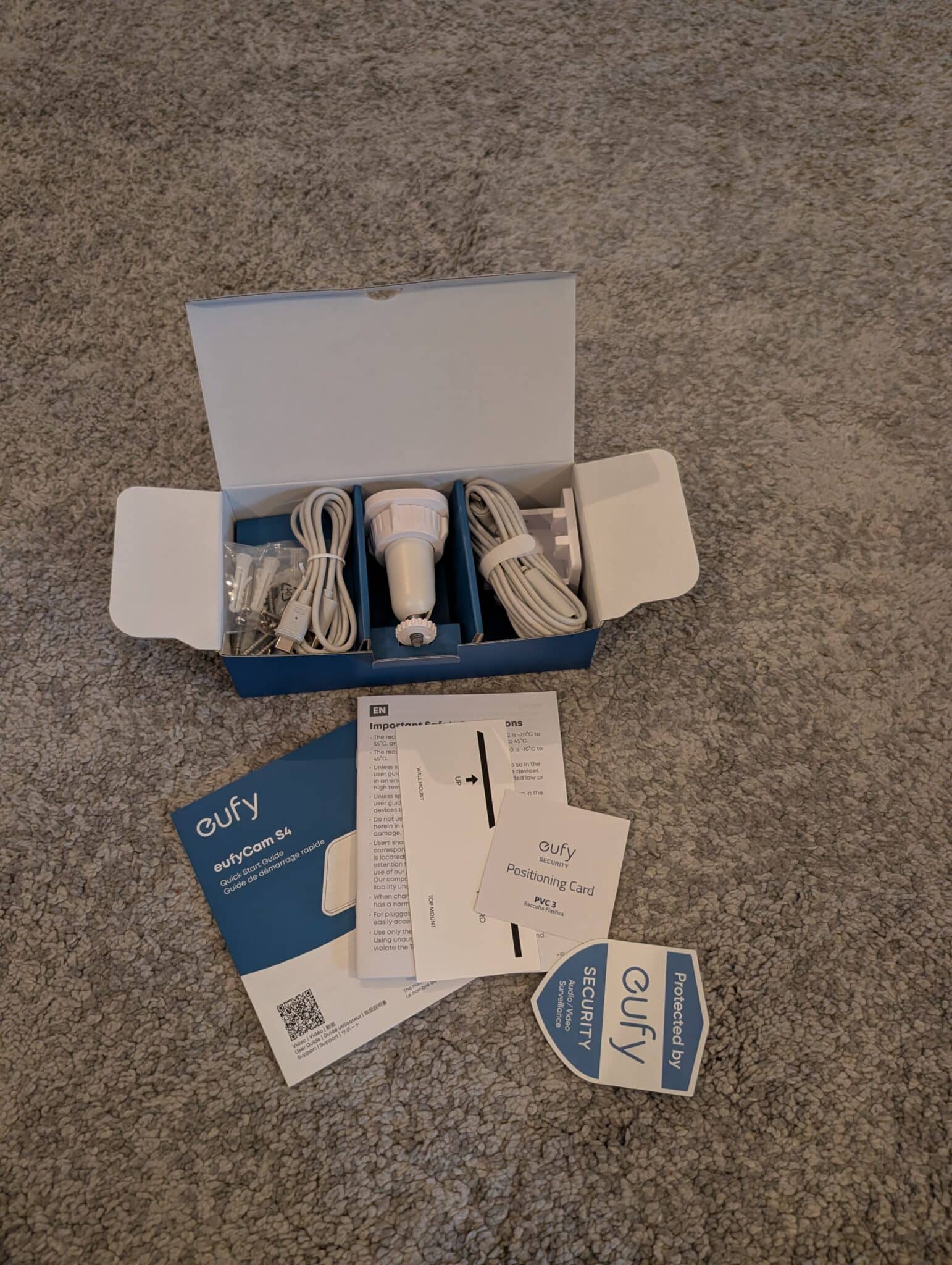
Nous ne referons pas de partie installation puisque nous avons déjà abordé ce point à diverses occasions lors de nos différents tests, mais si cela vous intéresse, n’hésitez pas à vous référez à notre dernière installation en date au moment du test de notre S3 Pro. L’installation, aussi bien hardware que software, est quasi la même avec notre modèle du jour.
Ce qui fait la particularité de la S4, c’est cette structure « hybride », presque inédite dans un produit grand public : une caméra fixe 4K grand-angle en haut, et une caméra PTZ orientable en bas, capable de pivoter à 360°, de s’incliner et de zoomer jusqu’à x8. Contrairement aux systèmes multi-caméras où chaque zone nécessite son propre appareil, ici, une seule unité couvre large tout en étant capable de s’approcher instantanément d’un détail. On passe d’une vue d’ensemble d’un jardin entier à une inspection précise d’un portail, d’une plaque d’immatriculation ou d’un colis en quelques secondes.
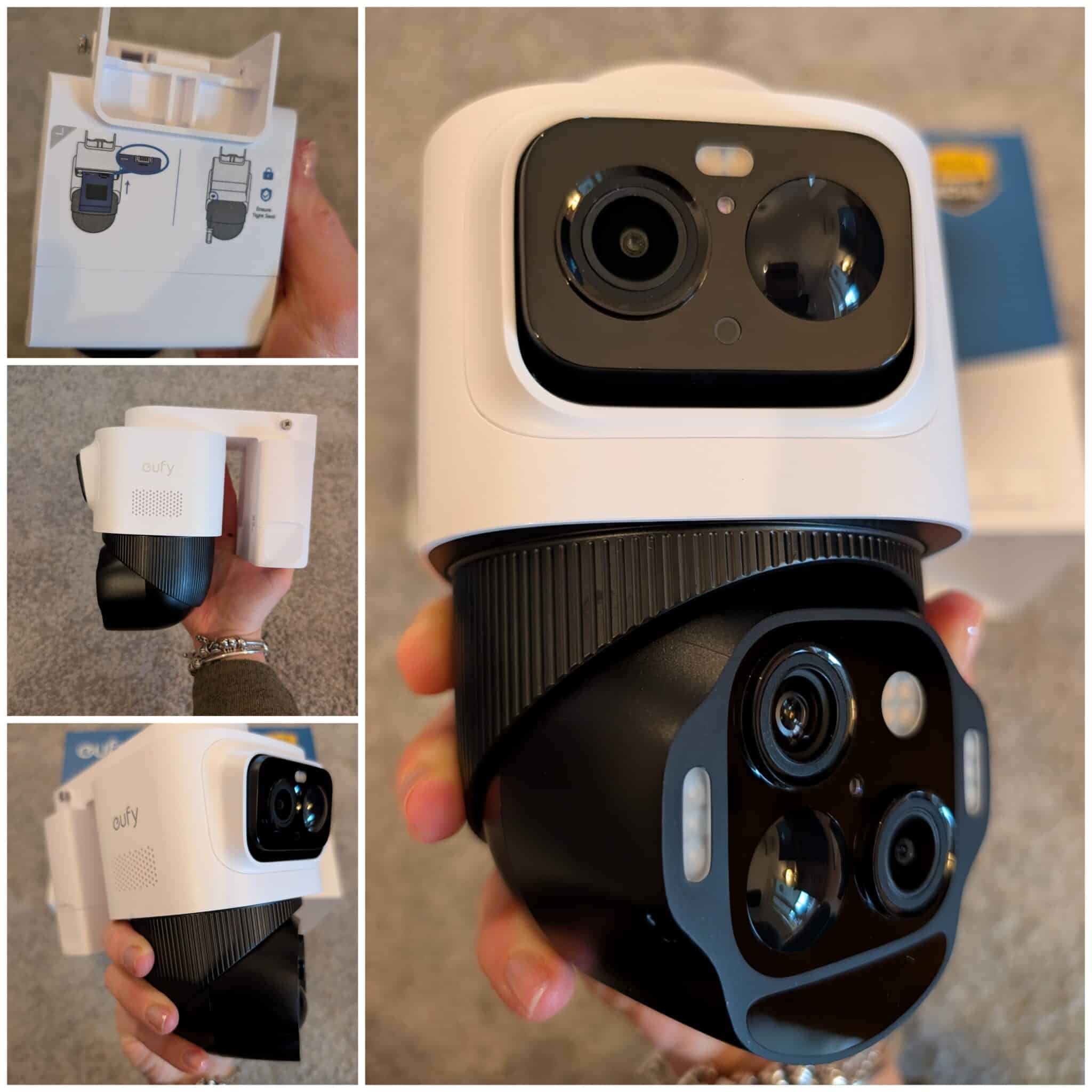
Au quotidien, cette dualité est bluffante. La caméra fixe capte tout ce qui entre dans son champ, tandis que la partie PTZ reste en attente… jusqu’au moment où un mouvement est détecté. Là, l’IA prend le relais : la caméra orientable se met en action, zoome automatiquement si elle détecte un visage, recule si un groupe de personnes est présent, et suit la scène sans saccades. On se retrouve avec un dispositif qui réagit instantanément, comme si quelqu’un prenait la télécommande au moment où il se passe quelque chose d’important.
La nuit, la S4 pousse encore un peu plus loin sa polyvalence. Selon la luminosité ambiante, elle bascule automatiquement entre vision infrarouge et vision nocturne en couleur. Lorsqu’un lampadaire, un éclairage de terrasse ou même une lune brillante est présent, la caméra est capable de produire des images nocturnes en couleur d’une excellente lisibilité. On voit clairement les silhouettes, les vêtements, les mouvements… là où d’autres caméras se contentent d’un noir et blanc approximatif.
La détection des mouvements repose sur deux technologies combinées : le radar, pour analyser la profondeur d’un déplacement, et le capteur PIR, qui perçoit la chaleur d’un corps. Ce duo réduit fortement les fausses alertes – un point essentiel quand on vit près d’un passage fréquenté ou dans un jardin où les chats ont tendance à élire domicile. Avec les bons réglages, on finit par ne recevoir que les notifications pertinentes.
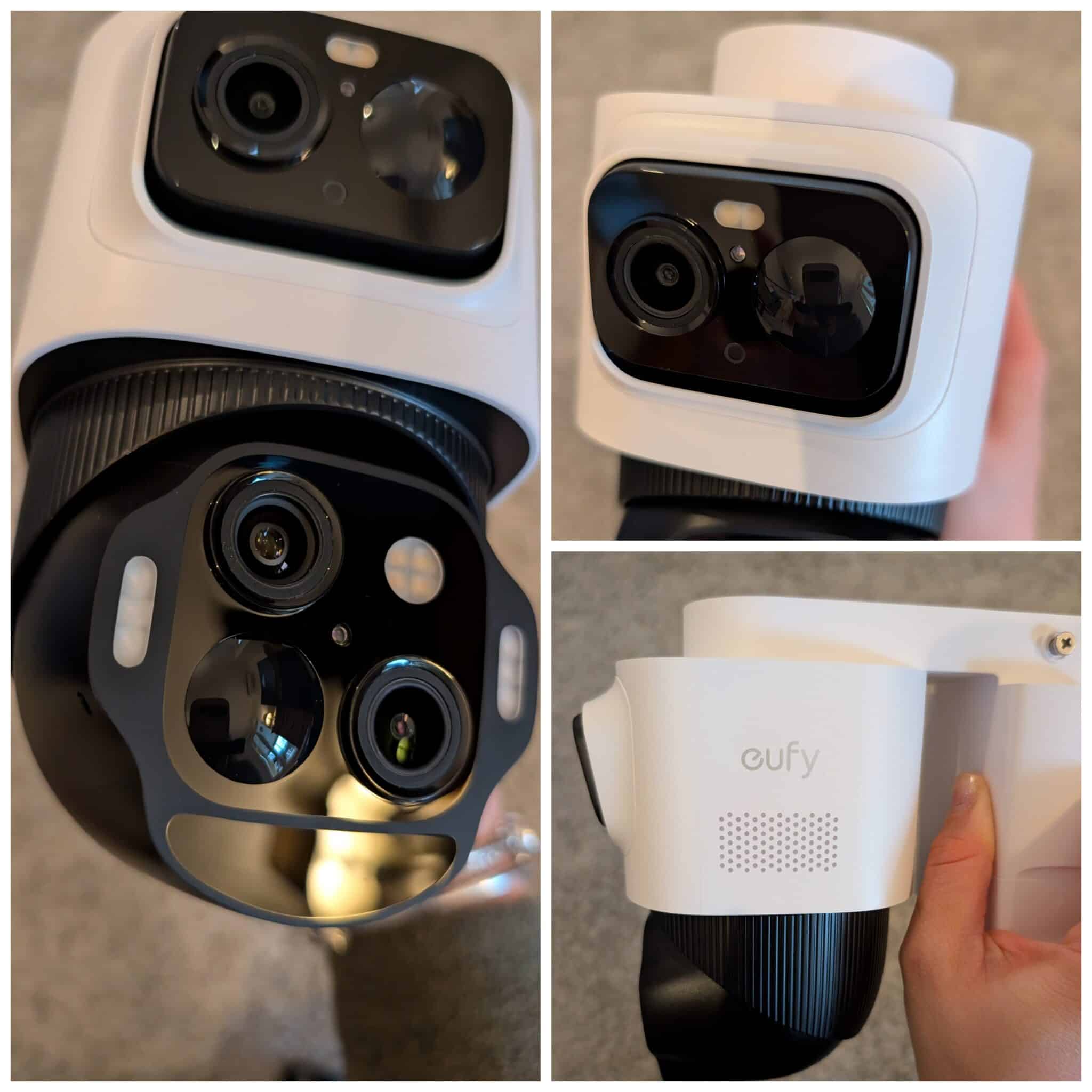 Honnêtement, on ne peut que souligner sa pertinence dans des situations réelles. Là où des caméras traditionnelles restent figées sur un angle large qui manque de détails, la S4 s’adapte (d’où son prix, aussi). Elle suit un livreur qui traverse l’allée, zoom automatiquement sur un visage, peut enregistrer une voiture qui ralentit devant la maison, ou même pivoter sur le côté pour suivre un mouvement inattendu. Cette capacité à se déplacer activement donne l’impression de ne rien manquer, comme si la caméra devenait réellement proactive. C’est exactement ce que la plupart des utilisateurs recherchent aujourd’hui. Une caméra qui n’attend pas passivement qu’un mouvement entre dans son petit cône de vision, mais une caméra qui agit, qui s’ajuste, qui complète son propre travail.
Évidemment, notre S4 a quelques défauts, et encore, quoi que. Comme souvent chez eufy, certaines fonctionnalités avancées poussent à utiliser une HomeBase, ce qui peut frustrer ceux qui ne veulent qu’un produit unique et autonome. Par exemple, la reconnaissance faciale la plus poussée, l’enregistrement continu ou certaines options avancées d’IA nécessitent une base dédiée avec plus de stockage. Autre point, nous le répétons à chaque fois : le panneau solaire est excellent, mais dépendant de son exposition. Une façade trop ombragée pourrait vous obliger à revenir à une recharge classique. Ce n’est pas un défaut de la S4 en soi, mais un point à anticiper au moment de choisir l’emplacement.
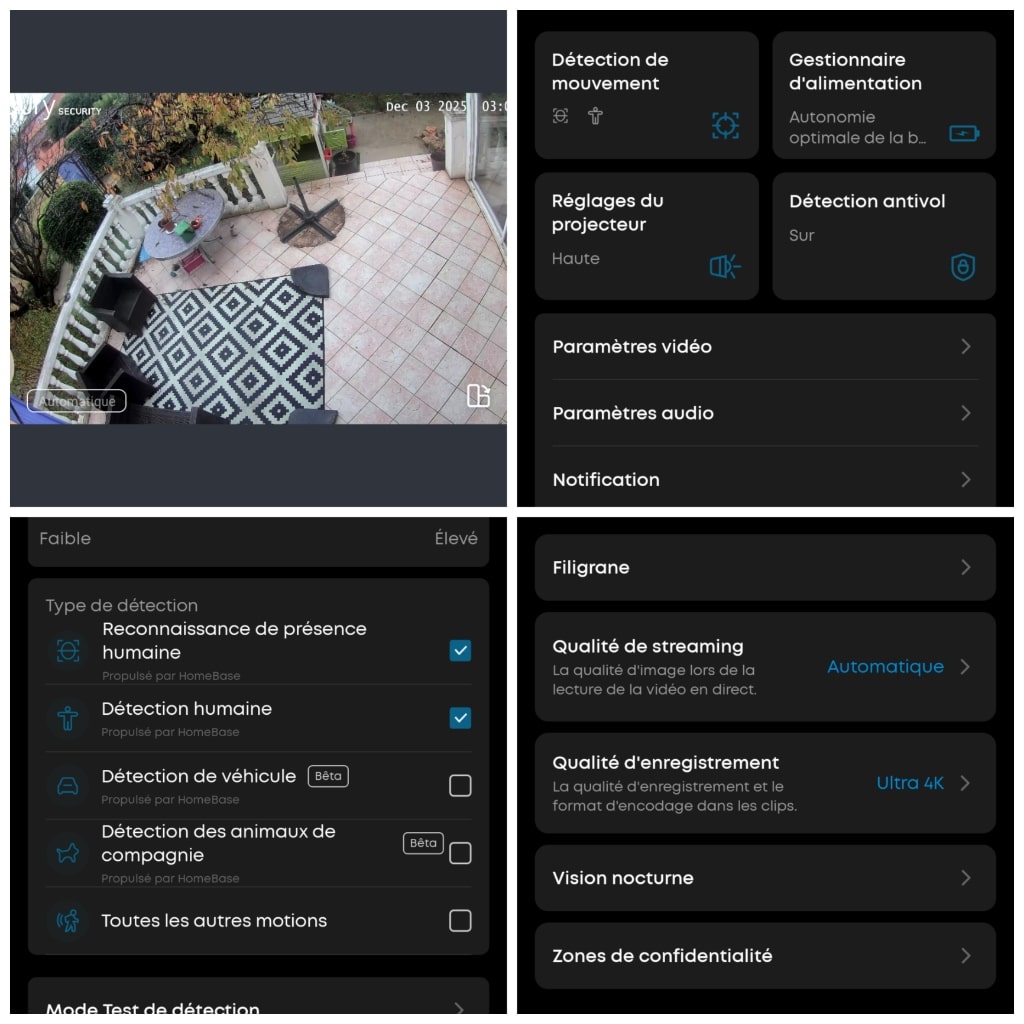
Enfin, la caméra est très sensible par défaut, ce qui implique de régler correctement les zones d’activité pour éviter une avalanche de notifications au début. Après l’ajustement, tout rentre dans l’ordre, mais il faut passer par cette phase de calibration.
Ce qui ressort au fil des jours, c’est cette sensation de tranquillité. La caméra surveille, détecte, suit, zoome, enregistre… et vous, vous n’avez quasiment rien à faire. Vous n’avez pas besoin de jongler entre plusieurs caméras, de vérifier plusieurs angles ou de vous demander si quelque chose a échappé à l’œil du capteur. La S4 couvre large ET précis en même temps, ce qui est probablement sa plus grande force.
La consultation dans l’app eufy est claire, intuitive, et les vidéos, notamment en 4K grand-angle, sont suffisamment détaillées pour analyser précisément une scène. Les vidéos issues du PTZ, elles, sont utiles pour zoomer sur un détail précis, comme un visage ou une plaque.
La eufyCam S4 n’essaie pas d’être une caméra de sécurité classique. Elle cherche à offrir une surveillance intelligente, capable de remplacer deux appareils, tout en restant simple à installer et à utiliser. Elle s’adresse à ceux qui veulent une surveillance extérieure ultra complète, polyvalente et fiable, sans se lancer dans une installation compliquée
Elle n’est pas faite pour ceux qui recherchent du 24/7 en haute qualité sans hub, ou pour les environnements très ombragés où le panneau solaire perd de son efficacité. Mais pour la grande majorité des installations résidentielles, surtout celles avec un jardin, une allée, une entrée ou une façade large, la S4 devient rapidement un choix évident, surtout si vous êtes déjà équipé.
Elle incarne parfaitement l’idée d’une caméra « premium accessible » : performante, intelligente, autonome, mais sans enfermer l’utilisateur derrière des abonnements obligatoires. Une réussite solide, et clairement l’une des propositions les plus complètes du moment pour sécuriser un espace extérieur.
Son prix oscille pas mal en ce moment, et il est vrai que la facture est tout de même élevée mais vous la retrouverez au prix de 299 € à l’heure où ses lignes sont écrites, alors soyez vigilants au promo !

Test – Caméra de surveillance S4 eufyCam de eufy a lire sur Vonguru.
Les chercheurs ont analysé des données concernant près de 30 millions de Français entre 2021 et 2025.

This episode of the Physics World Weekly podcast features Tim Hsieh of Canada’s Perimeter Institute for Theoretical Physics. We explore some of today’s hottest topics in quantum science and technology – including topological phases of matter; quantum error correction and quantum simulation.
Our conversation begins with an exploration of the quirky properties quantum matter and how these can be exploited to create quantum technologies. We look at the challenges that must be overcome to create large-scale quantum computers; and Hsieh reveals which problem he would solve first if he had access to a powerful quantum processor.
This interview was recorded earlier this autumn when I had the pleasure of visiting the Perimeter Institute and speaking to four physicists about their research. This is the third of those conversations to appear on the podcast.
The first interview in this series from the Perimeter Institute was with Javier Toledo-Marín, “Quantum computing and AI join forces for particle physics”; and the second was with Bianca Dittrich, “Quantum gravity: we explore spin foams and other potential solutions to this enduring challenge“.

This episode is supported by the APS Global Physics Summit, which takes place on 15–20 March, 2026, in Denver, Colorado, and online.
The post Building a quantum future using topological phases of matter and error correction appeared first on Physics World.

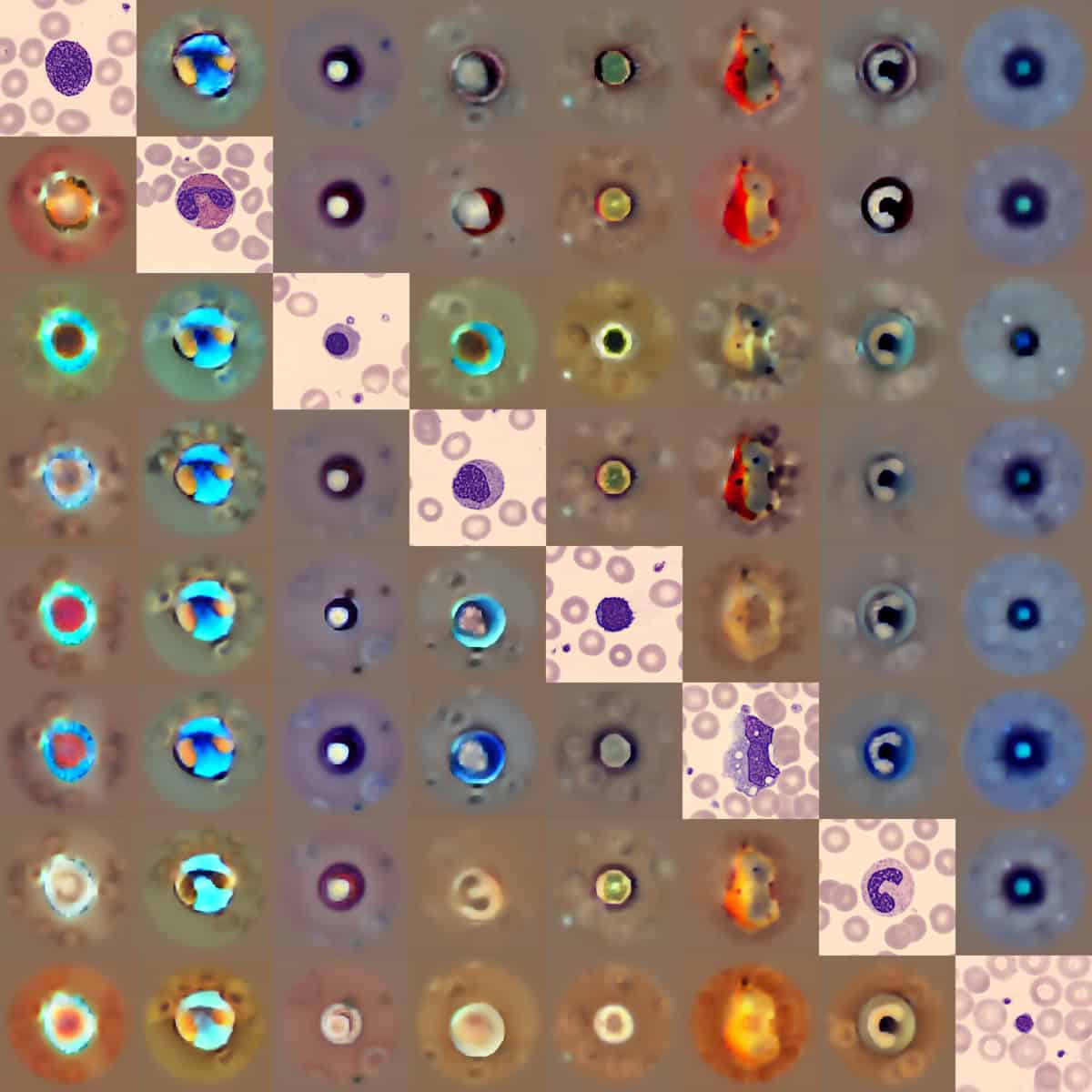
The shape and structure of blood cells provide vital indicators for diagnosis and management of blood disease and disorders. Recognizing subtle differences in the appearance of cells under a microscope, however, requires the skills of experts with years of training, motivating researchers to investigate whether artificial intelligence (AI) could help automate this onerous task. A UK-led research team has now developed a generative AI-based model, known as CytoDiffusion, that characterizes blood cell morphology with greater accuracy and reliability than human experts.
Conventional discriminative machine learning models can match human performance at classifying cells in blood samples into predefined classes. But discriminative models, which learn to recognise cell images based on expert labels, struggle with never-before-seen cell types and images from differing microscopes and staining techniques.
To address these shortfalls, the team – headed up at the University of Cambridge, University College London and Queen Mary University of London – created CytoDiffusion around a diffusion-based generative AI classifier. Rather than just learning to separate cell categories, CytoDiffusion models the full range of blood cell morphologies to provide accurate classification with robust anomaly detection.
“Our approach is motivated by the desire to achieve a model with superhuman fidelity, flexibility and metacognitive awareness that can capture the distribution of all possible morphological appearances,” the researchers write.
For AI-based analysis to be adopted in the clinic, it’s essential that users trust a model’s learned representations. To assess whether CytoDiffusion could effectively capture the distribution of blood cell images, the team used it to generate synthetic blood cell images. Analysis by experienced haematologists revealed that these synthetic images were near-indistinguishable from genuine images, showing that CytoDiffusion genuinely learns the morphological distribution of blood cells rather than using artefactual shortcuts.
The researchers used multiple datasets to develop and evaluate their diffusion classifier, including CytoData, a custom dataset containing more than half a million anonymized cell images from almost 3000 blood smear slides. In standard classification tasks across these datasets, CytoDiffusion achieved state-of-the-art performance, matching or exceeding the capabilities of traditional discriminative models.
Effective diagnosis from blood smear samples also requires the ability to detect rare or previously unseen cell types. The researchers evaluated CytoDiffusion’s ability to detect blast cells (immature blood cells) in the test datasets. Blast cells are associated with blood malignancies such as leukaemia, and high detection sensitivity is essential to minimize false negatives.
In one dataset, CytoDiffusion detected blast cells with sensitivity and specificity of 0.905 and 0.962, respectively. In contrast, a discriminative model exhibited a poor sensitivity of 0.281. In datasets with erythroblasts as the abnormal cells, CytoDiffusion again outperformed the discriminative model, demonstrating that it can detect abnormal cell types not present in its training data, with the high sensitivity required for clinical applications.
It’s important that a classification model is robust to different imaging conditions and can function with sparse training data, as commonly found in clinical applications. When trained and tested on diverse image datasets (different hospitals, microscopes and staining procedures), CytoDiffusion achieved state-of-the-art accuracy in all cases. Likewise, after training on limited subsets of 10, 20 and 50 images per class, CytoDiffusion consistently outperformed discriminative models, particularly in the most data-scarce conditions.
Another essential feature of clinical classification tasks, whether performed by a human or an algorithm, is knowing the uncertainty in the final decision. The researchers developed a framework for evaluating uncertainty and showed that CytoDiffusion produced superior uncertainty estimates to human experts. With uncertainty quantified, cases with high certainty could be processed automatically, with uncertain cases flagged for human review.
“When we tested its accuracy, the system was slightly better than humans,” says first author Simon Deltadahl from the University of Cambridge in a press statement. “But where it really stood out was in knowing when it was uncertain. Our model would never say it was certain and then be wrong, but that is something that humans sometimes do.”
Finally, the team demonstrated CytoDiffusion’s ability to create heat maps highlighting regions that would need to change for an image to be reclassified. This feature provides insight into the model’s decision-making process and shows that it understands subtle differences between similar cell types. Such transparency is essential for clinical deployment of AI, making models more trustworthy as practitioners can verify that classifications are based on legitimate morphological features.
“The true value of healthcare AI lies not in approximating human expertise at lower cost, but in enabling greater diagnostic, prognostic and prescriptive power than either experts or simple statistical models can achieve,” adds co-senior author Parashkev Nachev from University College London.
CytoDiffusion is described in Nature Machine Intelligence.
The post Generative AI model detects blood cell abnormalities appeared first on Physics World.
Almost every image that will be taken by future space observatories in low-Earth orbit could be tainted due to light contamination from satellites. That is according to a new analysis from researchers at NASA, which stresses that light pollution from satellites orbiting Earth must be reduced to guarantee astronomical research is not affected.
The number of satellites orbiting Earth has increased from about 2000 in 2019 to 15 000 today. Many of these are part of so-called mega-constellations that provide services such as Internet coverage around the world, including in areas that were previously unable to access it. Examples of such constellations include SpaceX’s Starlink as well as Amazon’s Kuiper and Eutelsat’s OneWeb.
Many of these mega-constellations share the same space as space-based observatories such as NASA’s Hubble Space Telescope. This means that the telescopes can capture streaks of reflected light from the satellites that render the images or data completely unusable for research purposes. That is despite anti-reflective coating that is applied to some newer satellites in SpaceX’s Starlink constellation, for example.
Previous work has explored the impact of such satellites constellations on ground-based astronomy, both optical and radioastronomy. Yet their impact on telescopes in space has been overlooked.
To find out more, Alejandro Borlaff from NASA’s Ames Research Center, and colleagues simulated the view of four space-based telescopes: Hubble and the near-infrared observatory SPHEREx, which launched in 2025, as well at the European Space Agency’s proposed near-infrared ARRAKIHS mission and China’s planned Xuntian telescopes.
These observatories are, or will be placed, between 400 and 800 km from the Earth’s surface.
The authors found that if the population of mega-constellation satellites grows to the 56 000 that is projected by the end of the decade, it would contaminate about 39.6% of Hubble’s images and 96% of images from the other three telescopes.
Borlaff and colleagues predict that the average number of satellites observed per exposure would be 2.14 for Hubble, 5.64 for SPHEREx, 69 for ARRAKIHS, and 92 for Xuntian.
The authors note that one solution could be to deploy satellites at lower orbits than the telescopes operate, which would make them about four magnitudes dimmer. The downside is that emissions from these lower satellites could have implications for Earth’s ozone layer.
Katherine Courtney, chair of the steering board for the Global Network on Sustainability in Space, says that without astronomy, the modern space economy “simply wouldn’t exist”.
“The space industry owes its understanding of orbital mechanics, and much of the technology development that has unlocked commercial opportunities for satellite operators, to astronomy,” she says. “The burgeoning growth of the satellite population brings many benefits to life on Earth, but the consequences for the future of astronomy must be taken into consideration.”
Courtney adds that there is now “an urgent need for greater dialogue and collaboration between astronomers and satellite operators to mitigate those impacts and find innovative ways for commercial and scientific operations to co-exist in space.”
The post Light pollution from satellite mega-constellations threaten space-based observations appeared first on Physics World.
Le projet sera financé au coût de 20 millions $ par l’établissement postsecondaire et par Google.


Physicists have obtained the first detailed picture of the internal structure of radium monofluoride (RaF) thanks to the molecule’s own electrons, which penetrated the nucleus of the molecule and interacted with its protons and neutrons. This behaviour is known as the Bohr-Weisskopf effect, and study co-leader Shane Wilkins says that this marks the first time it has been observed in a molecule. The measurements themselves, he adds, are an important step towards testing for nuclear symmetry violation, which might explain why our universe contains much more matter than antimatter.
RaF contains the radioactive isotope 225Ra, which is not easy to make, let alone measure. Producing it requires a large accelerator facility at high temperature and high velocity, and it is only available in tiny quantities (less than a nanogram in total) for short periods (it has a nuclear half-life of around 15 days).
“This imposes significant challenges compared to the study of stable molecules, as we need extremely selective and sensitive techniques in order to elucidate the structure of molecules containing 225Ra,” says Wilkins, who performed the measurements as a member of Ronald Fernando Garcia Ruiz’s research group at the Massachusetts Institute of Technology (MIT), US.
The team chose RaF despite these difficulties because theory predicts that it is particularly sensitive to small nuclear effects that break the symmetries of nature. “This is because, unlike most atomic nuclei, the radium atom’s nucleus is octupole deformed, which basically means it has a pear shape,” explains the study’s other co-leader, Silviu-Marian Udrescu.
In their study, which is detailed in Science, the MIT team and colleagues at CERN, the University of Manchester, UK and KU Leuven in the Netherlands focused on RaF’s hyperfine structure. This structure arises from interactions between nuclear and electron spins, and studying it can reveal valuable clues about the nucleus. For example, the nuclear magnetic dipole moment can provide information on how protons and neutrons are distributed inside the nucleus.
In most experiments, physicists treat electron-nucleus interactions as taking place at (relatively) long ranges. With RaF, that’s not the case. Udrescu describes the radium atom’s electrons as being “squeezed” within the molecule, which increases the probability that they will interact with, and penetrate, the radium nucleus. This behaviour manifests itself as a slight shift in the energy levels of the radium atom’s electrons, and the team’s precision measurements – combined with state-of-the-art molecular structure calculations – confirm that this is indeed what happens.
“We see a clear breakdown of this [long-range interactions] picture because the electrons spend a significant amount of time within the nucleus itself due to the special properties of this radium molecule,” Wilkins explains. “The electrons thus act as highly sensitive probes to study phenomena inside the nucleus.”
According to Udrescu, the team’s work “lays the foundations for future experiments that use this molecule to investigate nuclear symmetry violation and test the validity of theories that go beyond the Standard Model of particle physics.” In this model, each of the matter particles we see around us – from baryons like protons to leptons such as electrons – should have a corresponding antiparticle that is identical in every way apart from its charge and magnetic properties (which are reversed).
The problem is that the Standard Model predicts that the Big Bang that formed our universe nearly 14 billion years ago should have generated equal amounts of antimatter and matter – yet measurements and observations made today reveal an almost entirely matter-based universe. Subtler differences between matter particles and their antimatter counterparts might explain why the former prevailed, so by searching for these differences, physicists hope to explain antimatter-matter asymmetry.
Wilkins says the team’s work will be important for future such searches in species like RaF. Indeed, Wilkins, who is now at Michigan State University’s Facility for Rare Isotope Beams (FRIB), is building a new setup to cool and slow beams of radioactive molecules to enable higher-precision spectroscopy of species relevant to nuclear structure, fundamental symmetries and astrophysics. His long-term goal, together with other members of the RaX collaboration (which includes FRIB and the MIT team as well as researchers at Harvard University and the California Institute of Technology), is to implement advanced laser-based techniques using radium-containing molecules.
The post Physicists use a radioactive molecule’s own electrons to probe its internal structure appeared first on Physics World.
