As we enter the final stretch of the International Year of Quantum Science and Technology (IYQ), I hope you’ve enjoyed our extensive quantum coverage over the last 12 months. We’ve tackled the history of the subject, explored some of the unexplained mysteries that still make quantum physics so exciting, and examined many of the commercial applications of quantum technology. You can find most of our coverage collected into two free-to-read digital Quantum Briefings, available here and here on the Physics World website.
Over the last 100 years since Werner Heisenberg first developed quantum mechanics on the island of Helgoland in June 1925, quantum mechanics has proved to be an incredibly powerful, successful and logically consistent theory. Our understanding of the subatomic world is no longer the “lamentable hodgepodge of hypotheses, principles, theorems and computational recipes”, as the Israeli physicist and philosopher Max Jammer memorably once described it.
In fact, quantum mechanics has not just transformed our understanding of the natural world; it has immense practical ramifications too, with so-called “quantum 1.0” technologies – lasers, semiconductors and electronics – underpinning our modern world. But as was clear from the UK National Quantum Technologies Showcase in London last week, organized by Innovate UK, the “quantum 2.0” revolution is now in full swing.
The day-long event, which is now in its 10th year, featured over 100 exhibitors, including many companies that are already using fundamental quantum concepts such as entanglement and superposition to support the burgeoning fields of quantum computing, quantum sensing and quantum communication. The show was attended by more than 3000 delegates, some of whom almost had to be ushered out of the door at closing time, so keen were they to keep talking.
The first day, focusing on the foundations of quantum mechanics, ended with a panel discussion – chaired by my colleague Tushna Commissariat and Daisy Shearer from the UK’s National Quantum Computing Centre – with physicists Fay Dowker (Imperial College), Jim Al-Khalili (University of Surrey) and Peter Knight. They talked about whether the quantum wavefunction provides a complete description of physical reality, prompting much discussion with the audience. As Al-Khalili wryly noted, if entanglement has emerged as the fundamental feature of quantum reality, then “decoherence is her annoying and ever-present little brother”.
Knight, meanwhile, who is a powerful figure in quantum-policy circles, went as far as to say that the limit of decoherence – and indeed the boundary between the classical and quantum worlds – is not a fixed and yet-to-be revealed point. Instead, he mused, it will be determined by how much money and ingenuity and time physicists have at their disposal.
On the second day of the IOP conference at the RI, I chaired a discussion that brought together four future leaders of the subject: Mehul Malik (Heriot-Watt University) and Sarah Malik (University College London) along with industry insiders Nicole Gillett (Riverlane) and Muhammad Hamza Waseem (Quantinuum).
As well as outlining the technical challenges in their fields, the speakers all stressed the importance of developing a “skills pipeline” so that the quantum sector has enough talented people to meet its needs. Also vital will be the need to communicate the mysteries and potential of quantum technology – not just to the public but to industrialists, government officials and venture capitalists. By many measures, the UK is at the forefront of quantum tech – and it is a lead it should not let slip.
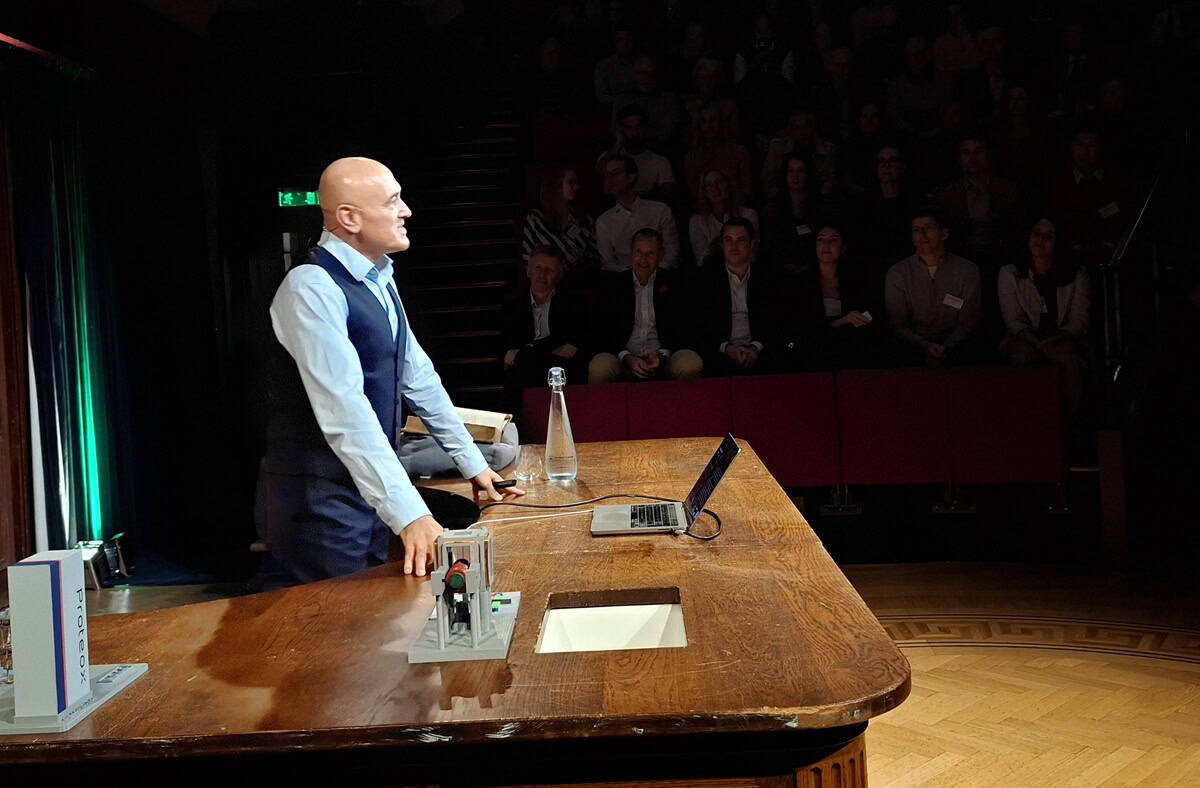
Clear talker Jim Al-Khalili giving his Friday night discourse at the Royal Institution on 7 November 2025. (Courtesy: Matin Durrani)
The week ended with Al-Khalili giving a public lecture, also at the Royal Institution, entitled “A new quantum world: ‘spooky’ physics to tech revolution”. It formed part of the RI’s famous Friday night “discourses”, which this year celebrate their 200th anniversary. Al-Khalili, who also presents A Life Scientific on BBC Radio 4, is now the only person ever to have given three RI discourses.
After the lecture, which was sold out, he took part in a panel discussion with Knight and Elizabeth Cunningham, a former vice-president for membership at the IOP. Al-Khalili was later presented with a special bottle of “Glentanglement” whisky made by Glasgow-based Fraunhofer UK for the Scottish Quantum Technology cluster.
“Global collaborations for European economic resilience” is the theme of SEMICON Europa 2025. The event is coming to Munich, Germany on 18–21 November and it will attract 25,000 semiconductor professionals who will enjoy presentations from over 200 speakers.
The TechARENA portion of the event will cover a wide range of technology-related issues including new materials, future computing paradigms and the development of hi-tech skills in the European workface. There will also be an Executive Forum, which will feature leaders in industry and government and will cover topics including silicon geopolitics and the use of artificial intelligence in semiconductor manufacturing.
SEMICON Europa will be held at the Messe München, where it will feature a huge exhibition with over 500 exhibitors from around the world. The exhibition is spread out over three halls and here are some of the companies and product innovations to look out for on the show floor.
Accelerating the future of electro-photonic integration with SmarAct
As the boundaries between electronic and photonic technologies continue to blur, the semiconductor industry faces a growing challenge: how to test and align increasingly complex electro-photonic chip architectures efficiently, precisely, and at scale. At SEMICON Europa 2025, SmarAct will address this challenge head-on with its latest innovation – Fast Scan Align. This is a high-speed and high-precision alignment solution that redefines the limits of testing and packaging for integrated photonics.
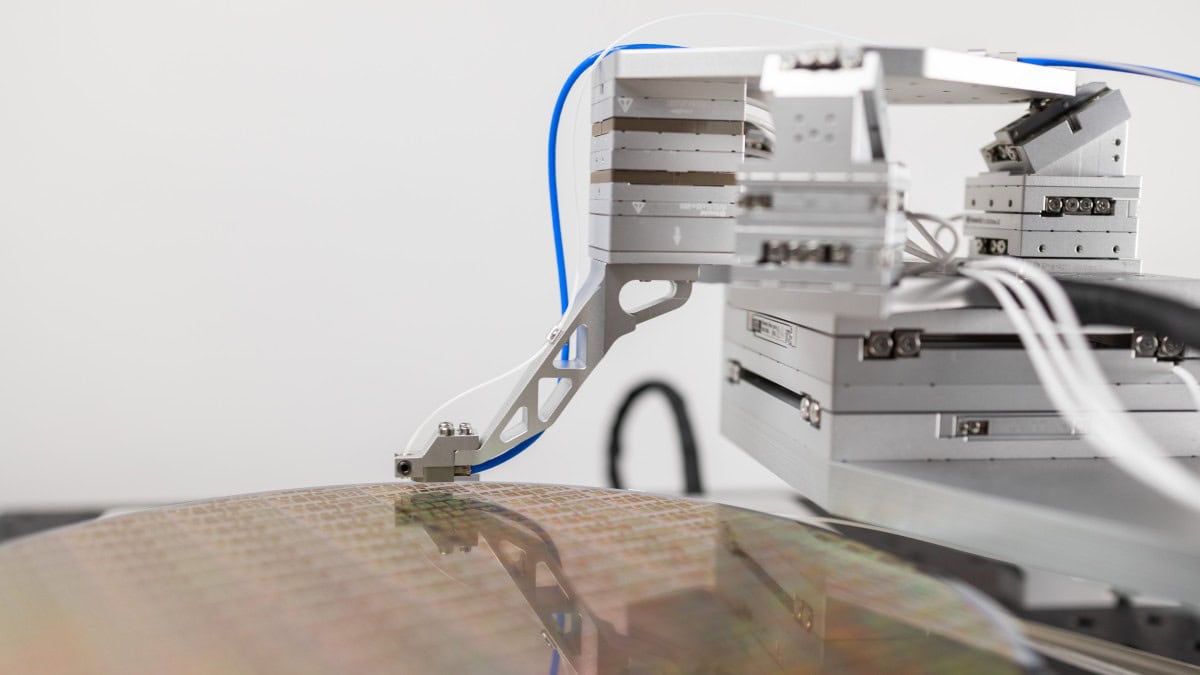
Fast Scan Align SmarAct’s high-speed and high-precision alignment solution redefines the limits of testing and packaging for integrated photonics. (Courtesy: SmarAct)
In the emerging era of heterogeneous integration, electronic and photonic components must be aligned and interconnected with sub-micrometre accuracy. Traditional positioning systems often struggle to deliver both speed and precision, especially when dealing with the delicate coupling between optical and electrical domains. SmarAct’s Fast Scan Align solution bridges this gap by combining modular motion platforms, real-time feedback control, and advanced metrology into one integrated system.
At its core, Fast Scan Align leverages SmarAct’s electromagnetic and piezo-driven positioning stages, which are capable of nanometre-resolution motion in multiple degrees of freedom. Fast Scan Align’s modular architecture allows users to configure systems tailored to their application – from wafer-level testing to fibre-to-chip alignment with active optical coupling. Integrated sensors and intelligent algorithms enable scanning and alignment routines that drastically reduce setup time while improving repeatability and process stability.
Fast Scan Align’s compact modules allow various measurement techniques to be integrated with unprecedented possibilities. This has become decisive for the increasing level of integration of complex electro-photonic chips.
Apart from the topics of wafer-level testing and packaging, wafer positioning with extreme precision is as crucial as never before for the highly integrated chips of the future. SmarAct’s PICOSCALE interferometer addresses the challenge of extreme position by delivering picometer-level displacement measurements directly at the point of interest.
When combined with SmarAct’s precision wafer stages, the PICOSCALE interferometer ensures highly accurate motion tracking and closed-loop control during dynamic alignment processes. This synergy between motion and metrology gives users unprecedented insight into the mechanical and optical behaviour of their devices – which is a critical advantage for high-yield testing of photonic and optoelectronic wafers.
Visitors to SEMICON Europa will also experience how all of SmarAct’s products – from motion and metrology components to modular systems and up to turn-key solutions – integrate seamlessly, offering intuitive operation, full automation capability, and compatibility with laboratory and production environments alike.
Optimized pressure monitoring: Efficient workflows with Thyracont’s VD800 digital compact vacuum meters
Thyracont Vacuum Instruments will be showcasing its precision vacuum metrology systems in exhibition hall C1. Made in Germany, the company’s broad portfolio combines diverse measurement technologies – including piezo, Pirani, capacitive, cold cathode, and hot cathode – to deliver reliable results across a pressure range from 2000 to 3e-11 mbar.
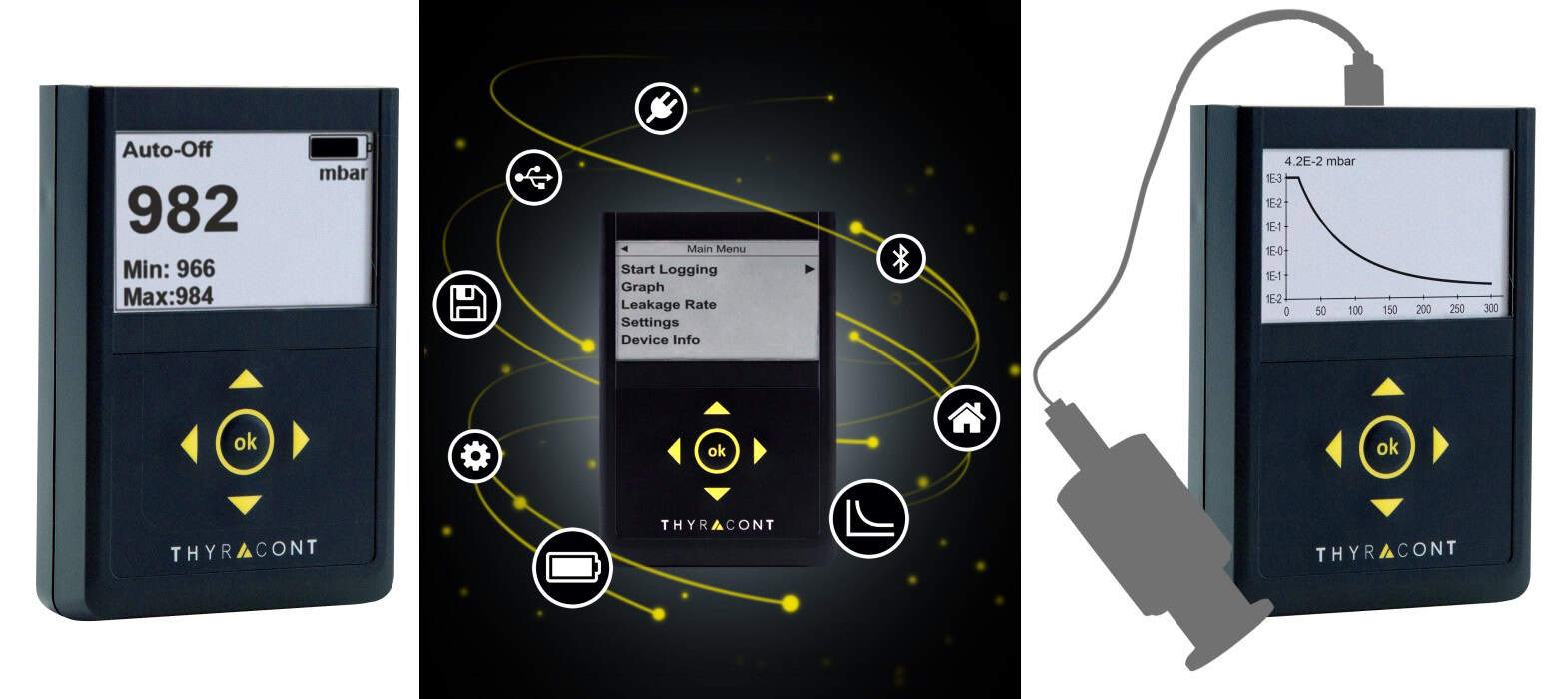
VD800 Thryracont’s series combines high accuracy with a highly intuitive user interface, defining the next generation of compact vacuum meters. (Courtesy: Thyracont)
Front-and-centre at SEMICON Europa will be Thyracont’s new series of VD800 compact vacuum meters. These instruments provide precise, on-site pressure monitoring in industrial and research environments. Featuring a direct pressure display and real-time pressure graphs, the VD800 series is ideal for service and maintenance tasks, laboratory applications, and test setups.
The VD800 series combines high accuracy with a highly intuitive user interface. This delivers real-time measurement values; pressure diagrams; and minimum and maximum pressure – all at a glance. The VD800’s 4+1 membrane keypad ensures quick access to all functions. USB-C and optional Bluetooth LE connectivity deliver seamless data readout and export. The VD800’s large internal data logger can store over 10 million measured values with their RTC data, with each measurement series saved as a separate file.
Data sampling rates can be set from 20 ms to 60 s to achieve dynamic pressure tracking or long-term measurements. Leak rates can be measured directly by monitoring the rise in pressure in the vacuum system. Intelligent energy management gives the meters extended battery life and longer operation times. Battery charging is done conveniently via USB-C.
The vacuum meters are available in several different sensor configurations, making them adaptable to a wide range of different uses. Model VD810 integrates a piezo ceramic sensor for making gas-type-independent measurements for rough vacuum applications. This sensor is insensitive to contamination, making it suitable for rough industrial environments. The VD810 measures absolute pressure from 2000 to 1 mbar and relative pressure from −1060 to +1200 mbar.
Model VD850 integrates a piezo/Pirani combination sensor, which delivers high resolution and accuracy in the rough and fine vacuum ranges. Optimized temperature compensation ensures stable measurements in the absolute pressure range from 1200 to 5e-5 mbar and in the relative pressure range from −1060 to +340 mbar.
The model VD800 is a standalone meter designed for use with Thyracont’s USB-C vacuum transducers, which are available in two models. The VSRUSB USB-C transducer is a piezo/Pirani combination sensor that measures absolute pressure in the 2000 to 5.0e-5 mbar range. The other is the VSCUSB USB-C transducer, which measures absolute pressures from 2000 down to 1 mbar and has a relative pressure range from -1060 to +1200 mbar. A USB-C cable connects the transducer to the VD800 for quick and easy data retrieval. The USB-C transducers are ideal for hard-to-reach areas of vacuum systems. The transducers can be activated while a process is running, enabling continuous monitoring and improved service diagnostics.
With its blend of precision, flexibility, and ease of use, the Thyracont VD800 series defines the next generation of compact vacuum meters. The devices’ intuitive interface, extensive data capabilities, and modern connectivity make them an indispensable tool for laboratories, service engineers, and industrial operators alike.
To experience the future of vacuum metrology in Munich, visit Thyracont at SEMICON Europa hall C1, booth 752. There you will discover how the VD800 series can optimize your pressure monitoring workflows.
Marking 100 years since the advent of quantum mechanics, IYQ aims to raise awareness of the impact of quantum physics and its myriad future applications, with a global diary of quantum-themed public talks, scientific conferences, industry events and more.
You can find out more about the contributions of Indian physicist Satyendra Nath Bose to quantum science; explore weird phenomena such as causal order and quantum superposition; and discover the latest applications of quantum computing.
A century after quantum mechanics was first formulated, many physicists are still undecided on some of the most basic foundational questions. There’s no agreement on which interpretation of quantum mechanics holds strong; whether the wavefunction is merely a mathematical tool or a true representation of reality; or what impact an observer has on a quantum state.
Some of the biggest unanswered questions in physics – such as finding the quantum/classical boundary or reconciling gravity and quantum mechanics – lie at the heart of these conundrums. So as we look to the future of quantum – from its fundamentals to its technological applications – let us hope that some answers to these puzzles will become apparent as we crack the quantum code to our universe.
Unless you’ve been living under a stone, you can’t have failed to notice that 2025 marks the first 100 years of quantum mechanics. A massive milestone, to say the least, about which much has been written in Physics World and elsewhere in what is the International Year of Quantum Science and Technology (IYQ). However, I’d like to focus on a specific piece of quantum technology, namely quantum computing.
I keep hearing about quantum computers, so people must be using them to do cool things, and surely they will soon be as commonplace as classical computers. But as a physicist-turned-engineer working in the aerospace sector, I struggle to get a clear picture of where things are really at. If I ask friends and colleagues when they expect to see quantum computers routinely used in everyday life, I get answers ranging from “in the next two years” to “maybe in my lifetime” or even “never”.
Before we go any further, it’s worth reminding ourselves that quantum computing relies on several key quantum properties, including superposition, which gives rise to the quantum bit, or qubit. The basic building block of a quantum computer – the qubit – exists as a combination of 0 and 1 states at the same time and is represented by a probabilistic wave function. Classical computers, in contrast, use binary digital bits that are either 0 or 1.
Also vital for quantum computers is the notion of entanglement, which is when two or more qubits are co-ordinated, allowing them to share their quantum information. In a highly correlated system, a quantum computer can explore many paths simultaneously. This “massive scale” parallel processing is how quantum may solve certain problems exponentially faster than a classical computer.
The other key phenomenon for quantum computers is quantum interference. The wave-like nature of qubits means that when different probability amplitudes are in phase, they combine constructively to increase the likelihood of the right solution. Conversely, destructive interference occurs when amplitudes are out of phase, making it less likely to get the wrong answer.
Quantum interference is important in quantum computing because it allows quantum algorithms to amplify the probability of correct answers and suppress incorrect ones, making calculations much faster. Along with superposition and entanglement, it means that quantum computers could process and store vast numbers of probabilities at once, outstripping even the best classical supercomputers.
Towards real devices
To me, it all sounds exciting, but what have quantum computers ever done for us so far? It’s clear that quantum computers are not ready to be deployed in the real world. Significant technological challenges need to be overcome before they become fully realisable. In any case, no-one is expecting quantum computers to displace classical computers “like for like”: they’ll both be used for different things.
Yet it seems that the very essence of quantum computing is also its Achilles heel. Superposition, entanglement and interference – the quantum properties that will make it so powerful – are also incredibly difficult to create and maintain. Qubits are also extremely sensitive to their surroundings. They easily lose their quantum state due to interactions with the environment, whether via stray particles, electromagnetic fields, or thermal fluctuations. Known as decoherence, it makes quantum computers prone to error.
That’s why quantum computers need specialized – and often cryogenically controlled – environments to maintain the quantum states necessary for accurate computation. Building a quantum system with lots of interconnected qubits is therefore a major, expensive engineering challenge, with complex hardware and extreme operating conditions. Developing “fault-tolerant” quantum hardware and robust error-correction techniques will be essential if we want reliable quantum computation.
As for the development of software and algorithms for quantum systems, there’s a long way to go, with a lack of mature tools and frameworks. Quantum algorithms require fundamentally different programming paradigms to those used for classical computers. Put simply, that’s why building reliable, real-world deployable quantum computers remains a grand challenge.
What does the future hold?
Despite the huge amount of work that still lies in store, quantum computers have already demonstrated some amazing potential. The US firm D-Wave, for example, claimed earlier this year to have carried out simulations of quantum magnetic phase transitions that wouldn’t be possible with the most powerful classical devices. If true, this was the first time a quantum computer had achieved “quantum advantage” for a practical physics problem (whether the problem was worth solving is another question).
There is also a lot of research and development going on around the world into solving the qubit stability problem. At some stage, there will likely be a breakthrough design for robust and reliable quantum computer architecture. There is probably a lot of technical advancement happening right now behind closed doors.
The first real-world applications of quantum computers will be akin to the giant classical supercomputers of the past. If you were around in the 1980s, you’ll remember Cray supercomputers: huge, inaccessible beasts owned by large corporations, government agencies and academic institutions to enable vast amounts of calculations to be performed (provided you had the money).
And, if I believe what I read, quantum computers will not replace classical computers, at least not initially, but work alongside them, as each has its own relative strengths. Quantum computers will be suited for specific and highly demanding computational tasks, such as drug discovery, materials science, financial modelling, complex optimization problems and increasingly large artificial intelligence and machine-learning models.
These are all things beyond the limits of classical computer resource. Classical computers will remain relevant for everyday tasks like web browsing, word processing and managing databases, and they will be essential for handling the data preparation, visualization and error correction required by quantum systems.
And there is one final point to mention, which is cyber security. Quantum computing poses a major threat to existing encryption methods, with potential to undermine widely used public-key cryptography. There are concerns that hackers nowadays are storing their stolen data in anticipation of future quantum decryption.
Having looked into the topic, I can now see why the timeline for quantum computing is so fuzzy and why I got so many different answers when I asked people when the technology would be mainstream. Quite simply, I still can’t predict how or when the tech stack will pan out. But as IYQ draws to a close, the future for quantum computers is bright.
When it comes to building a fully functional “fault-tolerant” quantum computer, companies and government labs all over the world are rushing to be the first over the finish line. But a truly useful universal quantum computer capable of running complex algorithms would have to entangle millions of coherent qubits, which are extremely fragile. Because of environmental factors such as temperature, interference from other electronic systems in hardware, and even errors in measurement, today’s devices would fail under an avalanche of errors long before reaching that point.
So the problem of error correction is a key issue for the future of the market. It arises because errors in qubits can’t be corrected simply by keeping multiple copies, as they are in classical computers: quantum rules forbid the copying of qubit states while they are still entangled with others, and are thus unknown. To run quantum circuits with millions of gates, we therefore need new tricks to enable quantum error correction (QEC).
Protected states
The general principle of QEC is to spread the information over many qubits so that an error in any one of them doesn’t matter too much. “The essential idea of quantum error correction is that if we want to protect a quantum system from damage then we should encode it in a very highly entangled state,” says John Preskill, director of the Institute for Quantum Information and Matter at the California Institute of Technology in Pasadena.
There is no unique way of achieving that spreading, however. Different error-correcting codes can depend on the connectivity between qubits – whether, say, they are coupled only to their nearest neighbours or to all the others in the device – which tends to be determined by the physical platform being used. However error correction is done, it must be done fast. “The mechanisms for error correction need to be running at a speed that is commensurate with that of the gate operations,” saysMichael Cuthbert, founding director of the UK’s National Quantum Computing Centre (NQCC). “There’s no point in doing a gate operation in a nanosecond if it then takes 100 microseconds to do the error correction for the next gate operation.”
At the moment, dealing with errors is largely about compensation rather than correction: patching up the problems of errors in retrospect, for example by using algorithms that can throw out some results that are likely to be unreliable (an approach called “post-selection”). It’s also a matter of making better qubits that are less error-prone in the first place.
Qubits are so fragile that their quantum state is very susceptible to the local environment, and can easily be lost through the process of decoherence. Current quantum computers therefore have very high error rates – roughly one error in every few hundred operations. For quantum computers to be truly useful, this error rate will have to be reduced to the scale of one in a million; especially as larger more complex algorithms would require one in a billion or even trillion error rates. This requires real-time quantum error correction (QEC).
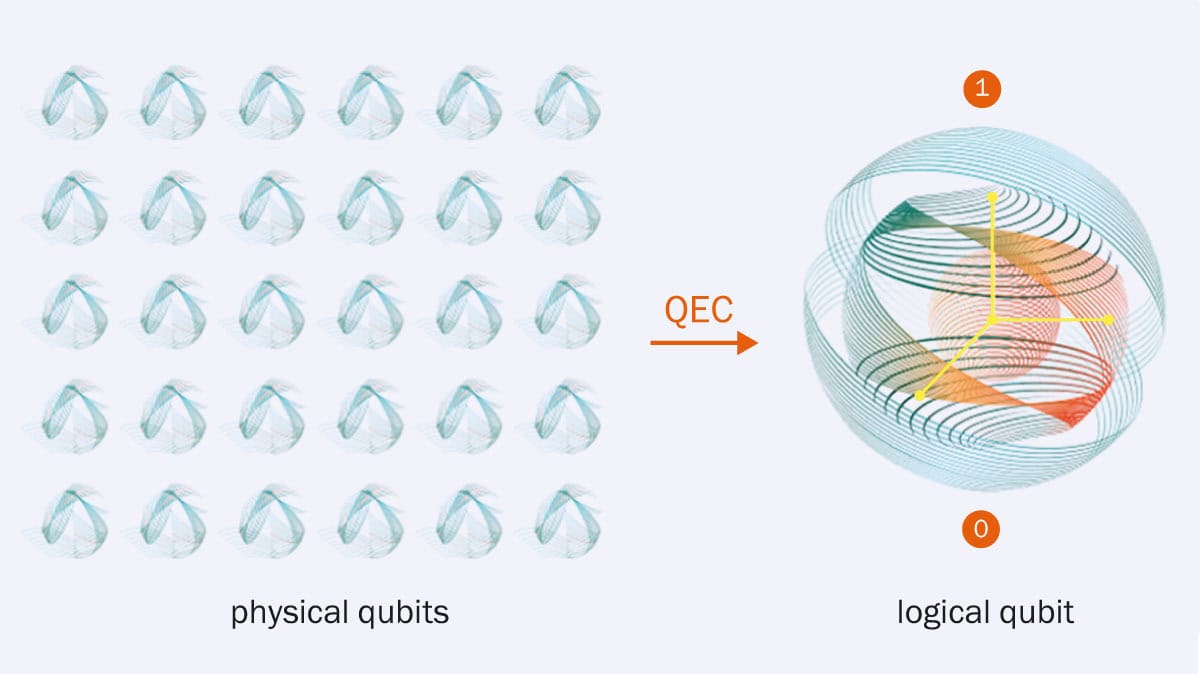
To protect the information stored in qubits, a multitude of unreliable physical qubits have to be combined in such a way that if one qubit fails and causes an error, the others can help protect the system. Essentially, by combining many physical qubits (shown above on the left), one can build a few “logical” qubits that are strongly resistant to noise.
According to Maria Maragkou, commercial vice-president of quantum error-correction company Riverlane, the goal of full QEC has ramifications for the design of the machines all the way from hardware to workflow planning. “The shift to support error correction has a profound effect on the way quantum processors themselves are built, the way we control and operate them, through a robust software stack on top of which the applications can be run,” she explains. The “stack” includes everything from programming languages to user interfaces and servers.
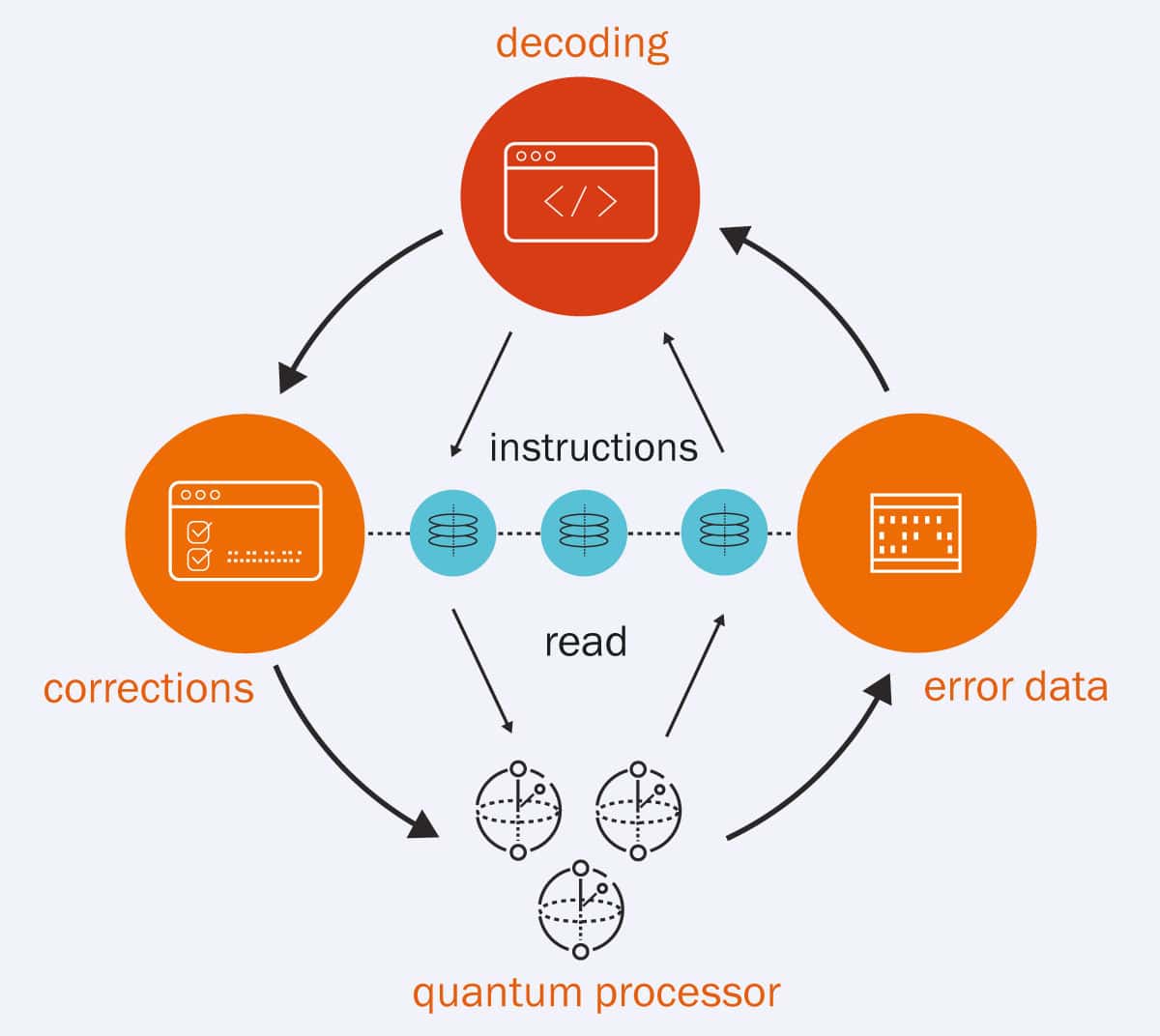
With genuinely fault-tolerant qubits, errors can be kept under control and prevented from proliferating during a computation. Such qubits might be made in principle by combining many physical qubits into a single “logical qubit” in which errors can be corrected (see figure 1). In practice, though, this creates a large overhead: huge numbers of physical qubits might be needed to make just a few fault-tolerant logical qubits. The question is then whether errors in all those physical qubits can be checked faster than they accumulate (see figure 2).
The illustration gives an overview of quantum error correction (QEC) in action within a quantum processing unit. UK-based company Riverlane is building its Deltaflow QEC stack that will correct millions of data errors in real time, allowing a quantum computer to go beyond the reach of any classical supercomputer.
Fault-tolerant quantum computing is the ultimate goal, says Jay Gambetta, director of IBM research at the company’s centre in Yorktown Heights, New York. He believes that to perform truly transformative quantum calculations, the system must go beyond demonstrating a few logical qubits – instead, you need arrays of at least a 100 of them, that can perform more than 100 million quantum operations (108 QuOps). “The number of operations is the most important thing,” he says.
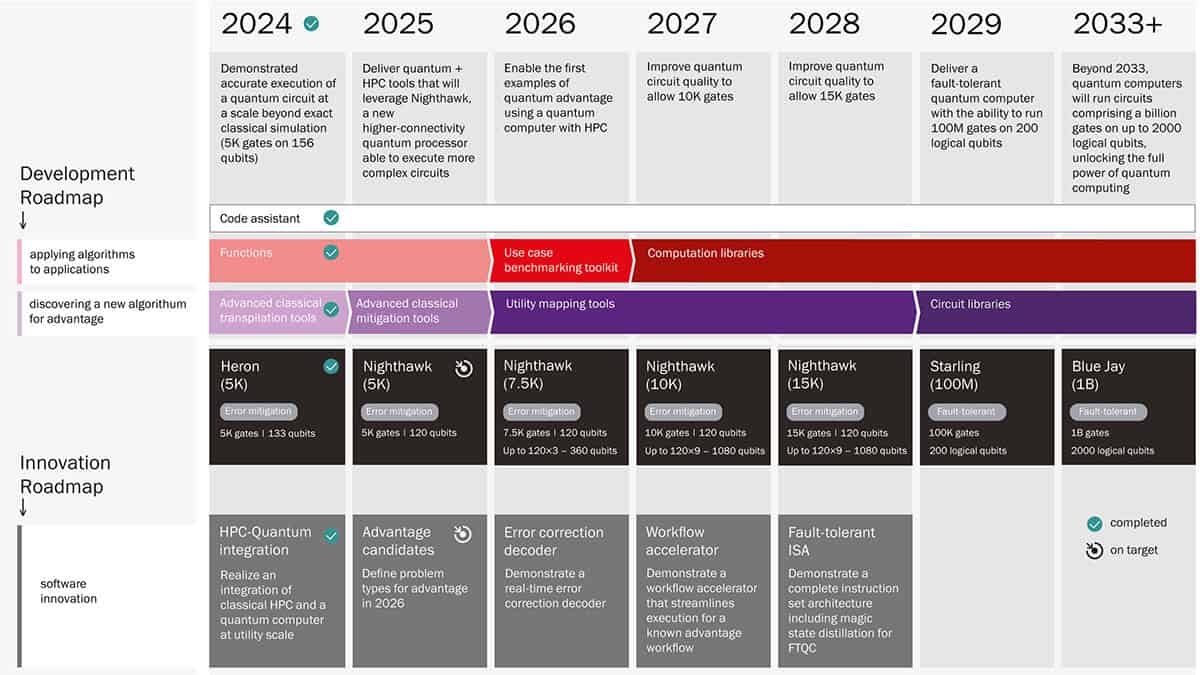
It sounds like a tall order, but Gambetta is confident that IBM will achieve these figures by 2029. By building on what has been achieved so far with error correction and mitigation, he feels “more confident than I ever did before that we can achieve a fault-tolerant computer.” Jerry Chow, previous manager of the Experimental Quantum Computing group at IBM, shares that optimism. “We have a real blueprint for how we can build [such a machine] by 2029,” he says (see figure 3).
Others suspect the breakthrough threshold may be a little lower: Steve Brierley, chief executive of Riverlane, believes that the first error-corrected quantum computer, with around 10 000 physical qubits supporting 100 logical qubits and capable of a million QuOps (a megaQuOp), could come as soon as 2027. Following on, gigaQuOp machines (109 QuOps) should be available by 2030–32, and teraQuOps (1012 QuOp) by 2035–37.
Platform independent
Error mitigation and error correction are just two of the challenges for developers of quantum software. Fundamentally, to develop a truly quantum algorithm involves taking full advantage of the key quantum-mechanical properties such as superposition and entanglement. Often, the best way to do that depends on the hardware used to run the algorithm. But ultimately the goal will be to make software that is not platform-dependent and so doesn’t require the user to think about the physics involved.
“At the moment, a lot of the platforms require you to come right down into the quantum physics, which is a necessity to maximize performance,” says Richard Murray of photonic quantum-computing company Orca. Try to generalize an algorithm by abstracting away from the physics and you’ll usually lower the efficiency with which it runs. “But no user wants to talk about quantum physics when they’re trying to do machine learning or something,” Murray adds. He believes that ultimately it will be possible for quantum software developers to hide those details from users – but Brierley thinks this will require fault-tolerant machines.
“In due time everything below the logical circuit will be a black box to the app developers”, adds Maragkou over at Riverlane. “They will not need to know what kind of error correction is used, what type of qubits are used, and so on.” She stresses that creating truly efficient and useful machines depends on developing the requisite skills. “We need to scale up the workforce to develop better qubits, better error-correction codes and decoders, write the software that can elevate those machines and solve meaningful problems in a way that they can be adopted.” Such skills won’t come only from quantum physicists, she adds: “I would dare say it’s mostly not!”
Yet even now, working on quantum software doesn’t demand a deep expertise in quantum theory. “You can be someone working in quantum computing and solving problems without having a traditional physics training and knowing about the energy levels of the hydrogen atom and so on,” says Ashley Montanaro, who co-founded the quantum software company Phasecraft.
On the other hand, insights can flow in the other direction too: working on quantum algorithms can lead to new physics. “Quantum computing and quantum information are really pushing the boundaries of what we think of as quantum mechanics today,” says Montanaro, adding that QEC “has produced amazing physics breakthroughs.”
Early adopters?
Once we have true error correction, Cuthbert at the UK’s NQCC expects to see “a flow of high-value commercial uses” for quantum computers. What might those be?
In this arena of quantum chemistry and materials science, genuine quantum advantage – calculating something that is impossible using classical methods alone – is more or less here already, says Chow. Crucially, however, quantum methods needn’t be used for the entire simulation but can be added to classical ones to give them a boost for particular parts of the problem.
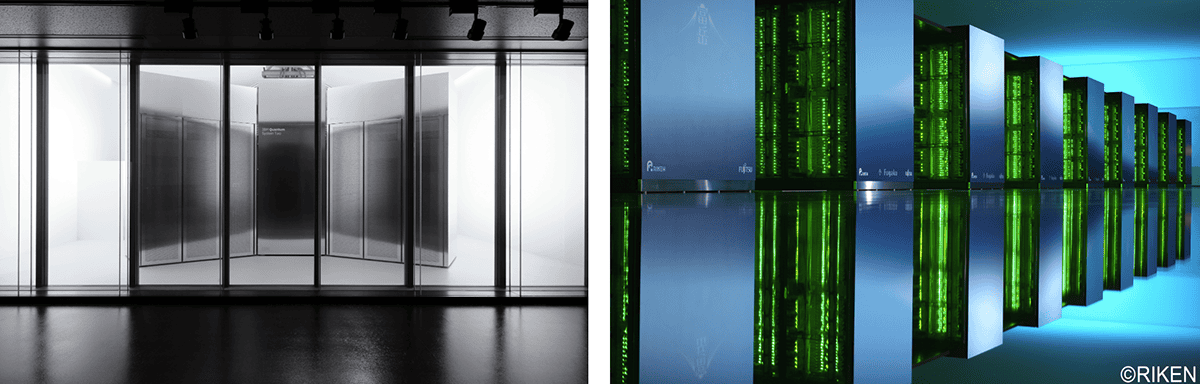
Joint effort In June 2025, IBM in the US and Japan’s national research laboratory RIKEN, unveiled the IBM Quantum System Two, the first to be used outside the US. It involved IBM’s 156-qubit IBM Heron quantum computing system (left) being paired with RIKEN’s supercomputer Fugaku (right) — one of the most powerful classical systems on Earth. The computers are linked through a high-speed network at the fundamental instruction level to form a proving ground for quantum-centric supercomputing. (Courtesy: IBM and RIKEN)
For example, last year researchers at IBM teamed up with scientists at several RIKEN institutes in Japan to calculate the minimum energy state for the iron sulphide cluster (4Fe-4S) at the heart of the bacterial nitrogenase enzyme that fixes nitrogen. This cluster is too big and complex to be accurately simulated using the classical approximations of quantum chemistry. The researchers used a combination of both quantum computing (with IBM’s 72-qubit Heron chip) and RIKEN’s Fugaku high performance computing (HPC). This idea of “improving classical methods by injecting quantum as a subroutine” is likely to be a more general strategy, says Gambetta. “The future of computing is going to be heterogeneous accelerators [of discovery] that include quantum.”
Likewise, Montanaro says that Phasecraft is developing “quantum-enhanced algorithms”, where a quantum computer is used, not to solve the whole problem, but just to help a classical computer in some way. “There are only certain problems where we know quantum computing is going to be useful,” he says. “I think we are going to see quantum computers working in tandem with classical computers in a hybrid approach. I don’t think we’ll ever see workloads that are entirely run using a quantum computer.” Among the first important problems that quantum machines will solve, according to Montanaro, are the simulation of new materials – to develop, for example, clean-energy technologies (see figure 4).
“For a physicist like me,” says Preskill, “what is really exciting about quantum computing is that we have good reason to believe that a quantum computer would be able to efficiently simulate any process that occurs in nature.”
3 Structural insights
(Courtesy: Phasecraft)
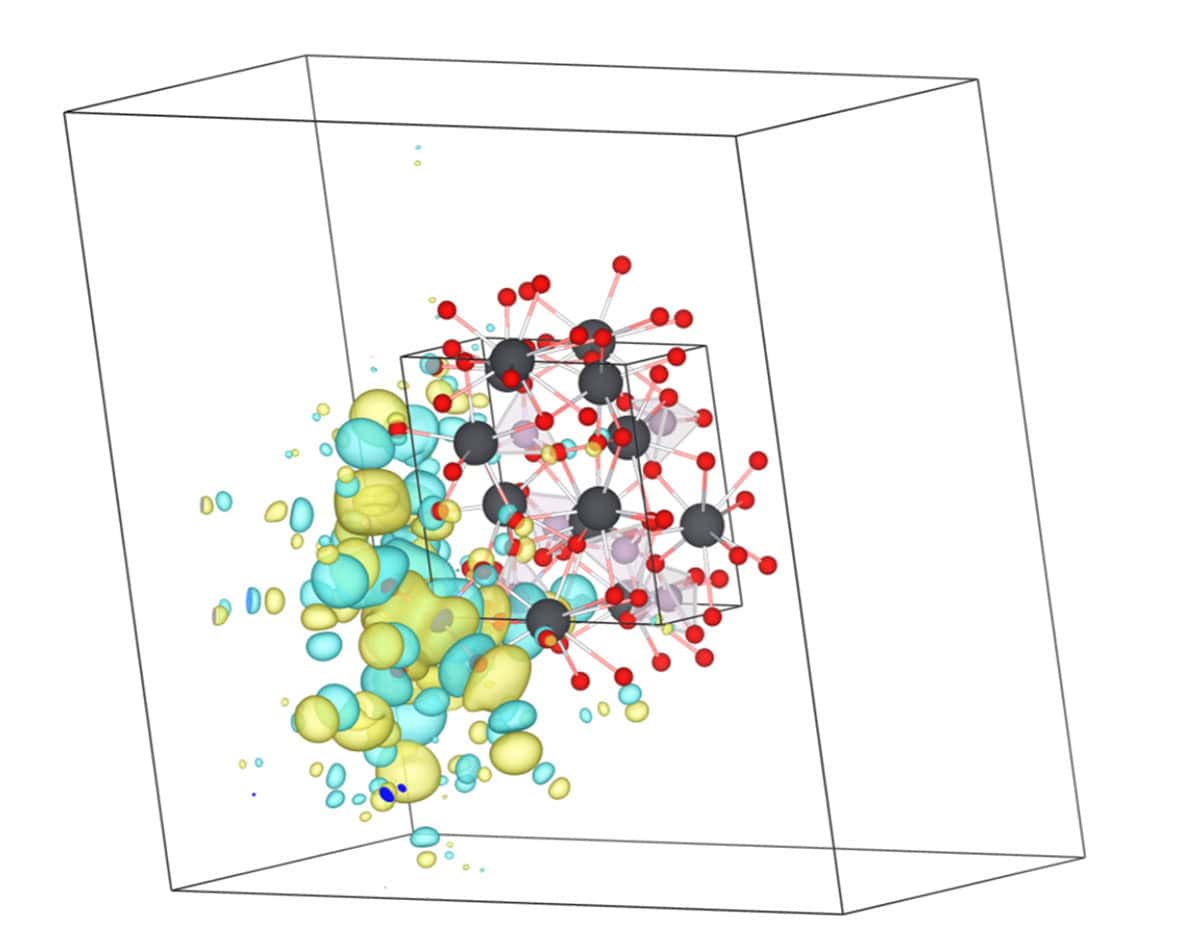
A promising application of quantum computers is simulating novel materials. Researchers from the quantum algorithms firm Phasecraft, for example, have already shown how a quantum computer could help simulate complex materials such as the polycrystalline compound LK-99, which was purported by some researchers in 2024 to be a room-temperature superconductor.
Using a classical/quantum hybrid workflow, together with the firm’s proprietary material simulation approach to encode and compile materials on quantum hardware, Phasecraft researchers were able to establish a classical model of the LK99 structure that allowed them to extract an approximate representation of the electrons within the material. The illustration above shows the green and blue electronic structure around red and grey atoms in LK-99.
Montanaro believes another likely near-term goal for useful quantum computing is solving optimization problems – both here and in quantum simulation, “we think genuine value can be delivered already in this NISQ era with hundreds of qubits.” (NISQ, a term coined by Preskill, refers to noisy intermediate-scale quantum computing, with relatively small numbers of rather noisy, error-prone qubits.)
One further potential benefit of quantum computing is that it tends to require less energy than classical high-performance computing, which is notoriously high. If the energy cost could be cut by even a few percent, it would be worth using quantum resources for that reason alone. “Quantum has real potential for an energy advantage,” says Chow. One study in 2020 showed that a particular quantum-mechanical calculation carried out on a HPC used many orders of magnitude more energy than when it was simulated on a quantum circuit. Such comparisons are not easy, however, in the absence of an agreed and well-defined metric for energy consumption.
Building the market
Right now, the quantum computing market is in a curious superposition of states itself – it has ample proof of principle, but today’s devices are still some way from being able to perform a computation relevant to a practical problem that could not be done with classical computers. Yet to get to that point, the field needs plenty of investment.
The fact that quantum computers, especially if used with HPC, are already unique scientific tools should establish their value in the immediate term, says Gambetta. “I think this is going to accelerate, and will keep the funding going.” It is why IBM is focusing on utility-scale systems of around 100 qubits or so and more than a thousand gate operations, he says, rather than simply trying to build ever bigger devices.
Montanaro sees a role for governments to boost the growth of the industry “where it’s not the right fit for the private sector”. One role of government is simply as a customer. For example, Phasecraft is working with the UK national grid to develop a quantum algorithm for optimizing the energy network. “Longer-term support for academic research is absolutely critical,” Montanaro adds. “It would be a mistake to think that everything is done in terms of the underpinning science, and governments should continue to support blue-skies research.”
The road ahead IBM’s current roadmap charts how the company plans on scaling up its devices to achieve a fault-tolerant device by 2029. Alongside hardware development, the firm will also focus on developing new algorithms and software for these devices. (Courtesy: IBM)
It’s not clear, though, whether there will be a big demand for quantum machines that every user will own and run. Before 2010, “there was an expectation that banks and government departments would all want their own machine – the market would look a bit like HPC,” Cuthbert says. But that demand depends in part on what commercial machines end up being like. “If it’s going to need a premises the size of a football field, with a power station next to it, that becomes the kind of infrastructure that you only want to build nationally.” Even for smaller machines, users are likely to try them first on the cloud before committing to installing one in-house.
According to Cuthbert , the real challenge in the supply-chain development is that many of today’s technologies were developed for the science community – where, say, achieving millikelvin cooling or using high-power lasers is routine. “How do you go from a specialist scientific clientele to something that starts to look like a washing machine factory, where you can make them to a certain level of performance,” while also being much cheaper, and easier to use?
But Cuthbert is optimistic about bridging this gap to get to commercially useful machines, encouraged in part by looking back at the classical computing industry of the 1970s. “The architects of those systems could not imagine what we would use our computation resources for today. So I don’t think we should be too discouraged that you can grow an industry when we don’t know what it’ll do in five years’ time.”
Montanaro too sees analogies with those early days of classical computing. “If you think what the computer industry looked like in the 1940s, it’s very different from even 20 years later. But there are some parallels. There are companies that are filling each of the different niches we saw previously, there are some that are specializing in quantum hardware development, there are some that are just doing software.” Cuthbert thinks that the quantum industry is likely to follow a similar pathway, “but more quickly and leading to greater market consolidation more rapidly.”
However, while the classical computing industry was revolutionized by the advent of personal computing in the 1970s and 80s, it seems very unlikely that we will have any need for quantum laptops. Rather, we might increasingly see apps and services appear that use cloud-based quantum resources for particular operations, merging so seamlessly with classical computing that we don’t even notice.
That, perhaps, would be the ultimate sign of success: that quantum computing becomes invisible, no big deal but just a part of how our answers are delivered.
In the first instalment of this two-part article, Philip Ball explores the latest developments in the quantum-computing industry
 Connexion