The Colla Indigenous people claim Rio Tinto’s plans to extract the key mineral will harm fragile ecosystems and livelihoods
Miriam Rivera Bordones tends her goats in a dusty paddock in the russet mountains of Chile’s Atacama desert. She also keeps chickens and has planted quince and peach trees and grapevines, which are watered by a stream winding down the hills towards the Indigenous community of Copiapó.
But now the huge British-Australian mining multinational Rio Tinto has signed a deal to extract lithium, the “white gold” of the energy transition, from a salt flat farther up the mountains, and she fears the project could affect the water sources of several communities in the area.
La ministre déléguée à l’Intérieur Marie-Pierre Vedrenne a critiqué, ce mercredi, la naturalisation de George Clooney et sa famille. Elle dit comprendre le sentiment de « deux poids deux mesures » chez certains Français.
La ministre déléguée à l’Intérieur Marie-Pierre Vedrenne a critiqué, ce mercredi, la naturalisation de George Clooney et sa famille. Elle dit comprendre le sentiment de « deux poids deux mesures » chez certains Français.
Exclusive: Met figures thought to reflect national picture with Covid, poverty and more people seeking help possible factors
The number of violent offences involving an adolescent attacking their parents or step-parents has increased by more than 60% in the past decade, according to figures recorded by the UK’s biggest police force.
Data released by Scotland Yard reveals that there were 1,886 such offences recorded in 2015 but this increased to 3,091 in the first 10 months of 2025 alone.
De Jean-Marie Le Pen à Claudia Cardinale en passant par Jean-Louis Debré, Thierry Ardisson, Bertrand Blier et Nicole Croisille, voici quelques-unes des personnalités disparues en France en 2025.
L’Élysée a proposé à la famille de Brigitte Bardot d’organiser un hommage pour l’icône du cinéma français, décédée dimanche. La famille n’a pas donné suite selon un proche du chef de l’État.
Popularity isn’t everything. But it is something, so for the second year running, we’re finishing our trip around the Sun by looking back at the physics stories that got the most attention over the past 12 months. Here, in ascending order of popularity, are the 10 most-read stories published on the Physics World website in 2025.
We’ve had quantum science on our minds all year long, courtesy of 2025 being UNESCO’s International Year of Quantum Science and Technology. But according to theoretical work by Partha Ghose and Dimitris Pinotsis, it’s possible that the internal workings of our brains could also literally be driven by quantum processes.
Though neurons are generally regarded as too big to display quantum effects, Ghose and Pinotsis established that the equations describing the classical physics of brain responses are mathematically equivalent to the equations describing quantum mechanics. They also derived a Schrödinger-like equation specifically for neurons. So if you’re struggling to wrap your head around complex quantum concepts, take heart: it’s possible that your brain is ahead of you.
Testing times A toy model from Marco Pettini seeks to reconcile quantum entanglement with Einstein’s theory of relativity. (Courtesy: Shutterstock/Eugene Ivanov)
Einstein famously disliked the idea of quantum entanglement, dismissing its effects as “spooky action at a distance”. But would he have liked the idea of an extra time dimension any better? We’re not sure he would, but that is the solution proposed by theoretical physicist Marco Pettini, who suggests that wavefunction collapse could propagate through a second time dimension. Pettini got the idea from discussions with the Nobel laureate Roger Penrose and from reading old papers by David Bohm, but not everyone is impressed by these distinguished intellectual antecedents. In this article, Bohm’s former student and frequent collaborator Jeffrey Bub went on the record to say he “wouldn’t put any money on” Pettini’s theory being correct. Ouch.
Continuing the theme of intriguing, blue-sky theoretical research, the eighth-most-read article of 2025 describes how two theoretical physicists, Kaden Hazzard and Zhiyuan Wang, proposed a new class of quasiparticles called paraparticles. Based on their calculations, these paraparticles exhibit quantum properties that are fundamentally different from those of bosons and fermions. Notably, paraparticles strikes a balance between the exclusivity of fermions and the clustering tendency of bosons, with up to two paraparticles allowed to occupy the same quantum state (rather than zero for fermions or infinitely many for bosons). But do they really exist? No-one knows yet, but Hazzard and Wang say that experimental studies of ultracold atoms could hold the answer.
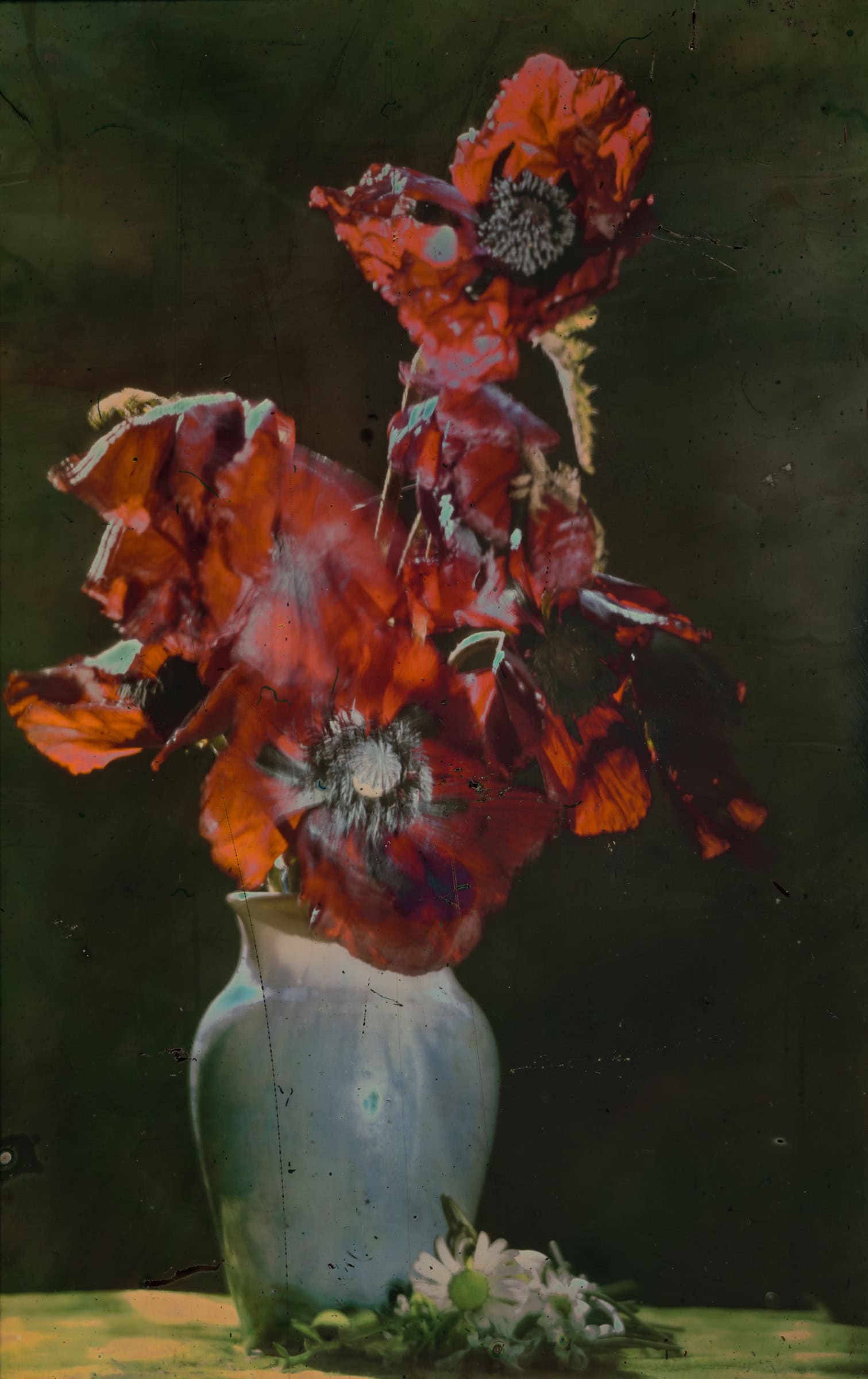
Capturing colour A still life taken by Lippmann using his method sometime between 1890 and 1910. By the latter part of this period, the method had fallen out of favour, superseded by the simpler Autochrome process. (Courtesy: Photo in public domain)
The list of early Nobel laureates in physics is full of famous names – Roentgen, Curie, Becquerel, Rayleigh and so on. But if you go down the list a little further, you’ll find that the 1908 prize went to a now mostly forgotten physicist by the name of Gabriel Lippmann, for a version of colour photography that almost nobody uses (though it’s rather beautiful, as the photo shows). This article tells the story of how and why this happened. A companion piece on the similarly obscure 1912 laureate, Gustaf Dalén, fell just outside this year’s top 10; if you’re a member of the Institute of Physics, you can read both of them together in the November issue of Physics World.
Why should physicists have all the fun of learning about the quantum world? This episode of the Physics World Weekly podcast focuses on the outreach work of Aleks Kissinger and Bob Coecke, who developed a picture-driven way of teaching quantum physics to a group of 15-17-year-old students. One of the students in the original pilot programme, Arjan Dhawan, is now studying mathematics at the University of Durham, and he joined his former mentors on the podcast to answer the crucial question: did it work?
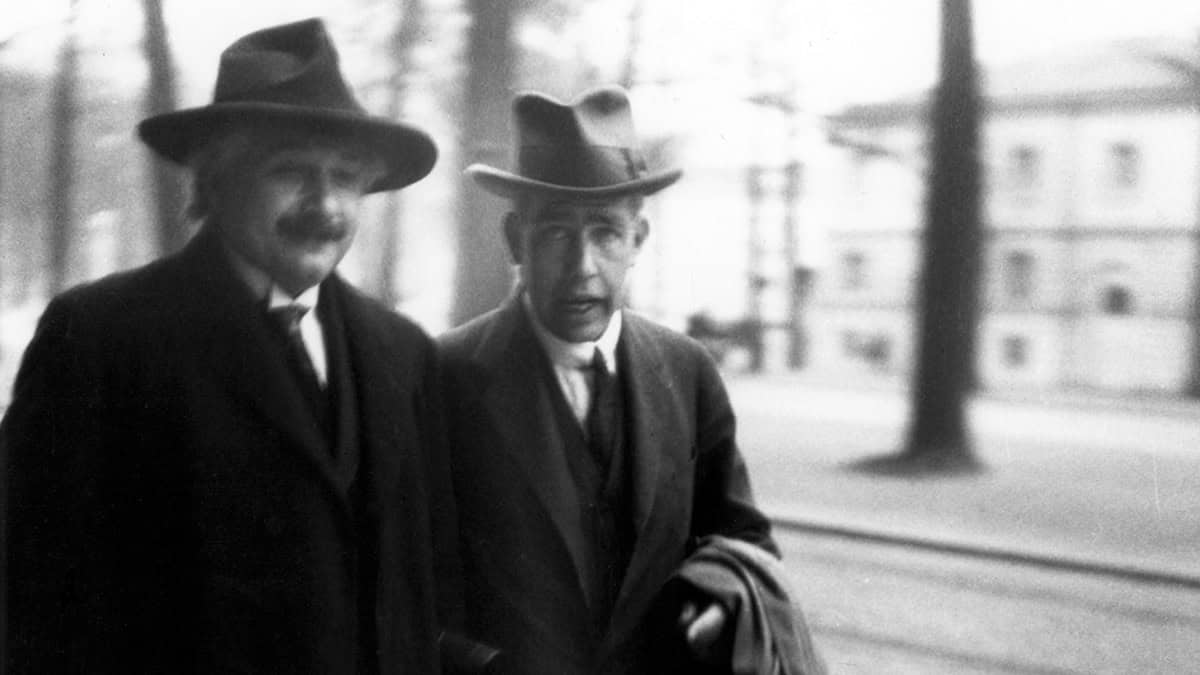
Conflicting views Stalwart physicists Albert Einstein and Niels Bohr had opposing views on quantum fundamentals from early on, which turned into a lifelong scientific argument between the two. (Paul Ehrenfest/Wikimedia Commons)
Niels Bohr had many good ideas in his long and distinguished career. But he also had a few that didn’t turn out so well, and this article by science writer Phil Ball focuses on one of them. Known as the Bohr-Kramers-Slater (BKS) theory, it was developed in 1923 with help from two of the assistants/students/acolytes who flocked to Bohr’s institute in Copenhagen. Several notable physicists hated it because it violated both causality and the conservation of energy, and within two years, experiments by Walther Boethe and Hans Geiger proved them right. The twist, though, is that Boethe went on to win a share of the 1954 Nobel Prize for Physics for this work – making Bohr surely one of the only scientists who won himself a Nobel Prize for his good ideas, and someone else a Nobel Prize for a bad one.
Black holes are fascinating objects in their own right. Who doesn’t love the idea of matter-swallowing cosmic maws floating through the universe? For some theoretical physicists, though, they’re also a way of exploring – and even extending – Einstein’s general theory of relativity. This article describes how thinking about black hole collisions inspired Jiaxi Wu, Siddharth Boyeneni and Elias Most to develop a new formulation of general relativity that mirrors the equations that describe electromagnetic interactions. According to this formulation, general relativity behaves the same way as the gravitational described by Isaac Newton more than 300 years ago, with the “gravito-electric” field fading with the inverse square of distance.
“Best of” lists are a real win-win. If you agree with the author’s selections, you go away feeling confirmed in your mutual wisdom. If you disagree, you get to have a good old moan about how foolish the author was for forgetting your favourites or including something you deem unworthy. Either way, it’s a success – as this very popular list of the top 5 Nobel Prizes for Physics awarded since the year 2000 (as chosen by Physics World editor-in-chief Matin Durrani) demonstrates.
We’re back to black holes again for the year’s second-most-read story, which focuses on a possible link between gravity and quantum information theory via the concept of entropy. Such a link could help explain the so-called black hole information paradox – the still-unresolved question of whether information that falls into a black hole is retained in some form or lost as the black hole evaporates via Hawking radiation. Fleshing out this connection could also shed light on quantum information theory itself, and the theorist who’s proposing it, Ginestra Bianconi, says that experimental measurements of the cosmological constant could one day verify or disprove it.
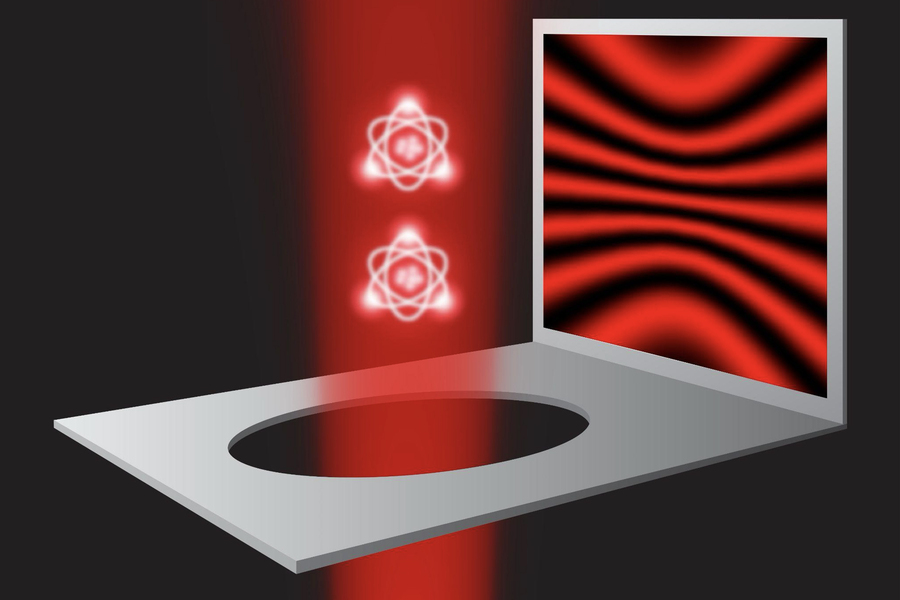
Experiment schematic Two single atoms floating in a vacuum chamber are illuminated by a laser beam and act as the two slits. The interference of the scattered light is recorded with a highly sensitive camera depicted as a screen. Incoherent light appears as background and implies that the photon has acted as a particle passing only through one slit. (Courtesy: Wolfgang Ketterle, Vitaly Fedoseev, Hanzhen Lin, Yu-Kun Lu, Yoo Kyung Lee and Jiahao Lyu)
Back in 2002, readers of Physics World voted Thomas Young’s electron double-slit experiment “the most beautiful experiment in physics”. More than 20 years later, it continues to fascinate the physics community, as this, the most widely read article of any that Physics World published in 2025, shows.
Young’s original experiment demonstrated the wave-like nature of electrons by sending them through a pair of slits and showing that they create an interference pattern on a screen even when they pass through the slits one-by-one. In this modern update, physicists at the Massachusetts Institute of Technology (MIT), US, stripped this back to the barest possible bones.
Using two single atoms as the slits, they inferred the path of photons by measuring subtle changes in the atoms’ properties after photon scattering. Their results matched the predictions of quantum theory: interference fringes when they didn’t observe the photons’ path, and two bright spots when they did.
It’s an elegant result, and the fact that the MIT team performed the experiment specifically to celebrate the International Year of Quantum Science and Technology 2025 makes its popularity with Physics World readers especially gratifying.
So here’s to another year full of elegant experiments and the theories that inspire them. Long may they both continue, and thank you, as always, for taking the time to read about them.
Javaid Perwaiz is serving a 59-year prison sentence after being convicted of health care fraud arising from medically unnecessary surgeries at Chesapeake Regional Medical Center in Chesapeake, Va.
George Clooney est français. Selon un décret de naturalisation publié samedi au Journal officiel, l’acteur américain, sa femme et leurs jumeaux de huit ans ont obtenu la nationalité française.
President Trump insists there are no more murders in Washington, D.C. “I wish that was true,” said Jamia Vaden, whose sister was gunned down in November.
Davian Morgan holding photos of Tristan Johnson, his godson, who was killed in Washington last month.
Susumu Noda of Kyoto University has won the 2026 Rank Prize for Optoelectronics for the development of the Photonic Crystal Surface Emitting Laser (PCSEL). For more than 25 years, Noda developed this new form of laser, which has potential applications in high-precision manufacturing as well as in LIDAR technologies.
Following the development of the laser in 1960, in more recent decades optical fibre lasers and semiconductor lasers have become competing technologies.
A semiconductor laser works by pumping an electrical current into a region where an n-doped (excess of electrons) and a p-doped (excess of “holes”) semiconductor material meet, causing electrons and holes to combine and release photons.
Semiconductors have several advantages in terms of their compactness, high “wallplug” efficiency, and ruggedness, but lack in other areas such as having a low brightness and functionality.
This means that conventional semiconductor lasers required external optical and mechanical elements to improve their performance, which results in large and impractical systems.
‘A great honour’
In the late 1990s, Noda began working on a new type of semiconductor laser that could challenge the performance of optical fibre lasers. These so-called PCSELs employ a photonic crystal layer in between the semiconductor layers. Photonic crystals are nanostructured materials in which a periodic variation of the dielectric constant — formed, for example, by a lattice of holes — creates a photonic band-gap.
Noda and his research made a series of breakthrough in the technology such as demonstrating control of polarization and beam shape by tailoring the phonic crystal structure and expansion into blue–violet wavelengths.
The resulting PCSELs emit a high-quality, symmetric beam with narrow divergence and boast high brightness and high functionality while maintaining the benefits of conventional semiconductor lasers. In 2013, 0.2 W PCSELs became available and a few years later Watt-class PCSEL lasers became operational.
Noda says that it is “a great honour and a surprise” to receive the prize. “I am extremely happy to know that more than 25 years of research on photonic-crystal surface-emitting lasers has been recognized in this way,” he adds. “I do hope to continue to further develop the research and its social implementation.”
Susumu Noda received his BSc and then PhD in electronics from Kyoto University in 1982 and 1991, respectively. From 1984 he also worked at Mitsubishi Electric Corporation, before joining Kyoto University in 1988 where he is currently based.
Founded in 1972 by the British industrialist and philanthropist Lord J Arthur Rank, the Rank Prize is awarded biennially in nutrition and optoelectronics. The 2026 Rank Prize for Optoelectronics, which has a cash award of £100 000, will be awarded formally at an event held in June.
It’s rare to come across someone who’s been responsible for enabling a seismic shift in society that has affected almost everyone and everything. Tim Berners-Lee, who invented the World Wide Web, is one such person. His new memoir This is for Everyone unfolds the history and development of the Web and, in places, of the man himself.
Berners-Lee was born in London in 1955 to parents, originally from Birmingham, who met while working on the Ferranti Mark 1 computer and knew Alan Turing. Theirs was a creative, intellectual and slightly chaotic household. His mother could maintain a motorbike with fence wire and pliers, and was a crusader for equal rights in the workplace. His father – brilliant and absent minded – taught Berners-Lee about computers and queuing theory. A childhood of camping and model trains, it was, in Berners-Lee’s view, idyllic.
Berners-Lee had the good fortune to be supported by a series of teachers and managers who recognized his potential and unique way of working. He studied physics at the University of Oxford (his tutor “going with the flow” of Berners-Lee’s unconventional notation and ability to approach problems from oblique angles) and built his own computer. After graduating, he married and, following a couple of jobs, took a six-month placement at the CERN particle-physics lab in Geneva in 1985.
This placement set “a seed that sprouted into a tool that shook up the world”. Berners-Lee saw how difficult it was to share information stored in different languages in incompatible computer systems and how, in contrast, information flowed easily when researchers met over coffee, connected semi-randomly and talked. While at CERN, he therefore wrote a rough prototype for a program to link information in a type of web rather than a structured hierarchy.
Back at CERN, Tim Berners-Lee developed his vision of a “universal portal” to information
The placement ended and the program was ignored, but four years later Berners-Lee was back at CERN. Now divorced and soon to remarry, he developed his vision of a “universal portal” to information. It proved to be the perfect time. All the tools necessary to achieve the Web – the Internet, address labelling of computers, network cables, data protocols, the hypertext language that allowed cross-referencing of text and links on the same computer – had already been developed by others.
Berners-Lee saw the need for a user-friendly interface, using hypertext that could link to information on other computers across the world. His excitement was “uncontainable”, and according to his line manager “few of us if any could understand what he was talking about”. But Berners-Lee’s managers supported him and freed his time away from his actual job to become the world’s first web developer.
Having a vision was one thing, but getting others to share it was another. People at CERN only really started to use the Web properly once the lab’s internal phone book was made available on it. As a student at the time, I can confirm that it was much, much easier to use the Web than log on to CERN’s clunky IBM mainframe, where phone numbers had previously been stored.
Wider adoption relied on a set of volunteer developers, working with open-source software, to make browsers and platforms that were attractive and easy to use. CERN agreed to donate the intellectual property for web software to the public domain, which helped. But the path to today’s Web was not smooth: standards risked diverging and companies wanted to build applications that hindered information sharing.
Feeling that “the Web was outgrowing my institution” and “would be a distraction” to a lab whose core mission was physics, Berners-Lee moved to the Massachusetts Institute of Technology in 1994. There he founded the World Wide Web Consortium (W3C) to ensure consistent, accessible standards were followed by everyone as the Web developed into a global enterprise. The progression sounds straightforward although earlier accounts, such as James Gillies and Robert Caillau’s 2000 book How the Web Was Born, imply some rivalry between institutions that is glossed over here.
Initially inclined to advise people to share good things and not search for bad things, Berners-Lee had reckoned without the insidious power of “manipulative and coercive” algorithms on social networks
The rest is history, but not quite the history that Berners-Lee had in mind. By 1995 big business had discovered the possibilities of the Web to maximize influence and profit. Initially inclined to advise people to share good things and not search for bad things, Berners-Lee had reckoned without the insidious power of “manipulative and coercive” algorithms on social networks. Collaborative sites like Wikipedia are closer to his vision of an ideal Web; an emergent good arising from individual empowerment. The flip side of human nature seems to come as a surprise.
The rest of the book brings us up to date with Berners-Lee’s concerns (data, privacy, misuse of AI, toxic online culture), his hopes (the good use of AI), a third marriage and his move into a data-handling business. There are some big awards and an impressive amount of name dropping; he is excited by Order of Merit lunches with the Queen and by sitting next to Paul McCartney’s family at the opening ceremony to the London Olympics in 2012. A flick through the index reveals names ranging from Al Gore and Bono to Lucien Freud. These are not your average computing technology circles.
There are brief character studies to illustrate some of the main players, but don’t expect much insight into their lives. This goes for Berners-Lee too, who doesn’t step back to particularly reflect on those around him, or indeed his own motives beyond that vision of a Web for all enabling the best of humankind. He is firmly future focused.
Still, there is no-one more qualified to describe what the Web was intended for, its core philosophy, and what caused it to develop to where it is today. You’ll enjoy the book whether you want an insight into the inner workings that make your web browsing possible, relive old and forgotten browser names, or see how big tech wants to monetize and monopolize your online time. It is an easy read from an important voice.
The book ends with a passionate statement for what the future could be, with businesses and individuals working together to switch the Web from “the attention economy to the intention economy”. It’s a future where users are no longer distracted by social media and manipulated by attention-grabbing algorithms; instead, computers and services do what users want them to do, with the information that users want them to have.
Berners-Lee is still optimistic, still an incurable idealist, still driven by vision. And perhaps still a little naïve too in believing that everyone’s values will align this time.
The Chinese particle physicist Chen-Ning Yang died on 18 October at the age of 103. Yang shared half of the 1957 Nobel Prize for Physics with Tsung-Dao Lee for their theoretical work that overturned the notion that parity is conserved in the weak force – one of the four fundamental forces of nature.
Born on 22 September 1922 in Hefei, China, Yang competed a BSc at the National Southwest Associated University in Kunming in 1942. After finishing an MSc in statistical physics at Tsinghua University two years later, in 1945 he moved to the University of Chicago in the US as part of a government-sponsored programme. He received his PhD in physics in 1948 working under the guidance of Edward Teller.
In 1949 Yang moved to the Institute for Advanced Study in Princeton, where he made pioneering contributions to quantum field theory, working together with Robert Mills. In 1953 they proposed the Yang-Mills theory, which became a cornerstone of the Standard Model of particle physics.
The ‘Wu experiment’
It was also at Princeton where Yang began a fruitful collaboration with Lee, who died last year aged 97. Their work on parity – a property of elementary particles that expresses their behaviour upon reflection in a mirror – led to the duo winning the Nobel prize.
In the early 1950s, physicists had been puzzled by the decays of two subatomic particles, known as tau and theta, which are identical except that the tau decays into three pions with a net parity of -1, while a theta particle decays into two pions with a net parity of +1.
There were two possible explanations: either the tau and theta are different particles or that parity in the weak interaction is not conserved with Yang and Lee proposing various ways to test their ideas (Phys. Rev.104 254).
This “parity violation” was later proved experimentally by, among others, Chien-Shiung Wu at Columbia University. She carried out an experiment based on the radioactive decay of unstable cobalt-60 nuclei into nickel-60 – what became known as the “Wu experiment”. For their work, Yang, who was 35 at the time, shared the 1957 Nobel Prize for Physics with Lee.
Influential physicist
In 1965 Yang moved to Stony Brook University, becoming the first director of the newly founded Institute for Theoretical Physics, which is now known as the C N Yang Institute for Theoretical Physics. During this time he also contributed to advancing science and education in China, setting up the Committee on Educational Exchange with China – a programme that has sponsored some 100 Chinese scholars to study in the US.
In 1997, Yang returned to Beijing where he became an honorary director of the Centre for Advanced Study at Tsinghua University. He then retired from Stony Brook in 1999, becoming a professor at Tsinghua University. During his time in the US, Yang obtained US citizenship, but renounced it in 2015.
More recently, Yang was involved in debates over whether China should build the Circular Electron Positron Collider (CEPC) – a huge 100 km circumference underground collider that would study the Higgs boson in unprecedented detail and be a successor to CERN’s Large Hadron Collider. Yang took a sceptical view calling it “inappropriate” for a developing country that is still struggling with “more acute issues like economic development and environment protection”.
Yang also expressed concern that the science performed on the CEPC is just “guess” work and without guaranteed results. “I am not against the future of high-energy physics, but the timing is really bad for China to build such a super collider,” he noted in 2016. “Even if they see something with the machine, it’s not going to benefit the life of Chinese people any sooner.”
Lasting legacy
As well as the Nobel prize, Yang won many other awards such as the US National Medal of Science in 1986, the Einstein Medal in 1995, which is presented by the Albert Einstein Society in Bern, and the American Physical Society’s Lars Onsager Prize in 1990.
“The world has lost one of the most influential physicists of the modern era,” noted Stony Brook president Andrea Goldsmith in a statement. “His legacy will continue through his transformational impact on the field of physics and through the many colleagues and students influenced by his teaching, scholarship and mentorship.”
 Connexion