Cet organisme mutant encaisse les radiations comme vous avalez vos tartines au petit-déj'. Il n'en fallait pas plus pour que la NASA s'y intéresse de près, avec l'espoir de nous voir un jour fouler le sol de la planète rouge
Cet organisme mutant encaisse les radiations comme vous avalez vos tartines au petit-déj'. Il n'en fallait pas plus pour que la NASA s'y intéresse de près, avec l'espoir de nous voir un jour fouler le sol de la planète rouge
Longtemps considérées comme des viviers de recherche fondamentale, les universités européennes s’imposent désormais comme de véritables moteurs de création de valeur dans la « deep tech » (issue de la recherche fondamentale). En 2025, près de 80 jeunes entreprises issues de laboratoires académiques ont franchi un cap symbolique, atteignant soit …
Longtemps considérées comme des viviers de recherche fondamentale, les universités européennes s’imposent désormais comme de véritables moteurs de création de valeur dans la « deep tech » (issue de la recherche fondamentale). En 2025, près de 80 jeunes entreprises issues de laboratoires académiques ont franchi un cap symbolique, atteignant soit …
While GLP-1 drugs promise an easy fix, our bodies still need what they have always needed: healthy food and regular exercise
Prof Devi Sridhar is chair of global public health at the University of Edinburgh
If there has been a hot topic in health in 2025, it’s definitely been GLP-1s, colloquially referred to as “anti-obesity” jabs. These medications, taken weekly as an injection into the abdomen, result in significant weight loss and, despite being developed to manage type 2 diabetes in those with metabolic disorders, have become mainstream in many countries as a treatment for obesity. Clinicians rave about the health outcomes in patients taking the medication, with study after study emerging on the health benefits of the associated weight loss in those who are obese. Celebrity endorsements, online sales and off-label use have seen them widely used by people of all ages and sizes who want to drop weight.
For the public health community, it’s an odd moment. For years, we’ve advocated for government action on obesity – not through new drugs, but by taking nutrition and food systems seriously. We’ve highlighted the need for government action on making nutritious food affordable, regulating ultra-processed foods, bringing in sugar taxes and banning advertising of unhealthy products to young people, alongside encouraging an increase in physical activity. The solutions are simple: get people to eat more nutritious food and move. The challenge has been implementation, especially in deprived areas.
Prof Devi Sridhar is chair of global public health at the University of Edinburgh
Fit Forever: Wellness for midlife and beyond
On Wednesday 28 January 2026, join Annie Kelly, Devi Sridhar, Joel Snape and Mariella Frostrup, as they discuss how to enjoy longer and healthier lives, with expert advice and practical tips. Book tickets here or at guardian.live
Un désastre écologique normalisé, pour lequel la planète paie un très lourd tribut. Avons-nous été déjà aussi indulgents envers une technologie, sous prétexte qu'elle accompagnerait le progrès du secteur numérique ?
From cutting onions to a LEGO Jodrell Bank, physics has had its fair share of quirky stories this year. Here is our pick of the best, not in any particular order.
Flight of the nematode
Researchers in the US this year discovered that a tiny jumping worm uses static electricity to increase its chances of attaching to unsuspecting prey. The parasitic roundworm Steinernema carpocapsae can leap some 25 times its body length by curling into a loop and springing in the air. If the nematode lands successfully on a victim, it releases bacteria that kills the insect within a couple of days upon which the worm feasts and lays its eggs. To investigate whether static electricity aids their flight, a team at Emory University and the University of California, Berkeley, used high-speed microscopy to film the worms as they leapt onto a fruit fly that was tethered with a copper wire connected to a high-voltage power supply. The researchers found that a charge of a few hundred volts – similar to that generated in the wild by an insect’s wings rubbing against ions in the air – fosters a negative charge on the worm, creating an attractive force with the positively charged fly. They discovered that without any electrostatics, only 1 in 19 worm trajectories successfully reached their target. The greater the voltage, however, the greater the chance of landing with 880 V resulting in an 80% probability of success. “We’re helping to pioneer the emerging field of electrostatic ecology,” notes Emory physicist Ranjiangshang Ran.
Tear-jerking result
While it is known that volatile chemicals released from onions irritate the nerves in the cornea to produce tears, how such chemical-laden droplets reach the eyes and whether they are influenced by the knife or cutting technique remain less clear. To investigate, Sunghwan Jung from Cornell University and colleagues built a guillotine-like apparatus and used high-speed video to observe the droplets released from onions as they were cut by steel blades. They found that droplets, which can reach up to 60 cm high, were released in two stages – the first being a fast mist-like outburst that was followed by threads of liquid fragmenting into many droplets. The most energetic droplets were released during the initial contact between the blade and the onion’s skin. When they began varying the sharpness of the blade and the cutting speed, they discovered that a greater number of droplets were released by blunter blades and faster cutting speeds. “That was even more surprising,” notes Jung. “Blunter blades and faster cuts – up to 40 m/s – produced significantly more droplets with higher kinetic energy.” Another surprise was that refrigerating the onions prior to cutting also produced an increased number of droplets of similar velocity, compared to room-temperature vegetables.
LEGO telescope
Students at the University of Manchester in the UK created a 30 500-piece LEGO model of the iconic Lovell Telescope to mark the 80th anniversary of the Jodrell Bank Observatory, which was founded in December 1945. Built in 1957, the 76.2 m diameter telescope was the largest steerable dish radio telescope in the world at the time. The LEGO model has been designed by Manchester’s undergraduate physics society and is based on the telescope’s original engineering blueprints. Student James Ruxton spent six months perfecting the design, which even involved producing custom-designed LEGO bricks with a 3D printer. Ruxton and fellow students began construction in April and the end result is a model weighing 30 kg with 30500 pieces and a whopping 4000-page instruction manual. “It’s definitely the biggest and most challenging build I’ve ever done, but also the most fun,” says Ruxton. “I’ve been a big fan of LEGO since I was younger, and I’ve always loved creating my own models, so recreating something as iconic as the Lovell is like taking that to the next level!” The model has gone on display in a “specially modified cabinet” at the university’s Schuster building, taking pride of place alongside a decade-old LEGO model of CERN’s ATLAS detector.
Petal physics
The curves and curls of leaves and flower petals arise due to the interplay between their natural growth and geometry. Uneven growth in a flat sheet, in which the edges grow quicker than the interior, gives rise to strain and in plant leaves and petals, for example, this can result in a variety of shapes such as saddle and ripple shapes. Yet when it comes to rose petals, the sharply pointed cusps – a point where two curves meet – that form at the edge of the petals set it apart from soft, wavy patterns seen in many other plants.
To investigate this intriguing difference, researchers from the Hebrew University of Jerusalem carried out theoretical modelling and conducted a series of experiments with synthetic disc “petals”. They found that the pointed cusps that form at the edge of rose petals are due to a type of geometric frustration called a Mainardi–Codazzi–Peterson (MCP) incompatibility. This type of mechanism results in stress concentrating in a specific area, which goes on to form cusps to avoid tearing or forming unnatural folding. When the researchers suppressed the formation of cusps, they found that the discs revert to being smooth and concave. The researchers say that the findings could be used for applications in soft robotics and even in the deployment of spacecraft components.
Wild Card physics
The Wild Cards universe is a series of novels set largely during an alternate history of the US following the Second World War. The series follows events after an extraterrestrial virus, known as the Wild Card virus, has spread worldwide. It mutates human DNA causing profound changes in human physiology. The virus follows a fixed statistical distribution in that 90% of those infected die, 9% become physically mutated (referred to as “jokers”) and 1% gain superhuman abilities (known as “aces”). Such capabilities include the ability to fly as well as being able to move between dimensions. George R R Martin, the author who co-edits the Wild Cards series, co-authored a paper examining the complex dynamics of the Wild Card virus together with Los Alamos National Laboratory theoretical physicist Ian Tregillis, who is also a science-fiction author. The model takes into consideration the severity of the changes (for the 10% that don’t instantly die) and the mix of joker/ace traits. The result is a dynamical system in which a carrier’s state vector constantly evolves through the model space – until their “card” turns. At that point the state vector becomes fixed and its permanent location determines the fate of the carrier. “The fictional virus is really just an excuse to justify the world of Wild Cards, the characters who inhabit it, and the plot lines that spin out from their actions,” says Tregillis.
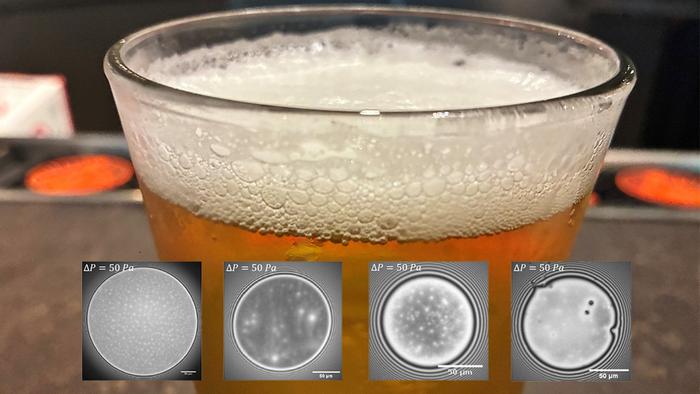
Bubble vision: researchers have discovered that triple-fermented beer feature the most stable beer foam heads (courtesy: AIP/Chatzigiannakis et al.)
Foamy top
And finally, a clear sign of a good brew is a big head of foam at the top of a poured glass. Beer foam is made of many small bubbles of air, separated from each other by thin films of liquid. These thin films must remain stable, or the bubbles will pop, and the foam will collapse. What holds these thin films together is not completely understood and is likely conglomerates of proteins, surface viscosity or the presence of surfactants – molecules that can reduce surface tension and are found in soaps and detergents. To find out more, researchers from ETH Zurich and Eindhoven University of Technology investigated beer-foam stability for different types of beers at varying stages of the fermentation process. They found that for single-fermentation beers, the foams are mostly held together with the surface viscosity of the beer. This is mostly influenced by the proteins in the beer – the more they contain, the more viscous the film and more stable the foam will be. However, for double-fermented beers, the proteins in the beer are slightly denatured by the yeast cells and come together to form a two-dimensional membrane that keeps the foam intact longer. The head was found to be even more stable for triple-fermented beers, which include Trappist beers. The team says that the work could be used to identify ways to increase or decrease the amount of foam so that everyone can pour a perfect glass of beer every time. Cheers!
You can be sure that 2026 will throw up its fair share of quirky stories from the world of physics. See you next year!
Un désastre écologique normalisé, pour lequel la planète paie un très lourd tribut. Avons-nous été déjà aussi indulgents envers une technologie, sous prétexte qu'elle accompagnerait le progrès du secteur numérique ?
Next head of Cern backs massive replacement for world’s largest machine to investigate mysteries of the universe
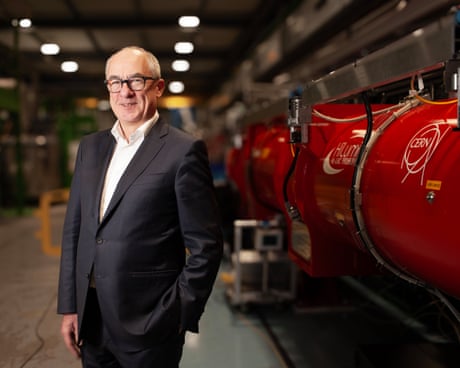
Mark Thomson, a professor of experimental particle physics at the University of Cambridge, has landed one of the most coveted jobs in global science. But it is hard not to wonder, when looked at from a certain angle, whether he has taken one for the team.
On 1 January, Thomson takes over as the director general of Cern, the multi-Nobel prizewinning nuclear physics laboratory on the outskirts of Geneva. It is here, deep beneath the ground, that the Large Hadron Collider (LHC), the largest scientific instrument ever built, recreates conditions that existed microseconds after the big bang.
Research shows that people who sleep poorly tend to have brain age that is older than their actual age. Chronic inflammation in the body caused by poor sleep likely plays a part.
The bioscience startup has attracted billions in investment – and a flurry of criticism, but founder tells the Guardian plans to bring back the woolly mammoth will not be derailed
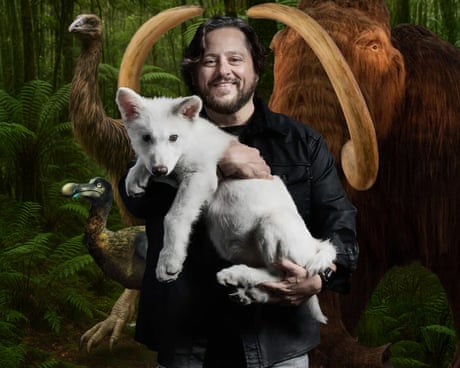
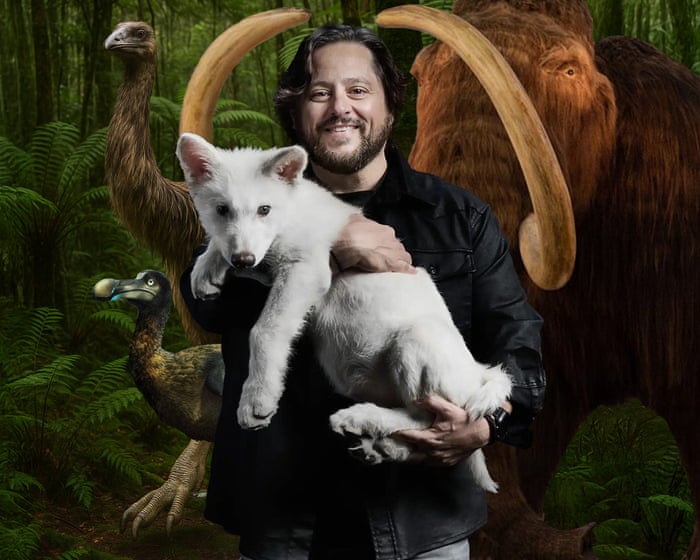
Death and taxes are supposed to be the things we can depend on in this life. But in 2025, the American entrepreneur Ben Lamm sold much of the world on the idea that death did not, after all, need to be for ever.
This was the year the billionaire’s genetics startup, Colossal Biosciences, claimed it had resurrected the dire wolf, an animal that disappeared at the end of the last ice age, by tweaking the DNA of grey wolves. According to the company, it had also edged closer to bringing the woolly mammoth back from the dead, with the creation of genetically engineered “woolly mice”.
C’est une première historique : grâce aux capacités spectroscopiques du télescope spatial James Webb, des astronomes estiment avoir identifié l’atmosphère la plus convaincante jamais observée autour d’un monde solide situé hors de notre Système solaire. TOI-561 b, un monde de lave sous haute surveillance Au centre de cette …
Des souris génétiquement programmées pour développer Alzheimer ont vu leurs symptômes disparaître après un traitement expérimental. Tenons-nous là un début d'espoir pour les millions de patients atteints de cette grave pathologie ?
Des souris génétiquement programmées pour développer Alzheimer ont vu leurs symptômes disparaître après un traitement expérimental. Tenons-nous là un début d'espoir pour les millions de patients atteints de cette grave pathologie ?
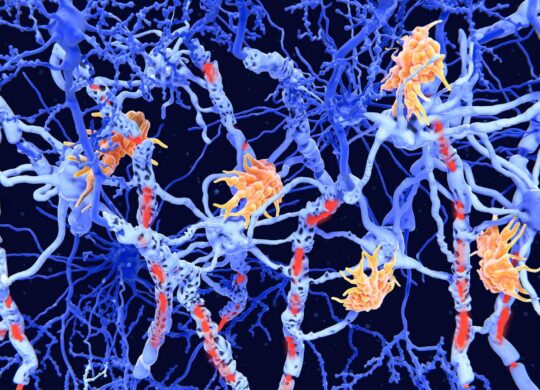
La sclérose en plaques (SEP) est souvent décrite comme une maladie unique aux trajectoires multiples. En réalité, deux patients présentant un diagnostic similaire peuvent évoluer de manière très différente, avec des réponses contrastées aux traitements. Une équipe de chercheurs associant l’University College London (UCL) et Queen Square Analytics …
L'orbite basse est saturée, et sans gouvernance mondiale pour remédier à ce problème, la conquête spatiale pourrait se transformer en véritable cauchemar.
 Connexion