↩ Accueil

Vue lecture

Google Gemini AI Now Built Into Opera One and Opera GX Browsers

Opera has announced an expansion of its partnership with Google to integrate the latest Gemini AI models across much of its browser lineup.
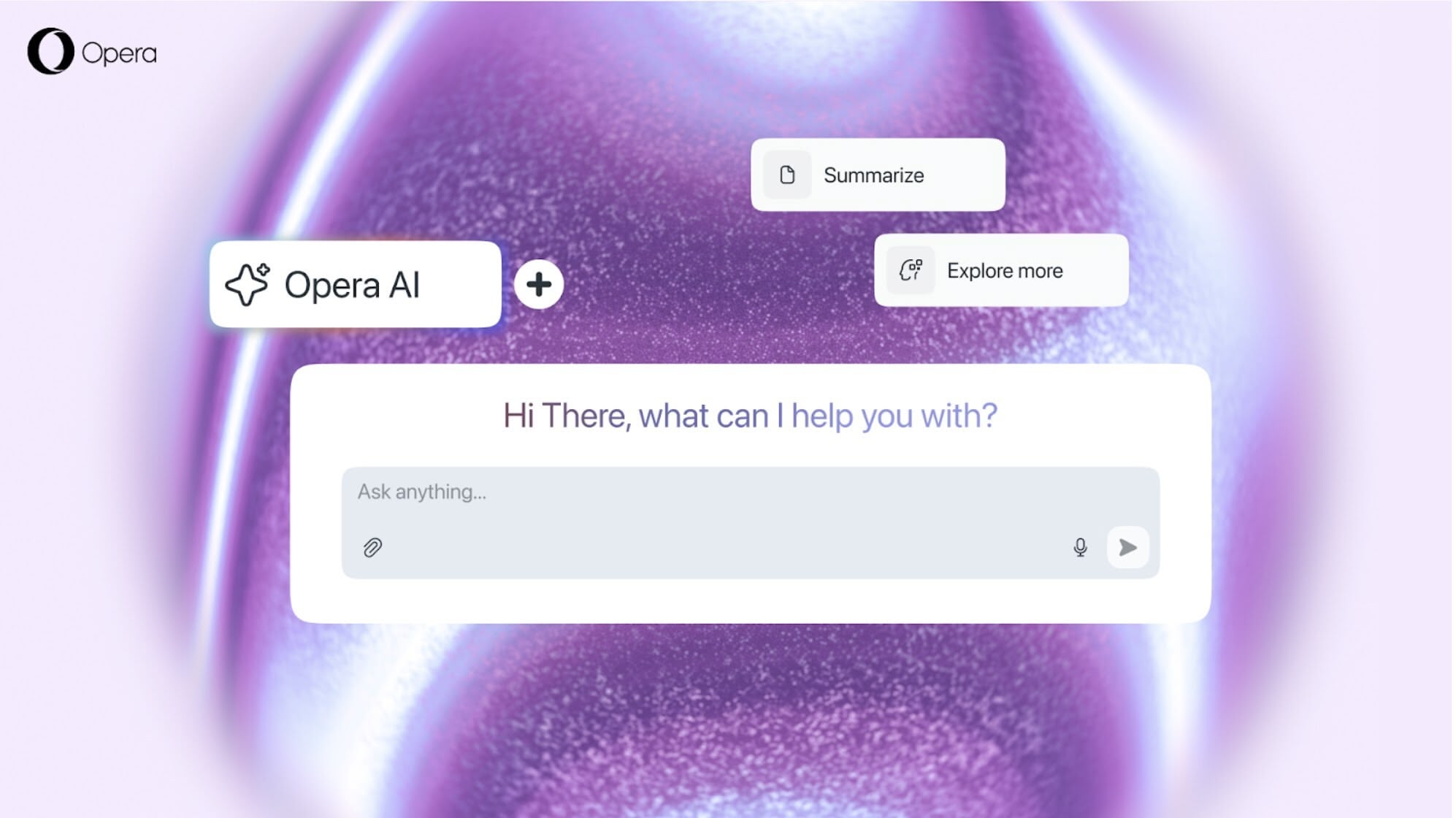

The expansion means the Gemini-powered side panel previously exclusive to Opera Neon is now freely available in the company's free-to-download Opera One and Opera GX browsers.

By interacting with the side panel's AI chatbot, users can get contextually relevant answers based on the current webpage and group of webpages, as well as videos. Opera says responses can include easy research, content summaries, and comparisons between different tabs.

In addition, Opera AI supports voice input and output, along with file analysis for multiple file types, including images and video.

The company says the engine has been rebuilt for speed, with 20% faster responses thanks to the use of a new architecture that adopts an agentic-approach from Opera Neon.

Opera also emphasizes that its privacy features ensure the user has full control over what context is shared with Opera AI and what is kept outside its awareness.
"AI is reshaping how people interact with the web, and the browser is the natural entry point for those experiences,” said Opera's EVP Commercial, Per Wetterdal. "Through our partnership with Google, we are able to offer users the experiences they really want through native search and AI features, for free, directly in their Opera One and Opera GX browsers while our most advanced users of the agentic Opera Neon browser are already getting access to Gemini 3 Pro."
Many users have been critical of AI's creep into browsers, but Opera argues that browsing is the next AI frontier. "Unlike a standalone chat interface, the browser has access to real-time context such as a user's open tabs, page content, and browsing flows," says the company's press release. "This enables more relevant and efficient assistance, supporting task completion directly within the browsing experience."

You can decide for yourself by visiting Opera's website, which includes download links for Opera Browser, Opera Air, Opera GX, and Opera Mini.
This article, "Google Gemini AI Now Built Into Opera One and Opera GX Browsers" first appeared on MacRumors.com

Discuss this article in our forums
  •  

Apple Launches Tap to Pay on iPhone in Singapore

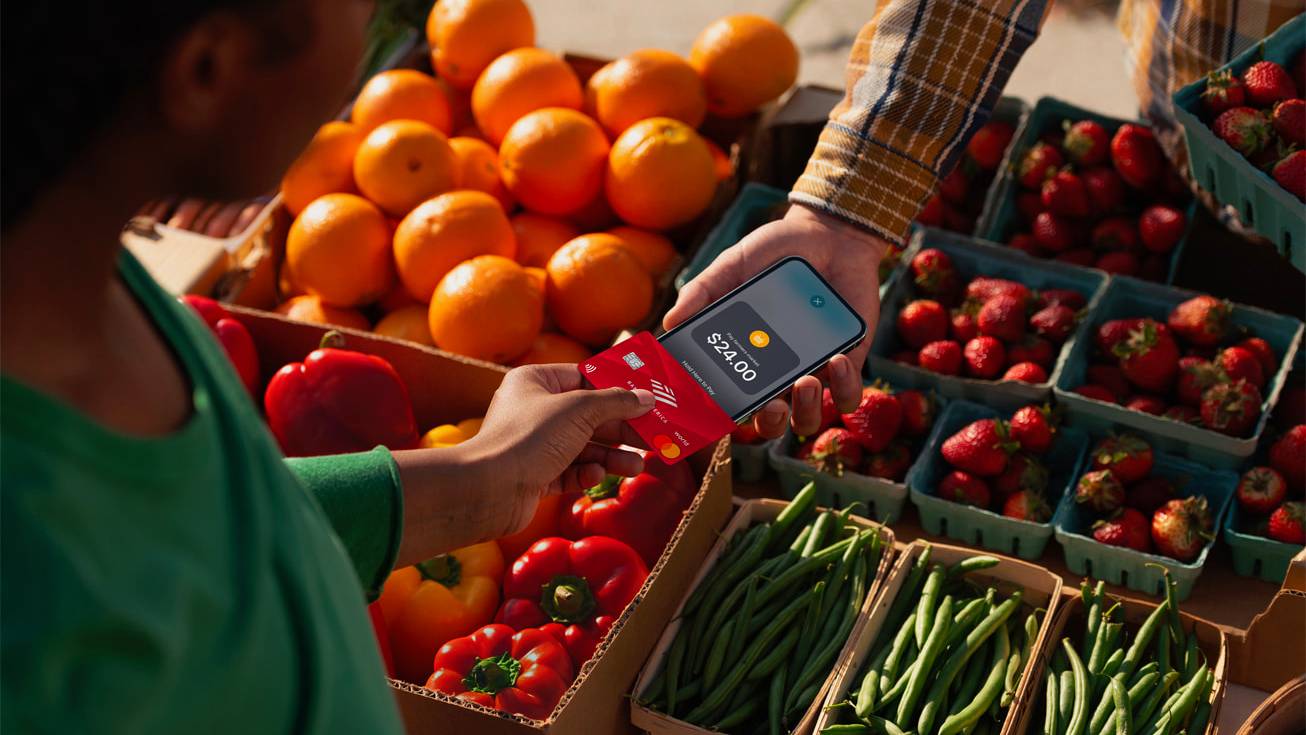
Apple has announced that Tap to Pay on iPhone is now available in Singapore, providing a way for independent sellers, small businesses, and larger merchants in the country to use an ‌iPhone‌ as a contactless payment terminal.


Tap to Pay first arrived in February 2022 in the US, and allows iPhones to accept payments via Apple Pay, contactless credit and debit cards, and other digital wallets‌‌‌. All transactions are encrypted, and Apple has no information about what is purchased or the person who made the purchase.

No additional hardware or credit card machine is required‌ to use Tap to Pay on ‌iPhone. The feature uses NFC technology to securely authenticate the contactless payments, plus the feature also supports PIN entry, which includes accessibility options.

Tap to Pay will initially support Adyen, Fiuu, HitPay, Revolut, Stripe, and Zoho in Singapore. Apple says Grab will offer Tap to Pay on iPhone beginning early next year.

Tap to Pay on ‌‌‌‌‌iPhone‌‌‌‌‌ requires ‌‌‌‌‌iPhone‌‌‌‌‌ XS or newer models, and works for customers as any normal ‌‌‌‌‌Apple Pay‌‌‌‌‌ transaction would. Sellers just need to open up the app, register the sale, and present their ‌‌‌‌‌iPhone‌‌‌‌‌ to the buyer, who can then use an appropriate contactless payment method.

Tap to Pay on iPhone is now available in 50 countries and regions around the world. Apple's website maintains a list of countries where it is available.
This article, "Apple Launches Tap to Pay on iPhone in Singapore" first appeared on MacRumors.com

Discuss this article in our forums
  •  

Apple to Resist India's Order to Preload Government App on iPhones

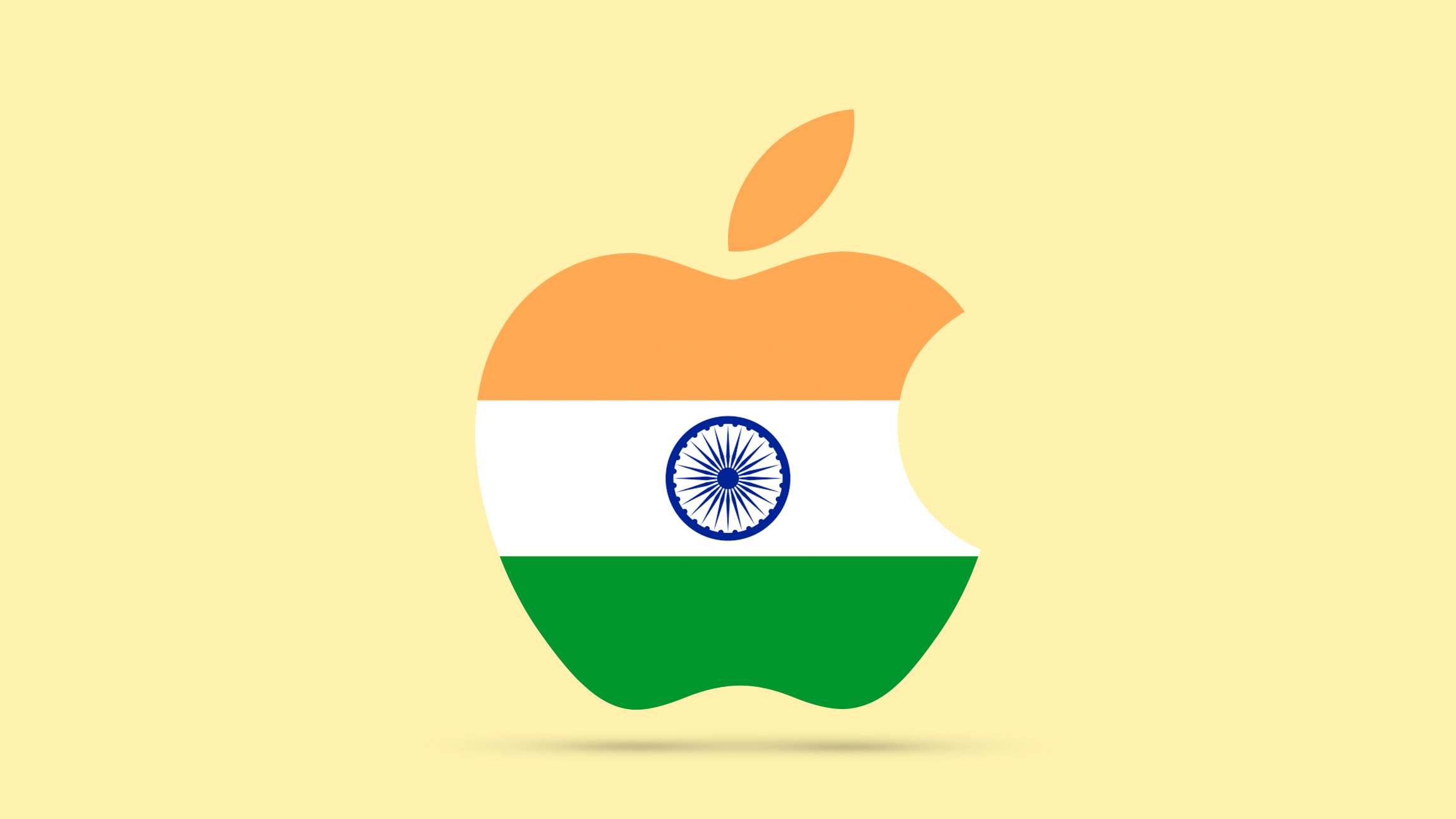
Apple will resist a new Indian government directive that would require all iPhones sold in the country to ship with a preinstalled state-run security app, reports Reuters.


This week, India's Department of Telecommunications ordered all smartphone makers to preload Sanchar Saathi, a non-removable government app designed to help users block stolen devices, report fraudulent calls, and verify second-hand phones.

The app includes detailed tracking functionality controlled by the government, potentially opening a pathway for broad data access and potential surveillance, so there are privacy and security implications for iPhone users.

According to The Business Standard, citing industry sources familiar with the matter, Apple has informed officials it does not plan to comply with the requirement. The company will reportedly tell the government it does not follow such mandates anywhere in the world as they raise a host of privacy and security issues for the company's iOS ecosystem.

Apple's resistance to the directive will put added pressure on New Delhi, with political opposition parties already accusing the government of overreach.

In response to the criticism, India's telecom minister Jyotiraditya M. Scindia on Tuesday said the app was "completely optional," adding that users can choose to activate it and can "easily delete it from their phone at any time." Scindia rejected allegations of surveillance, stating the app contains no provisions for snooping or call monitoring.

There are more than 700 million smartphone users in India, so any final decision will have major implications for how much control the government can exert over device software and how far tech companies like Apple can go in enforcing their own privacy standards.
Tag: India

This article, "Apple to Resist India's Order to Preload Government App on iPhones" first appeared on MacRumors.com

Discuss this article in our forums
  •  

Here Are the Four MacBooks Apple Is Expected to Launch Next Year

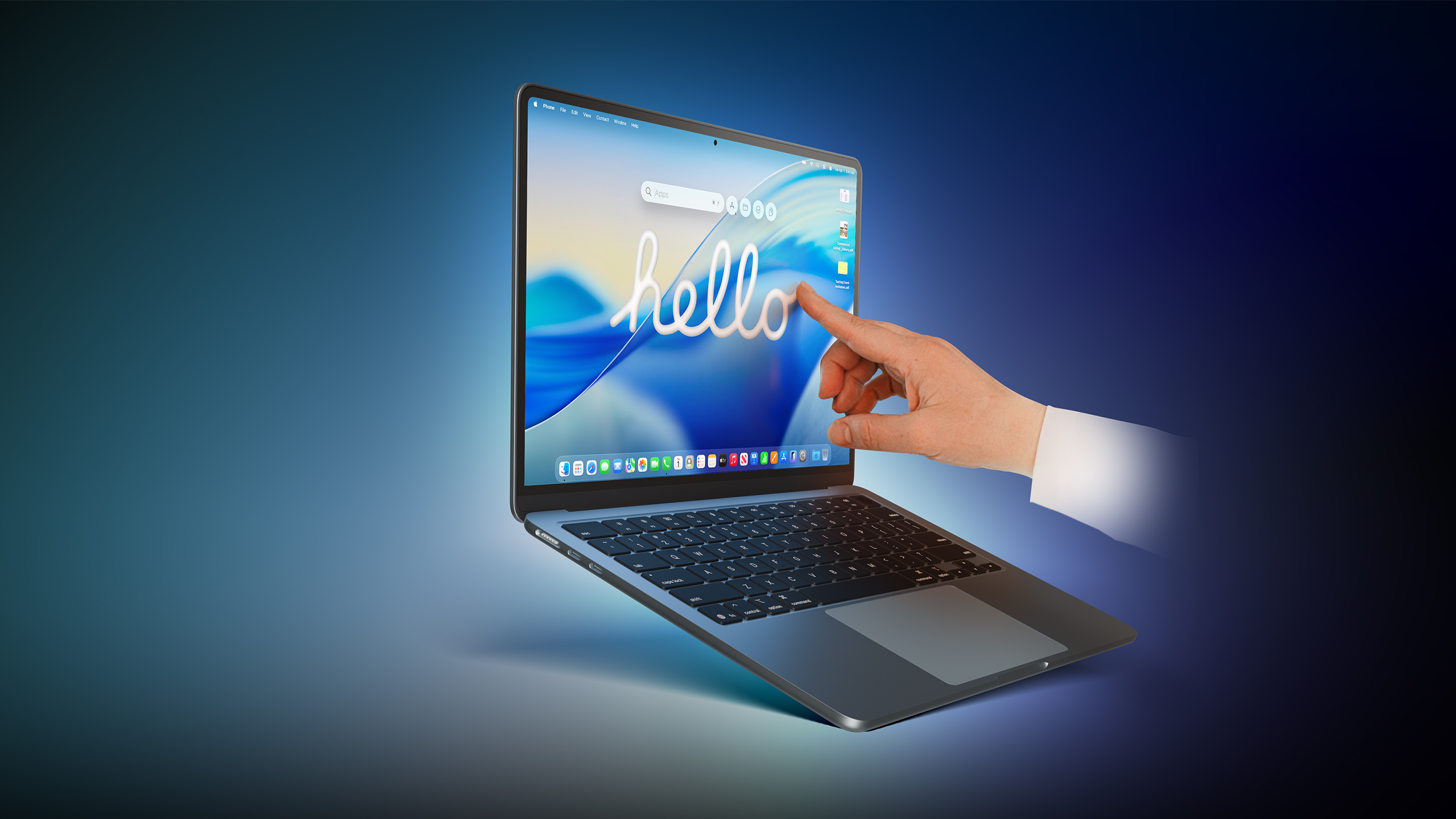
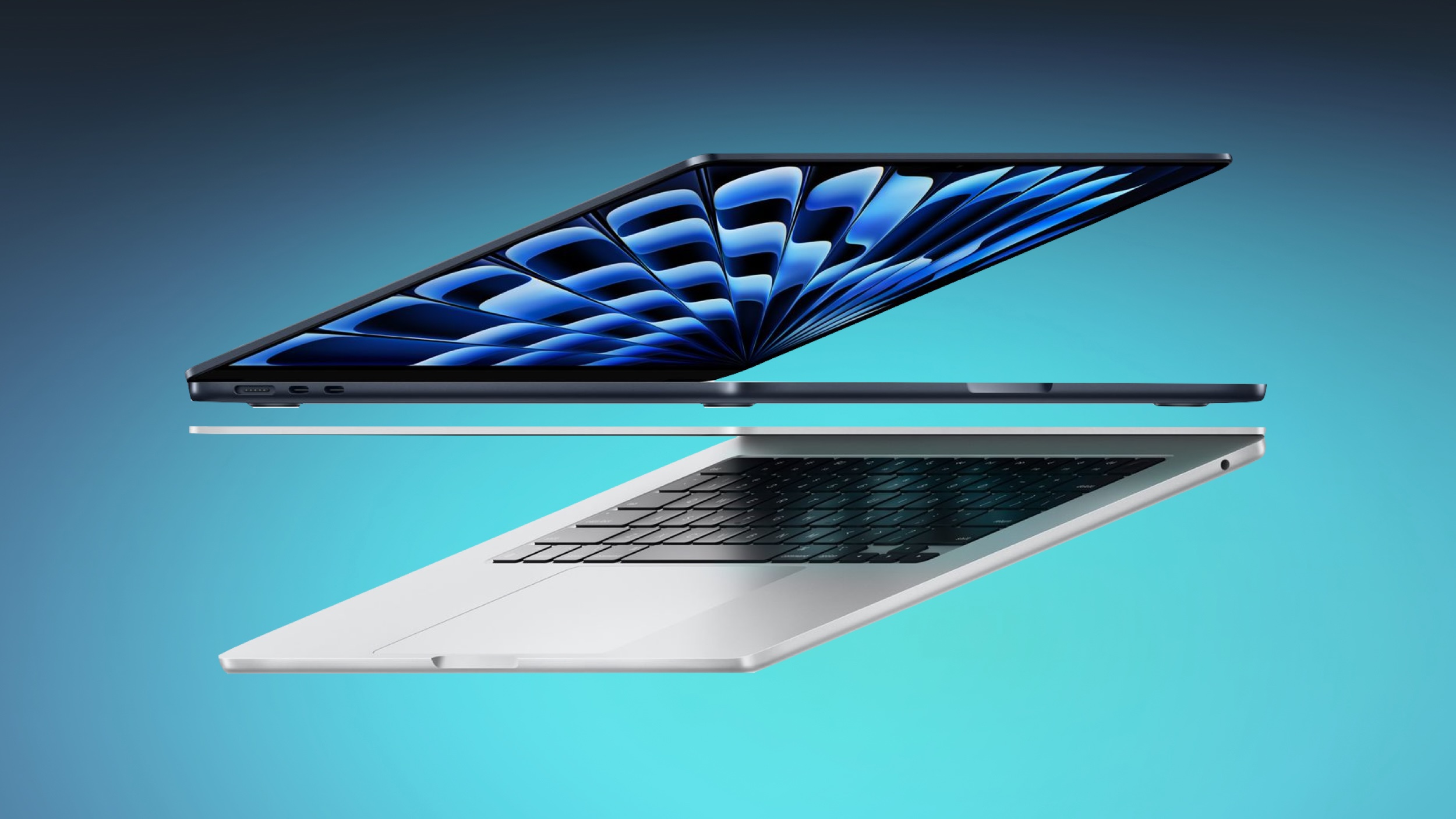
2026 could be a bumper year for Apple's Mac lineup, with the company expected to announce as many as four separate MacBook launches. Rumors suggest Apple will court both ends of the consumer spectrum, with more affordable options for students and feature-rich premium lines for users that seek the highest specifications from a laptop.


Below is a breakdown of what we're expecting over the next 12 months from Apple's multi-pronged MacBook offering. Got your eye on a particular model? Let us know in the comments what you're most looking forward to.

Low-Cost MacBook


Apple is preparing to enter the low-cost laptop market for the first time by developing a budget MacBook aimed at luring away customers from Chromebooks and entry-level Windows PCs, according to Bloomberg's Mark Gurman. The new device is said to be designed for students, businesses, and casual users, and will target people who mainly browse the web, work on documents, or dabble in light media editing.

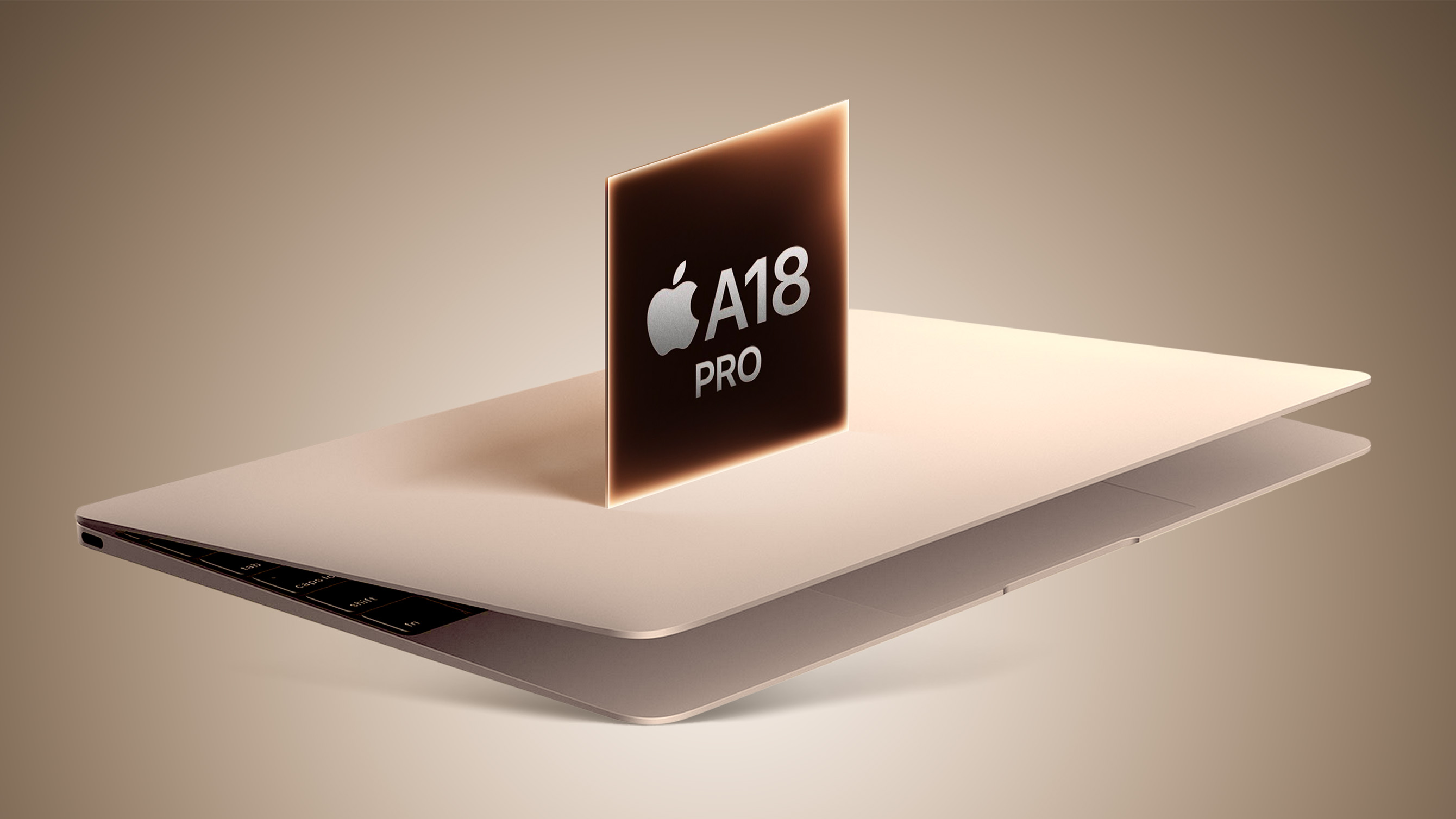
The new MacBook is said to have a 13-inch display, similar to but slightly smaller than the MacBook Air, and will feature an ultra-thin, lightweight design with a lower-end LCD display. According to reputable industry analyst Ming-Chi Kuo, Apple is said to be using its A18 Pro chip to power the machine. The A18 Pro chip debuted in the iPhone 16 Pro last year and is around 40% slower than Apple's latest M4 chip, but its multi-core CPU performance is virtually identical to the M1 chip in the 2020 MacBook Air, and it even outperforms the M1 chip for graphics.

The A18 Pro chip lacks Thunderbolt support, so the new MacBook would likely be equipped with regular USB-C ports. The current 13-inch MacBook Air starts at $999 in the U.S., so the new MacBook would likely have a starting price of between $699 and $899. The more-affordable MacBook could also come in some fun new colors like Silver, Blue, Pink, and Yellow.

MacBook Pro With M5 Pro and M5 Max


Apple is going to refresh the rest of the MacBook Pro lineup with M5 Pro and M5 Max chips in early 2026, having already updated its base 14-inch MacBook Pro with a standard M5 chip in October. The M5 series is based on TSMC's third-generation 3-nanometer technology. Based on improvements to the base MacBook Pro with M5 chip, faster SSD performance and higher memory bandwith are also likely for the high-end models. No other major changes are expected, with Apple holding over a completely refreshed design until the M6 models.

If Apple retains current pricing levels, the 14-inch MacBook Pro with M5 Pro chip will start at $1,999, while the 16-inch model with M5 Pro chip will start at $2,399. For the M5 Max equivalents, prices could start at $3,199 for the 14-inch model, and $3,499 for the 16-inch machine.

M5 MacBook Air


While the M4 MacBook Air model isn't exactly old, attention is already turning to its successor. The M5 series is reportedly being manufactured using TSMC's advanced 3-nanometer process technology, and we have some idea of what to expect in terms of performance, thanks to the recently released M5 iPad Pro: benchmarks show single-core scores around 4,133 and multi-core scores around 15,437. That's roughly a 12-15% jump over the current M4 iPad Pro in both categories. As for graphics performance, the M5 chip appears to have up to a 36% faster GPU compared to the M4 chip.

The benchmark suggests Apple has focused on modest clock speed increases and core-level efficiency improvements for the M5 chip, rather than an architecture overhaul. In other words, the M5 will be similar to the step-wise performance upgrade from M3 to M4. Expect 10-15% faster CPU speeds, a slightly more powerful GPU, and better efficiency, potentially leading to even longer battery life.

Bloomberg's Mark Gurman reports that Apple plans to roll out M5 versions of the MacBook Air in the first quarter of 2026. Based on previous spring refreshes, this suggests a likely March 2026 window. As for pricing, we expect it to remain stable, with the base model sticking with the current entry-level $999 price.

MacBook Pro With Touch-Screen OLED Display


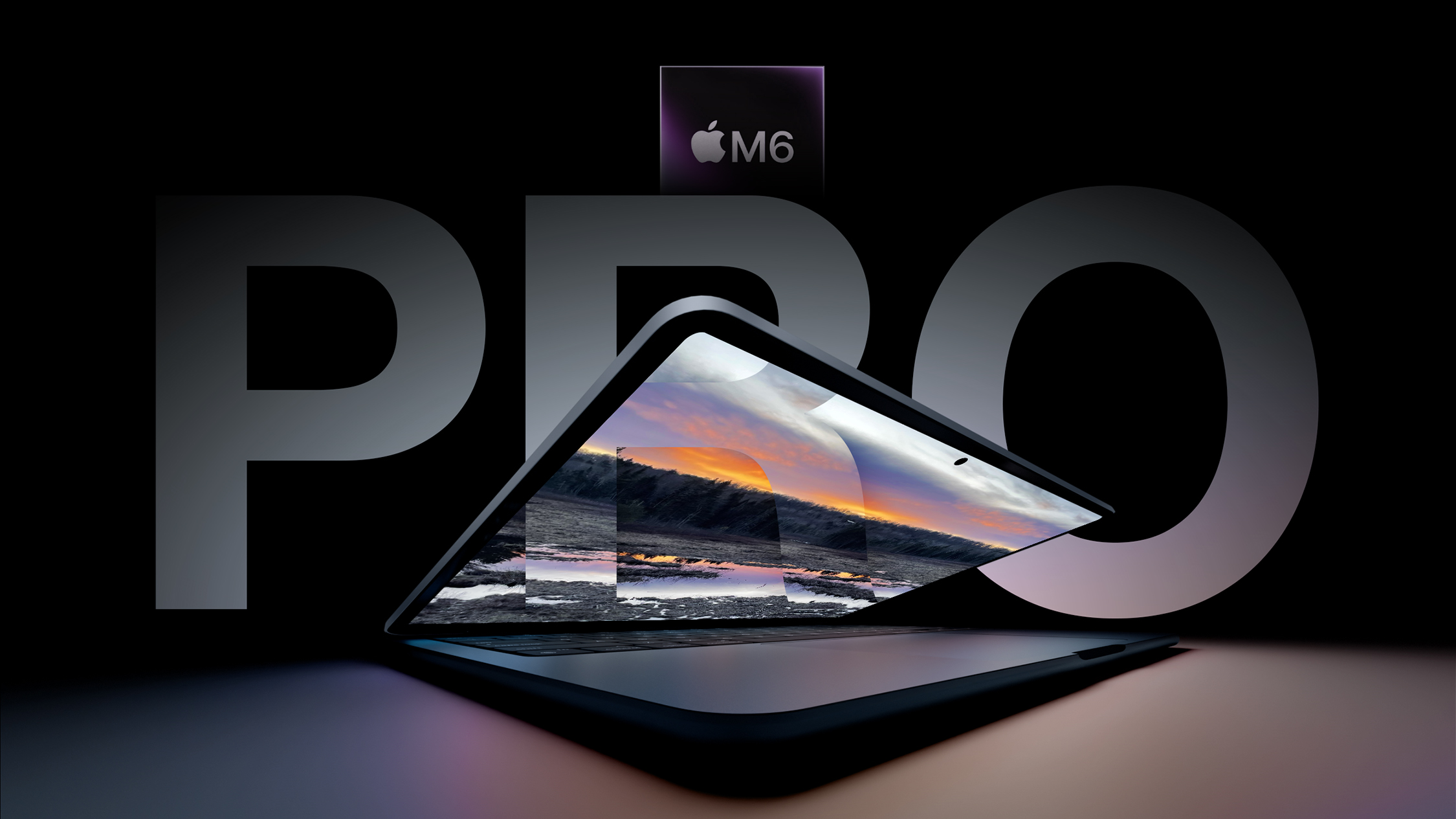
Apple is reportedly developing a completely new version of the MacBook Pro packed with next-generation hardware features. The redesigned models are expected to boast M6 chips, which could adopt a completely new packaging based on TSMC's 2nm process that allows components such as the CPU, GPUs, DRAM, and Neural Engine to be more tightly integrated.

Bloomberg's Mark Gurman says Apple is readying OLED technology for these models. Compared to current MacBook Pro models that use mini-LED screens, the benefits of OLED technology would include increased brightness, higher contrast ratio with deeper blacks, improved power efficiency for longer battery life, and more. In addition, Gurman reports that the new machines will also have "thinner and lighter frames." Apple is apparently focusing on delivering the thinnest possible device without compromising on battery life or major new features.

The redesigned 14-inch and 16-inch MacBook Pro models are also expected to have a hole-punch camera at the top of the display, rather than the notch we've become accustomed to. Gurman says that the design "leaves a display area around the sensor... similar in concept to the Dynamic Island on the iPhone."

Apple's first OLED MacBook Pro will also feature a touch screen display, according to analyst Ming-Chi Kuo. The claim has since been corroborated by Gurman, noting that the touch-screen MacBook Pro will retain a full trackpad and keyboard.

Research firm Omdia says Apple is "highly likely" to introduce new MacBook Pros featuring OLED displays next year, while Gurman has said the new OLED machines are being readied for late 2026 or early 2027. It would be unusual for Apple to introduce two ‌MacBook Pro‌ refreshes in the same year, but there is precedent for it: Apple updated the MacBook Pro lineup twice in 2023, first with M2 Pro/M2 Max chips in January and then with M3/M3 Pro/M3 Max chips in late October.

Due to the pricier components, the new 14-inch and 16-inch MacBook Pros are expected to cost a few hundred dollars more than current versions. Today's models with high-end chips start at $1,999 for the 14-inch version and $2,499 for the 16-inch one.
This article, "Here Are the Four MacBooks Apple Is Expected to Launch Next Year" first appeared on MacRumors.com

Discuss this article in our forums
  •  

Netflix Kills Casting From Its Mobile App to Most Modern TVs

Netflix has quietly removed the ability to cast content from its mobile apps to most modern TVs and streaming devices, including newer Chromecast models and the Google TV Streamer.


The change was first spotted by users on Reddit and confirmed in an updated Netflix support page (via Android Authority), which now states that the streaming service no longer supports casting from mobile devices to most TVs and TV-streaming devices. Users are instead directed to use the remote that came with their TV hardware and use its native Netflix app.

The only exception appears to apply to older Chromecast models without remotes, as well as TVs with built-in Google Cast support. However, even on these legacy devices, casting only remains for those on costlier ad-free plans, but it is unavailable for subscribers on Netflix's ad-supported plan.

User reports appear to suggest Netflix began removing the Cast button from its mobile apps in mid-November, but the company provided no advance warning to users. One Reddit user said customer service explained that devices with remotes can no longer cast, claiming the decision was made to improve the customer experience.

The move bears similarities to Netflix's 2019 decision to remove AirPlay support from its iOS app, citing an inability to distinguish between different AirPlay-enabled devices (i.e., what is an ‌Apple TV‌ vs. what isn't) as Apple expanded the technology to third-party TVs.
Tag: Netflix

This article, "Netflix Kills Casting From Its Mobile App to Most Modern TVs" first appeared on MacRumors.com

Discuss this article in our forums
  •  

iPhone Fold: Launch, Pricing, and What to Expect From Apple's Foldable

Apple is expected to launch a new foldable iPhone next year, based on multiple rumors and credible sources. The long-awaited device has been rumored for years now, but signs increasingly suggest that 2026 could indeed be the year that Apple releases its first foldable device.


Below, we've collated an updated set of key details that have been leaked about Apple's foldable iPhone so far. Apple will allegedly call the device the "‌iPhone‌ Fold," which is the name the media has already adopted when sharing rumors about the product.

Overall Design

Book-Style

According to Bloomberg's Mark Gurman, Apple's foldable iPhone is similar in style to Samsung's Galaxy Z Fold, which uses a book-style folding mechanism, rather than the clamshell design of the Samsung Galaxy Z Flip. Industry analyst Ming-Chi Kuo expects the foldable ‌iPhone‌ to measure between 9 and 9.5 mm when folded, and around 4.5 to 4.8 mm when unfolded. More recently, Weibo-based leaker Instant Digital has said that the foldable iPhone will have a thickness of at least 4.8mm.

Display Sizes

Dual Screens

When folded, users will interact with a 5.5-inch outer display that is similar to a typical iPhone screen, while unfolding it will reveal a larger 7.8-inch iPad-style screen. These dimensions have been corroborated by two reputable sources. According to one rumor, the inner folding display will be approximately the size of a piece of A6 paper and will use a 2,713 x 1,920 resolution, while the outer display will use a 2,088 x 1,422 resolution.

Crease Visibility

'Crease-Free'

The inner display is said to be virtually crease-free, thanks to Apple's use of a metal plate that can disperse and control the stress generated by bending the display, according to analyst Ming-Chi Kuo. Apple is said to be using liquid metal in the hinges to improve durability and help eliminate screen creasing. Liquid metal, manufactured using a die-casting process, has been chosen by Apple to address this common issue with foldable devices, according to the analyst. Citing supply chain sources, Chinese site UDN says that Apple has solved "the crease problem" that has plagued most foldable smartphones, and the foldable ‌iPhone‌ will be the first crease-free foldable smartphone on the market.

Chassis and Hinge

Durable Materials

The foldable iPhone reportedly has a titanium chassis, with the hinge constructed from a combination of titanium and stainless steel, according to analyst Ming-Chi Kuo. The frame itself will use a titanium alloy to prevent bending issues – a solution that has worked well for Apple's new ultra-thin iPhone Air. However, analyst Jeff Pu believes that Apple is using aluminum and titanium, whereas Kuo believes a mix of stainless steel and titanium has been chosen.

Cameras

Front and Rear

The foldable iPhone is expected to include a dual-lens rear camera, with a front-facing camera for both folded and unfolded states, according to Kuo. Bloomberg's Mark Gurman recently corroborated reports that the device will have four cameras consisting of one front camera, one inner camera, and two rear cameras. Prolific Weibo-based leaker Digital Chat Station claims that the rear dual lenses will be 48 megapixels each. Other sources have claimed that the inner display features an under-screen camera (USC), while the outer display – in the device's folded state – will have a punch-hole camera.

Authentication

Touch ID

Kuo believes the phone will forgo Face ID authentication, and instead use a Touch ID side button as a means to save precious internal space, and Bloomberg's Mark Gurman recently corroborated the rumor. Apple has previously integrated Touch ID into the side button of the iPad, iPad Air, and iPad mini.

Cellular Connectivity

C2 Modem

The foldable iPhone will use Apple's second-generation C2 modem for cellular connectivity, according to Bloomberg's Mark Gurman. Apple debuted its custom-designed C1 modem in the iPhone 16e earlier this year, followed by the C1X featured in the iPhone Air, as part of a multi-year plan to transition away from Qualcomm modems. Gurman says the foldable device will not have a physical SIM slot.

Battery Life

High-Density Cells

Apple is putting a heavy focus on improving power efficiency by slimming down key components like the display driver to make room for more battery cells, according to a Korean blog that has leaked accurate details about unreleased products before. The phone will reportedly use high-density battery cells. Expect the C2 modem to be faster overall, and for it to gain mmWave support in the United States. Further power efficiency improvements are likely too.

Color Options

Black and White

Apple is currently only testing variations of black and white for the folding phone with suppliers, according to Bloomberg's Mark Gurman, although he says that Apple's plans could evolve before the device launches.

Pricing

Premium Segment

Multiple reports have suggested the foldable iPhone will be priced between $2,000 and $2,500 in the United States, which could make it the most expensive iPhone ever. Meanwhile, analysts at investment banking firm UBS and Fubon Research believe the phone will be either between $1,800 and $2,000 or around $2,399, respectively. However, Kuo recently claimed that the hinge is expected to carry an average selling price (ASP) of approximately $70 to $80 when mass production begins – well below the market expectation of $100 to $120 or higher. Kuo attributed the cost decline to "assembly design optimization" and Foxconn's influence in production scaling. Whether the reduction in hinge price will reduce retail price or simply bolster Apple's margins is an open question. Regardless of the price, the foldable is expected to tap into Apple's loyal fanbase, some of whom will view it as a "must-have device" if its quality meets expectations.

Launch Date

Late 2026

According to industry analyst Jeff Pu, the device entered the New Product Introduction (NPI) phase at Foxconn in March 2025, while a November report from Chinese site UDN reported that the device has now entered the engineering validation stage, and Apple is gearing up for mass production. Foxconn is expected to officially start producing Apple's foldable iPhone early in the fourth quarter (October), and a recent report has suggested Apple is already stockpiling components for pre-production. An exact launch date is currently unknown, but both Kuo and Pu say mass production is planned for the second half of 2026. Bloomberg reporter Mark Gurman has said he expects the device to be launched next year in the fall season. However, Japan's Mizuho Securities banking firm has suggested a postponement to 2027 could still happen because of Apple taking longer to decide on key design elements such as the hinge.
This article, "iPhone Fold: Launch, Pricing, and What to Expect From Apple's Foldable" first appeared on MacRumors.com

Discuss this article in our forums
  •  

Use ChatGPT as Your iPhone's Action Button Assistant

Apple doesn't currently allow iPhone users to change the Side button's Siri functionality to another assistant, but owners of iPhone 15 Pro and newer models can assign ChatGPT to the Action button instead. Keep reading to learn how.


OpenAI's free ChatGPT app for iPhone lets you interact with the chatbot using text or voice. What's more, if you assign voice mode directly to the Action button, you can use it to jump straight into a spoken conversation, giving you quick, handsfree access to a far more capable assistant.

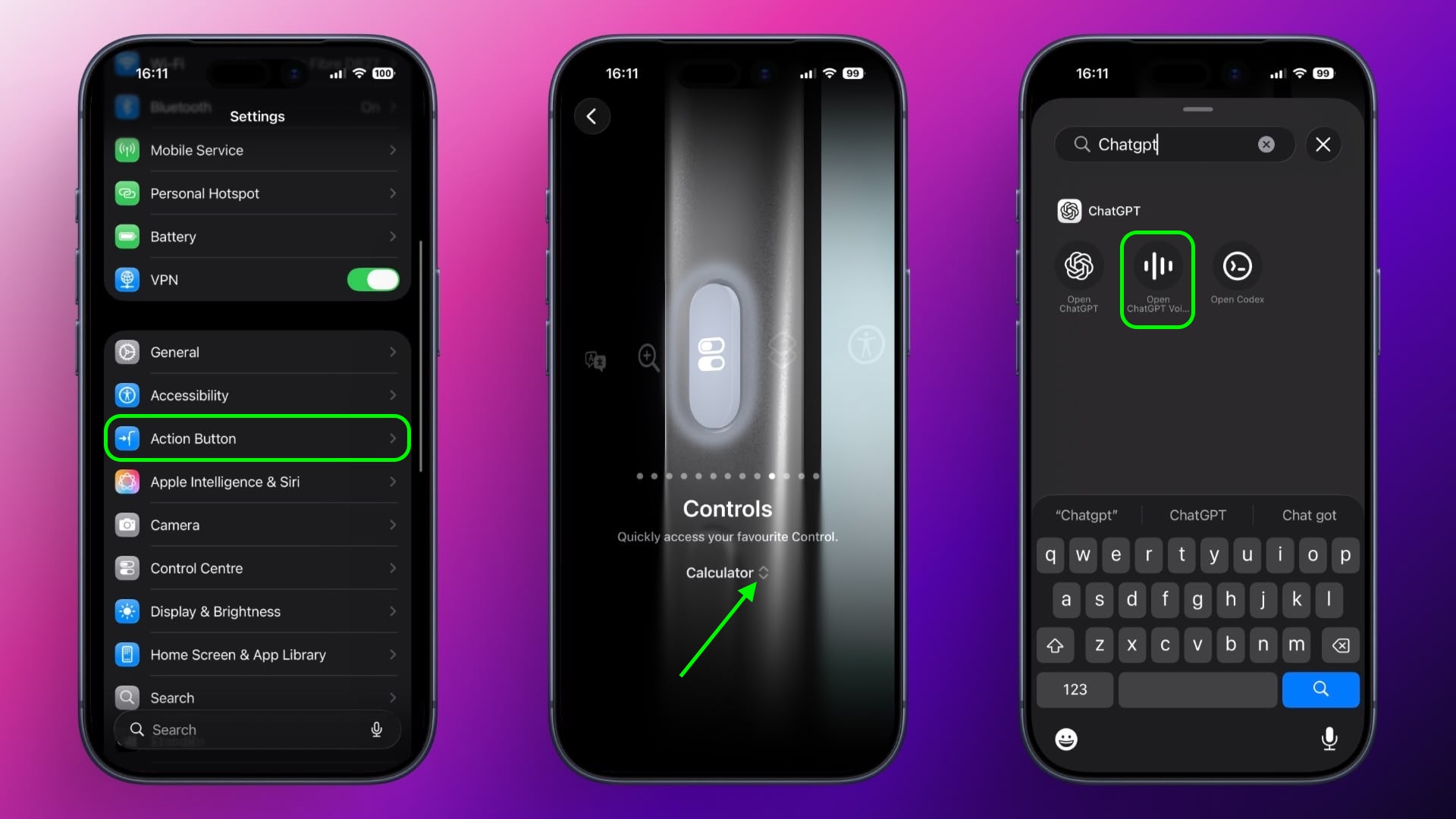
  1. Install the ChatGPT app, then sign into your account or create a new one.

  2. Next, open the Settings app.

  3. Tap Action Button.

  4. Swipe to Controls, then tap the two chevrons beside the currently assigned control.

  5. Using the control search field, type "ChatGPT."

  6. Select the control Open ChatGPT Voice.


A long press of the Action button will now open ChatGPT's voice mode. The first time you activate it, the app may request microphone access. Tap Allow to proceed. After that, you can begin speaking immediately.

A recent update means voice conversations now take place inside the same chat window as text-based prompts, instead of switching to a separate voice-only interface. Responses appear in real time, combining spoken output with on-screen text and any visuals the model generates. This keeps your conversation's context intact and makes switching between typing and speaking smoother.

Continue the Conversation Anywhere


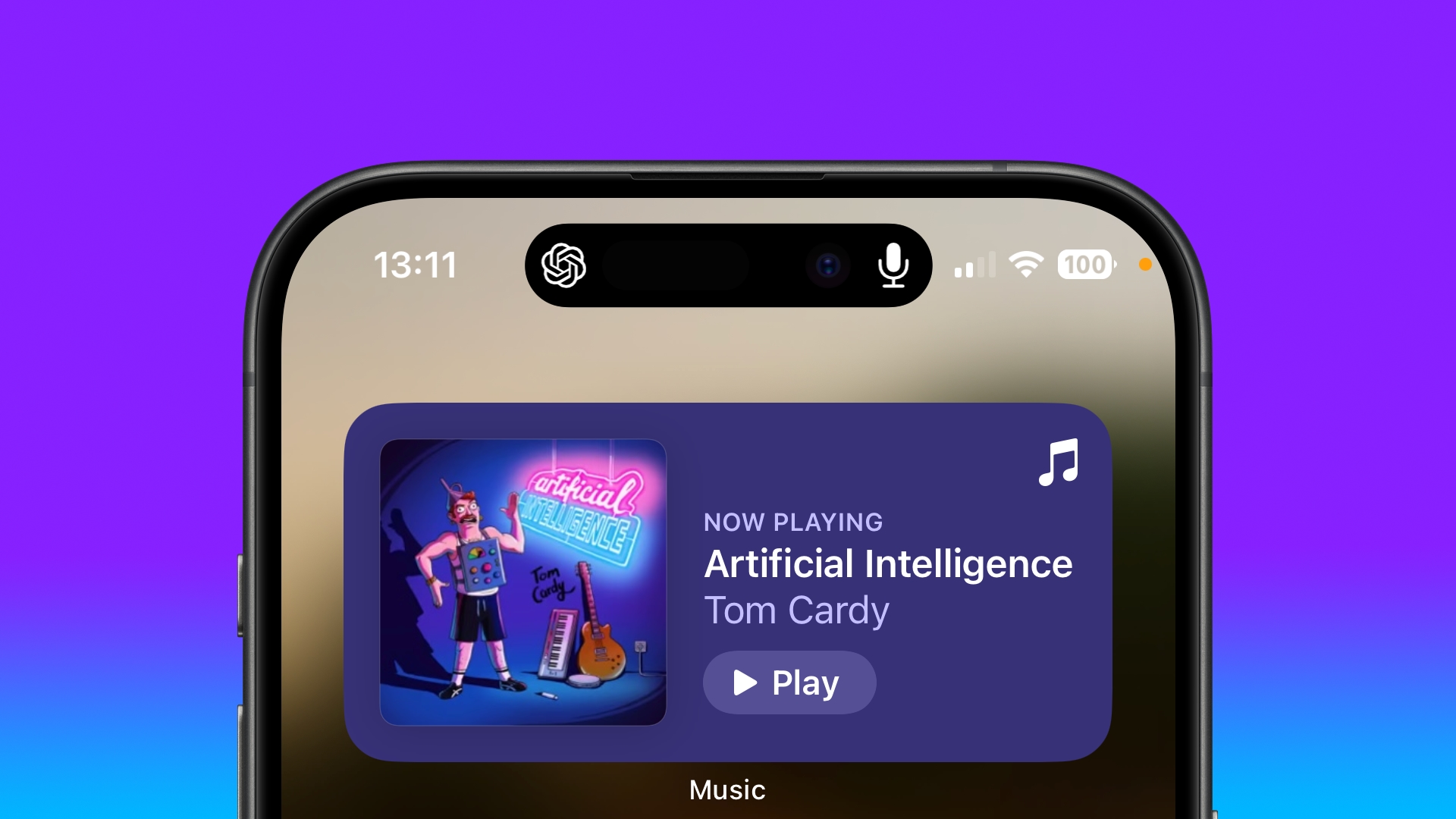
You can also leave the ChatGPT app during a voice session without ending it. When you swipe away, the conversation continues and appears in the Dynamic Island as long as the assistant is listening and preparing a response. To stop, tap the Dynamic Island to return to the app, then tap End.

Note that while this setup gives you a fast, physical shortcut to a richer, more context-aware assistant, ChatGPT can't perform Siri-like system actions like accessing your calendar or setting an alarm.
Tag: ChatGPT

This article, "Use ChatGPT as Your iPhone's Action Button Assistant" first appeared on MacRumors.com

Discuss this article in our forums
  •