↩ Accueil

Vue lecture

Institute of Physics celebrates 2025 Business Award winners at parliamentary event

A total of 14 physics-based firms in sectors from quantum and energy to healthcare and aerospace have won 2025 Business Awards from the Institute of Physics (IOP), which publishes Physics World. The awards were presented at a reception in the Palace of Westminster yesterday attended by senior parliamentarians and policymakers as well as investors, funders and industry leaders.

The IOP Business Awards, which have been running since 2012, recognise the role that physics and physicists play in the economy, creating jobs and growth “by powering innovation to meet the challenges facing us today, ranging from climate change to better healthcare and food production”. More than 100 firms have now won Business Awards, with around 90% of those companies still commercially active.

The parliamentary event honouring the 2025 winners were hosted by Dave Robertson, the Labour MP for Lichfield, who spent 10 years as a physics teacher in Birmingham before working for teaching unions. There was also a speech from Baron Sharma, who studied applied physics before moving into finance and later becoming a Conservative MP, Cabinet minister and president of the COP-26 climate summit.

Seven firms were awarded 2025 IOP Business Innovation Awards, which recognize companies that have “delivered significant economic and/or societal impact through the application of physics”. They include Oxford-based Tokamak Energy, which has developed “compact, powerful, robust, quench-resilient” high-temperature superconducting magnets for commercial fusion energy and for  propulsion systems, accelerators and scientific instruments.
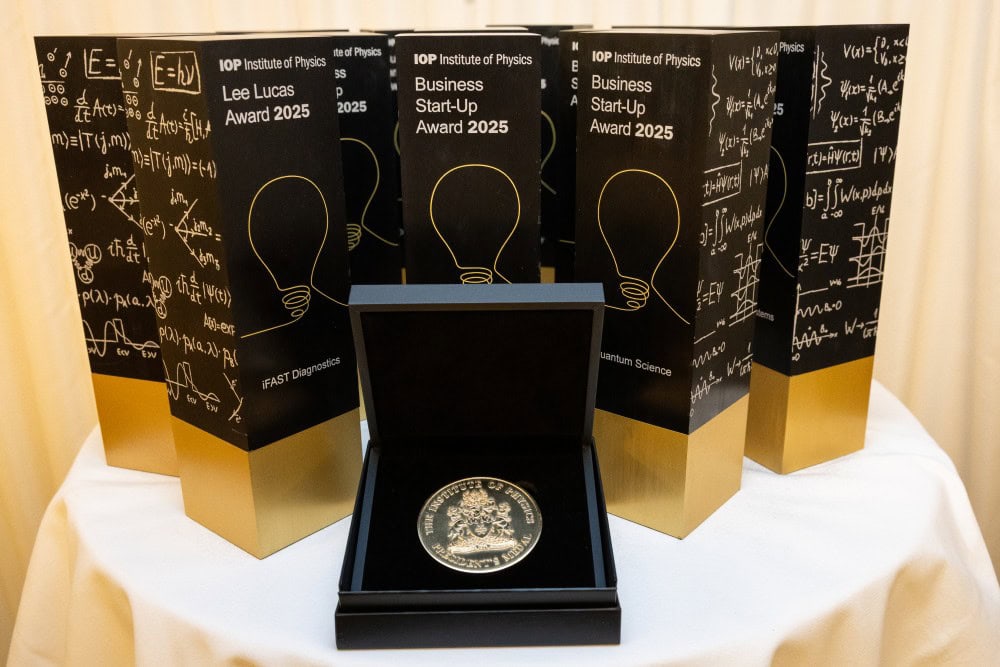
(courtesy: Carmen Valino)

Oxford Instruments was honoured for developing a novel analytical technique for scanning electron microscopes, enabling new capabilities and accelerating time to results by at least an order of magnitude. Ionoptika, meanwhile, was recognized for developing Q-One, which is a new generation of focused ion-beam instrumentation, providing single atom through to high-dose nanoscale advanced materials engineering for photonic and quantum technologies.

The other four winners were: electronics firm FlexEnable for their organic transistor materials; Lynkeos Technology for the development of muonography in the nuclear industry; the renewable energy company Sunamp for their thermal storage system; and the defence and security giant Thales UK for the development of a solid-state laser for laser rangefinders.

Business potential

Six other companies have won an IOP Start-up Award, which celebrates young companies “with a great business idea founded on a physics invention, with the potential for business growth and significant societal impact”. They include Astron Systems for developing “long-lifetime turbomachinery to enable multi-reuse small rocket engines and bring about fully reusable small launch vehicles”, along with MirZyme Therapeutics for “pioneering diagnostics and therapeutics to eliminate preeclampsia and transform maternal health”.

The other four winners were: Celtic Terahertz Technology for a metamaterial filter technology; Nellie Technologies for a algae-based carbon removal technology; Quantum Science for their development of short-wave infrared quantum dot technology; and Wayland Additive for the development and commercialisation of charge-neutralised electron beam metal additive manufacturing.

James McKenzie, a former vice-president for business at the IOP, who was involved in judging the awards, says that all awardees are “worthy winners”. “It’s the passion, skill and enthusiasm that always impresses me,” McKenzie told Physics World.

iFAST Diagnostics were also awarded the IOP Lee Lucas Award that recognises early-stage companies taking innovative products into the medical and healthcare sector. The firm, which was spun out of the University of Southampton, develops blood tests that can test the treatment of bacterial infections in a matter of hours rather than days. They are expecting to have approval for testing next year.

“Especially inspiring was the team behind iFAST,” adds McKenzie, “who developed a method to test very rapid tests cutting time from 48 hours to three hours, so patients can be given the right antibiotics.”

“The award-winning businesses are all outstanding examples of what can be achieved when we build upon the strengths we have, and drive innovation off the back of our world-leading discovery science,” noted Tom Grinyer, IOP chief executive officer. “In the coming years, physics will continue to shape our lives, and we have some great strengths to build upon here in the UK, not only in specific sectors such as quantum, semiconductors and the green economy, but in our strong academic research and innovation base, our growing pipeline of spin-out and early-stage companies, our international collaborations and our growing venture capital community.”

For the full list of winners, see here.

The post Institute of Physics celebrates 2025 Business Award winners at parliamentary event appeared first on Physics World.

  •  

Fermilab opens new building dedicated to Tevatron pioneer Helen Edwards

Fermilab has officially opened a new building named after the particle physicist Helen Edwards. Officials from the lab and the US Department of Energy (DOE) opened the Helen Edwards Engineering Research Center at a ceremony held on 5 December.  The new building is the lab’s largest purpose-built lab and office space since the lab’s iconic Wilson Hall, which was completed in 1974.

Construction of the Helen Edwards Engineering Research Center began in 2019 and was completed three years later. The centre is an 7500 m2 multi-story lab and office building that is adjacent and connected to Wilson Hall.

The new centre is designed as a collaborative lab where engineers, scientists and technicians design, build and test technologies across several areas of research such as neutrino science, particle detectors, quantum science and electronics.

The centre also features cleanrooms, vibration-sensitive labs and cryogenic facilities in which the components of the near detector for the Deep Underground Neutrino Experiment will be assembled and tested.

A pioneering spirit

With a PhD in experimental particle physics from Cornell University, Edwards was heavily involved with commissioning the university’s 10 GeV electron synchrotron. In 1970 Fermilab’s director Robert Wilson appointed Edwards as associate head of the lab’s booster section and she later became head of the accelerator division.

While at Fermilab, Edwards’ primary responsibility was designing, constructing, commissioning and operating the Tevatron, which led to the discoveries of the top quark in 1995 and the tau neutrino in 2000.

Edwards retired in the early 1990s but continued to work as guest scientists at Fermilab and officially switched the Tevatron off during a ceremony held on 30 September 2011. Edwards died in 2016.

Darío Gil, the undersecretary for science at the DOE says that Edwards’ scientific work “is a symbol of the pioneering spirit of US research”.

“Her contributions to the Tevatron and the lab helped the US become a world leader in the study of elementary particles,” notes Gil. “We honour her legacy by naming this research centre after her as Fermilab continues shaping the next generation of research using [artificial intelligence], [machine learning] and quantum physics.”

The post Fermilab opens new building dedicated to Tevatron pioneer Helen Edwards appeared first on Physics World.

  •  

Light pollution from satellite mega-constellations threaten space-based observations

Almost every image that will be taken by future space observatories in low-Earth orbit could be tainted due to light contamination from satellites. That is according to a new analysis from researchers at NASA, which stresses that light pollution from satellites orbiting Earth must be reduced to guarantee astronomical research is not affected.

The number of satellites orbiting Earth has increased from about 2000 in 2019 to 15 000 today. Many of these are part of so-called mega-constellations that provide services such as Internet coverage around the world, including in areas that were previously unable to access it. Examples of such constellations include SpaceX’s Starlink as well as Amazon’s Kuiper and Eutelsat’s OneWeb.

Many of these mega-constellations share the same space as space-based observatories such as NASA’s Hubble Space Telescope. This means that the telescopes can capture streaks of reflected light from the satellites that render the images or data completely unusable for research purposes. That is despite anti-reflective coating that is applied to some newer satellites in SpaceX’s Starlink constellation, for example.

Previous work has explored the impact of such satellites constellations on ground-based astronomy, both optical and radioastronomy. Yet their impact on telescopes in space has been overlooked.

To find out more, Alejandro Borlaff from NASA’s Ames Research Center, and colleagues simulated the view of four space-based telescopes: Hubble and the near-infrared observatory SPHEREx, which launched in 2025, as well at the European Space Agency’s proposed near-infrared ARRAKIHS mission and China’s planned Xuntian telescopes.

These observatories are, or will be placed, between 400 and 800 km from the Earth’s surface.

The authors found that if the population of mega-constellation satellites grows to the 56 000 that is projected by the end of the decade, it would contaminate about 39.6% of Hubble’s images and 96% of images from the other three telescopes.

Borlaff and colleagues predict that the average number of satellites observed per exposure would be 2.14 for Hubble, 5.64 for SPHEREx, 69 for ARRAKIHS, and 92 for Xuntian.

The authors note that one solution could be to deploy satellites at lower orbits than the telescopes operate, which would make them about four magnitudes dimmer. The downside is that emissions from these lower satellites could have implications for Earth’s ozone layer.

An ‘urgent need for dialogue’

Katherine Courtney, chair of the steering board for the Global Network on Sustainability in Space, says that without astronomy, the modern space economy “simply wouldn’t exist”.

“The space industry owes its understanding of orbital mechanics, and much of the technology development that has unlocked commercial opportunities for satellite operators, to astronomy,” she says. “The burgeoning growth of the satellite population brings many benefits to life on Earth, but the consequences for the future of astronomy must be taken into consideration.”

Courtney adds that there is now “an urgent need for greater dialogue and collaboration between astronomers and satellite operators to mitigate those impacts and find innovative ways for commercial and scientific operations to co-exist in space.”

  • Katherine Courtney, chairs the Global Network on Sustainability in Space, and Alice Gorman from Flinders University in Adelaide, Australia, appeared on a Physics World Live panel discussion about the impact of space debris that was held on 10 November. A recording of the event is available here.

The post Light pollution from satellite mega-constellations threaten space-based observations appeared first on Physics World.

  •  

Semiconductor laser pioneer Susumu Noda wins 2026 Rank Prize for Optoelectronics

Susumu Noda of Kyoto University has won the 2026 Rank Prize for Optoelectronics for the development of the Photonic Crystal Surface Emitting Laser (PCSEL). For more than 25 years, Noda developed this new form of laser, which has potential applications in high-precision manufacturing as well as in LIDAR technologies.

Following the development of the laser in 1960, in more recent decades optical fibre lasers and semiconductor lasers have become competing technologies.

A semiconductor laser works by pumping an electrical current into a region where an n-doped (excess of electrons) and a p-doped (excess of “holes”) semiconductor material meet, causing electrons and holes to combine and release photons.

Semiconductors have several advantages in terms of their compactness, high “wallplug” efficiency, and ruggedness, but lack in other areas such as having a low brightness and functionality.

This means that conventional semiconductor lasers required external optical and mechanical elements to improve their performance, which results in large and impractical systems.

‘A great honour’

In the late 1990s, Noda began working on a new type of semiconductor laser that could challenge the performance of optical fibre lasers. These so-called PCSELs employ a photonic crystal layer  in between the semiconductor layers. Photonic crystals are nanostructured materials in which a periodic variation of the dielectric constant — formed, for example, by a lattice of holes — creates a photonic band-gap.

Noda and his research made a series of breakthrough in the technology such as demonstrating control of polarization and beam shape by tailoring the phonic crystal structure and expansion into blue–violet wavelengths.

The resulting PCSELs emit a high-quality, symmetric beam with narrow divergence and boast high brightness and high functionality while maintaining the benefits of conventional semiconductor lasers. In 2013, 0.2 W PCSELs became available and a few years later Watt-class PCSEL lasers became operational.

Noda says that it is “a great honour and a surprise” to receive the prize. “I am extremely happy to know that more than 25 years of research on photonic-crystal surface-emitting lasers has been recognized in this way,” he adds. “I do hope to continue to further develop the research and its social implementation.”

Susumu Noda received his BSc and then PhD in electronics from Kyoto University in 1982 and 1991, respectively. From 1984 he also worked at Mitsubishi Electric Corporation, before joining Kyoto University in 1988 where he is currently based.

Founded in 1972 by the British industrialist and philanthropist Lord J Arthur Rank, the Rank Prize is awarded biennially in nutrition and optoelectronics. The 2026 Rank Prize for Optoelectronics, which has a cash award of £100 000, will be awarded formally at an event held in June.

The post Semiconductor laser pioneer Susumu Noda wins 2026 Rank Prize for Optoelectronics appeared first on Physics World.

  •  

‘Caustic’ light patterns inspire new glass artwork

UK artist Alison Stott has created a new glass and light artwork – entitled Naturally Focused – that is inspired by the work of theoretical physicist Michael Berry from the University of Bristol.

Stott, who recently competed an MA in glass at Arts University Plymouth, spent over two decades previously working in visual effects for film and television, where she focussed on creating photorealistic imagery.

Her studies touched on how complex phenomena can arise from seemingly simple set-ups, for example in a rotating glass sculpture lit by LEDs.

“My practice inhabits the spaces between art and science, glass and light, craft and experience,” notes Stott. “Working with molten glass lets me embrace chaos, indeterminacy, and materiality, and my work with caustics explores the co-creation of light, matter, and perception.”

The new artwork is based on “caustics” – the curved patterns that form when light is reflected or refracted by curved surfaces or objects

The focal point of the artwork is a hand-blown glass lens that was waterjet-cut into a circle and polished so that its internal structure and optical behaviour are clearly visible. The lens is suspended within stainless steel gyroscopic rings and held by a brass support and stainless stell backplate.

The rings can be tilted or rotated to “activate shifting field of caustic projections that ripple across” the artwork. Mathematical equations are also engraved onto the brass that describe the “singularities of light” that are visible on the glass surface.

The work is inspired by Berry’s research into the relationship between classical and quantum behaviour and how subtle geometric structures govern how waves and particles behave.

Berry recently won the 2025 Isaac Newton Medal and Prize, which is presented by the Institute of Physics, for his “profound contributions across mathematical and theoretical physics in a career spanning over 60 years”.

Stott says that working with Berry has pushed her understanding of caustics. “The more I learn about how these structures emerge and why they matter across physics, the more compelling they become,” notes Stott. “My aim is to let the phenomena speak for themselves, creating conditions where people can directly encounter physical behaviour and perhaps feel the same awe and wonder I do.”

The artwork will go on display at the University of Bristol following a ceremony to be held on 27 November.

The post ‘Caustic’ light patterns inspire new glass artwork appeared first on Physics World.

  •  

Scientists in China celebrate the completion of the underground JUNO neutrino observatory

The $330m Jiangmen Underground Neutrino Observatory (JUNO) has released its first results following the completion of the huge underground facility in August.

JUNO is located in Kaiping City, Guangdong Province, in the south of the country around 150 km west of Hong Kong.

Construction of the facility began in 2015 and was set to be complete some five years later. Yet the project suffered from serious flooding, which delayed construction.

JUNO, which is expected to run for more than 30 years, aims to study the relationship between the three types of neutrino: electron, muon and tau. Although JUNO will be able to detect neutrinos produced by supernovae as well as those from Earth, the observatory will mainly measure the energy spectrum of electron antineutrinos released by the Yangjiang and Taishan nuclear power plants, which both lie 52.5 km away.

To do this, the facility has a 80 m high and 50 m diameter experimental hall located 700 m underground. Its main feature is a 35 m radius spherical neutrino detector, containing 20,000 tonnes of liquid scintillator. When an electron antineutrino occasionally bumps into a proton in the liquid, it triggers a reaction that results in two flashes of light that are detected by the 43,000 photomultiplier tubes that observe the scintillator.

On 18 November, a paper was submitted to the arXiv preprint server concluding that the detector’s key performance indicators fully meet or surpass design expectations.

New measurement 

Neutrinos oscillate from one flavour to another as they travel near the speed of light, rarely interacting with matter. This oscillation is a result of each flavour being a combination of three neutrino mass states.

Yet scientists do not know the absolute masses of the three neutrinos but can measure neutrino oscillation parameters, known as θ12, θ23 and θ13, as well as the square of the mass differences (Δm2) between two different types of neutrinos.

A second JUNO paper submitted on 18 November used data collected between 26 August and 2 November to measure the solar neutrino oscillation parameter θ12 and Δm221 with a factor of 1.6 better precision than previous experiments.

Those earlier results, which used solar neutrinos instead of reactor antineutrinos, showed a 1.5 “sigma” discrepancy with the Standard Model of particle physics. The new JUNO measurements confirmed this difference, dubbed the solar neutrino tension, but further data will be needed to prove or disprove the finding.

“Achieving such precision within only two months of operation shows that JUNO is performing exactly as designed,” says Yifang Wang from the Institute of High Energy Physics of the Chinese Academy of Sciences, who is JUNO project manager and spokesperson. “With this level of accuracy, JUNO will soon determine the neutrino mass ordering, test the three-flavour oscillation framework, and search for new physics beyond it.”

JUNO, which is an international collaboration of more than 700 scientists from 75 institutions across 17 countries including China, France, Germany, Italy, Russia, Thailand, and the US, is the second neutrino experiment in China, after the Daya Bay Reactor Neutrino Experiment. It successfully measured a key neutrino oscillation parameter called θ13 in 2012 before being closed down in 2020.

JUNO is also one of three next-generation neutrino experiments, the other two being the Hyper-Kamiokande in Japan and the Deep Underground Neutrino Experiment in the US. Both are expected to become operational later this decade.

The post Scientists in China celebrate the completion of the underground JUNO neutrino observatory appeared first on Physics World.

  •  

Physicists discuss the future of machine learning and artificial intelligence

Pierre Gentine, Jimeng Sun, Jay Lee and Kyle Cranmer
Looking ahead to the future of machine learning: (clockwise from top left) Jay Lee, Jimeng Sun, Pierre Gentine and Kyle Cranmer.

IOP Publishing’s Machine Learning series is the world’s first open-access journal series dedicated to the application and development of machine learning (ML) and artificial intelligence (AI) for the sciences.

Part of the series is Machine Learning: Science and Technology, launched in 2019, which bridges the application and advances in machine learning across the sciences. Machine Learning: Earth is dedicated to the application of ML and AI across all areas of Earth, environmental and climate sciences while Machine Learning: Health covers healthcare, medical, biological, clinical and health sciences and Machine Learning: Engineeringfocuses on applied AI and non-traditional machine learning to the most complex engineering challenges.

Here, the editors-in-chief (EiC) of the four journals discuss the growing importance of machine learning and their plans for the future.

Kyle Cranmer is a particle physicist and data scientist at the University of Wisconsin-Madison and is EiC of Machine Learning: Science and Technology (MLST). Pierre Gentine is a geophysicist at Columbia University and is EiC of Machine Learning: Earth. Jimeng Sun is a biophysicist at the University of Illinois at Urbana-Champaign and is EiC of Machine Learning: Health. Mechanical engineer Jay Lee is from the University of Maryland and is EiC of Machine Learning: Engineering.

What do you attribute to the huge growth over the past decade in research into and using machine learning?

Kyle Cranmer (KC): It is due to a convergence of multiple factors. The initial success of deep learning was driven largely by benchmark datasets, advances in computing with graphics processing units, and some clever algorithmic tricks. Since then, we’ve seen a huge investment in powerful, easy-to-use tools that have dramatically lowered the barrier to entry and driven extraordinary progress.

Pierre Gentine (PG): Machine learning has been transforming many fields of physics, as it can accelerate physics simulation, better handle diverse sources of data (multimodality), help us better predict.

Jimeng Sun (JS): Over the past decade, we have seen machine learning models consistently reach — and in some cases surpass — human-level performance on real-world tasks. This is not just in benchmark datasets, but in areas that directly impact operational efficiency and accuracy, such as medical imaging interpretation, clinical documentation, and speech recognition. Once ML proved it could perform reliably at human levels, many domains recognized its potential to transform labour-intensive processes.

Jay Lee (JL):  Traditionally, ML growth is based on the development of three elements: algorithms, big data, and computing.  The past decade’s growth in ML research is due to the perfect storm of abundant data, powerful computing, open tools, commercial incentives, and groundbreaking discoveries—all occurring in a highly interconnected global ecosystem.

What areas of machine learning excite you the most and why?

KC: The advances in generative AI and self-supervised learning are very exciting. By generative AI, I don’t mean Large Language Models — though those are exciting too — but probabilistic ML models that can be useful in a huge number of scientific applications. The advances in self-supervised learning also allows us to engage our imagination of the potential uses of ML beyond well-understood supervised learning tasks.

PG: I am very interested in the use of ML for climate simulations and fluid dynamics simulations.

JS: The emergence of agentic systems in healthcare — AI systems that can reason, plan, and interact with humans to accomplish complex goals. A compelling example is in clinical trial workflow optimization. An agentic AI could help coordinate protocol development, automatically identify eligible patients, monitor recruitment progress, and even suggest adaptive changes to trial design based on interim data. This isn’t about replacing human judgment — it’s about creating intelligent collaborators that amplify expertise, improve efficiency, and ultimately accelerate the path from research to patient benefit.

JL: One area is  generative and multimodal ML — integrating text, images, video, and more — are transforming human–AI interaction, robotics, and autonomous systems. Equally exciting is applying ML to nontraditional domains like semiconductor fabs, smart grids, and electric vehicles, where complex engineering systems demand new kinds of intelligence.

What vision do you have for your journal in the coming years?

KC: The need for a venue to propagate advances in AI/ML in the sciences is clear. The large AI conferences are under stress, and their review system is designed to be a filter not a mechanism to ensure quality, improve clarity and disseminate progress. The large AI conferences also aren’t very welcoming to user-inspired research, often casting that work as purely applied. Similarly, innovation in AI/ML often takes a back seat in physics journals, which slows the propagation of those ideas to other fields. My vision for MLST is to fill this gap and nurture the community that embraces AI/ML research inspired by the physical sciences.

PG: I hope we can demonstrate that machine learning is more than a nice tool but that it can play a fundamental role in physics and Earth sciences, especially when it comes to better simulating and understanding the world.

JS: I see Machine Learning: Health becoming the premier venue for rigorous ML–health research — a place where technical novelty and genuine clinical impact go hand in hand. We want to publish work that not only advances algorithms but also demonstrates clear value in improving health outcomes and healthcare delivery. Equally important, we aim to champion open and reproducible science. That means encouraging authors to share code, data, and benchmarks whenever possible, and setting high standards for transparency in methods and reporting. By doing so, we can accelerate the pace of discovery, foster trust in AI systems, and ensure that our field’s breakthroughs are accessible to — and verifiable by — the global community.

JL:  Machine Learning: Engineering envisions becoming the global platform where ML meets engineering. By fostering collaboration, ensuring rigour and interpretability, and focusing on real-world impact, we aim to redefine how AI addresses humanity’s most complex engineering challenges.

The post Physicists discuss the future of machine learning and artificial intelligence appeared first on Physics World.

  •  

China’s Shenzhou-20 crewed spacecraft return delayed by space debris impact

China has delayed the return of a crewed mission to the country’s space station over fears that the astronaut’s spacecraft has been struck by space debris. The craft was supposed to return to Earth on 5 November but the China Manned Space Agency says it will now carry out an impact analysis and risk assessment before making any further decisions about when the astronauts will return.

The Shenzhou programme involves taking astronauts to and from China’s Tiangong space station, which was constructed in 2022, for six-month stays.

Shenzhou-20, carrying three crew, launched on 24 April from Jiuquan Satellite Launch Center on board a Long March 2F rocket. Once docked with Tiangong the three-member crew of Shenzhou-19 began handing over control of the station to the crew of Shenzhou-20 before they returned to Earth on 30 April.

The three-member crew of Shenzhou-21 launched on 31 October and underwent the same hand-over process with the crew of Shenzhou-20 before they were set to return to Earth on Wednesday.

Yet pre-operation checks revealed that the craft had been hit by “a small piece of debris” with the location and scale of the damage to Shenzhou-20 having not been released.

If the craft is deemed unsafe following the assessment, it is possible that the crew of Shenzhou-20 will return to Earth aboard Shenzhou-21. Another option is to launch a back-up Shenzhou spacecraft, which remains on stand-by and could be launched within eight days.

Space debris is of increasing concern and this marks the first time that a crewed craft has been delayed due to a potential space debris impact. In 2021, for example, China noted that Tiangong had to perform two emergency avoidance manoeuvres to avoid fragments produced by Starlink satellites that were launched by SpaceX.

The post China’s Shenzhou-20 crewed spacecraft return delayed by space debris impact appeared first on Physics World.

  •  

Spooky physics: from glowing green bats to vibrating spider webs

It’s Halloween today and so what better time than to bring you a couple of spooky stories from the world of physics.

First up is researchers at the University of Georgia in the US who have confirmed that six different species of bats found in North America emit a ghoulish green light when exposed to ultraviolet light.

The researchers examined 60 specimens from the Georgia Museum of Natural History and exposed the bats to UV light.

They found that the wings and hind limbs of six species – big brown bats, eastern red bats, Seminole bats, southeastern myotis, grey bats and the Brazilian free-tailed bat – gave off photoluminescence with the resulting glow being a shade of green.

While previous research found that some mammals, like pocket gophers, also emit a glow under ultraviolet light, this was the first discovery of such a phenomenon for bats located in North America.

The colour and location of the glow on the winged mammals suggest it is not down to genetics or camouflage and as it is the same between sexes it is probably not used to attract mates.

“It may not seem like this has a whole lot of consequence, but we’re trying to understand why these animals glow,” notes wildlife biologist Steven Castleberry from the University of Georgia.

Given that many bats can see the wavelengths emitted, one option is that the glow may be an inherited trait used for communication.

“The data suggests that all these species of bats got it from a common ancestor. They didn’t come about this independently,” adds Castleberry. “It may be an artifact now, since maybe glowing served a function somewhere in the evolutionary past, and it doesn’t anymore.”

Thread lightly

In other frightful news, spider webs are a classic Halloween decoration and while the real things are marvels of bioengineering, there is still more to understand about these sticky structures.

Many spider species build spiral wheel-shaped webs – orb webs – to capture prey, and some incorporate so-called “stabilimenta” into their web structure. These “extra touches” look like zig-zagging threads that span the gap between two adjacent “spokes,” or threads arranged in a circular “platform” around the web’s centre.

The purpose of stabilimenta is unknown and proposed functions include as a deterrence for predatory wasps or birds.

Yet Gabriele Greco of the Swedish University of Agricultural Sciences and colleagues suggest such structures might instead influence the propagation of web vibrations triggered by the impact of captured prey.

Greco and colleagues observed different stabilimentum geometries that were constructed by wasp spiders, Argiope bruennichi. The researchers then performed numerical simulations to explore how stabilimenta affect prey impact vibrations.

For waves generated at angles perpendicular to the threads spiralling out from the web centre, stabilimenta caused negligible delays in wave propagation.

However, for waves generated in the same direction as the spiral threads, vibrations in webs with stabilimenta propagated to a greater number of potential detection points across the web – where a spider might sense them – than in webs without stabilimenta.

This suggests that stabilimenta may boost a spider’s ability to pinpoint the location of unsuspecting prey caught in its web.

Spooky.

The post Spooky physics: from glowing green bats to vibrating spider webs appeared first on Physics World.

  •  

Influential theoretical physicist and Nobel laureate Chen-Ning Yang dies aged 103

The Chinese particle physicist Chen-Ning Yang died on 18 October at the age of 103. Yang shared half of the 1957 Nobel Prize for Physics with Tsung-Dao Lee for their theoretical work that overturned the notion that parity is conserved in the weak force – one of the four fundamental forces of nature.

Born on 22 September 1922 in Hefei, China, Yang competed a BSc at the National Southwest Associated University in Kunming in 1942. After finishing an MSc in statistical physics at Tsinghua University two years later, in 1945 he moved to the University of Chicago in the US as part of a government-sponsored programme. He received his PhD in physics in 1948 working under the guidance of Edward Teller.

In 1949 Yang moved to the Institute for Advanced Study in Princeton, where he made pioneering contributions to quantum field theory, working together with Robert Mills. In 1953 they proposed the Yang-Mills theory, which became a cornerstone of the Standard Model of particle physics.

The ‘Wu experiment’

It was also at Princeton where Yang began a fruitful collaboration with Lee, who died last year aged 97. Their work on parity – a property of elementary particles that expresses their behaviour upon reflection in a mirror – led to the duo winning the Nobel prize.

In the early 1950s, physicists had been puzzled by the decays of two subatomic particles, known as tau and theta, which are identical except that the tau decays into three pions with a net parity of -1, while a theta particle decays into two pions with a net parity of +1.

There were two possible explanations: either the tau and theta are different particles or that parity in the weak interaction is not conserved with Yang and Lee proposing various ways to test their ideas (Phys. Rev. 104 254).

This “parity violation” was later proved experimentally by, among others, Chien-Shiung Wu at Columbia University. She carried out an experiment based on the radioactive decay of unstable cobalt-60 nuclei into nickel-60 – what became known as the “Wu experiment”. For their work, Yang, who was 35 at the time, shared the 1957 Nobel Prize for Physics with Lee.

Influential physicist

In 1965 Yang moved to Stony Brook University, becoming the first director of the newly founded Institute for Theoretical Physics, which is now known as the C N Yang Institute for Theoretical Physics. During this time he also contributed to advancing science and education in China, setting up the Committee on Educational Exchange with China – a programme that has sponsored some 100 Chinese scholars to study in the US.

In 1997, Yang returned to Beijing where he became an honorary director of the Centre for Advanced Study at Tsinghua University. He then retired from Stony Brook in 1999, becoming a professor at Tsinghua University. During his time in the US, Yang obtained US citizenship, but renounced it in 2015.

More recently, Yang was involved in debates over whether China should build the Circular Electron Positron Collider (CEPC) – a huge 100 km circumference underground collider that would study the Higgs boson in unprecedented detail and be a successor to CERN’s Large Hadron Collider. Yang took a sceptical view calling it “inappropriate” for a developing country that is still struggling with “more acute issues like economic development and environment protection”.

Yang also expressed concern that the science performed on the CEPC is just “guess” work and without guaranteed results. “I am not against the future of high-energy physics, but the timing is really bad for China to build such a super collider,” he noted in 2016. “Even if they see something with the machine, it’s not going to benefit the life of Chinese people any sooner.”

Lasting legacy

As well as the Nobel prize, Yang won many other awards such as the US National Medal of Science in 1986, the Einstein Medal in 1995, which is presented by the Albert Einstein Society in Bern, and the American Physical Society’s Lars Onsager Prize in 1990.

“The world has lost one of the most influential physicists of the modern era,” noted Stony Brook president Andrea Goldsmith in a statement. “His legacy will continue through his transformational impact on the field of physics and through the many colleagues and students influenced by his teaching, scholarship and mentorship.”

The post Influential theoretical physicist and Nobel laureate Chen-Ning Yang dies aged 103 appeared first on Physics World.

  •  

This jumping roundworm uses static electricity to attach to flying insects

Researchers in the US have discovered that a tiny jumping worm uses static electricity to increase the chances of attaching to its unsuspecting prey.

The parasitic roundworm Steinernema carpocapsae, which live in soil, are already known to leap some 25 times their body length into the air. They do this by curling into a loop and springing in the air, rotating hundreds of times a second.

If the nematode lands successfully, it releases bacteria that kills the insect within a couple of days upon which the worm feasts and lays its eggs. At the same time, if it fails to attach to a host then it faces death itself.

While static electricity plays a role in how some non-parasitic nematodes detach from large insects, little is known whether static helps their parasitic counterparts to attach to an insect.

To investigate, researchers are Emory University and the University of California, Berkeley, conducted a series of experiments, in which they used high-speed microscopy techniques to film the worms as they leapt onto a fruit fly.

They did this by tethering a fly with a copper wire that was connected to a high-voltage power supply.

They found that a charge of a few hundred volts – similar to that generated in the wild by an insect’s wings rubbing against ions in the air – fosters a negative charge on the worm, creating an attractive force with the positively charged fly.

Carrying out simulations of the worm jumps, they found that without any electrostatics, only 1 in 19 worm trajectories successfully reached their target. The greater the voltage, however, the greater the chance of landing. For 880 V, for example, the probability was 80%.

The team also carried out experiments using a wind tunnel, finding that the presence of wind helped the nematodes drift and this also increased their chances of attaching to the insect.

“Using physics, we learned something new and interesting about an adaptive strategy in an organism,” notes Emory physicist Ranjiangshang Ran. “We’re helping to pioneer the emerging field of electrostatic ecology.”

The post This jumping roundworm uses static electricity to attach to flying insects appeared first on Physics World.

  •