SAN FRANCISCO – Hydrosat, a thermal imagery startup focused on water-resource management, has raised $60 million in Series B funding from equity investors and sovereign wealth funds. With the influx […]
A Crew Dragon spacecraft splashed down off the California coast Jan. 15, bringing back four people from the ISS more than a month early because of a medical issue.
Taking medication as and when prescribed is crucial for it to have the desired effect. But nearly half of people with chronic conditions don’t adhere to their medication regimes, a serious problem that leads to preventable deaths, drug resistance and increased healthcare costs. So how can medical professionals ensure that patients are taking their medicine as prescribed?
A team at Massachusetts Institute of Technology (MIT) has come up with a solution: a drug capsule containing an RFID tag that uses radiofrequency (RF) signals to communicate that it has been swallowed, and then bioresorbs into the body.
“Medication non-adherence remains a major cause of preventable morbidity and cost, but existing ingestible tracking systems rely on non-degradable electronics,” explains project leader Giovanni Traverso. “Our motivation was to create a passive, battery-free adherence sensor that confirms ingestion while fully biodegrading, avoiding long-term safety and environmental concerns associated with persistent electronic devices.”
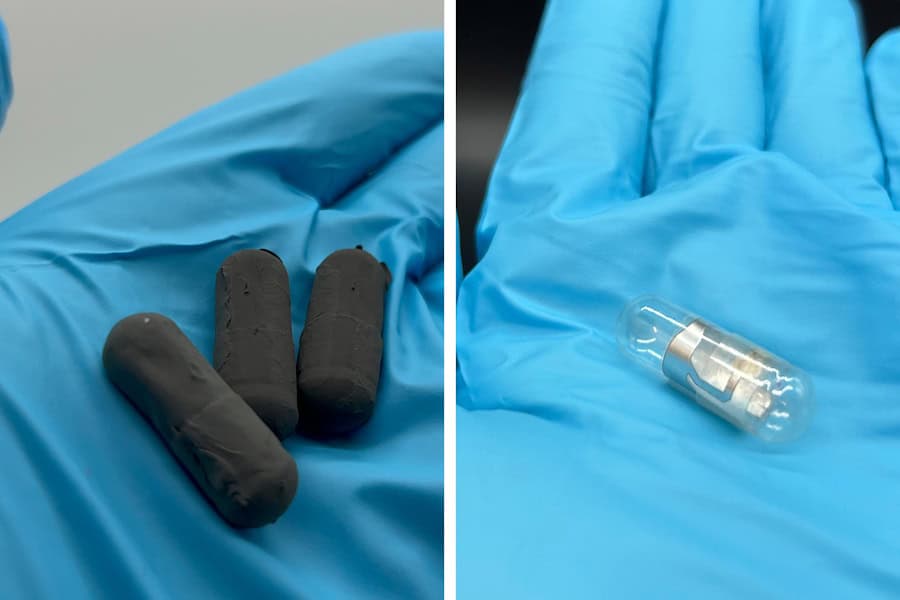
The device – named SAFARI (smart adherence via Faraday cage and resorbable ingestible) – incorporates an RFID tag with a zinc foil RF antenna and an RF chip, as well as the drug payload, inside an ingestible gelatin capsule. The capsule is coated with a mixture of cellulose and molybdenum particles, which blocks the transit of any RF signals.
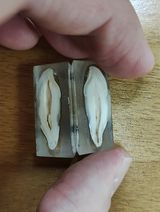
SAFARI capsules Photos of the capsules with (left) and without (right) the RF-blocking coating. (Courtesy: Mehmet Say)
Once swallowed, however, this shielding layer breaks down in the stomach. The RFID tag (which can be preprogrammed with information such as dose metadata, manufacturing details and unique ID) can then be wirelessly queried by an external reader and return a signal from inside the body confirming that the medication has been ingested.
The capsule itself dissolves upon exposure to digestive fluids, releasing the desired medication; the metal antenna components also dissolve completely in the stomach. The use of biodegradable materials is key as it eliminates the need for device retrieval and minimizes the risk of gastrointestinal (GI) blockage. The tiny (0.16 mm²) RFID chip remains intact and should safely leave the body through the GI tract.
Traverso suggests that the first clinical applications for the SAFARI capsule will likely be high-risk settings in which objective ingestion confirmation is particularly valuable. “[This includes] tuberculosis, HIV, transplant immunosuppression or cardiovascular therapies, where missed doses can have serious clinical consequences,” he tells Physics World.
In vivo demonstration
To assess the degradation of the SAFARI capsule and its components in vitro, Traverso and colleagues placed the capsule into simulated gastric fluid at physiological temperature (37 °C). The RF shielding coating dissolved in 10–20 min, while the capsule and the zinc layer in the RFID tag disintegrated into pieces after one day.
Next, the team endoscopically delivered the SAFARI capsules into the stomachs of sedated pigs, chosen as they have a similar sized GI tract to humans. Once in contact with gastric fluid in the stomach, the capsule coating swelled and then partially dissolved (as seen using endoscopic images), exposing the RFID tag. The researchers found that, in general, the tag and capsule parts disintegrated in the stomach at up to 24 h later.
A panel antenna positioned 10 cm from the animal captured the tag data. Even with the RFID tags immersed in gastric fluid, the external receiver could effectively record signals in the frequency range of 900–925 MHz, with RSSI (received signal strength indicator) values ranging from 65 to 78 dB – demonstrating that the tag could effectively transmit RF signals from inside the stomach.
The researchers conclude that this successful use of SAFARI in swine indicates the potential for translation to clinical research. They note that the device should be safe for human ingestion as its composite materials meet established dietary and biomedical exposure limits, with levels of zinc and molybdenum orders of magnitude below those associated with toxicity.
“We have demonstrated robust performance and safety in large-animal models, which is an important translational milestone,” explains first author Mehmet Girayhan Say. “Before human studies, further work is needed on chronic exposure with characterization of any material accumulation upon repeated dosing, as well as user-centred integration of external readers to support real-world clinical workflows.”
Chinese commercial firm CAS Space launched its first Lihong-1 suborbital flight and recovery test mission, seeing a successful parachute descent of the capsule.
Long known for communicating through scent and sound, learn how deer may also be using photoluminescence to advertise their presence and mating status.
Learn how growth patterns in tooth enamel and residues trapped in dental plaque were used to reconstruct childhood development and adult diets in an Iron Age Italian community.
When President John F. Kennedy stood before Congress in May 1961 and declared that the United States would land a man on the moon before the decade’s end, his purpose was not to invent the space program, but to impose a clear objective, a deadline and the resources to unify these efforts. The success of […]
Physicists at the University of Stuttgart, Germany have teleported a quantum state between photons generated by two different semiconductor quantum dot light sources located several metres apart. Though the distance involved in this proof-of-principle “quantum repeater” experiment is small, members of the team describe the feat as a prerequisite for future long-distance quantum communications networks.
“Our result is particularly exciting because such a quantum Internet will encompass these types of distant quantum nodes and will require quantum states that are transmitted among these different nodes,” explains Tim Strobel, a PhD student at Stuttgart’s Institute of Semiconductor Optics and Functional Interfaces (IHFG) and the lead author of a paper describing the research. “It is therefore an important step in showing that remote sources can be effectively interfaced in this way in quantum teleportation experiments.”
In the Stuttgart study, one of the quantum dots generates a single photon while the other produces a pair of photons that are entangled – meaning that the quantum state of one photon is closely linked to the state of the other, no matter how far apart they are. One of the photons in the entangled pair then travels to the other quantum dot and interferes with the photon there. This process produces a superposition that allows the information encapsulated in the single photon to be transferred to the distant “partner” photon from the pair.
Quantum frequency converters
Strobel says the most challenging part of the experiment was making photons from two remote quantum dots interfere with each other. Such interference is only possible if the two particles are indistinguishable, meaning they must be similar in every regard, be it in their temporal shape, spatial shape or wavelength. In contrast, each quantum dot is unique, especially in terms of its spectral properties, and each one emits photons at slightly different wavelengths.
To close the gap, the team used devices called quantum frequency converters to precisely tune the wavelength of the photons and match them spectrally. The researchers also used the converters to shift the original wavelengths of the photons emitted from the quantum dots (around 780 nm) to a wavelength commonly used in telecommunications (1515 nm) without altering the quantum state of the photons. This offers further advantages: “Being at telecommunication wavelengths makes the technology compatible with the existing global optical fibre network, an important step towards real-life applications,” Strobel tells Physics World.
Proof-of-principle experiment
In this work, the quantum dots were separated by an optical fibre just 10 m in length. However, the researchers aim to push this to considerably greater distances in the future. Strobel notes that the Stuttgart study was published in Nature Communications back-to-back with an independent work carried out by researchers led by Rinaldo Trotta of Sapienza University in Rome, Italy. The Rome-based group demonstrated quantum state teleportation across the Sapienza University campus at shorter wavelengths, enabled by the brightness of their quantum-dot source.
“These two papers that we published independently strengthen the measurement outcomes, demonstrating the maturity of quantum dot light sources in this domain,” Strobel says. Semiconducting quantum dots are particularly attractive for this application, he adds, because as well as producing both single and entangled photons on demand, they are also compatible with other semiconductor technologies.
Fundamental research pays off
Simone Luca Portalupi, who leads the quantum optics group at IHFG, notes that “several years of fundamental research and semiconductor technology are converging into these quantum teleportation experiments”. For Peter Michler, who led the study team, the next step is to leverage these advances to bring quantum-dot-based teleportation technology out of a controlled laboratory environment and into the real world.
Strobel points out that there is already some precedent for this, as one of the group’s previous studies showed that they could maintain photon entanglement across a 36-km fibre link deployed across the city of Stuttgart. “The natural next step would be to show that we can teleport the state of a photon across this deployed fibre link,” he says. “Our results will stimulate us to improve each building block of the experiment, from the sample to the setup.”
If you stayed in a hotel last night, there’s a good chance you saw that familiar placard in the bathroom: “Help save the planet — hang your towel and we won’t wash it.” At a recent panel, I asked the audience how many had seen that sign. Most hands went up. Then I asked them […]
This episode of the Physics World Weekly podcast features a conversation with Tim Prior and John Devaney of the National Physical Laboratory (NPL), which is the UK’s national metrology institute.
Prior is NPL’s quantum programme manager and Devaney is its quantum standards manager. They talk about NPL’s central role in the recent launch of NMI-Q, which brings together some of the world’s leading national metrology institutes to accelerate the development and adoption of quantum technologies.
Prior and Devaney describe the challenges and opportunities of developing metrology and standards for rapidly evolving technologies including quantum sensors, quantum computing and quantum cryptography. They talk about the importance of NPL’s collaborations with industry and academia and explore the diverse career opportunities for physicists at NPL. Prior and Devaney also talk about their own careers and share their enthusiasm for working in the cutting-edge and fast-paced field of quantum metrology.
This podcast is sponsored by the National Physical Laboratory.
SpaceX’s 2026 IPO plans were an early Christmas present for space investors who were already bullish about the year ahead. The move helps push the industry further into the mainstream investment and public consciousness. It also paves the way for others to go public in a capital-intensive business. Despite ongoing financial uncertainty, demand for sovereign […]
The global security environment is becoming more volatile, not less. The war in Ukraine grinds on. China is increasingly assertive in the Indo-Pacific. The Middle East remains unstable. North Korea continues to test missiles and challenge regional stability. Together, these dynamics are straining the international system in ways not seen since the early Cold War. […]
 Connexion