Discover how widespread self-sabotaging behavior is linked to how our brains evolved in a world full of unknown dangers and how to break the cycle for good.
Learn how radio observations uncovered unusually hot gas inside a young galaxy cluster, revealing how black holes and star formation may heat clusters far earlier than expected.
Thanks to an enormous stroke of luck and serendipitous timing, astronomers were able to calculate the mass and distance of a free-floating planet for the first time. Learn more about it.
Multiple studies have linked cellphone use to an increased risk of car accidents. Learn how new research suggests delays in rapid-eye movement when talking might be at least partly to blame.
Learn how ancient DNA from human remains provided the first direct evidence that a common childhood virus has been part of the human genome since the Iron Age.
House and Senate appropriators have released the text of a final appropriations bill for fiscal 2026 that largely rejects the steep cuts the Trump administration proposed for NASA.
Dubai / Male’ November 18, 2025 – ARCHE ORBITAL SYSTEMS, a global space-technology company specializing in advanced mission design and in-orbit services operations, has signed a Memorandum of Understanding (MoU) […]
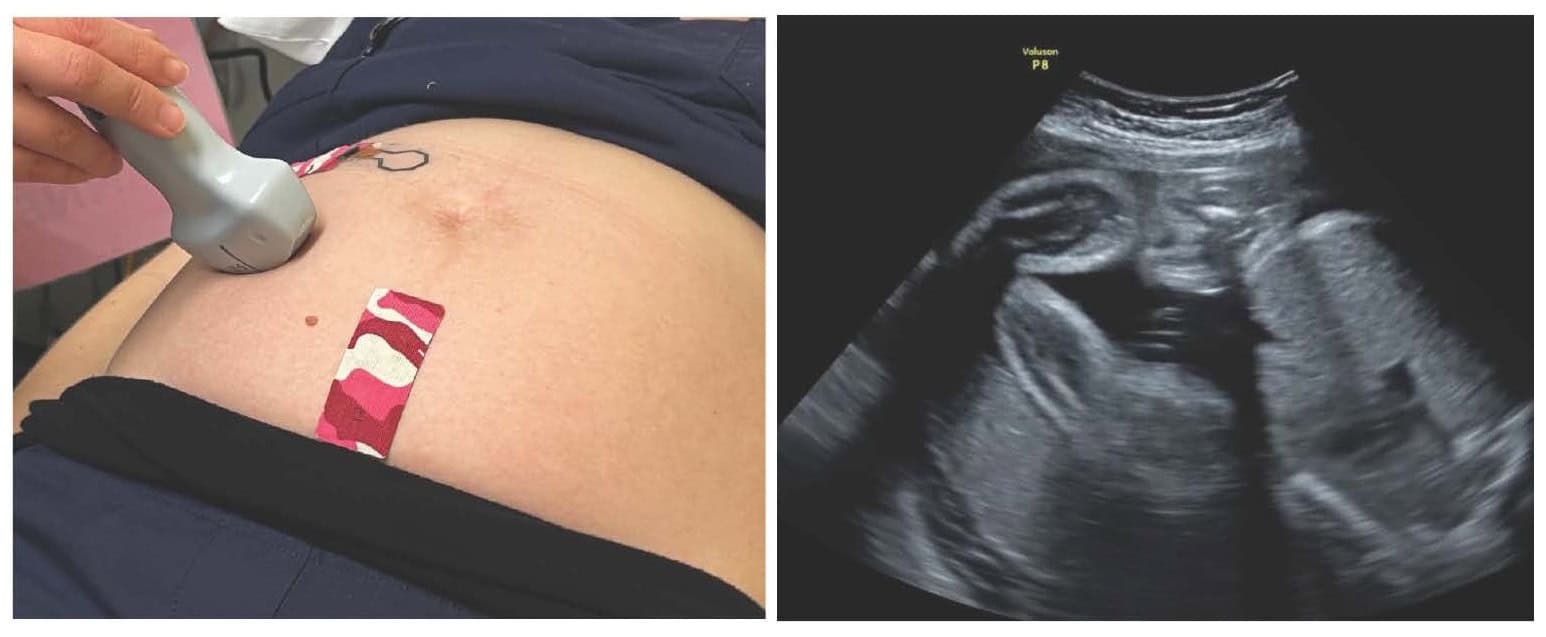
Multimodal monitoring Pressure and strain sensors on a clinical trial volunteer undergoing an ultrasound scan (left). Snapshot image of the ultrasound video recording (right). (Courtesy: Yap et al., Sci. Adv. 11 eady2661)
The ability to continuously monitor and interpret foetal movement patterns in the third trimester of a pregnancy could help detect any potential complications and improve foetal wellbeing. Currently, however, such assessment of foetal movement is performed only periodically, with an ultrasound exam at a hospital or clinic.
A lightweight, easily wearable, adhesive patch-based sensor developed by engineers and obstetricians at Monash University in Australia may change this. The patches, two of which are worn on the abdomen, can detect foetal movements such as kicking, waving, hiccups, breathing, twitching, and head and trunk motion.
Reduced foetal movement can be associated with potential impairment in the central nervous system and musculoskeletal system, and is a common feature observed in pregnancies that end in foetal death and stillbirth. A foetus compromised in utero may reduce movements as a compensatory strategy to lower oxygen consumption and conserve energy.
To help identify foetuses at risk of complications, the Monash team developed an artificial intelligence (AI)-powered wearable pressure–strain combo sensor system that continuously and accurately detects foetal movement-induced motion in the mother’s abdominal skin. As reported in Science Advances, the “band-aid”-like sensors can discriminate between foetal and non-foetal movement with over 90% accuracy.
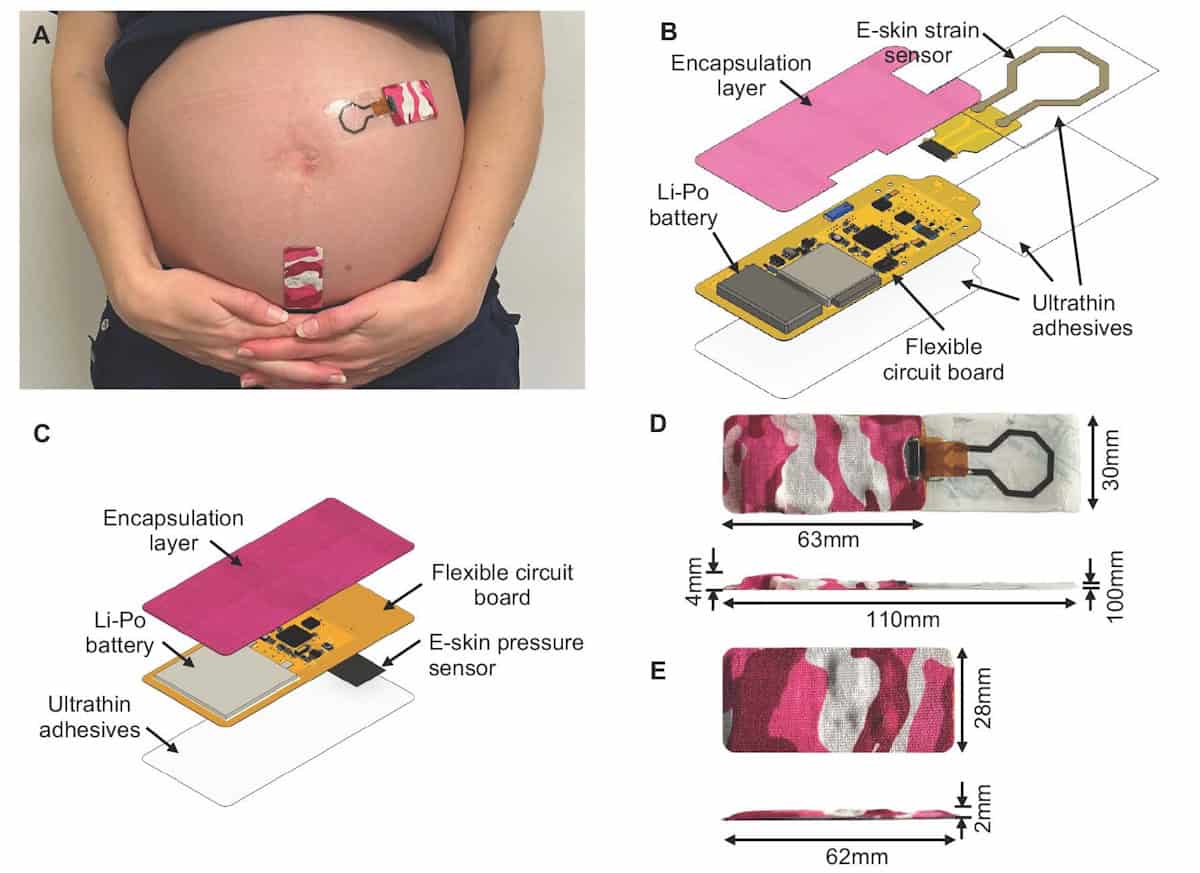
The system comprises two soft, thin and flexible patches designed to conform to the abdomen of a pregnant woman. One patch incorporates an octagonal gold nanowire-based strain sensor (the “Octa” sensor), the other is an interdigitated electrode-based pressure sensor.
Pressure and strain combo Photograph of the sensors on a pregnant mother (A). Exploded illustration of the foetal kicks strain sensor (B) and the pressure sensor (C). Dimensions of the strain (D) and pressure (E) sensors. (Courtesy: Yap et al., Sci. Adv. 11 eady2661)
The patches feature a soft polyimide-based flexible printed circuit (FPC) that integrates a thin lithium polymer battery and various integrated circuit chips, including a Bluetooth radiofrequency system for reading the sensor’s electrical resistance, storing data and communicating with a smartphone app. Each patch is encapsulated with kinesiology tape and sticks to the abdomen using a medical double-sided silicone adhesive.
The Octa sensor is attached to a separate FPC connector attached to the primary device, enabling easy replacement after each study. The pressure sensor is mounted on the silicone adhesive, to connect with the interdigitated electrode beneath the primary device. The Octa and pressure sensor patches are lightweight (about 3 g) and compact, measuring 63 x 30 x 4 mm and 62 x 28 x 2 mm, respectively.
Trialling the device
The researchers validated their foetal movement monitoring system via comparison with simultaneous ultrasound exams, examining 59 healthy pregnant women at Monash Health. Each participant had the pressure sensor attached to the area of their abdomen where they felt the most vigorous foetal movements, typically in the lower quadrant, while the strain sensor was attached to the region closest to foetal limbs. An accelerometer placed on the participant’s chest captured non-foetal movement data for signal denoising and training the machine-learning model.
Principal investigator Wenlong Cheng, now at the University of Sydney, and colleagues report that “the wearable strain sensor featured isotropic omnidirectional sensitivity, enabling detection of maternal abdominal [motion] over a large area, whereas the wearable pressure sensor offered high sensitivity with a small domain, advantageous for accurate localized foetal movement detection”.
The researchers note that the pressure sensor demonstrated higher sensitivity to movements directly beneath it compared with motion farther away, while the Octa sensor performed consistently across a wider sensing area. “The combination of both sensor types resulted in a substantial performance enhancement, yielding an overall AUROC [area under the receiver operating characteristic curve] accuracy of 92.18% in binary detection of foetal movement, illustrating the potential of combining diverse sensing modalities to achieve more accurate and reliable monitoring outcomes,” they write.
In a press statement, co-author Fae Marzbanrad explains that the device’s strength lies in a combination of soft sensing materials, intelligent signal processing and AI. “Different foetal movements create distinct strain patterns on the abdominal surface, and these are captured by the two sensors,” she says. “The machine-learning system uses the signals to detect when movement occurs while cancelling maternal movements.”
The lightweight and flexible device can be worn by pregnant women for long periods without disrupting daily life. “By integrating sensor data with AI, the system automatically captures a wider range of foetal movements than existing wearable concepts while staying compact and comfortable,” Marzbanrad adds.
The next steps towards commercialization of the sensors will include large-scale clinical studies in out-of-hospital settings, to evaluate foetal movements and investigate the relationship between movement patterns and pregnancy complications.
A small but important change can be found at the end of President Trump’s sweeping December 18, 2025, Executive Order, “Ensuring American Space Superiority.” The Executive Order removes the requirement for the United States government to make basic space situational awareness data and space traffic management services available “free of direct user fees,” instead saying […]
China’s astronaut corps has completed a near month-long underground cave training, conducted in part to prepare for future crewed lunar landing missions.
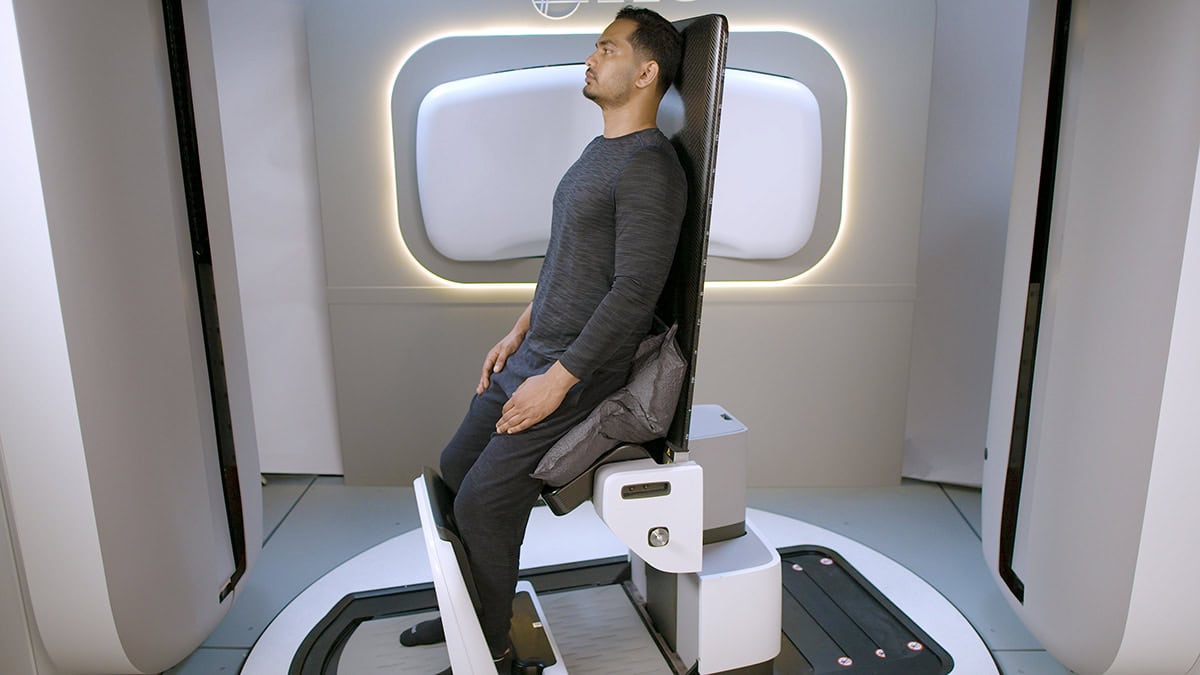
Since the beginning of radiation therapy, almost all treatments have been delivered with the patient lying on a table while the beam rotates around them. But a resurgence in upright patient positioning is changing that paradigm. Novel radiation accelerators such as proton therapy, VHEE, and FLASH therapy are often too large to rotate around the patient, making access limited. By instead rotating the patient, these previously hard-to-access beams could now become mainstream in the future.
Join leading clinicians and experts as they discuss how this shift in patient positioning is enabling exploration of new treatment geometries and supporting the development of advanced future cancer therapies.
L-R Serdar Charyyev, Eric Deutsch, Bill Loo, Rock Mackie
Novel beams covered and their representative speaker
Serdar Charyyev – Proton Therapy – Clinical Assistant Professor at Stanford University School of Medicine Eric Deutsch – VHEE FLASH – Head of Radiotherapy at Gustave Roussy Bill Loo – FLASH Photons – Professor of Radiation Oncology at Stanford Medicine Rock Mackie – Emeritus Professor at University of Wisconsin and Co-Founder and Chairman of Leo Cancer Care
Be curious As CTO of a quantum tech company, Andrew Lamb values evidence-based decision making and being surrounded by experts. (Courtesy: Delta.g)
What skills do you use every day in your job?
A quantum sensor is a combination of lots of different parts working together in harmony: a sensor head containing the atoms and isolating them from the environment; a laser system to probe the quantum structure and manipulate atomic states; electronics to drive the power and timing of a device; and software to control everything and interpret the data. As the person building, developing and maintaining these devices you need to have expertise across all these areas. In addition to these skills, as the CTO my role also requires me to set the company’s technical priorities, determine the focus of R&D activities and act as the top technical authority in the firm.
In a developing field like quantum metrology, evidence-based decision making is crucial as you critically assess information, disregarding what is irrelevant and making an informed choice – especially when the “right answer” may not be obvious for months or even years. Challenges arise that may never have been solved before, and the best way to do so is to dive deep into the “why and how” something happens. Once the root cause is identified a creative solution then needs to be found; whether it is something brand new, or implementing an approach from an entirely different discipline.
What do you like best and least about your job?
The best thing about my job is the way in which it enables me to grow my knowledge and understanding of a wide variety of fields, while also providing me opportunities for creative problem solving. When you surround yourself with people who are experts in their field, there is no end to the opportunities to learn. Before co-founding Delta.g I was a researcher at the University of Birmingham where I learnt my technical skills. Moving into a start-up, we built a multidisciplinary team to address the operational, regulatory and technical barriers to establish a disruptive product in the marketplace. The diversity created within our company has afforded a greater pool of experts to learn from.
As the CTO, my role sits at the intersection of the technical and the commercial within the business. That means it is my responsibility to translate commercial milestones into a scientific plan, while also explaining our progress to non-experts. This can be challenging and quite stressful at times – particularly when I need to describe our scientific achievements in a way that truly reflects our advances, while still being accessible.
What do you know today that you wish you knew when you were starting out in your career?
For a long time, I didn’t know what direction I wanted to take, and I used to worry that the lack of a clear purpose would hold me back. Today I know that it doesn’t. Instead of fixating on finding a perfect path early on, it’s far more valuable to focus on developing skills that open doors. Whether those skills are technical, managerial or commercial, no knowledge is ever wasted. I’m still surprised by how often something I learned as far back as GCSE ends up being useful in my work now.
I also wish I had understood just how important it is to stay open to new opportunities. Looking back, every pivotal point in my career – switching from civil engineering to a physics degree, choosing certain undergraduate modules, applying for unexpected roles, even co-founding Delta.g – came from being willing to make a shift when an opportunity appeared. Being flexible and curious matters far more than having everything mapped out from the beginning.
The administration has made it clear that Nicolás Maduro's capture was tied to Venezuela’s vast oil reserves. Much less certain is how US companies will actually access them—or if they even want to.
Descriptive set theorists study the niche mathematics of infinity. Now, they’ve shown that their problems can be rewritten in the concrete language of algorithms.
Orbital launch activity set another annual record in 2025, although future growth may depend on factors different from those that fueled the recent surge.
A Spanish military communications satellite launched in October was struck by what its operator described as a “space particle,” an incident that could jeopardize the spacecraft’s mission.
 Connexion








 Since the beginning of radiation therapy, almost all treatments have been delivered with the patient lying on a table while the beam rotates around them. But a resurgence in upright patient positioning is changing that paradigm. Novel radiation accelerators such as proton therapy, VHEE, and FLASH therapy are often too large to rotate around the patient, making access limited. By instead rotating the patient, these previously hard-to-access beams could now become mainstream in the future.