South Korea’s Innospace said it will attempt a second launch of its small rocket in the first half of 2026 after its inaugural flight failed shortly after liftoff Dec. 22.
How well have you been following events in physics? There are 20 questions in total: blue is your current question and white means unanswered, with green and red being right and wrong.
16–20 Top quark – congratulations, you’ve hit Einstein level
11–15 Strong force – good but not quite Nobel standard
WIRED spoke with DeepMind’s Pushmeet Kohli about the recent past—and promising future—of the Nobel Prize-winning research project that changed biology and chemistry forever.
ZAP-X is a next-generation, cobalt-free, vault-free stereotactic radiosurgery system purpose-built for the brain. Delivering highly precise, non-invasive treatments with exceptionally low whole-brain and whole-body dose, ZAP-X’s gyroscopic beam delivery, refined beam geometry and fully integrated workflow enable state-of-the-art SRS without the burdens of radioactive sources or traditional radiation bunkers.
Theresa Hofman
Theresa Hofman is deputy head of medical physics at the European Radiosurgery Center Munich (ERCM), specializing in stereotactic radiosurgery with the CyberKnife and ZAP‑X systems. She has been part of the ERCM team since 2018 and has extensive clinical experience with ZAP‑X, one of the first centres worldwide to implement the technology in 2021. Since then, the team has treated more than 900 patients with ZAP‑X, and she is deeply involved in both clinical use and evaluation of its planning software.
She holds a master’s degree in physics from Ludwig Maximilian University of Munich, where she authored two first‑author publications on range verification in carbon‑ion therapy. At ERCM, she has published additional first‑author studies on CyberKnife kidney‑treatment accuracy and on comparative planning between ZAP‑X and CyberKnife. She is currently conducting further research on the latest ZAP‑X planning software. Her work is driven by the goal of advancing high‑quality radiosurgery and ensuring the best possible treatment for every patient.
An Indian LVM3 rocket launched AST SpaceMobile’s next-generation direct-to-device BlueBird satellite Dec. 23, kicking off a rollout of dozens of spacecraft built around the largest commercial communications antenna ever deployed in LEO.
MILAN — The European Space Agency announced plans to hire approximately 520 new staff members starting in 2026, following decisions approved at ESA’s 342nd Council meeting earlier this month. The recruitment will result in a net increase of about 400 staff, alongside the replacement of roughly 120 positions due to retirements. The move will bring […]
In this episode of Space Minds, host David Ariosto speaks with Juan Alonso — CTO and Co-founder of Luminary Cloud and professor at Stanford University — about the rapid transformation underway in aerospace engineering.
This episode of the Physics World Weekly podcast features Pat Hanrahan, who studied nuclear engineering and biophysics before becoming a founding employee of Pixar Animation Studios. As well as winning three Academy Awards for his work on computer animation, Hanrahan won the Association for Computing Machinery’s A.M. Turing Award for his contributions to 3D computer graphics, or CGI.
Earlier this year, Hanrahan spoke to Physics World’s Margaret Harris at the Heidelberg Laureate Forum in Germany. He explains how he was introduced to computer graphics by his need to visualize the results of computer simulations of nervous systems. That initial interest led him to Pixar and his development of physically-based rendering, which uses the principles of physics to create realistic images.
Hanrahan explains that light interacts with different materials in very different ways, making detailed animations very challenging. Indeed, he says that creating realistic looking skin is particularly difficult – comparing it to the quest for a grand unified theory in physics.
He also talks about how having a background in physics has helped his career – citing his physicist’s knack for creating good models and then using them to solve problems.
 Connexion







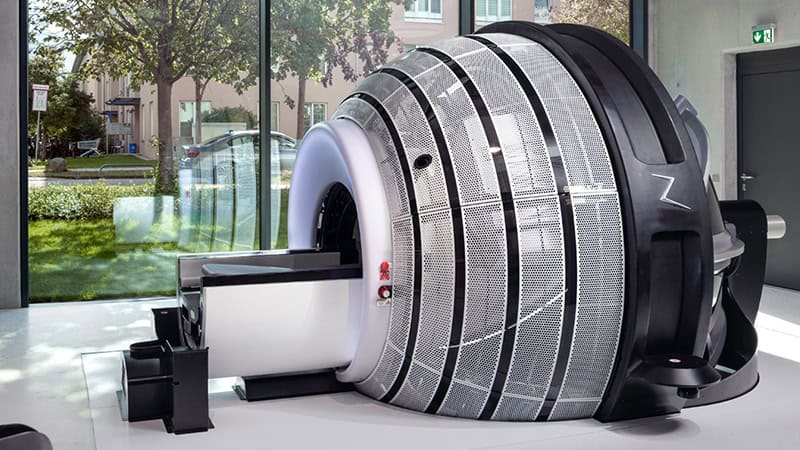 ZAP-X is a next-generation, cobalt-free, vault-free stereotactic radiosurgery system purpose-built for the brain. Delivering highly precise, non-invasive treatments with exceptionally low whole-brain and whole-body dose, ZAP-X’s gyroscopic beam delivery, refined beam geometry and fully integrated workflow enable state-of-the-art SRS without the burdens of radioactive sources or traditional radiation bunkers.