In this episode of Space Minds, host Mike Gruss talks with Dr. Gurpartap “GP” Sandhoo about what he calls "almost a watershed year" for the Space Development Agency.
Recent analysis by Reeves in the Mitchell Institute’s “Charting a Path to Space Superiority: The Cross-Domain Imperative” identifies the need for centralized command and control (C2) of counterspace capabilities under U.S. Space Command to ensure unity of effort. However, Reeves’s critique of the United States Army’s development of counterspace capabilities fundamentally misunderstands the Army’s role […]
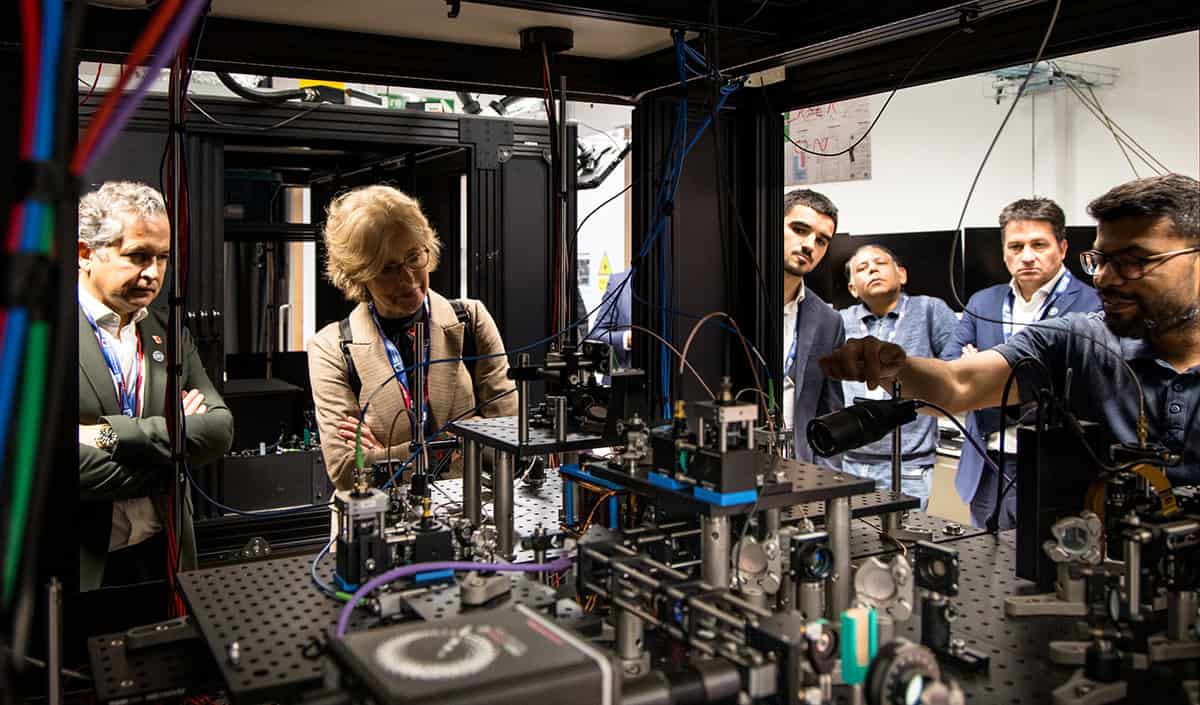
Julia Sutcliffe (second from the left), Chief Scientific Advisor for the UK’s Department for Business and Trade, visits the NQCC’s experimental facilities on the Harwell Cluster (Courtesy: NQCC)
Ever since the National Quantum Computing Centre was launched five years ago, its core mission has been to accelerate the pathway towards practical adoption of the technology. That has required technical innovation to scale up hardware platforms and create the software tools and algorithms needed to tackle real-world applications, but there has also been a strong focus on engaging with companies to build connections, provide access to quantum resources, and identify opportunities for deriving near-term value from quantum computing.
It makes sense, then, that the NQCC should form the cornerstone of a new Quantum Cluster at the Harwell Campus of Science and Innovation in Oxfordshire. The hope is that the NQCC’s technical expertise and infrastructure, combined with the services and facilities available on the wider Harwell Campus, will provide a magnet for new quantum start-ups as well as overseas companies that are seeking to establish a presence within the UK’s quantum ecosystem.
By accelerating collaboration across government, industry and academia, we will turn research excellence into industrial strength.
“We want to leverage the public investment that has been made into the NQCC to catalyse business growth and attract more investment into the UK’s quantum sector,” said Najwa Sidqi, manager of the Harwell Quantum Cluster, at the official launch event in November. “By accelerating collaboration across government, industry and academia, we will turn research excellence into industrial strength.”
The cluster, which has been ramping up its activities over the last year, is working to ambitious targets. Over the next decade the aim is to incubate at least 100 quantum companies on the Harwell site, create more than 1000 skilled jobs, and generate more than £1 billion of private and public investment. “Our aim is to build the foundations of a globally competitive quantum economy that delivers impact far beyond science and research,” added Sidqi.
Tangible evidence that the approach works is offered by the previous clustering activities on the Harwell Campus, notably the Space Cluster that has expanded rapidly since its launch in 2010. Anchored by the RAL Space national laboratory and bolstered by the presence of ESA and the UK Space Agency, the Space Cluster now comprises more than 100 organizations that range from small start-ups to the UK technology hubs of global heavyweights such as Airbus and Lockheed Martin.
More generally, the survival rate of start-up companies operating on the Harwell site is around 95%, compared with an average of around 50%. “At Harwell there is a high density of innovators sharing the same space, which generates more connections and more ideas,” said Julia Sutcliffe, Chief Scientific Advisor for the UK’s Department for Business and Trade. “It provides an incredible combination of world-class infrastructure and expertise, accelerating the innovation pathway and helping to create a low-risk environment for early-stage businesses and investors.”
The NQCC has already seeded that innovation activity through its early engagement with both quantum companies and end users of the technology. One major initiative has been the testbed programme, which has enabled the NQCC to invest £30m in seven hardware companies to deploy prototype quantum computers on the Harwell Campus. As well as providing access to operational systems based on all of the leading qubit modalities, the testbed programme has also provided an impetus for inward investment and job creation.
One clear example is provided by QuEra Computing, a US-based spin-off from Harvard University and the Massachusetts Institute of Technology that is developing a hardware platform based on neutral atoms. QuEra was one of the companies to win funding through the testbed programme, with the firm setting up a UK-based team to deploy its prototype system on the Harwell Campus. But the company could soon see the benefits of establishing a UK centre for technology development on the site. “Harwell is immensely helpful to us,” said Ed Durking, Corporate Director of QuEra Computing UK. “It’s a nucleus where we enjoy access to world-class talent, vendors, customers, and suppliers.”
On a practical level, establishing its UK headquarters on the Harwell Campus has provided QueEra with easy access to specialist contractors and services for fitting out and its laboratories. In June the company moved into a building that is fully equipped with flexible lab space for R&D and manufacturing, and since then the UK-based team has started to build the company’s most powerful quantum computer at the facility. Longer term, establishing a base within the UK could open the door to new collaborations and funding opportunities for QuEra to further develop its technology, with the company now focused on integrating full error correction into its neutral-atom platform by 2026.
Access to the world-class infrastructure on the Harwell Campus has benefitted the other testbed providers in different ways. For ORCA Computing, a UK company developing and manufacturing photonic quantum computers, the goal was to install a testbed system within Harwell’s high-performance computing centre rather than the NQCC’s experimental labs. “Our focus is to build commercial photonic quantum systems that can be integrated into conventional datacentres, enabling hybrid quantum-classical workflows for real-world applications,” explained Geoff Barnes, Head of Customer Success at ORCA. “Having the NQCC as an expert customer enabled us to demonstrate and validate our capabilities, building the system in our own facility and then deploying it within an operational environment.”
This process provided a valuable learning experience for the ORCA engineers. The experts at Harwell helped them to navigate the constraints of installing equipment within a live datacentre, while also providing practical assistance with the networking infrastructure. Now that the system is up and running, the Harwell site also provides ORCA with an open environment for showcasing its technology to prospective customers. “As well as delivering a testbed system to the NQCC, we can now demonstrate our platform to clients within a real-world setting,” added Barnes. “It has also been a critical step toward commercial deployment on our roadmap, enabling our partners to access our systems remotely for applications development.”
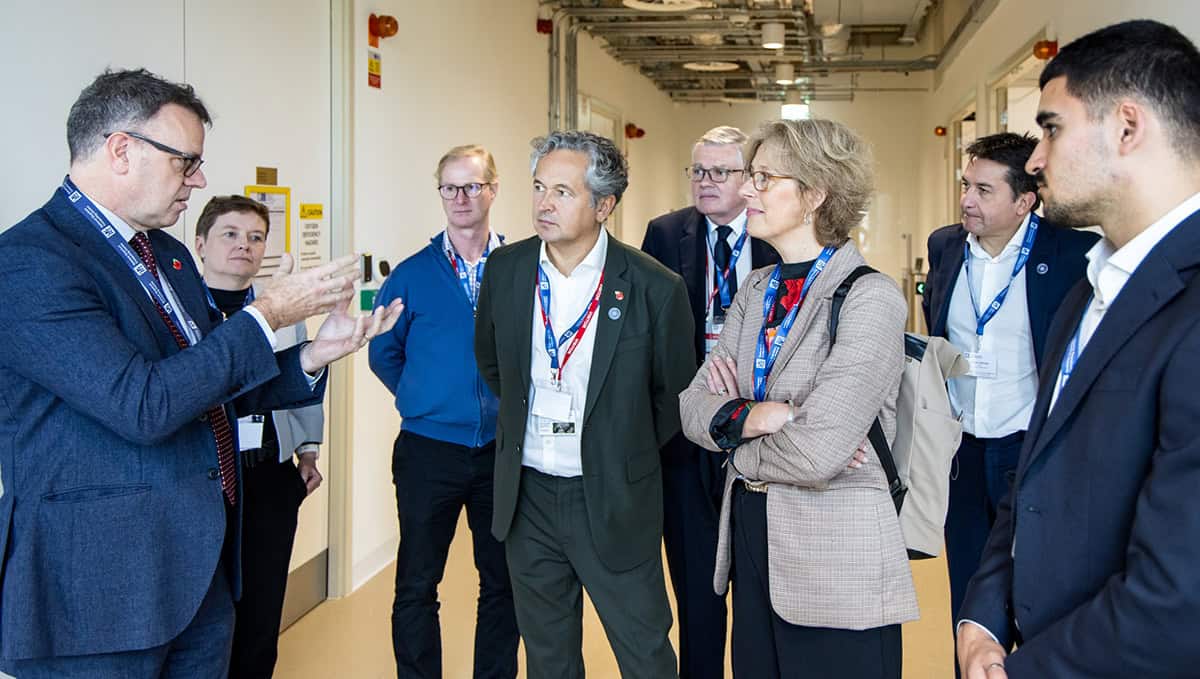
Michael Cuthbert (left), Director of the NQCC, takes Sutcliffe and other visitors on a tour of the national lab (Courtesy: NQCC)
While the NQCC has already played a vital role in supporting companies as they make the transition towards commercialization, the Quantum Cluster has a wider remit to extend those efforts into other quantum technologies, such as sensing and communications, that are already finding real-world applications. It will also have a more specific focus on attracting new investment into the UK, and supporting the growth of companies that are transitioning from the start-up phase to establish larger scale commercial operations.
“In the UK we have traditionally been successful in creating spin-off activities from our strong research base, but it has been more challenging to generate the large capital investments needed to scale businesses in the technology sector,” commented Sidqi. “We want to strengthen that pipeline to ensure that the UK can translate its leadership in quantum research and early-stage innovation into long-term prosperity.”
To accelerate that process the Quantum Cluster announced a strategic partnership with Quantum Exponential, the first UK-based venture capital fund to be entirely focused on quantum technologies. Ian Pearson, the non-executive chairman of the Quantum Exponential, explained that the company is working to generate an investment fund of £100m by the end of 2027 that will support quantum companies as they commercialize their technologies and scale up their businesses. “Now is the time for investment into quantum sector,” said Pearson. “A specialist quantum fund with the expertise needed to analyse and price deals, and to do all the necessary due diligence, will attract more private investment that will help UK companies to grow and scale.”
Around two-thirds of the investments will be directed towards UK-based companies, and as part of the partnership Quantum Exponential will work with the Quantum Cluster to identify and support high-potential quantum businesses within the Harwell Campus. The Quantum Cluster will also play a crucial role in boosting investor confidence – particularly in the unique ability of the Harwell Campus to nurture successful technology businesses – and making connections with international innovation networks to provide UK-based companies with improved access to global markets.
“This new cluster strengthens our national capability and sends a clear signal to global investors that the UK is the place to develop and scale quantum technologies,” commented Michael Cuthbert, Director of the NQCC. “It will help to ensure that quantum innovation delivers benefits not just for science and industry, but for the economy and society as a whole.”
The space community welcomed the confirmation of Jared Isaacman as NASA’s next administrator, expressing hope he can lead the agency forward and relief that a long confirmation process is over.
An aerogel material that is more than 99% transparent to light and is an excellent thermal insulator has been developed by Ivan Smalyukh and colleagues at the University of Colorado Boulder in the US. Called MOCHI, the material can be manufactured in large slabs and could herald a major advance in energy-efficient windows.
While the insulating properties of building materials have steadily improved over the past decades, windows have consistently lagged behind. The problem is that current materials used in windows – mostly glass – have an inherent trade-off between insulating ability and optical transparency. This is addressed to some extent by using two or three layers of glass in double- and triple-glazed windows. However, windows remain the largest source of heat loss from most buildings.
A solution to the window problem could lie with aerogels in which the liquid component of a regular gel is replaced with air. This creates solid materials with networks of pores that make aerogels the lightest solid materials ever produced. If the solid component is a poor conductor of heat, then the aerogel will be an extremely good thermal insulator.
“Conventional aerogels, like the silica and cellulose based ones, are common candidates for transparent, thermally insulating materials,” Smalyukh explains. “However, their visible-range optical transparency is intrinsically limited by the scattering induced by their polydisperse pores – which can range from nanometres to micrometres in scale.”
Hazy appearance
While this problem can be overcome fairly easily in thin aerogel films, creating appropriately-sized pores on the scale of practical windows has so far proven much more difficult, leading to a hazy, translucent appearance.
Now, Smalyukh’s team has developed a new fabrication technique involving a removable template. Their approach hinges on the tendency of surfactant molecules called CPCL to self-assemble in water. Under carefully controlled conditions, the molecules spontaneously form networks of cylindrical tubes, called micelles. Once assembled, the aerogel precursor – a silicone material called polysiloxane – condenses around the micelles, freezing their structure in place.
“The ensuing networks of micelle-templated polysiloxane tubes could be then preserved upon the removal of surfactant, and replacing the fluid solvent with air,” Smalyukh describes. The end result was a consistent mesoporous structure, with pores ranging from 2–50 nm in diameter. This is too small to scatter visible light, but large enough to interfere with heat transport.
As a result, the mesoporous, optically clear heat insulator (MOCHI) maintains its transparency even when fabricated in slabs over 3 cm thick and a square metre in area. This suggests that it could be used to create practical windows.
High thermal performance
“We demonstrated thermal conductivity lower than that of still air, as well as an average light transmission above 99%,” Smalyukh says. “Therefore, MOCHI glass units can provide a similar rate of heat transfer to high-performing building roofs and walls, with thicknesses comparable to double pane windows.”
If rolled out on commercial scales, this could lead to entirely new ways to manage interior heating and cooling. According to the team’s calculations, a building retrofitted with MOCHI windows could boost its energy efficiency from around 6% (a typical value in current buildings) to over 30%, while reducing the heat energy passing through by around 50%.
With its ability to admit light while blocking heat transport, the researchers suggest that MOCHI could unlock entirely new functionalities for conventional windows. “Such transparent insulation also allows for efficient harnessing of thermal energy from unconcentrated solar radiation in different climate zones, promising the use of parts of opaque building envelopes as solar thermal energy generating panels,” Smalyukh adds.
As the world looks to incorporate more renewables into energy grids, centuries-old systems that can balance supply and demand are being reappraised and innovated upon.
Errors are the bugbear of quantum computing, and they’re hard to avoid. While quantum computers derive their computational clout from the fact that their qubits can simultaneously court multiple values, the fragility of qubit states ramps up their error rates. Many research groups are therefore seeking to reduce or manage errors so they can increase the number of qubits without reducing the whole enterprise to gibberish.
A team at the US-based firm Atom Computing is now reporting substantial success in this area thanks to a multi-part strategy for keeping large numbers of qubits operational in quantum processors based on neutral atoms. “These capabilities allow for the execution of more complex, longer circuits that are not possible without them,” says Matt Norcia, one of the Atom Computing researchers behind this work.
While neutral atoms offer several advantages over other qubit types, they traditionally have significant drawbacks for one of the most common approaches to error correction. In this approach, some of the entangled qubits are set aside as so-called “ancillaries”, used for mid-circuit measurements that can indicate how a computation is going and what error correction interventions may be necessary.
In neutral-atom quantum computing, however, such interventions are generally destructive. Atoms that are not in their designated state are simply binned off – a profligate approach that makes it challenging to scale up atom-based computers. The tendency to discard atoms is particularly awkward because the traps that confine atoms are already prone to losing atoms, which introduces additional errors while reducing the number of atoms available for computations.
Reduce, re-use, replenish
As well as demonstrating protocols for performing measurements to detect errors in quantum circuits with little atom loss, the researchers at Atom Computing also showed they could re-use ancillary atoms – a double-pronged way of retaining more atoms for calculations. In addition, they demonstrated that they could replenish the register of atoms for the computation from a spatially separated stash in a magneto-optic trap without compromising the quantum state of the atoms already in the register.
Norcia says that these achievements — replacing atoms from a continuous source, while reducing the number of atoms needing replacement to begin with — are key to running computations without running out of atoms. “To our knowledge, any useful quantum computations will require the execution of many layers of gates, which will not be possible unless the atom number can be maintained at a steady-state level throughout the computation,” he tells Physics World.
Cool and spaced out
Norcia and his collaborators at Microsoft Quantum, the Colorado School of Mines and Stanford University worked with ytterbium (Yb) atoms, which he describes as “natural qubits” since they have two ground states. A further advantage is that the transitions between these qubit states and other states used for imaging and cooling are weak, meaning the researchers could couple just one qubit state to these other states at a time. The team also leveraged a previously-developed approach for mid-circuit measurement that scatters light from only one qubit state and does not disturb the other, making it less destructive.
Still, Norcia tells Physics World, “the challenge was to re-use atoms, and key to this was cooling and performance.” To this end, they first had to shift the atoms undergoing mid-circuit measurements away from the atoms in the computational register, to avoid scattering laser light off the latter. They further avoided laser-related collateral damage by designing the register such that the measurement and cooling light was not at the resonant wavelength of the register atoms. Next, they demonstrated they could cool already-measured atoms for re-use in the calculation. Finally, they showed they could non-disruptively replenish these atoms with others from a magneto-optical trap positioned 300 nm below the tweezer arrays that held atoms for the computational register.
Mikhail Lukin, a physicist at Harvard University, US who has also worked on the challenges of atom loss and re-use in scalable, fault-tolerant neutral atom computing, has likewise recently reported successful atom re-use and diminished atom loss. Although Lukin’s work differs from that of the Atom Computing team in various ways – using rubidium instead of ytterbium atoms and a different approach for low atom loss mid-circuit measurements, for starters – he says that the work by Norcia and his team “represents an important technical advance for the Yb quantum computing platform, complementing major progress in the neutral atom quantum computing community in 2025”.
Data detectives see validation in deal with U.S. government that penalizes Dana-Farber Cancer Institute for misrepresenting data in NIH grant applications
Learn how a digitally reconstructed 1.5-million-year-old fossil from Ethiopia is reshaping ideas about what early human migrants out of Africa actually looked like.
NASA is at an inflection point. 2026 will now begin with a newly-confirmed Jared Isaacman as a NASA Administrator with the White House directive to beat China back to the moon with astronauts. On the science side, we hope that NASA will continue its in-depth exploration of the Earth, solar system and universe. While the […]
The Senate confirmed Jared Isaacman as NASA administrator Dec. 17, concluding arguably the most unusual effort to select a leader in the space agency’s history.
 Connexion