↩ Accueil

Vue lecture

Influential theoretical physicist and Nobel laureate Chen-Ning Yang dies aged 103

The Chinese particle physicist Chen-Ning Yang died on 18 October at the age of 103. Yang shared half of the 1957 Nobel Prize for Physics with Tsung-Dao Lee for their theoretical work that overturned the notion that parity is conserved in the weak force – one of the four fundamental forces of nature.

Born on 22 September 1922 in Hefei, China, Yang competed a BSc at the National Southwest Associated University in Kunming in 1942. After finishing an MSc in statistical physics at Tsinghua University two years later, in 1945 he moved to the University of Chicago in the US as part of a government-sponsored programme. He received his PhD in physics in 1948 working under the guidance of Edward Teller.

In 1949 Yang moved to the Institute for Advanced Study in Princeton, where he made pioneering contributions to quantum field theory, wotrking together with Robert Mills. In 1953 they proposed the Yang-Mills theory, which became a cornerstone of the Standard Model of particle physics.

The ‘Wu experiment’

It was also at Princeton where Yang began a fruitful collaboration with Lee, who died last year aged 97. Their work on parity – a property of elementary particles that expresses their behaviour upon reflection in a mirror – led to the duo winning the Nobel prize.

In the early 1950s, physicists had been puzzled by the decays of two subatomic particles, known as tau and theta, which are identical except that the tau decays into three pions with a net parity of -1, while a theta particle decays into two pions with a net parity of +1.

There were two possible explanations: either the tau and theta are different particles or that parity in the weak interaction is not conserved with Yang and Lee proposing various ways to test their ideas (Phys. Rev. 104 254).

This “parity violation” was later proved experimentally by, among others, Chien-Shiung Wu at Columbia University. She carried out an experiment based on the radioactive decay of unstable cobalt-60 nuclei into nickel-60 – what became known as the “Wu experiment”. For their work, Yang, who was 35 at the time, shared the 1957 Nobel Prize for Physics with Lee.

Influential physicist

In 1965 Yang moved to Stony Brook University, becoming the first director of the newly founded Institute for Theoretical Physics, which is now known as the C N Yang Institute for Theoretical Physics. During this time he also contributed to advancing science and education in China, setting up the Committee on Educational Exchange with China – a programme that has sponsored some 100 Chinese scholars to study in the US.

In 1997, Yang returned to Beijing where he became an honorary director of the Centre for Advanced Study at Tsinghua University. He then retired from Stony Brook in 1999, becoming a professor at Tsinghua University. During his time in the US, Yang obtained US citizenship, but renounced it in 2015.

More recently, Yang was involved in debates over whether China should build the Circular Electron Positron Collider (CEPC) – a huge 100 km circumference underground collider that would study the Higgs boson in unprecented detail and be a successor to CERN’s Large Hadron Collider. Yang took a sceptical view calling it “inappropriate” for a developing country that is still struggling with “more acute issues like economic development and environment protection”.

Yang also expressed concern that the science performed on the CEPC is just “guess” work and without guaranteed results. “I am not against the future of high-energy physics, but the timing is really bad for China to build such a super collider,” he noted in 2016. “Even if they see something with the machine, it’s not going to benefit the life of Chinese people any sooner.”

Lasting legacy

As well as the Nobel prize, Yang won many other awards such as the US National Medal of Science in 1986, the Einstein Medal in 1995, which is presented by the Albert Einstein Society in Bern, and the American Physical Society’s Lars Onsager Prize in 1990.

“The world has lost one of the most influential physicists of the modern era,” noted Stony Brook president Andrea Goldsmith in a statement. “His legacy will continue through his transformational impact on the field of physics and through the many colleagues and students influenced by his teaching, scholarship and mentorship.”

The post Influential theoretical physicist and Nobel laureate Chen-Ning Yang dies aged 103 appeared first on Physics World.

  •  

Taiwan should build a space-enabled kill web, not big warships

Earth observation taken during a night pass over Taiwan by an Expedition 36 crew member on board the International Space Station. Credit: NASA / Karen Nyberg

As part of a broader modernization effort, United States defense assistance should focus on freeing Taiwan’s senior military leadership from outdated paradigms by embedding multi-domain operations, joint training and campaign-level wargaming. The Pentagon’s most valuable contribution is doctrinal and architectural: helping Taiwan build a kill web — a distributed sensor-to-shooter network spanning space, air, sea […]

The post Taiwan should build a space-enabled kill web, not big warships appeared first on SpaceNews.

  •  

Starlink mini lasers to link Muon Space satellites for near real-time connectivity

SpaceX is supplying optical terminals to Muon Space, the four-year-old Californian manufacturer said Oct. 21, enabling its future Halo satellites to use the Starlink broadband constellation as a global data-relay network.

The post Starlink mini lasers to link Muon Space satellites for near real-time connectivity appeared first on SpaceNews.

  •  

Precision sensing experiment manipulates Heisenberg’s uncertainty principle

Physicists in Australia and the UK have found a new way to manipulate Heisenberg’s uncertainty principle in experiments on the vibrational mode of a trapped ion. Although still at the laboratory stage, the work, which uses tools developed for error correction in quantum computing, could lead to improvements in ultra-precise sensor technologies like those used in navigation, medicine and even astronomy.

“Heisenberg’s principle says that if two operators – for example, position x and momentum, p – do not commute, then one cannot simultaneously measure both of them to absolute precision,” explains team leader Ting Rei Tan of the University of Sydney’s Nano Institute. “Our result shows that one can instead construct new operators – namely ‘modular position’ x̂ and ‘modular momentum’ p̂. These operators can be made to commute, meaning that we can circumvent the usual limitation imposed by the uncertainty principle.”

The modular measurements, he says, give the true measurement of displacements in position and momentum of the particle if the distance is less than a specific length l, known as the modular length. In the new work, they measured x̂ = x mod lx and p̂ = p mod lp, where lx and lp are the modular length in position and momentum.

“Since the two modular operators x̂ and p̂ commute, this means that they are now bounded by an uncertainty principle where the product is larger or equal to 0 (instead of the usual ℏ/2),” adds team member Christophe Valahu. “This is how we can use them to sense position and momentum below the standard quantum limit. The catch, however, is that this scheme only works if the signal being measured is within the sensing range defined by the modular lengths.”

The researchers stress that Heisenberg’s uncertainty principle is in no way “broken” by this approach, but it does mean that when observables associated with these new operators are measured, the precision of these measurements is not limited by this principle. “What we did was to simply push the uncertainty to a sensing range that is relatively unimportant for our measurement to obtain a better precision at finer details,” Valahu tells Physics World.

This concept, Tan explains, is related to an older method known as quantum squeezing that also works by shifting uncertainties around. The difference is that in squeezing, one reshapes the probability, reducing the spread in position at the cost of enlarging the spread of momentum, or vice versa. “In our scheme, we instead redistribute the probability, reducing the uncertainties of position and momentum within a defined sensing range, at the cost of an increased uncertainty if the signal is not guaranteed to lie within this range,” Tan explains. “We effectively push the unavoidable quantum uncertainty to places we don’t care about (that is, big, coarse jumps in position and momentum) so the fine details we do care about can be measured more precisely.

“Thus, as long as we know the signal is small (which is almost always the case for precision measurements), modular measurements give us the correct answer.”

Repurposed ideas and techniques

The particle being measured in Tan and colleagues’ experiment was a 171Yb+ ion trapped in a so-called grid state, which is a subclass of error-correctable logical state for quantum bits, or qubits. The researchers then used a quantum phase estimation protocol to measure the signal they imprinted onto this state, which acts as a sensor.

This measurement scheme is similar to one that is commonly used to measure small errors in the logical qubit state of a quantum computer. “The difference is that in this case, the ‘error’ corresponds to a signal that we want to estimate, which displaces the ion in position and momentum,” says Tan. “This idea was first proposed in a theoretical study.”

Towards ultra-precise quantum sensors

The Sydney researchers hope their result will motivate the development of next-generation precision quantum sensors. Being able to detect extremely small changes is important for many applications of quantum sensing, including navigating environments where GPS isn’t effective (such as on submarines, underground or in space). It could also be useful for biological and medical imaging, materials analysis and gravitational systems.

Their immediate goal, however, is to further improve the sensitivity of their sensor, which is currently about 14 x10-24 N/Hz1/2, and calculate its limit. “It would be interesting if we could push that to the 10-27 N level (which, admittedly, will not be easy) since this level of sensitivity could be relevant in areas like the search for dark matter,” Tan says.

Another direction for future research, he adds, is to extend the scheme to other pairs of observables. “Indeed, we have already taken some steps towards this: in the latter part of our present study, which is published in Science Advances, we constructed a modular number operator and a modular phase operator to demonstrate that the strategy can be extended beyond position and momentum.”

The post Precision sensing experiment manipulates Heisenberg’s uncertainty principle appeared first on Physics World.

  •  

Eye implant restores vision to patients with incurable sight loss

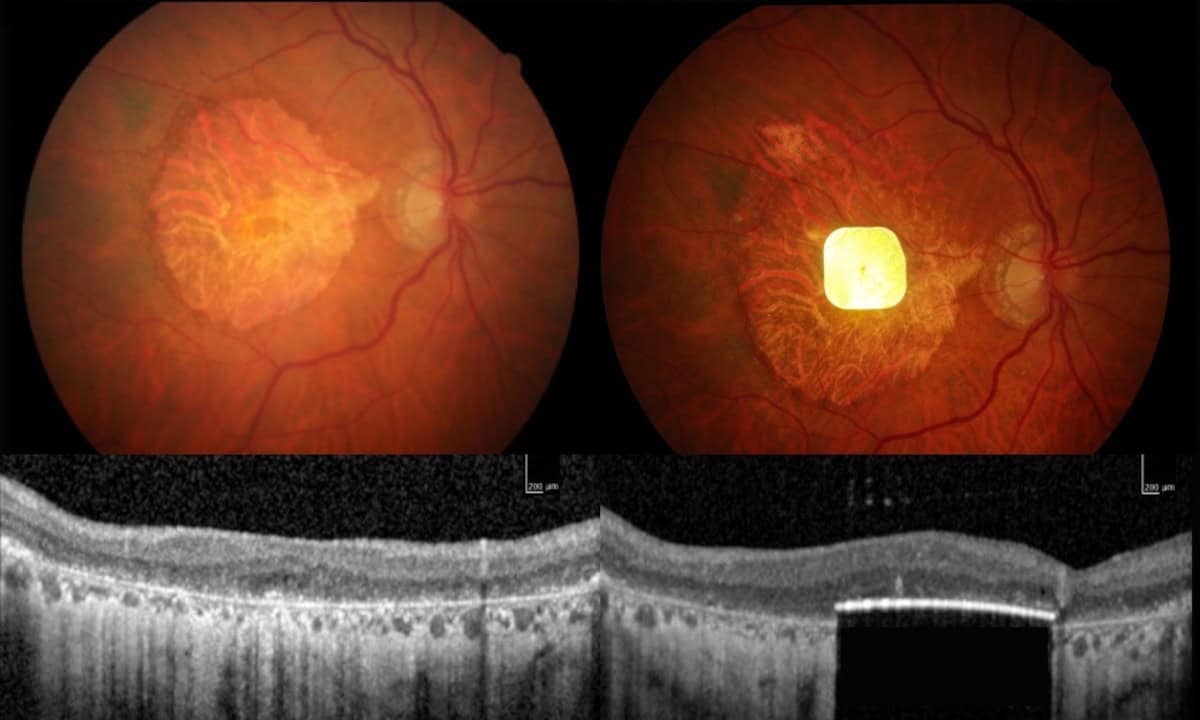
A tiny wireless implant inserted under the retina can restore central vision to patients with sight loss due to age-related macular degeneration (AMD). In an international clinical trial, the PRIMA (photovoltaic retina implant microarray) system restored the ability to read in 27 of 32 participants followed up after a year.

AMD is the most common cause of incurable blindness in older adults. In its advanced stage, known as geographic atrophy, AMD can cause progressive, irreversible death of light-sensitive photoreceptors in the centre of the retina. This loss of photoreceptors means that light is not transduced into electrical signals, causing profound vision loss.

The PRIMA system works by replacing these lost photoreceptors. The two-part system includes the implant itself: a 2 × 2 mm array of 378 photovoltaic pixels, plus PRIMA glasses containing a video camera that captures images and, after processing, projects them onto the implant using near-infrared light. The pixels in the implant convert this light into electrical pulses, restoring the flow of visual information to the brain. Patients can use the glasses to focus and zoom the image that they see.

The clinical study, led by Frank Holz of the University of Bonn in Germany, enrolled 38 participants at 17 hospital sites in five European countries. All participants had geographic atrophy due to AMD in both eyes, as well as loss of central sight in the study eye over a region larger than the implant (more than 2.4 mm in diameter), leaving only limited peripheral vision.

Around one month after surgical insertion of the 30 μm-thick PRIMA array into one eye, the patients began using the glasses. All underwent training to learn to interpret the visual signals from the implant, with their vision improving over months of training.

Eye images before and after array implantation
The PRIMA implant Representative fundus and OCT images obtained before and after implantation of the array in a patient’s eye. (Courtesy: Science Corporation)

After one year, 27 of the 32 patients who completed the trial could read letters and words (with some able to read pages in a book) and 26 demonstrated clinically meaningful improvement in visual acuity (the ability to read at least two extra lines on a standard eye chart). On average, participants could read an extra five lines, with one person able to read an additional 12 lines.

Nineteen of the participants experienced side-effects from the surgical procedure, with 95% of adverse events resolving within two months. Importantly, their peripheral vision was not impacted by PRIMA implantation. The researchers note that the infrared light used by the implant is not visible to remaining photoreceptors outside the affected region, allowing patients to combine their natural peripheral vision with the prosthetic central vision.

“Before receiving the implant, it was like having two black discs in my eyes, with the outside distorted,” Sheila Irvine, a trial patient treated at Moorfields Eye Hospital in the UK, says in a press statement. “I was an avid bookworm, and I wanted that back. There was no pain during the operation, but you’re still aware of what’s happening. It’s a new way of looking through your eyes, and it was dead exciting when I began seeing a letter. It’s not simple, learning to read again, but the more hours I put in, the more I pick up. It’s made a big difference.”

The PRIMA system – originally designed by Daniel Palanker at Stanford University – is being developed and manufactured by Science Corporation. Based on these latest results, reported in the New England Journal of Medicine, the company has applied for clinical use authorization in Europe and the United States.

The post Eye implant restores vision to patients with incurable sight loss appeared first on Physics World.

  •  

America needs a ‘Plan B’ to reach the moon first

Render of a conceptual Chinese lunar base.

China is on track to land its first crew on the lunar surface by 2030 and establish a base at the resource-rich south pole — a site that offers continuous sunlight, access to water ice and control of the most valuable real estate beyond Earth. Beijing’s record of steady, disciplined progress in space suggests they […]

The post America needs a ‘Plan B’ to reach the moon first appeared first on SpaceNews.

  •  

Single-phonon coupler brings different quantum technologies together

Researchers in the Netherlands have demonstrated the first chip-based device capable of splitting phonons, which are quanta of mechanical vibrations. Known as a single-phonon directional coupler, or more simply as a phonon splitter, the new device could make it easier for different types of quantum technologies to “talk” to each other. For example, it could be used to transfer quantum information from spins, which offer advantages for data storage, to superconducting circuits, which may be better for data processing.

“One of the main advantages of phonons over photons is they interact with a lot of different things,” explains team leader Simon Gröblacher of the Kavli Institute of Nanoscience at Delft University of Technology. “So it’s very easy to make them interface with systems.”

There are, however, a few elements still missing from the phononic circuitry developer’s toolkit. One such element is a reversible beam splitter that can either combine two phonon channels (which might be carrying quantum information transferred from different media) or split one channel into two, depending on its orientation.

While several research groups have already investigated designs for such phonon splitters, these works largely focused on surface acoustic waves. This approach has some advantages, as waves of this type have already been widely explored and exploited commercially. Mobile phones, for example, use surface acoustic waves as filters for microwave signals. The problem is that these unconfined mechanical excitations are prone to substantial losses as phonons leak into the rest of the chip.

Mimicking photonic beam splitters

Gröblacher and his collaborators chose instead to mimic the design of beam splitters used in photonic chips. They used a strip of thin silicon to fashion a waveguide for phonons that confined them in all dimensions but one, giving additional control and reducing loss. They then brought two waveguides into contact with each other so that one waveguide could “feel” the mechanical excitations in the other. This allowed phonon modes to be coupled between the waveguides – something the team demonstrated down to the single-phonon level. The researchers also showed they could tune the coupling between the two waveguides by altering the contact length.

Although this is the first demonstration of single-mode phonon coupling in this kind of waveguide, the finite element method simulations Gröblacher and his colleagues ran beforehand made him pretty confident it would work from the outset. “I’m not surprised that it worked. I’m always surprised how hard it is to get it to work,” he tells Physics World. “Making it to look and do exactly what you design it to do – that’s the really hard part.”

Prospects for integrated quantum phononics

According to A T Charlie Johnson, a physicist at the University of Pennsylvania, US whose research focuses on this area, that hard work paid off. “These very exciting new results further advance the prospects for phonon-based qubits in quantum technology,” says Johnson, who was not directly involved in the demonstration. “Integrated quantum phononics is one significant step closer.”

As well as switching between different quantum media, the new single-phonon coupler could also be useful for frequency shifting. For instance, microwave frequencies are close to the frequencies of ambient heat, which makes signals at these frequencies much more prone to thermal noise. Gröblacher already has a company working on transducers to transform quantum information from microwave to optical frequencies with this challenge in mind, and he says a single-phonon coupler could be handy.

One remaining challenge to overcome is dispersion, which occurs when phonon modes couple to other unwanted modes. This is usually due to imperfections in the nanofabricated device, which are hard to avoid. However, Gröblacher also has other aspirations. “I think the one component that’s missing for us to have the similar level of control over phonons as people have with photons is a phonon phase shifter,” he tells Physics World. This, he says, would allow on-chip interferometry to route phonons to different parts of a chip, and perform advanced quantum experiments with phonons.

The study is reported in Optica.

The post Single-phonon coupler brings different quantum technologies together appeared first on Physics World.

  •