SAN FRANCISCO – The National Oceanic and Atmospheric Administration intends to dramatically increase commercial weather data purchases, Taylor Jordan, Commerce Department assistant secretary for environmental observation and prediction, said Jan. […]
TAMPA, Fla. — A shell company chaired by venture capitalist Raphael Roettgen began trading on the Nasdaq stock exchange Jan. 28 after raising $200 million to pursue a merger with a space-related business. Space Asset Acquisition Corp., a special purpose acquisition company (SPAC) that offers a fast-track to the public markets for firms seeking capital, […]
Gas projects in the US pipeline explicitly linked to data centers increased by almost 25 times over the past two years, according to new research from Global Energy Monitor.
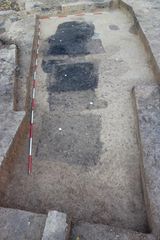
Learn about the cult district of Nida, an ancient cult site uncovered under Frankfurt that archaeologists are calling one of the most significant Roman discoveries in Europe.
Gen. Stephen Whiting: A space becomes a contested military domain, the Pentagon needs not just rockets but also a sustainment and mobility infrastructure to support satellites
The Space Futures Centre a global independent center established in partnership with the World Economic Forum and the Saudi Space Agency to support the growth of the global space economy […]
OQ Technology is preparing to deploy a small satellite to test using C-band to connect smartphones from LEO, joining SpaceX in a push to repurpose part of the spectrum for direct-to-device services.
For more than a decade, the Earth observation industry has insisted that commercial adoption is just around the corner. Yet adoption outside defense remains limited, uneven, and difficult to sustain. The question is no longer whether EO is valuable, but whether the industry is delivering it in a form commercial users can actually use. The […]
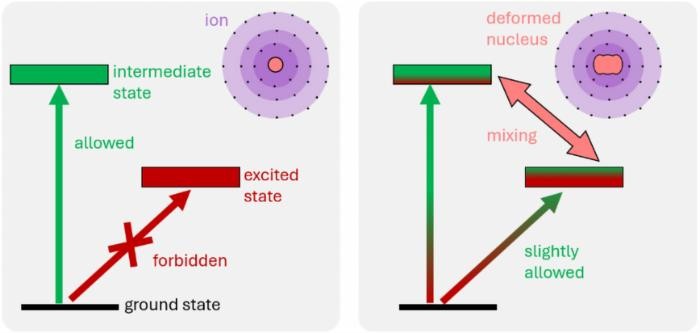
Nuclear effect The deformed shape of the ytterbium-173 nucleus (right) makes it possible to excite the clock transition with a relatively low-power laser. The same transition is forbidden (left) if the nucleus is not deformed. (Courtesy: Physikalisch-Technische Bundesanstalt (PTB))
An atomic transition in ytterbium-173 could be used to create an optical multi-ion clock that is both precise and stable. That is the conclusion of researchers in Germany and Thailand who have characterized a clock transition that is enhanced by the non-spherical shape of the ytterbium-173 nucleus. As well as applications in timekeeping, the transition could be used in quantum computing. Furthermore, the interplay between atomic and nuclear effects in the transition could provide insights into the physics of deformed nuclei.
The ticking of an atomic clock is defined by the frequency of the electromagnetic radiation that is absorbed and emitted by a specific transition between atomic energy levels. These clocks play crucial roles in technologies that require precision timing – such as global navigation satellite systems and communications networks. Currently, the international definition of the second is given by the frequency of caesium-based clocks, which deliver microwave time signals.
Today’s best clocks, however, work at higher optical frequencies and are therefore much more precise than microwave clocks. Indeed, at some point in the future metrologists will redefine the second in terms of an optical transition – but the international metrology community has yet to decide which transition will be used.
Broadly speaking, there are two types of optical clock. One uses an ensemble of atoms that are trapped and cooled to ultralow temperatures using lasers; the other involves a single atomic ion (or a few ions) held in an electromagnetic trap. Clocks that use one ion are extremely precise, but lack stability; whereas clocks that use many atoms are very stable, but sacrifice precision.
Optimizing performance
As a result, some physicists are developing clocks that use multiple ions with the aim of creating a clock that optimizes precision and stability.
Now, researchers at PTB and NIMT (the national metrology institutes of Germany and Thailand respectively) have characterized a clock transition in ions of ytterbium-173, and have shown that the transition could be used to create a multi-ion clock.
“This isotope has a particularly interesting transition,” explains PTB’s Tanja Mehlstäubler – who is a pioneer in the development of multi-ion clocks.
The ytterbium-173 nucleus is highly deformed with a shape that resembles a rugby ball. This deformation affects the electronic properties of the ion, which should make it much easier to use a laser to excite a specific transition that would be very useful for creating a multi-ion clock.
Stark effect
This clock transition can also be excited in ytterbium-171 and has already been used to create a single-ion clock. However, excitation in a ytterbium-171 clock requires an intense laser pulse, which creates a strong electric field that shifts the clock frequency (called the AC Stark effect). This is a particular problem for multi-ion clocks because the intensity of the laser (and hence the clock frequency) can vary across the region in which the ions are trapped.
To show that a much lower laser intensity can be used to excite the clock transition in ytterbium-173, the team studied a “Coulomb crystal” in which three ions were trapped in a line and separated by about 10 micron. They illuminated the ions with laser light that was not uniform in intensity across the crystal. They were able to excite the transition at a relatively low laser intensity, which resulted in very small AC Stark shifts between the frequencies of the three ions.
According to the team, this means that as many as 100 trapped ytterbium-173 ions could be used to create a clock that could be used as a time standard; to redefine the second; and also to make very precise measurements of the Earth’s gravitational field.
As well as being useful for creating an optical ion clock, this multi-ion capability could also be exploited to create quantum-computing architectures based on multiple trapped ions. And because the observed effect is a result of the shape of the ytterbium-173 nucleus, further studies could provide insights into nuclear physics.
The Federal Aviation Administration office that regulates commercial spaceflight expects continued growth in launches, despite industry concerns about whether the office can keep pace.
Most researchers know the disappointment of submitting an abstract to give a conference lecture, only to find that it has been accepted as a poster presentation instead. If this has been your experience, I’m here to tell you that you need to rethink the value of a good poster.
For years, I pestered my university to erect a notice board outside my office so that I could showcase my group’s recent research posters. Each time, for reasons of cost, my request was unsuccessful. At the same time, I would see similar boards placed outside the offices of more senior and better-funded researchers in my university. I voiced my frustrations to a mentor whose advice was, “It’s better to seek forgiveness than permission.” So, since I couldn’t afford to buy a notice board, I simply used drawing pins to mount some unauthorized posters on the wall beside my office door.
Some weeks later, I rounded the corner to my office corridor to find the head porter standing with a group of visitors gathered around my posters. He was telling them all about my research using solar energy to disinfect contaminated drinking water in disadvantaged communities in Sub-Saharan Africa. Unintentionally, my illegal posters had been subsumed into the head porter’s official tour that he frequently gave to visitors.
The group moved on but one man stayed behind, examining the poster very closely. I asked him if he had any questions. “No, thanks,” he said, “I’m not actually with the tour, I’m just waiting to visit someone further up the corridor and they’re not ready for me yet. Your research in Africa is very interesting.” We chatted for a while about the challenges of working in resource-poor environments. He seemed quite knowledgeable on the topic but soon left for his meeting.
A few days later while clearing my e-mail junk folder I spotted an e-mail from an Asian “philanthropist” offering me €20,000 towards my research. To collect the money, all I had to do was send him my bank account details. I paused for a moment to admire the novelty and elegance of this new e-mail scam before deleting it. Two days later I received a second e-mail from the same source asking why I hadn’t responded to their first generous offer. While admiring their persistence, I resisted the urge to respond by asking them to stop wasting their time and mine, and instead just deleted it.
So, you can imagine my surprise when the following Monday morning I received a phone call from the university deputy vice-chancellor inviting me to pop up for a quick chat. On arrival, he wasted no time before asking why I had been so foolish as to ignore repeated offers of research funding from one of the college’s most generous benefactors. And that is how I learned that those e-mails from the Asian philanthropist weren’t bogus.
The gentleman that I’d chatted with outside my office was indeed a wealthy philanthropic funder who had been visiting our university. Having retrieved the e-mails from my deleted items folder, I re-engaged with him and subsequently received €20,000 to install 10,000-litre harvested-rainwater tanks in as many primary schools in rural Uganda as the money would stretch to.
Secret to success Kevin McGuigan discovered that one research poster can lead to generous funding contributions. (Courtesy: Antonio Jaen Osuna)
About six months later, I presented the benefactor with a full report accounting for the funding expenditure, replete with photos of harvested-rainwater tanks installed in 10 primary schools, with their very happy new owners standing in the foreground. Since you miss 100% of the chances you don’t take, I decided I should push my luck and added a “wish list” of other research items that the philanthropist might consider funding.
The list started small and grew steadily ambitious. I asked for funds for more tanks in other schools, a travel bursary, PhD registration fees, student stipends and so on. All told, the list came to a total of several hundred thousand euros, but I emphasized that they had been very generous so I would be delighted to receive funding for any one of the listed items and, even if nothing was funded, I was still very grateful for everything he had already done. The following week my generous patron deposited a six-figure-euro sum into my university research account with instructions that it be used as I saw fit for my research purposes, “under the supervision of your university finance office”.
In my career I have co-ordinated several large-budget, multi-partner, interdisciplinary, international research projects. In each case, that money was hard-earned, needing at least six months and many sleepless nights to prepare the grant submission. It still amuses me that I garnered such a large sum on the back of one research poster, one 10-minute chat and fewer than six e-mails.
So, if you have learned nothing else from this story, please don’t underestimate the power of a strategically placed and impactful poster describing your research. You never know with whom it may resonate and down which road it might lead you.
IRVINE, CA – January 28, 2026 – Terran Orbital proudly announces the Mitsubishi Electric LEO Demo Mission, a state-of-the-art project in collaboration with Mitsubishi Electric Corporation and Mitsubishi Electric US. […]
 Connexion