As AI gets more heavily integrated into Windows, enhanced cybersecurity is required to prevent these agents from being used against us—and just how little it takes to mount an attack prior to a patch is truly horrifying. Fortunately, this coverage of the latest Copilot exploit, dubbed Reprompt, comes after the fact of the exploit being patched.
Apple appears to be pulling out all the stops when it comes to the engineering effort going into its long rumored foldable iPhone, as the company looks to breath new life into its mobile phone lineup. The company seems to have been laser focused on making the device’s display crease-free per previous info, but according to fresh leak, other
AMD's extant "X3D" processors include a feature called 3D V-Cache, which involves bonding a slab of SRAM cache to the logic die in such a way that it physically extends the L3 cache of the CPU to triple its original capacity. What if we could do the same thing for L2 cache? AMD may actually be investigating that, as one of its employees filed
Henning Koczy was offered an unusual gig in October of 2012.
He was invited to spend a little over two months on an island in tropical Belize with Lucas Martell and other artists to make an animated short film together. You should really go spend 10 minutes with the film, embedded below, but if you don't have the time right now let me give you a quick overview.
A lighthouse pokes out of a vast desert stretching to the horizon. The world wasn't always like this and, above this desolate landscape, a lone pilot flies toward a small cloud. The pilot doesn't seem to have a plan, exactly, but they've strapped a dream to this plane anyway. Hope is little more than a sketch the pilot put on paper labeled "Rain Maker" and the pilot isn't alone in these dangerous skies. Other planes with vast funnels flying behind them aim to pull the last bit of water from the air first.
Can the pilot complete their mission and make it rain before so many others, desperate for water too, knock them out of the sky?
Martell's gathering of artists did everything on that island from storyboarding to animation over that two-month span, drawing inspiration from one another and their island surroundings. That's where a company was born called Mighty Coconut.
"I had about a quarter of what it would've taken to pay everyone their typical day rates, but that turned out to be enough to fly everyone down, rent houses, pay for food, small per diems, etc.," Martell wrote on a diary video recalling that 'Destination Production'. "This trip was all self-funded through my own freelance gigs."
Martell hasn't taken any outside investment for Mighty Coconut and didn't release a VR game until 2020, when he crested the wave of Oculus Quest 2 headsets selling during the pandemic with the release of Walkabout Mini Golf. These days enough people pay for a safe and fun escape inside each new course he releases that Mighty Coconut employs 34 people contributing oceans of art, animation, music and gameplay.
Martell feels some pressure.
Other independent studios, like Pistol Whip developer Cloudhead, reduced headcount in the face of changing priorities at platform companies. More than a decade after that creative getaway in Belize founding Mighty Coconut, is it possible Martell feels a bit like that pilot flying toward the cloud? My exclusive tour of Tiki à Coco with Koczy recalls his time on that island and the origins of Mighty Coconut as we move along the Walkabout path.
We start at a crashed plane on the beach of a tropical island with drums pounding in the distance. Huts cover the island but, somehow, the one that's furthest away is the biggest. That curiosity drawn straight into the landscape invites us to investigate further and, along the way, we discover the mythical origins of mini golf.
Hail Jerry
0:00
/0:51
Long ago a coconut fell from a tree and rolled into a hole in the ground.
His name was Jerry, and the game of golf was born to a bunch of coconuts who saw the very first hole-in-one. Jerry's fall led to a whole culture of happy coconuts living on a volcanic island in virtual reality.
"Jerry fell out of a coconut tree and fell into a hole and in doing so created golf," art director Don Carson explained on the tour. "And so it's an island inhabited with coconuts that worship the game of golf. And so that's the story basically."
Mighty Coconut's artists offer us a tapestry across the back wall of a tiki hut depicting the fall of Jerry. Exit the side of the hut and you make your way into a bustling village. You might want to stop for a photo with the CocoVision camera in front of the coconut baby taking its first rolls between mom and dad.
Walkabout introduced some of its first animated characters to the game with the release of Labyrinth in 2022. Now with Tiki à Coco, Walkabout's animators find their footing in a place without any. That's Mighty Coconut canon. The Coconuts, as the artists call themselves, decided their virtual coconuts lack feet. At one hole, a bunch of bandaged coconuts cheer on their fearful friend at the very edge of rolling off a plank above and into a "Jerry's Fall" recreation.
Koczy said after my interview he doesn't stop and think about how unusual his job is until I bring it up on our tours. But it's a bit striking, isn't it?
In 2012, he worked for Lucas Martell on a tropical island making a 10-minute animated film about a visionary producing a spark of something magical from almost nothing at all.
In 2025, he worked for Lucas Martell from home designing 36 holes of mini golf for a tropical island inhabited by happy little coconuts in virtual reality.
Memory chip makers are trying to keep the AI beast fed, and as part of that effort, SK hynix is speeding up plans to open a new chip fab a few months ahead of schedule, according to Reuters. Before you get excited thinking that the memory chip shortage is about to end, the accelerated schedule still amounts to an opening that is more than
Meta has canceled the Batman: Arkham Shadow sequel, UploadVR has learned, and conducted significant layoffs at Camouflaj, the developer of the first game.
Unlike Twisted Pixel Games (Deadpool VR), Sanzaru Games (Asgard's Wrath), and Armature Studio (Resident Evil 4 VR), Camouflaj has not been entirely shut down. But it has seen significant layoffs, and will no longer be developing VR games.
Further, UploadVR can confirm that Sanzaru was working on the Arkham Shadow sequel, and the studio's closure earlier this week ended this work.
Batman: Arkham Shadow was the blockbuster bundled title for Quest 3S, given for free with new headset purchases for well over a year, and we strongly praised it in our review.
In 2024, the founder and studio head of Camouflaj, Ryan Payton, told UploadVR that he would "love to" make a sequel. Then, four months ago, the voice actor for Commissioner Gordon confirmed that a sequel was about to enter development.
Work on that sequel had started – at Sanzaru Games rather than Camouflaj – but has now fully ended, and the sequel will no longer be happening.
Beat Saber and Population: One are live service games, and there's no indication of a sequel arriving for either. Meanwhile, Ouro Interactive's focus remains entirely on Horizon Worlds.
The closure of three studios and significant layoffs at Camouflaj are part of a wider strategy shift at Meta, seeing funding from VR reallocated toward smart glasses, a reaction to the sales momentum the company saw last year for each type of device.
Through at least the first three quarters of the year, Quest headset sales were down compared to 2024. Meanwhile, sales of Ray-Ban Meta glasses skyrocketed, with several variants selling as fast as they can be manufactured. This week, Bloomberg reported that Meta was considering doubling or even tripling smart glasses production capacity.
Last month, Meta officially confirmed "shifting some of our investment from Metaverse toward AI glasses and Wearables", and the layoffs at its acquired studios are some of the first casualties of this shift.
Ecco the Dolphin is one of SEGAs more underrated franchises from back when the publisher made its own console hardware. Following years of silence, the publisher confirmed back in May of last year that not only is Ecco the Dolphin returning, but that multiple projects are planned. Now SEGA seems to be gearing up for a proper unveiling – officially launching a brand new teaser site.
Following the announcement last year that Ecco the Dolphin would be returning with remasters and new projects, studio A&R Atelier (headed by the creator of the franchise) have now published a new website. Available HERE, little has been officially shared in the way of concrete details, however the team wrote:
“We're dedicated to expanding the Ecco the Dolphin IP to the level it has always deserved. We're currently working on new Ecco games and products that honor the spirit of the original while bringing fresh experiences to both longtime fans and new players discovering Ecco's epic world for the first time.”
Alongside this, the website itself features a timer in the bottom left which appears to be counting down to the 22nd of April 2026. Perhaps we will learn more then?
Regardless, the Ecco the Dolphin series was highly unique and so it is exciting to see the franchise coming back.
KitGuru says: Are you a fan of Ecco the Dolphin? What was your favourite SEGA exclusive back in the day (other than Sonic)? Let us know down below.
Ford has just unleashed the 2026 Mustang Dark Horse SC, a supercharged beast designed to bridge the massive gap between the standard 500-horsepower Dark Horse and the $325,000 limited-run Mustang GTD.
Revealed ahead of the 2026 Detroit Auto Show, the SC (supercharged) designation marks the return of the factory-blown V8 to the Mustang lineup.
The White House has announced a 25% tariff on certain advanced computing chips, including NVIDIA's H200 silicon based on its Hopper architecture and AMD's Instinct MI325X accelerator based on CDNA 3, both of which now have the green light to ship into China. Interestingly, the levy is described as a tariff on chip imports, not exports.
Back
After two decades of quiet data processing on millions of crowd-sourced home computers, the SETI@home project has narrowed down billions of space whispers to 100 signals. Could one of these point to intelligent alien life?
Launched in 1999, SETI@home turned the search for extraterrestrial intelligence into a global phenomenon by allowing
Over the past decade Josef Fares has made a name for himself in the video games industry not only due to his unique personality, but thanks to the creator’s constant push towards innovating in the co-op space, with each successive project receiving higher praise than the last. While Fares and Hazelight Studios’ latest release Split Fiction continues to find a growing audience, the team’s previous project – It Takes Two – is nearing another massive sales milestone.
In an interview conducted by Christopher Dring of TheGameBusiness, Hazelight Studios CEO Josef Fares spoke on a wide range of topics including 2025’s GOTY winner Clair Obscur: Expedition 33; the state of the industry, generative AI and more.
In discussing Hazelight’s last game prior to Split Fiction – It Takes Two – Fares revealed that the 2021 game of the year winner is continuing to sell millions of copies, confirming that the co-op title is now closing in on hitting 27 million copies sold.
While an incredible achievement in its own right, as with many of Hazelight’s games, It Takes Two included a friends pass allowing you to play through the whole game online with a friend without them needing to own a copy. This means that at this point over 50 million people have experienced the game.
Considering the fact that the game is set to receive an adaptation of some kind at some point (though we have heard little from the project since its initial announcement), It Takes Two will likely continue to sell well for many more years.
KitGuru says: What did you think of It Takes Two? How does it compare to the rest of Josef Fares’ output? Will Split Fiction manage to reach similar heights? Let us know down below.
Verizon confirmed that it has resolved a frustrating service outage that left many wireless subscribers scrambling through posts on social media to see what was going on. Details are still light, but those who found their way to X (formerly Twitter) in search of answers on why their service suddenly went dark would have seen rivals AT&T and
Following its official announcement back during Tokyo Game Show 2025, Microsoft confirmed that we would be learning more about Forza Horizon 6 during the console maker’s upcoming Xbox Developer Direct. Set to go live on the 22nd of January, users have reported receiving a pop-up inside Forza Horizon 5 which seems to have leaked the release date for its sequel.
As shared by Twitter user XboxF10, an in-game pop-up within Forza Horizon 5 appears to have offered full details on the upcoming Forza Horizon 6, including its release date, Premium Edition content and more.
Though unable to be directly replicated by others so far, the pop-up claims that Forza Horizon 6 will officially launch on the 19th of May – with Premium Edition owners gaining 4 days of advanced access (starting on the 14th).
Beyond this, the message includes the full list of Premium Edition content, namely:
VIP Membership
Welcome Pack
Car Pass
Time Attack Car Pack
Italian Passion Car Pack (post-launch)
2 Premium Expansions (post-launch)
Last but not least, all those who pre-order the game are said to receive “a pre-tuned and exclusive Ferrari J50”. Of course, this should all be taken with a pinch of salt for now, but with the Xbox Developer Direct set to go live in one week’s time, we likely won’t have to wait long to learn all about Forza Horizon 6 in an official capacity.
KitGuru says: Are you looking forward to the developer direct? Which of the three announced titles are you most excited to learn more about? Does Xbox’s advanced access strategy bother you or not? Let us know down below.
Each month, Sony updates its PlayStation Plus Extra/Premium tiers with a selection of titles, from old games to new games, and classics on occasion. For the first month of 2026, PS Plus subscribers can look forward to playing a number of high profile releases, including the latest Resident Evil Village, Like a Dragon: Infinite Wealth and more.
Making the announcement via the PlayStation Blog, Sony officially listed the full line-up of titles set to join PS Plus Extra/Premium, with the following arriving on the service next Tuesday, the 20th of January:
Resident Evil Village | PS5, PS4
Like a Dragon: Infinite Wealth | PS5, PS4
Expeditions: A MudRunner Game | PS5, PS4
A Quiet Place: The Road Ahead | PS5
Darkest Dungeon II | PS5, PS4
The Exit 8 | PS5, PS4
Art of Rally | PS5, PS4
A Little to the Left | PS5, PS4
Ridge Racer | PS5, PS4 (PS Plus Premium)
The headliners for the month are of course Resident Evil Village and Like a Dragon: Infinite Wealth, with the former being the latest mainline entry in the RE series – arriving just in time for a playthrough ahead of Resident Evil 9: Requiem’s launch in February.
Infinite Wealth meanwhile is one of the most content-rich entries in the Yakuza (Like a Dragon) series, offering a compelling story alongside countless side activities, missions and mini games – making for an experience which you likely won’t want to end.
As mentioned, January’s PS Plus Extra / Premium line-up will be available to play from Tuesday the 20th. In case you missed it, PS Plus’s Essential line-up went live earlier this month, the details of which can be found HERE.
KitGuru says: What do you think of January’s line-up? Is this a good start to the year? Let us know down below.
The Team Group T-Force GA Pro is a PCIe Gen 5 SSD that delivers excellent 4K random write performance, a very large SLC cache, and strong sustained speeds. In our testing, however, real-world performance can't match the best Gen 4 drives, while power consumption and heat output are high, making effective cooling a critical requirement.
With 2025 behind us, many services have already released their annual recaps, with the likes of PlayStation going live with its own wrap-up back in December. Though slightly later than others, Nintendo’s annual year-in-review is now available to view – including data stretching as far back as the Switch 1’s launch.
Though you can of course read about your most played games, player milestones, monthly breakdowns and more from the past year, 2025’s recap also allows you to go all the way back to 2017 when the Switch first launched to see a breakdown of whichever year you please.
KitGuru says: What did your Switch activity in 2025 look like? What was your most played game? Between 2017 and now, which year did you play Nintendo games the most? Let us know down below.
The PlayStation 5 Pro arrived in November 2024 with the promise of being the definitive way to play console games, but its first year has been somewhat muted. While it is technically the most powerful console on the market, some still feel that its specialised hardware remains underutilised. A particular sticking point has been the initial iteration of PSSR (PlayStation Spectral Super Resolution), which, in many titles, has been prone to visual glitches and shimmering rather than providing a consistent “next-gen” leap in image clarity.
That narrative may be about to change. According to @Gust_FAN (via PC Guide), a reliable Japanese insider with a proven track record for accurately leaking the PS5 Slim and the Hyperpop collection, the PS5 Pro is scheduled to receive a major system overhaul this quarter. This update would include “PSSR 2.0”, which has been reportedly designed to fix existing image quality issues while also improving performance across the board.
Supposedly, PSSR 2.0 will have features similar to AMD's FSR 4, which makes a lot of sense considering the strategic partnership in place between AMD and Sony. This shift in upscaling logic aims to deliver a “double win” of higher image fidelity and improved frame rates. For some, the most exciting prospect is probably the push to 120 FPS, as titles that currently sit in the 70–80 FPS range on the Pro are expected to receive a boost to hit that mark.
The update also appears to focus heavily on legacy content. The leak suggests that PSSR 2.0 will provide a high-resolution boost for “traditional low-resolution games”, implying that backwards-compatible titles and classic games available through PlayStation Plus could see a visual upgrade at the system level. If successful, this feature could make the more expensive PlayStation Plus tiers slightly more attractive.
To ensure developers can make the most of this transition, Sony is reportedly preparing a suite of new debugging tools too. These resources are intended to help studios iron out issues and ensure that PSSR 2.0 doesn't have the artifacting problems of its predecessor.
KitGuru says: The first year of the PS5 Pro has felt lacklustre for many. PSSR 1.0 was bold, but the visual “ghosting” did it no favours. If PSSR 2.0 can truly deliver FSR 4-level quality and a system-wide boost in resolution for classic games, the Pro might finally have the software backbone to justify its price tag.
Throughout 2025 we saw an increasing number of leaks and rumours surrounding Ubisoft’s long-awaited Prince of Persia The Sands of Time Remake, with recent reports claiming that the title is scheduled to launch as early as this month. While Ubisoft have yet to officially let the cat out of the bag, the ESRB has now published a rating for Prince of Persia: The Sands of Time Remake – indicating an imminent unveiling.
Ahead of the leaked launch date for Prince of Persia: The Sands of Time Remake (which is purportedly planned to arrive some time this month), the Entertainment Software Ratings Board [ESRB] has published an official listing for the long-awaited remake.
With a T for Teen rating, the Sands of Time Remake is said to include “Blood, Partial Nudity, Sexual Themes, and Violence”. While we did not get too much in the way of gameplay details, the summary does feature a section which confirms that the game will include 2D side-scrolling elements – to some degree at least.
Though wholly expected, the remake is also confirmed to include puzzles, platforming challenges and a plethora of traps (including spike pits, wall-mounted blades and saws).
KitGuru says: Are you excited for Prince of Persia: The Sands of Time Remake? How different do you think it will look compared to the initial reveal? Will the wait have been worth it? Let us know your thoughts / hopes down below.
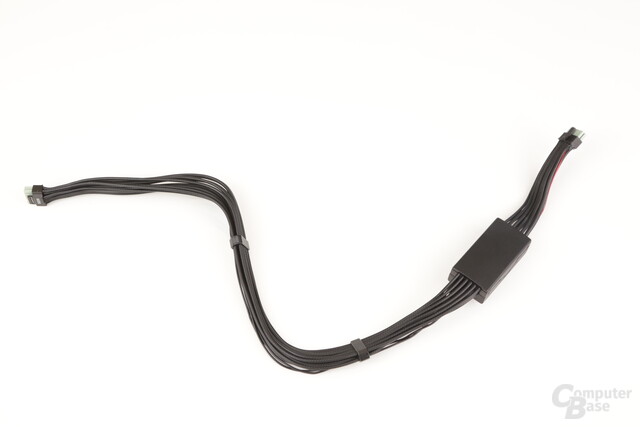
Cybenetics Labs has unveiled a prototype ‘anti-melt' cable designed to address the infamous reliability issues of the 12VHPWR/12V-2×6 standard. This integrates proactive monitoring directly into the cable itself, aiming to provide a fail-safe for enthusiasts who want to avoid any potential melting or burning risk associated with flagship cards like the RTX 5090.
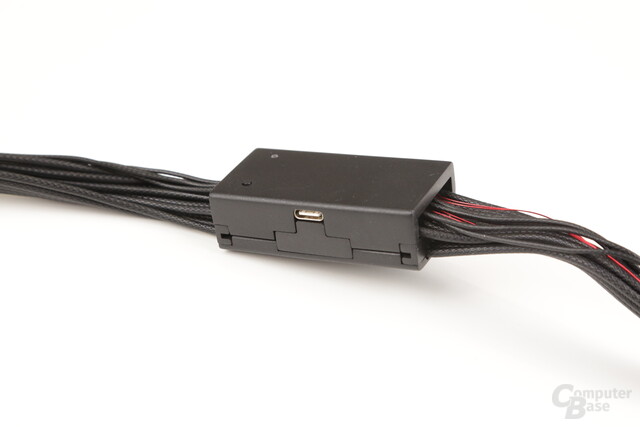
According to ComputerBase, the prototype is a native 12V-2×6-to-12V-2×6 cable with a small, low-profile inline box. This box contains the monitoring electronics and a status LED, avoiding the added bulk of screens or fans that can cause compatibility issues with large air coolers or tight cases. Because it is a flexible cable, it fits almost all Founders Edition and custom AIB layouts without obstructing the shroud or requiring awkward mounting angles.
Technically, the cable operates as an active circuit breaker. It monitors current and temperatures at both the GPU and PSU ends. While it features a USB-C port, this is strictly for data logging and configuration. The safety features, including a high-pitched buzzer and an emergency power-cut function, are fully autonomous. Once thresholds are configured via the software, the USB can be disconnected, and the cable will maintain its protection profile independently.
The cable is designed to distinguish between harmless transient spikes and dangerous sustained thermal runaway. Moreover, it allows users to configure thresholds for settings such as “Over Current Trigger” (default 8-12 A) and “Over Temperature Trigger” (default 80-95°C). The cable also has a dual-stage warning that, when a limit is breached, activates the buzzer for 10 seconds (default but configurable). If the condition persists, the cable cuts power to the GPU. Lastly, when connected via USB, the software provides updates every 100 ms, allowing users to export thermal and current data to Excel for long-term stability testing.
Although it looks useful, actual availability is currently uncertain. Cybenetics has not yet secured a mass-market distribution partner. It has been stated that there is a desire to sell the cable “close to cost” to improve the safety of the PC ecosystem rather than for profit. Currently, the cable also requires a native 12V-2×6 output on the PSU side, though a dual 8-pin version for older power supplies could be technically feasible if the project reaches production.
KitGuru says: It is a sad indictment of modern hardware standards that we need a “smart cable” just to ensure our flagship graphics card doesn't catch fire. However, the Cybenetics solution is arguably the most elegant we've seen so far. We hope a production partner steps up soon.
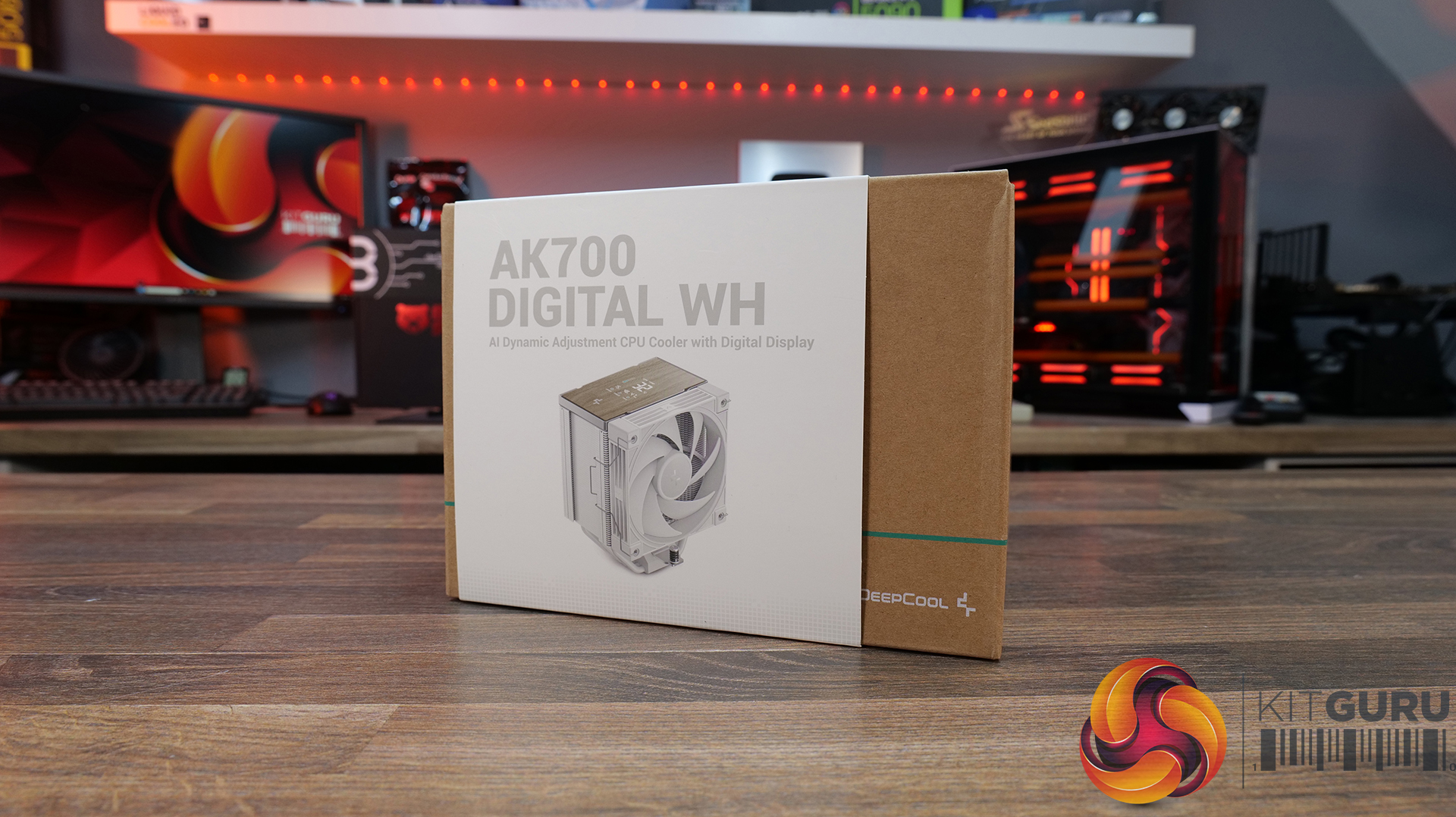
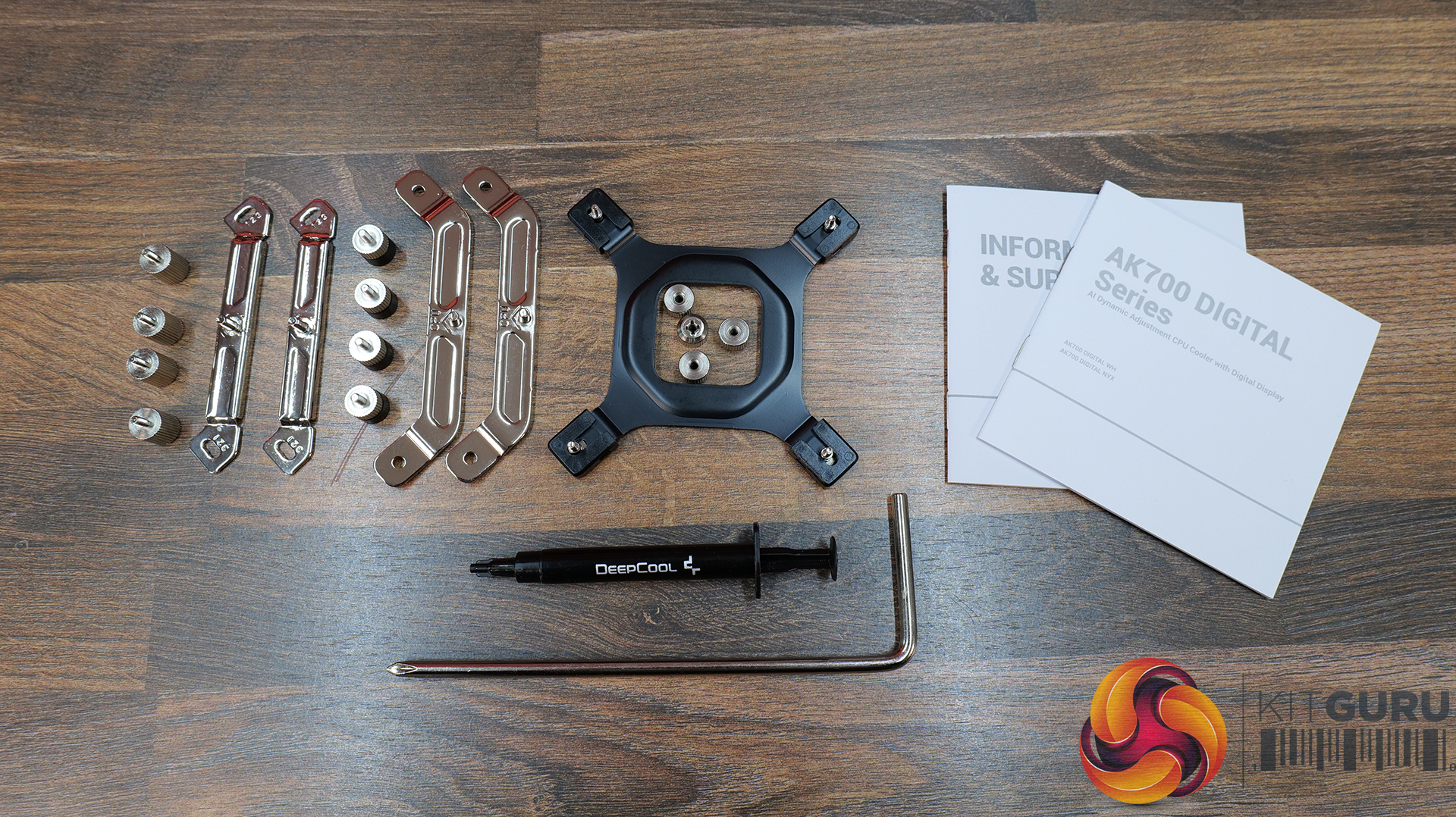
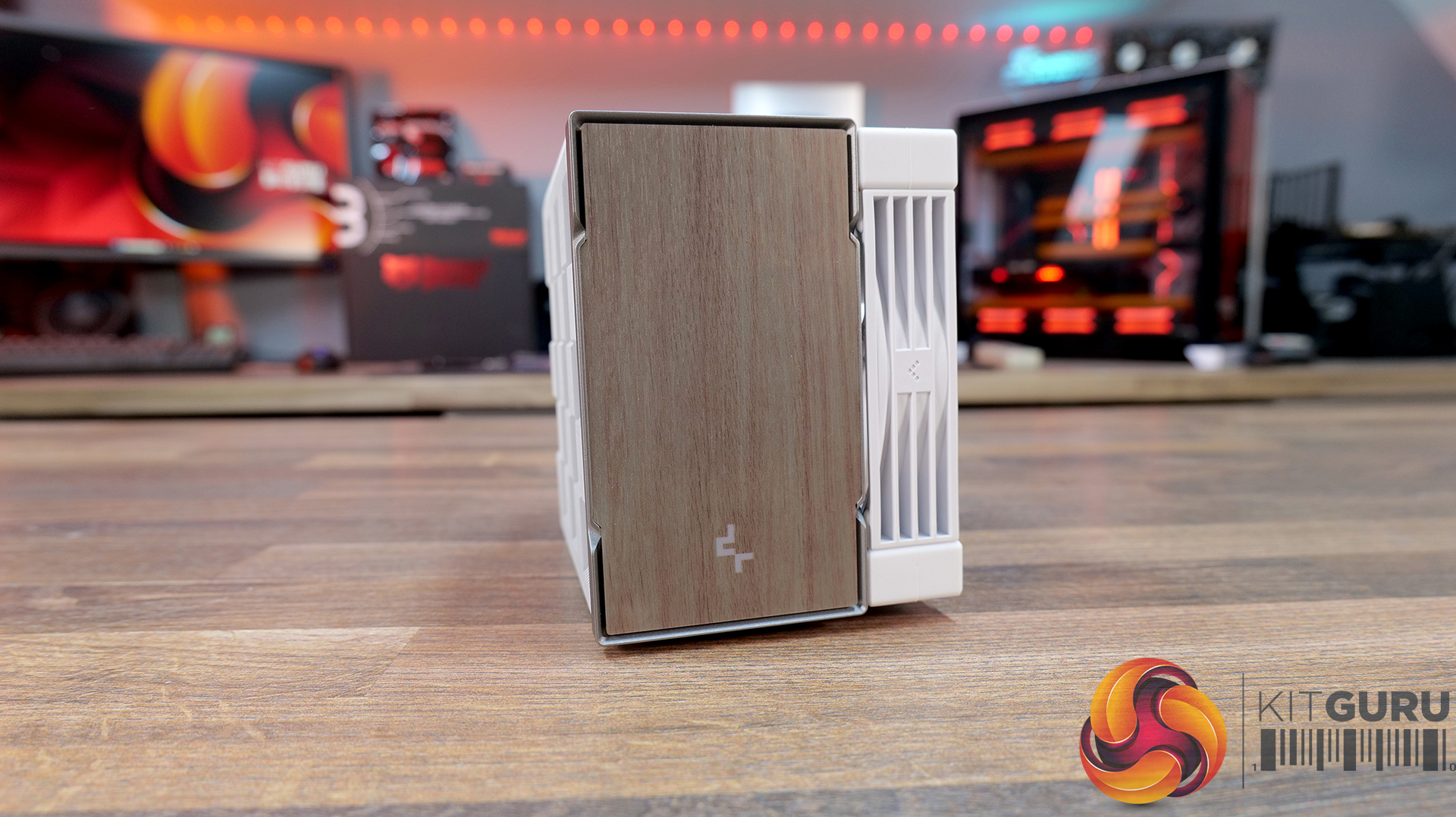
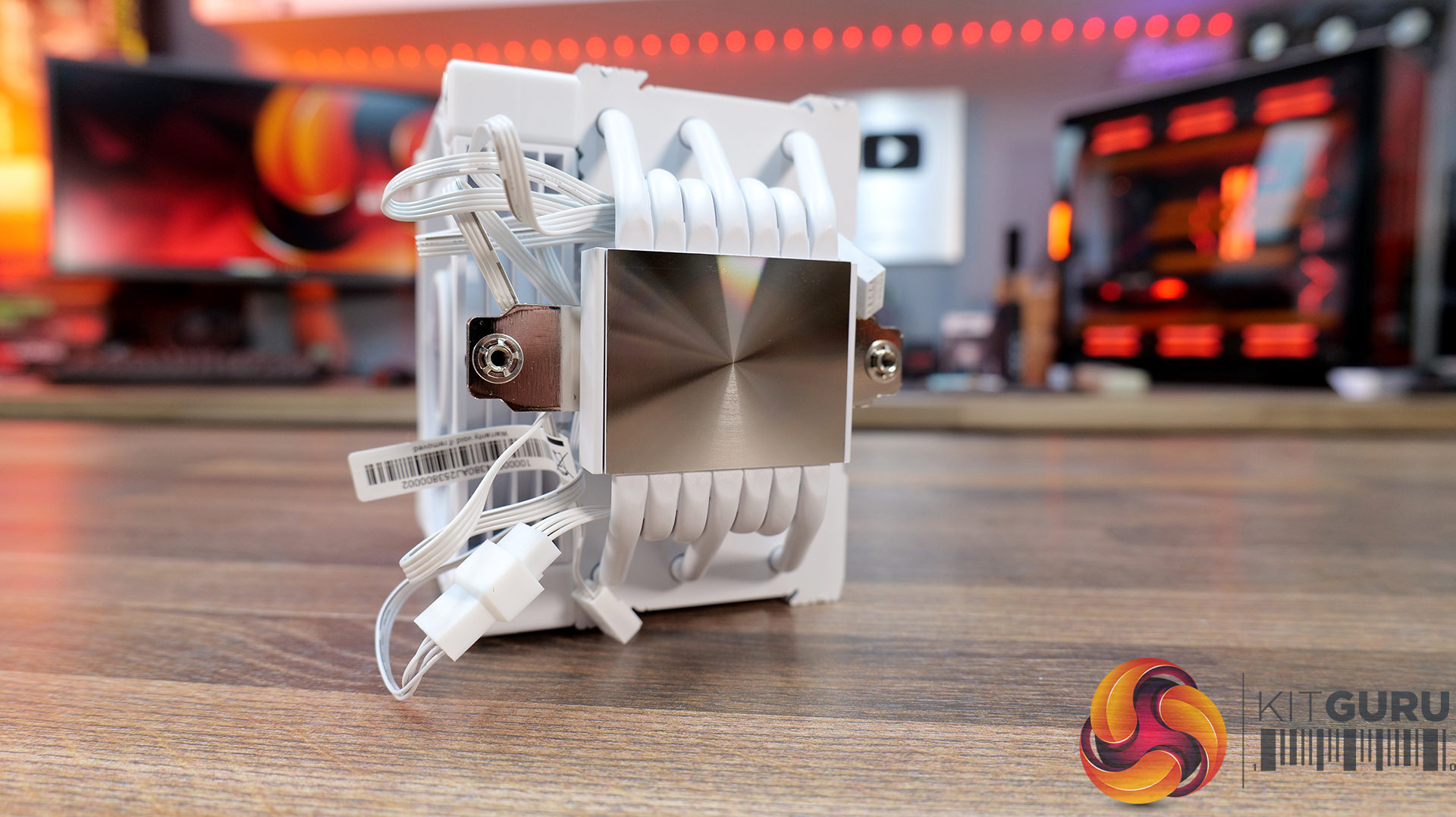
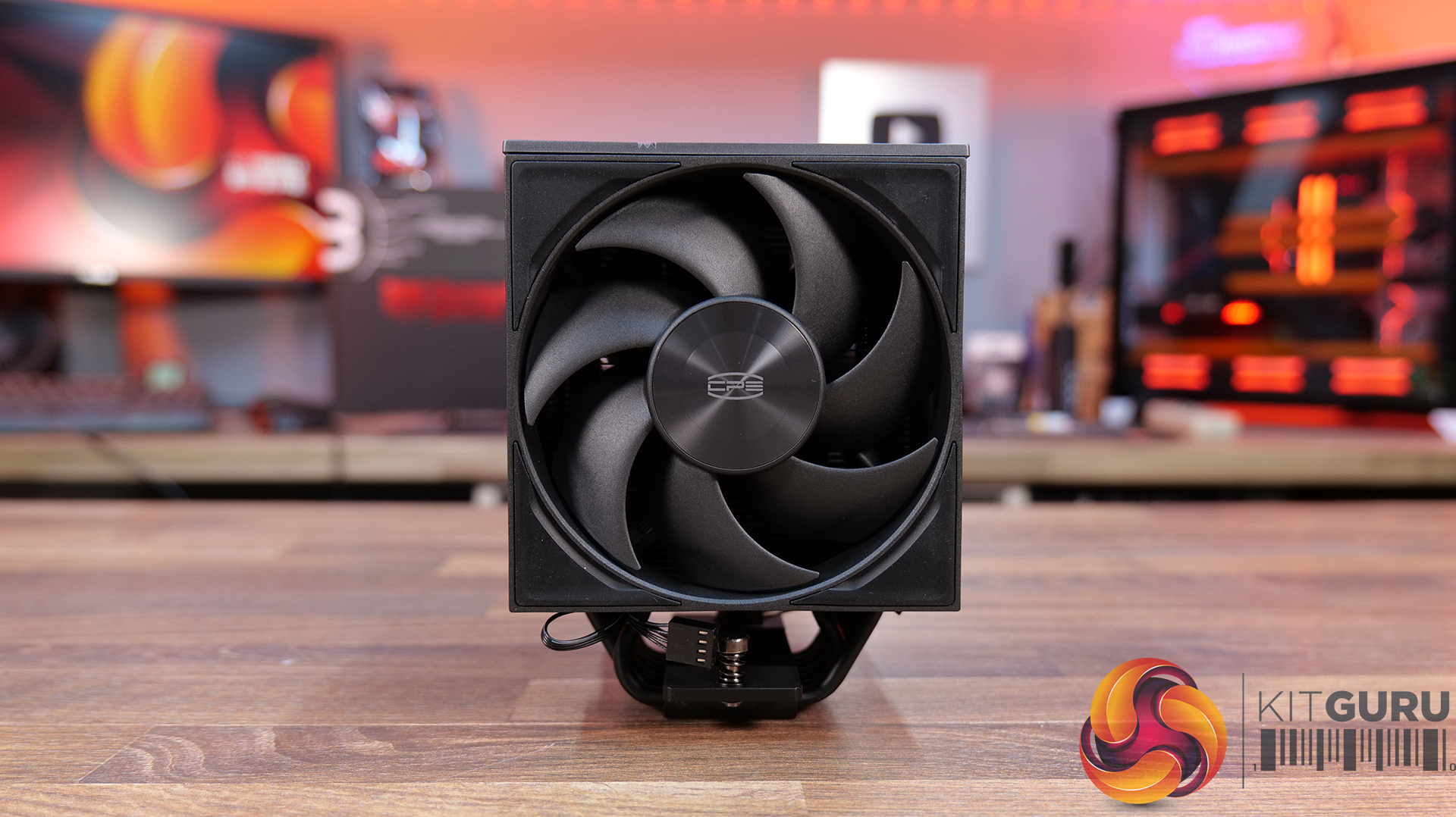
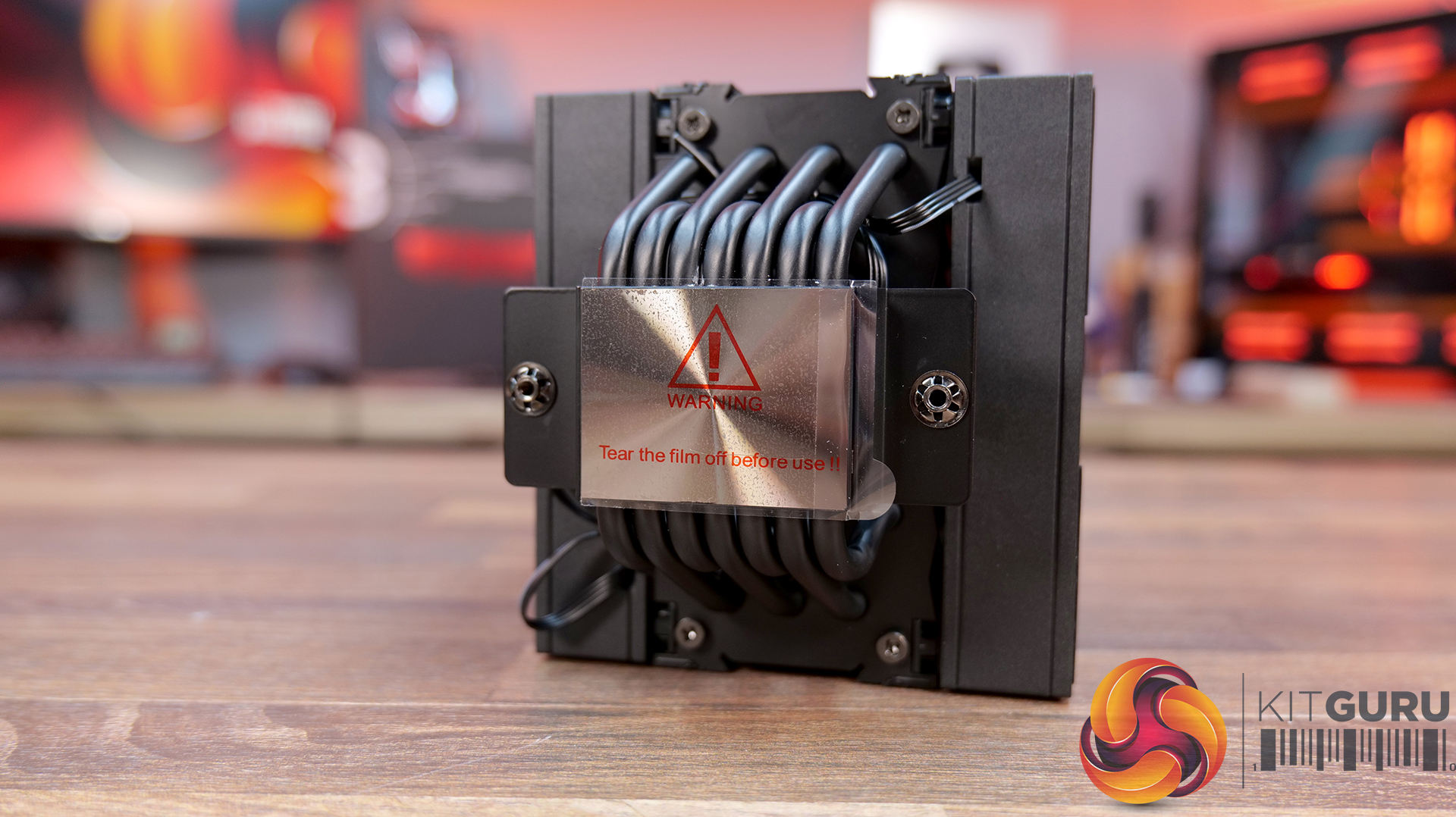
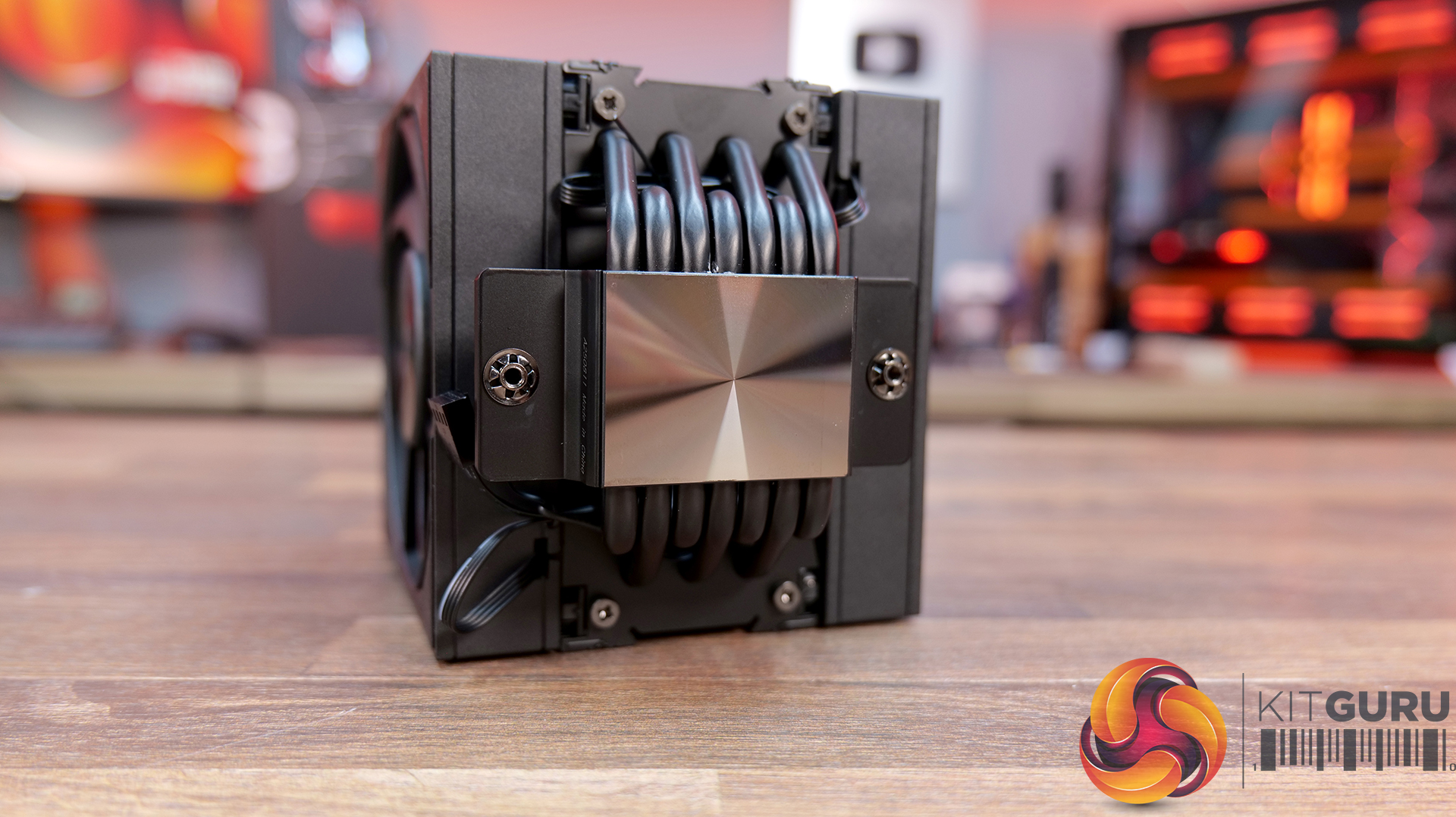
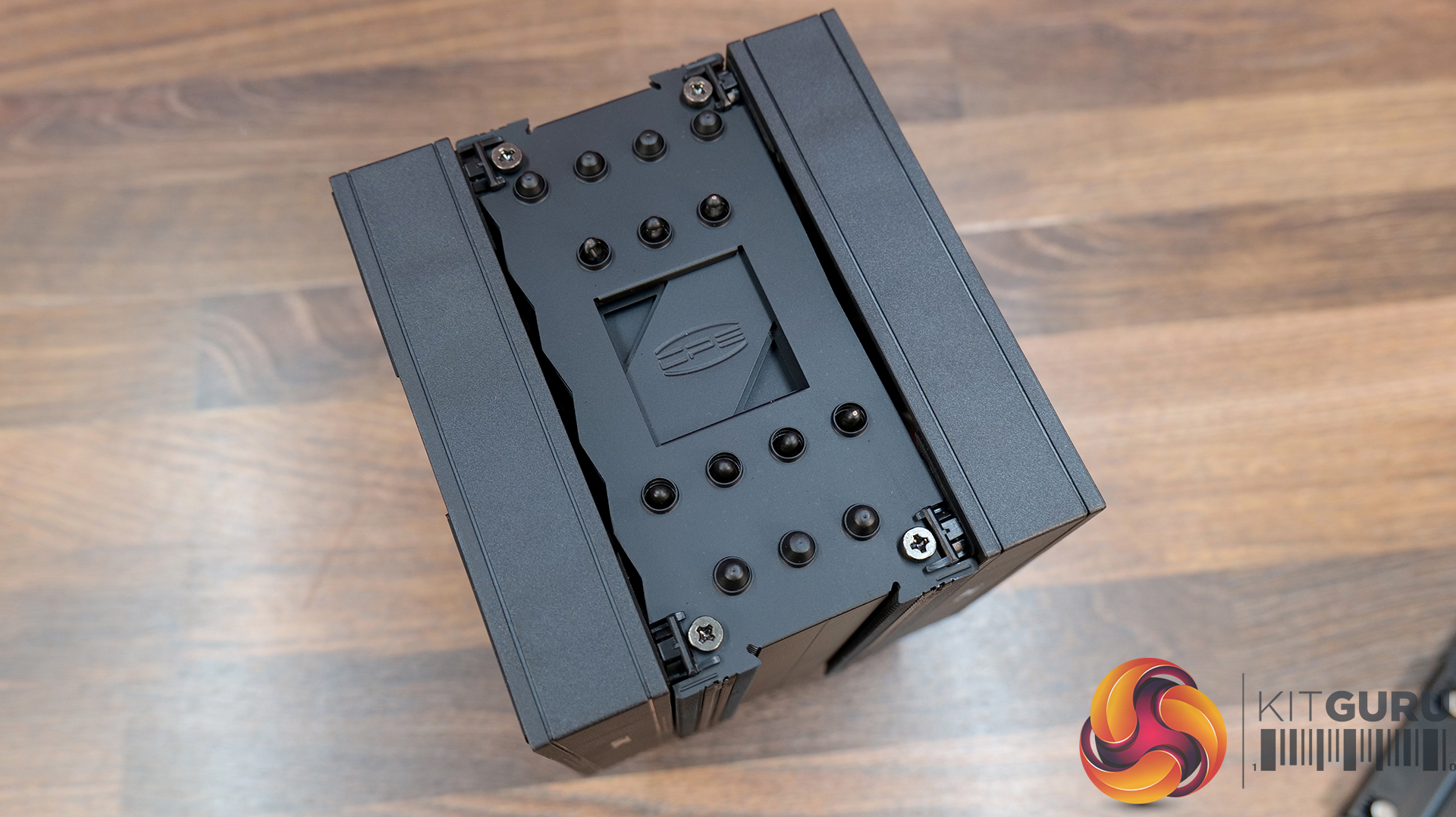
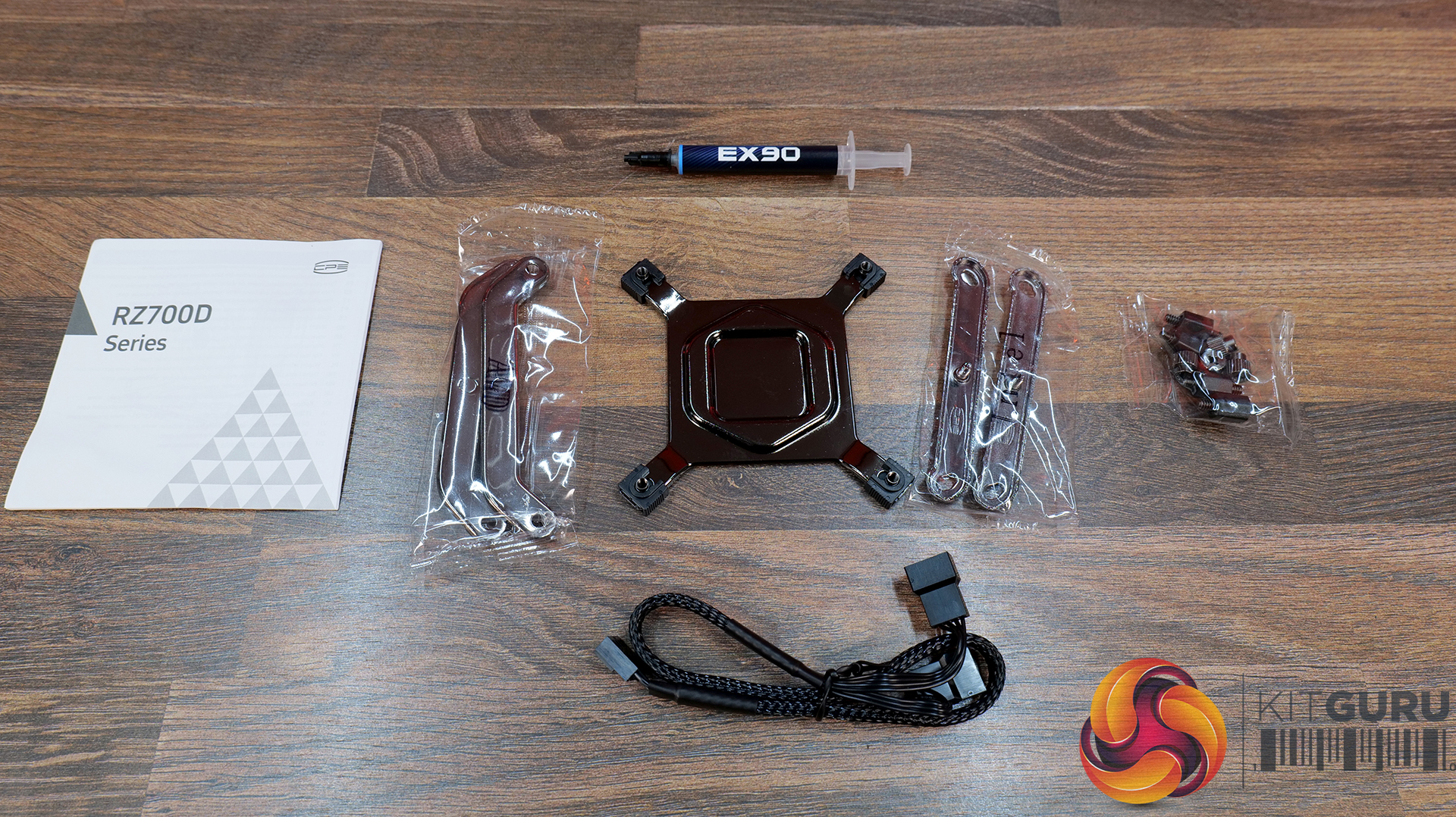
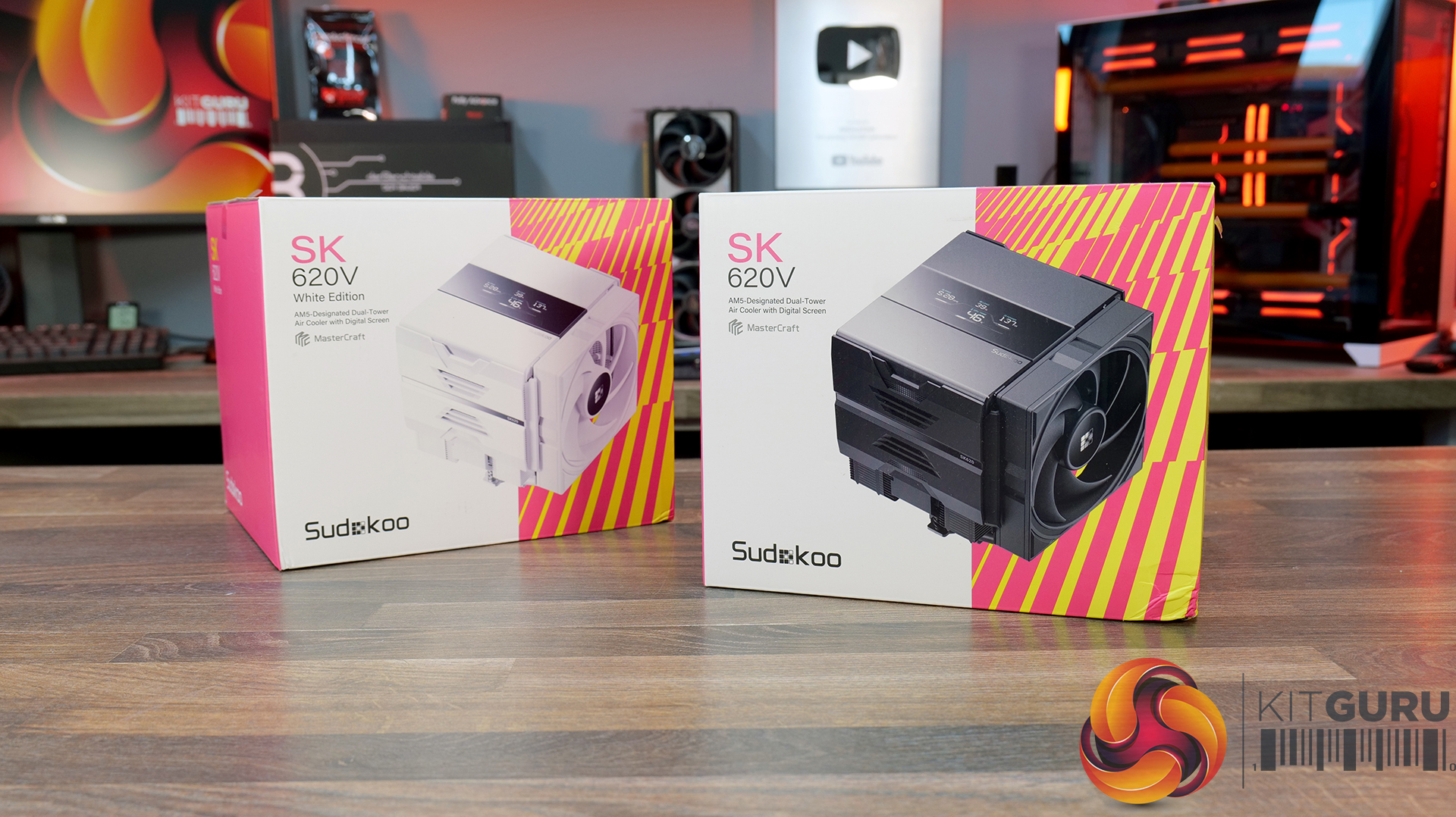
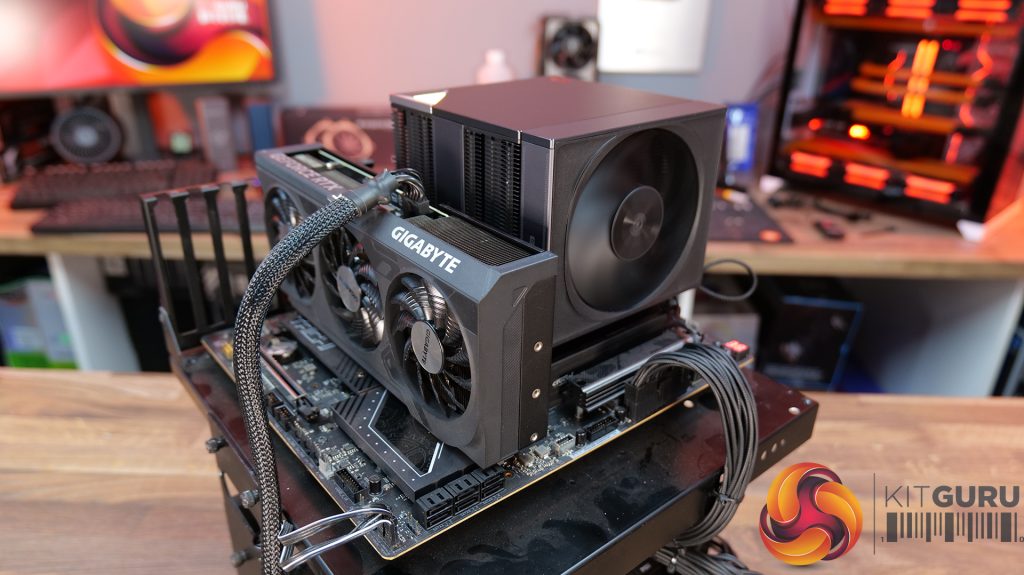
Today we’re comparing three mid to high-end CPU air coolers: DeepCool’s AK700 Digital, CPS PCCooler’s RZ700D, and the Sudokoo SK620V. All three target performance-focused systems, but take slightly different approaches in design and features. We’ll be testing thermals, noise, build quality, and installation on Ryzen 9800X3D-based system to see which comes out on top.
Timestamps:
00:00 Start
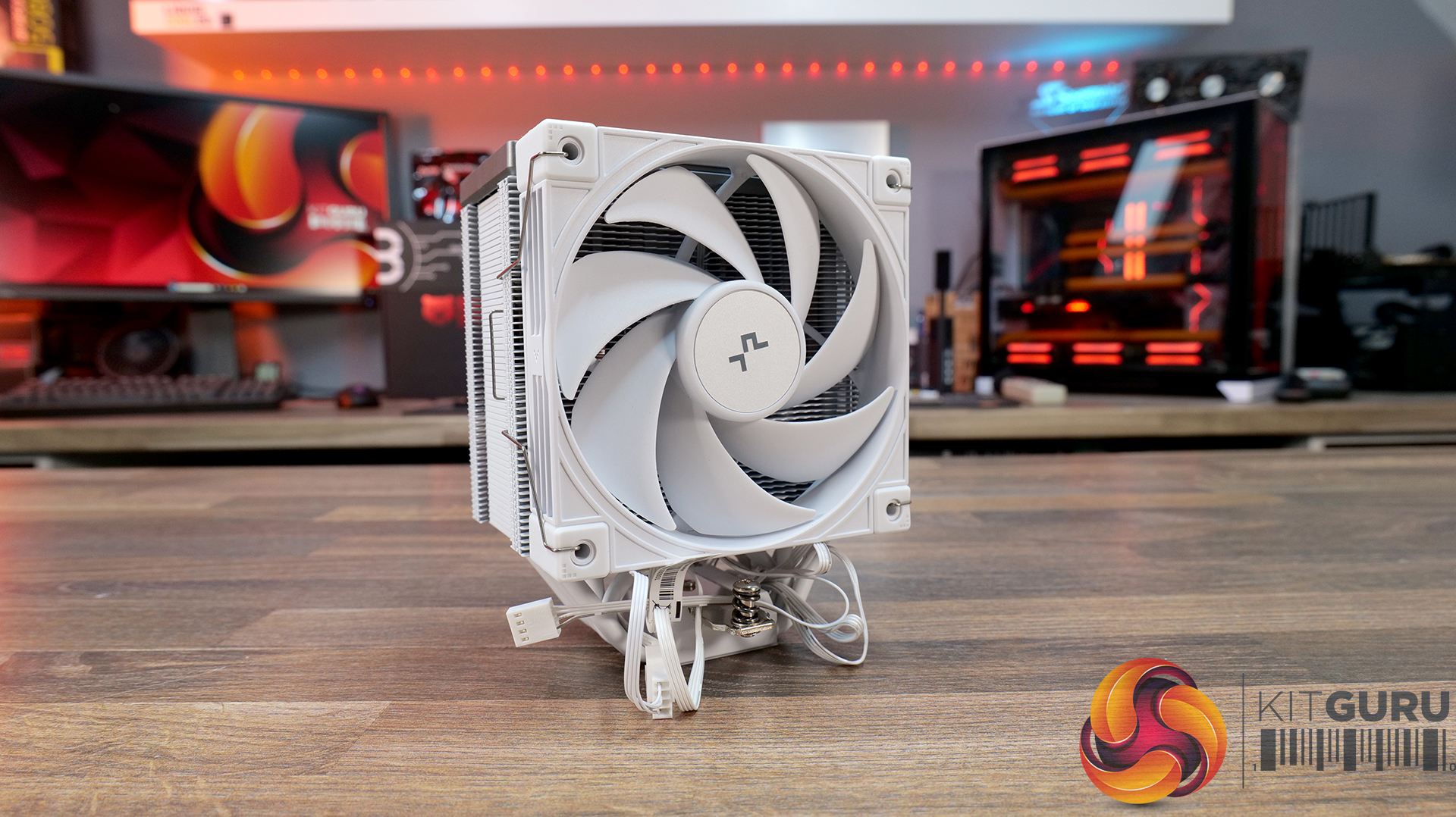
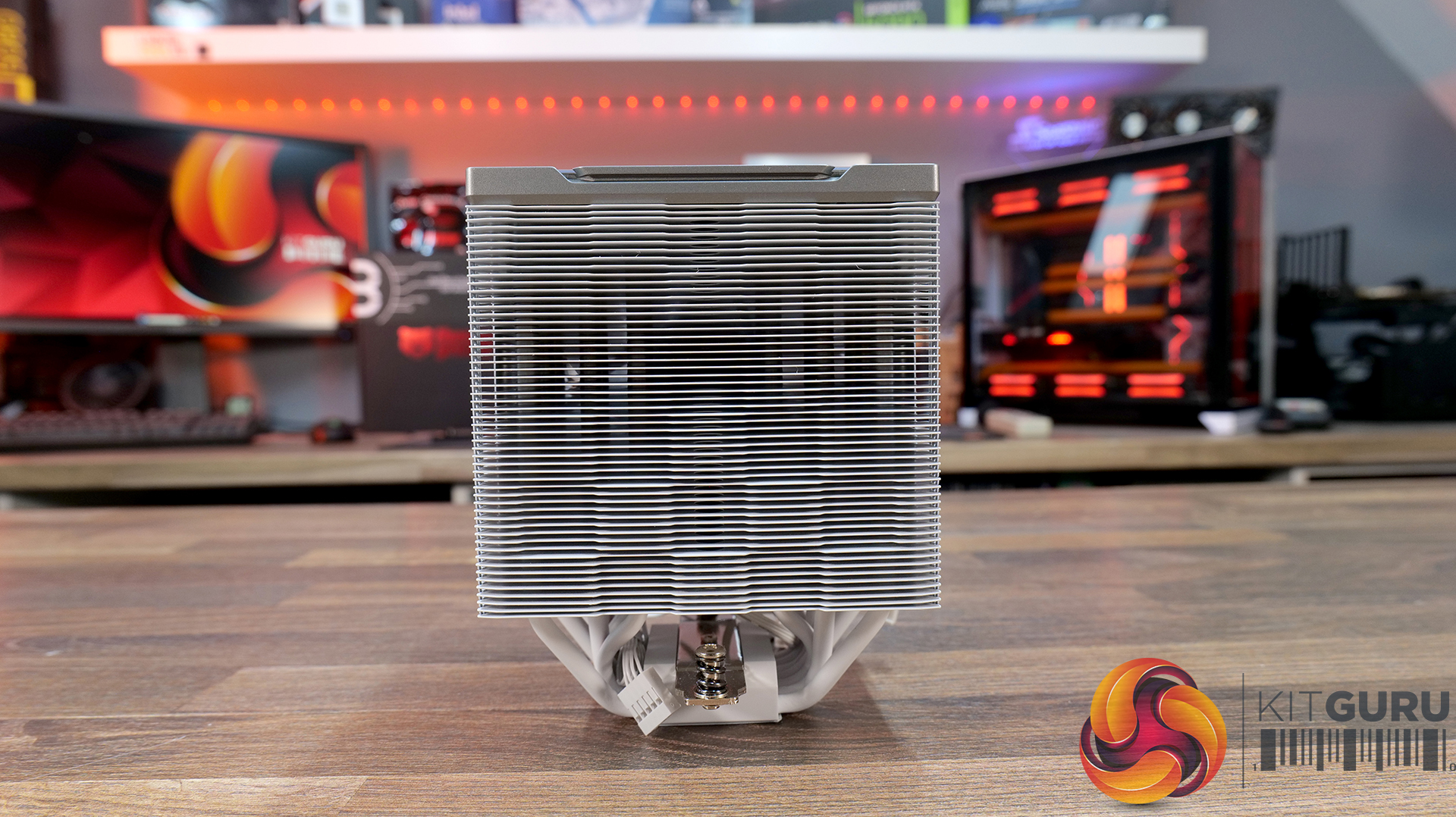
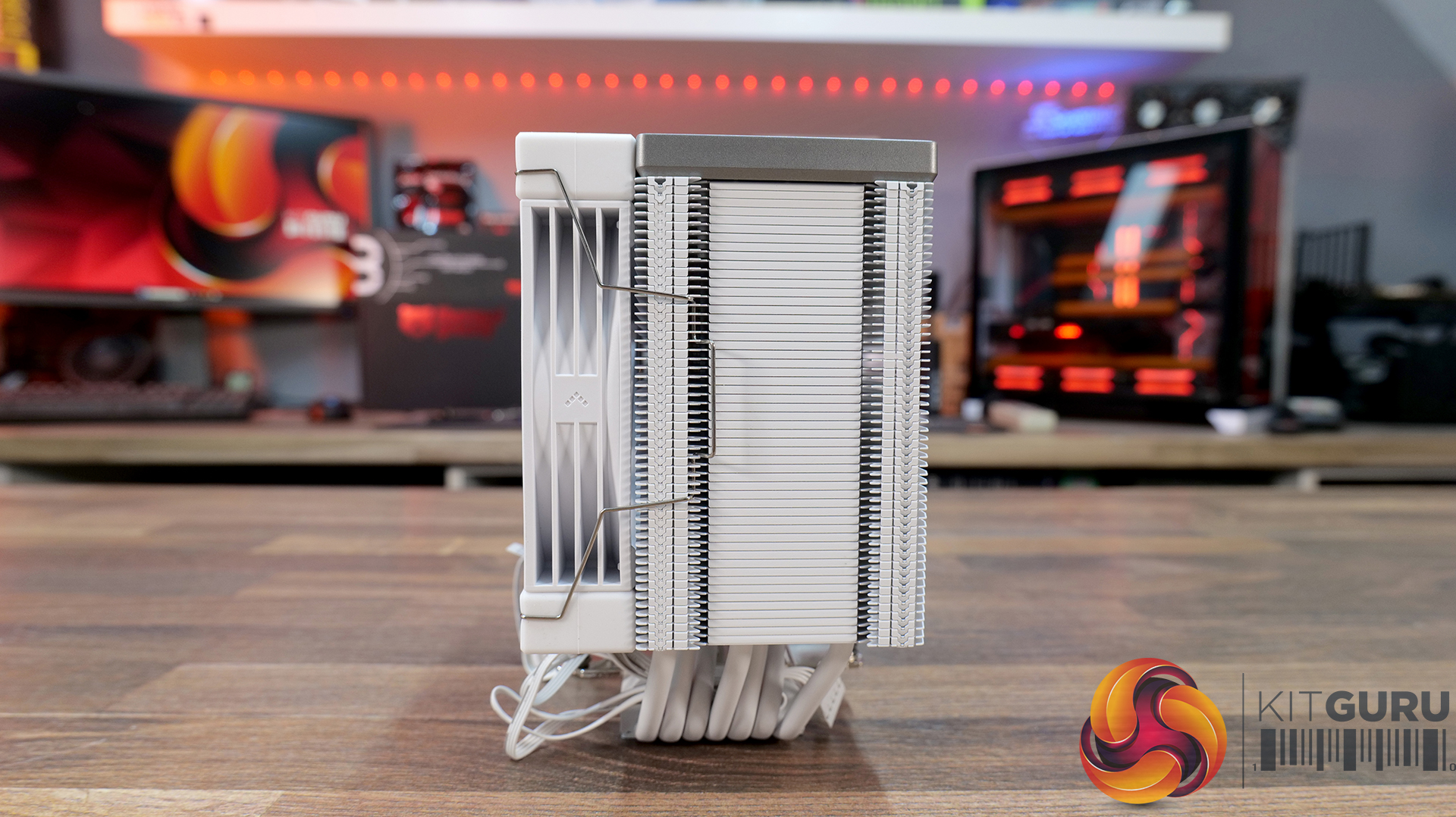
00:54 DeepCool AK700 Digital
05:20 Accessories
06:12 PC Cooler RZ700D
09:40 Accessories
10:32 Sudokoo SK620V
16:16 Accessories
17:19 Installation of the 3 coolers
18:30 LCD screens and software
19:02 Thermal And Noise Output – testing
22:54 James Closing Thoughts
DeepCool AK700 Digital WH: Available late February 2026 – £54.99 MSRP
AI-Driven Cooling Control: Uses DeepCool's DeepCreative software AI algorithm to automatically adjust the fan speed curve based on real-time CPU load for balanced cooling and quiet operation.
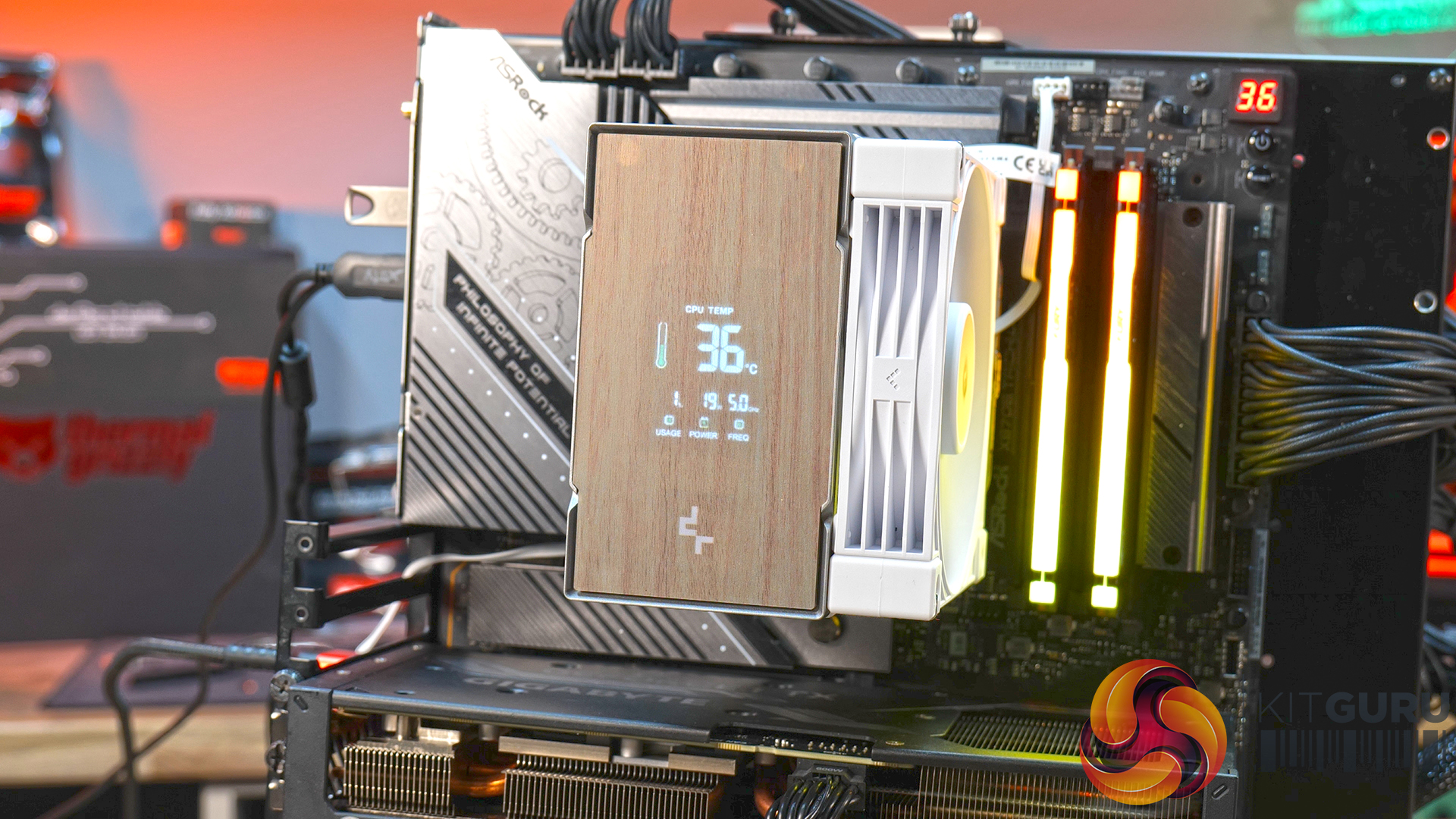
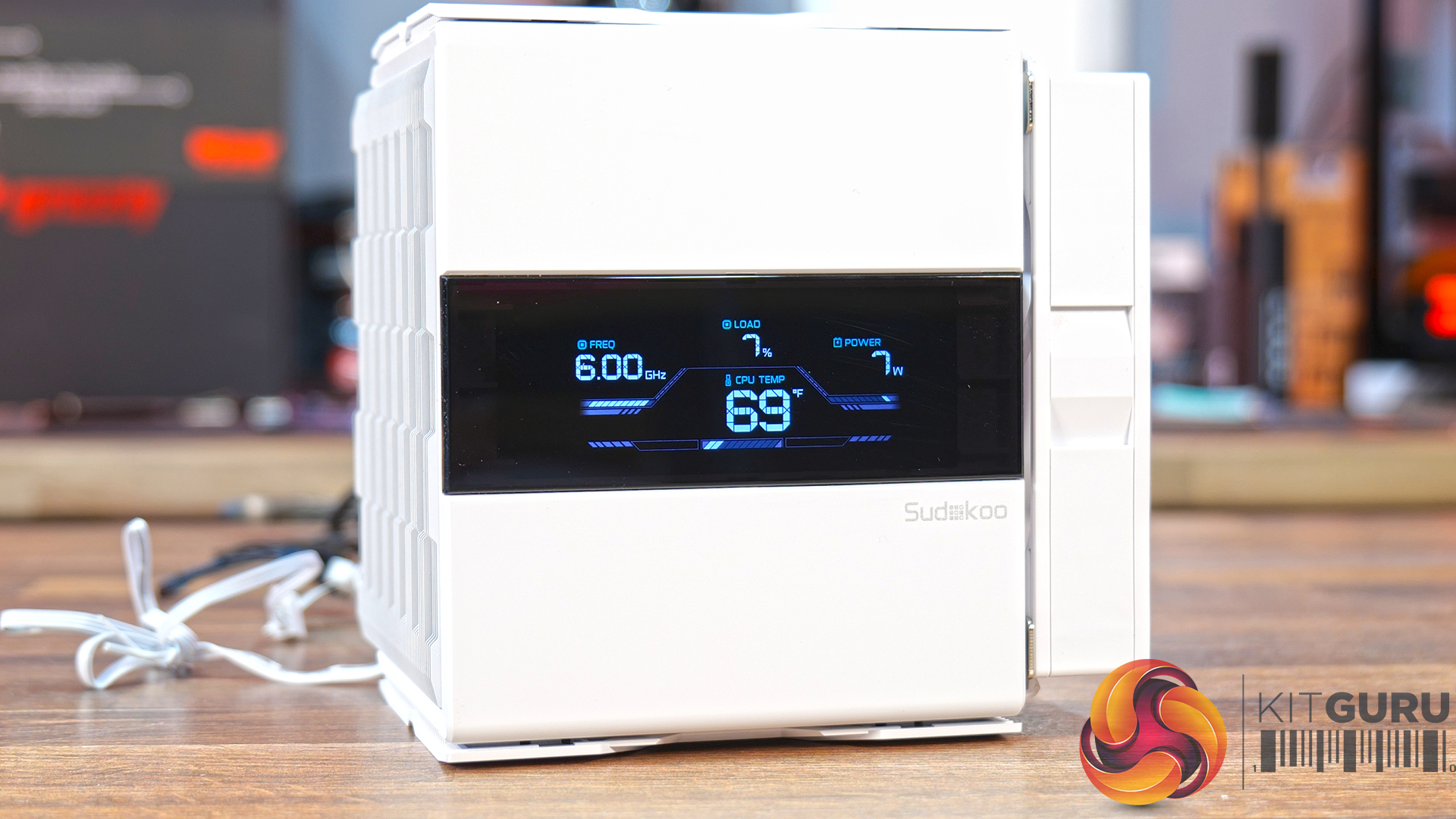
Quad-Segmented Digital Display: It features a High-end display that shows CPU temperature, usage, wattage, and frequency in real time, controllable via DeepCool software and connected through a USB 2.0 motherboard header.
Advanced Thermal Design: AK700 Digital WH is equipped with seven copper heat pipes, a dense single-tower heatsink, and Core Touch Technology (CTT 2.0) for enhanced heat transfer and cooling performance.
Quiet & Reliable Operation: Newly designed silent fan with hydraulic bearings, 0-RPM startup/stop, and Activate Clearing Tech (ACT) for automatic dust clearing, delivering smooth airflow with minimal noise.
Heatsink Dimensions: 124 × 76 × 151 mm (L × W × H)
Net Weight: 1252 g
Heat pipes: Ø6 mm × 7 pcs
Fan Dimensions: 120 × 120 × 25 mm (L × W × H)
Fan Speed: Up to 2700 ±10% RPM
Fan Airflow: 77.23 CFM
Fan Air Pressure: 5.13 mmAq
Fan Noise: 0 / 28.8 / 36.0 dB(A)
Fan Connector: 4-pin PWM
Bearing Type: Hydro Bearing
Fan Rated Voltage: 12 VDC
Fan Rated Current: 0.35 A
Fan Power Consumption: 4.2 W
Display Module Rated Voltage: 5 VDC
Display Module Rated Current: 0.13 A ±10%
Display Module Power Consumption: 0.65 W
Display Area: 29 × 39 mm
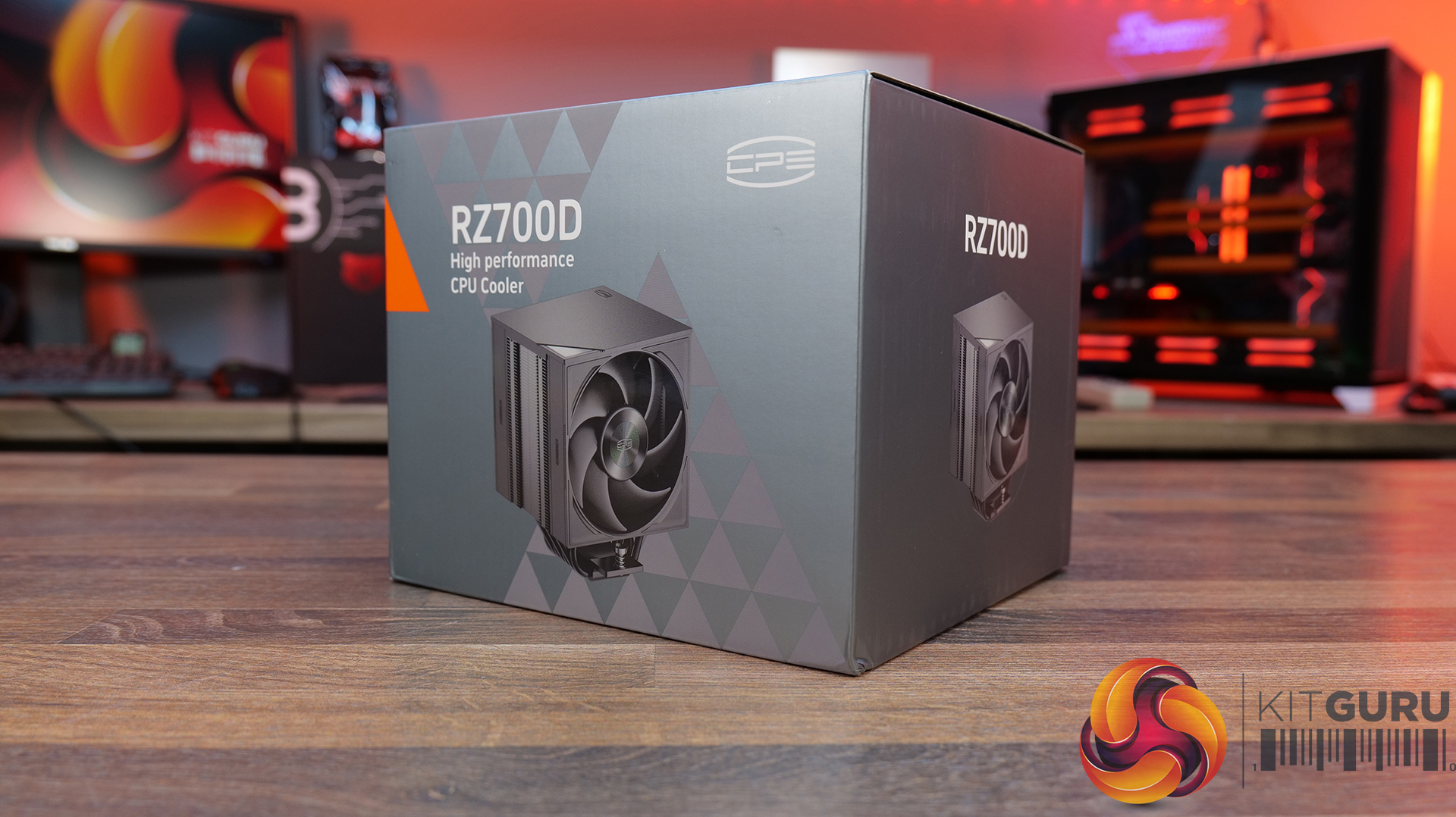
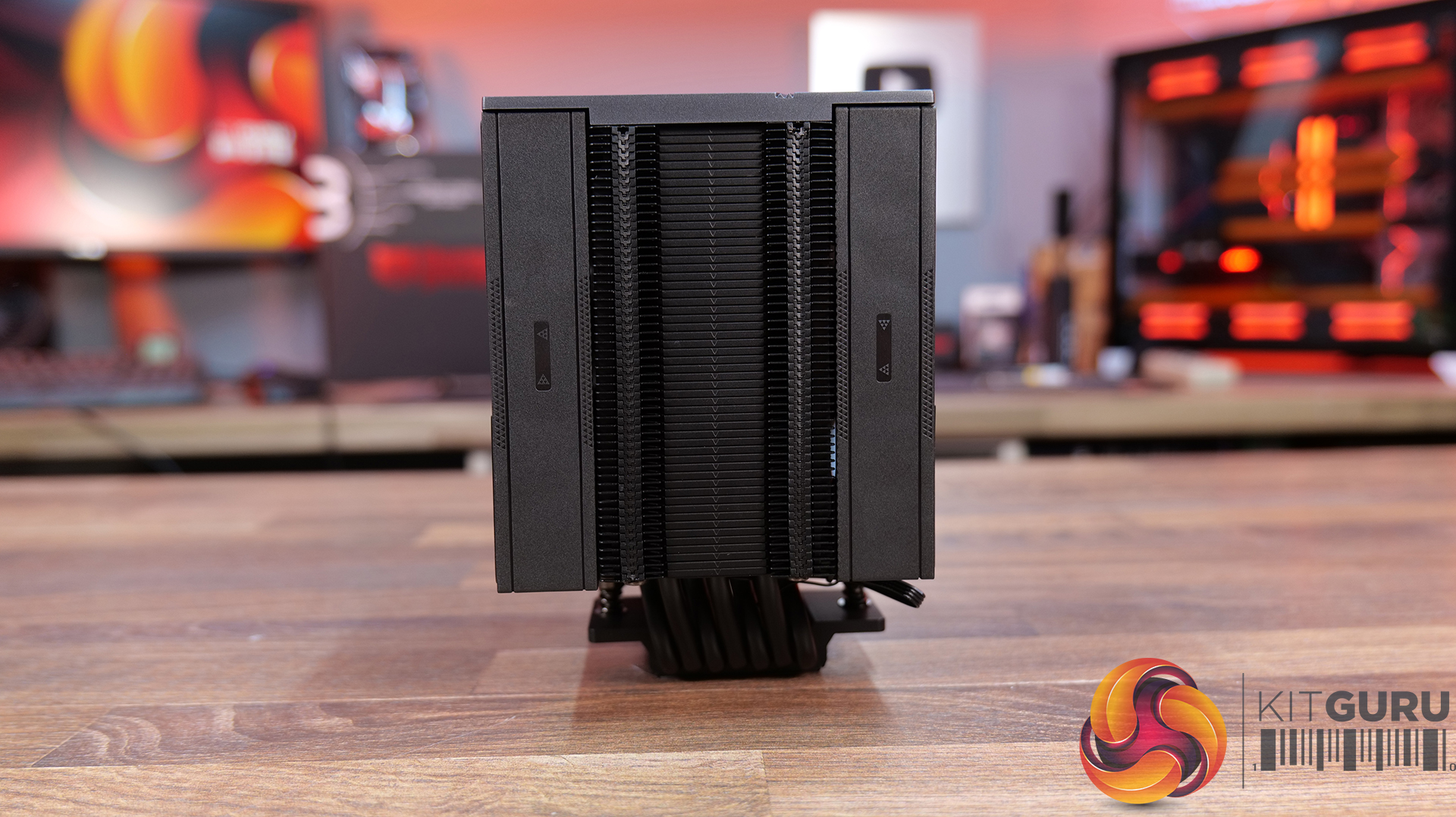
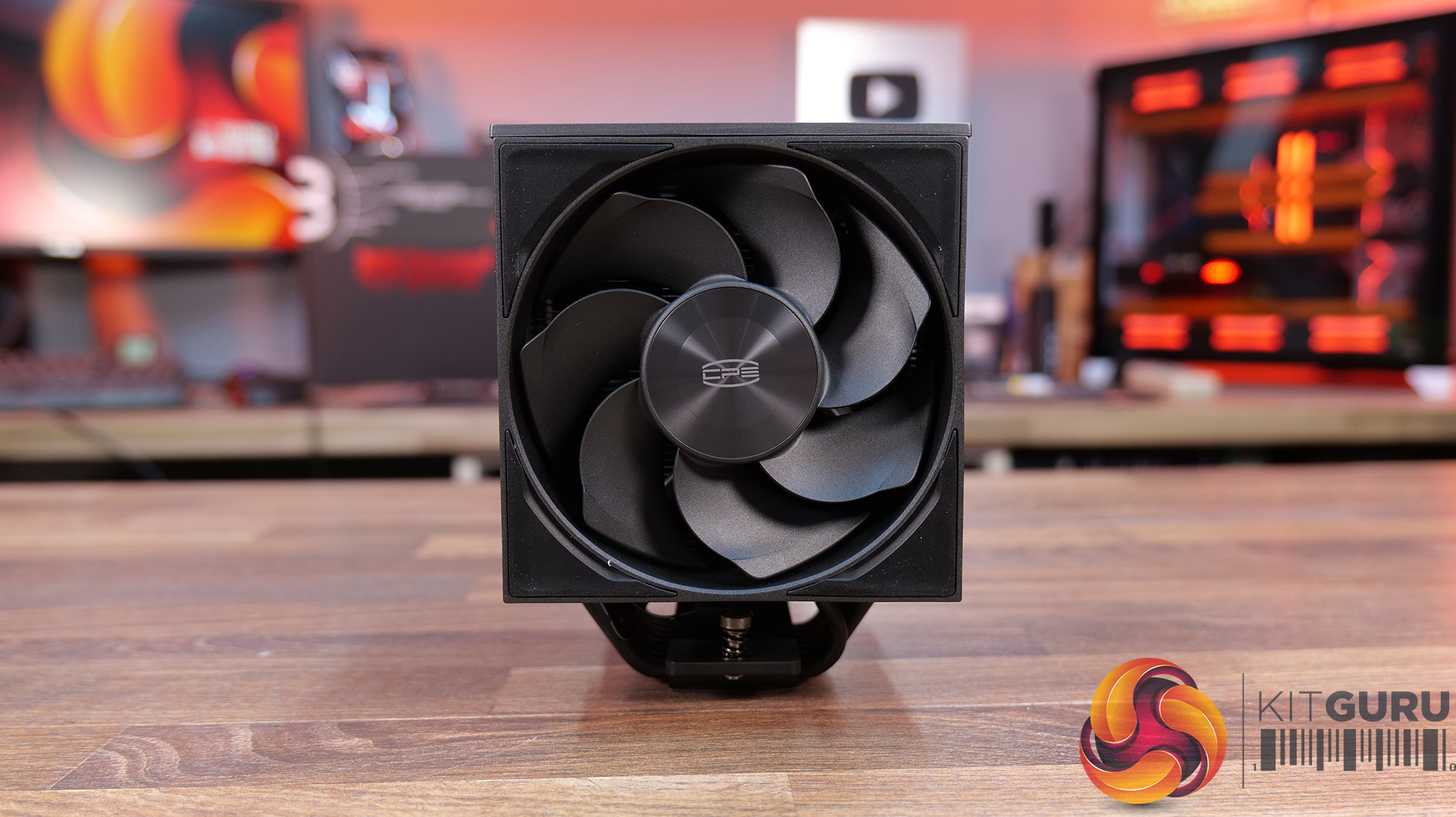
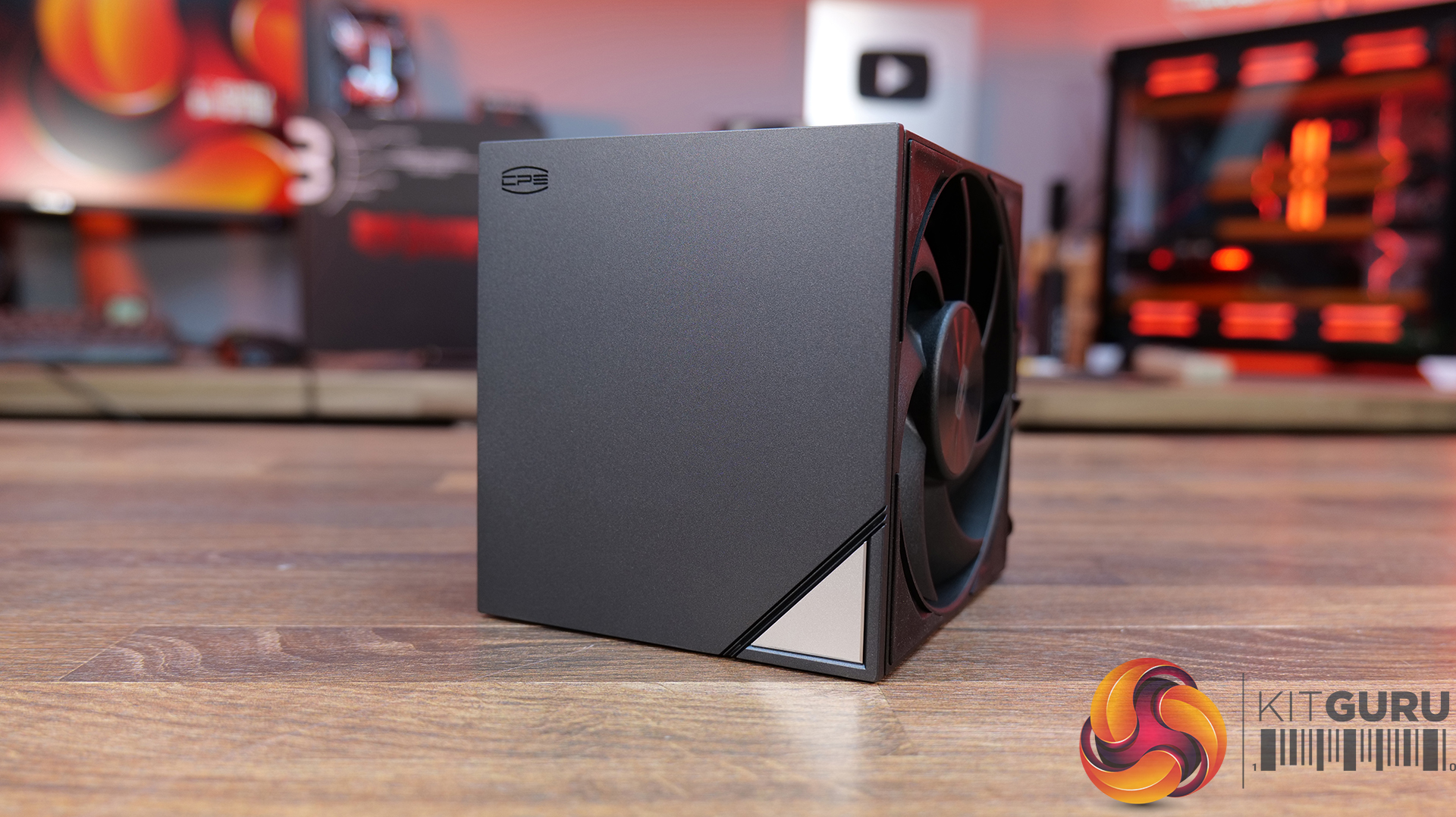
CPS PCCooler RZ700D: UK availability expected February 2026 – £59.99 MSRP
7-heatpipe thick single-tower design: Featuring next-generation Ø6 mm × 7 heatpipes and a 60 mm thick single tower fin stack for enhanced heat dissipation.
Dual-fan configuration: Designed with speed-offset noise reduction, using a standard curved-blade fan and a mirrored reverse-blade fan to reduce high-frequency noise and resonance.
High-performance Fans: With dual-ball bearing design delivering up to 79.8 CFM airflow and up to 4.4 mmH₂O static pressure for strong cooling efficiency.
User-friendly and compatible design: RZ700D is equipped with a magnetic top cover, tidy no-buckle fin layout, copper-plated nickel reflow soldered base, and no RAM interference.
Fan Rated Current: 0.15 A (Normal Blade), 0.12 A (Reverse Blade)
Fan Power Consumption: 1.8 W (Normal Blade),1.44 W (Reverse Blade)
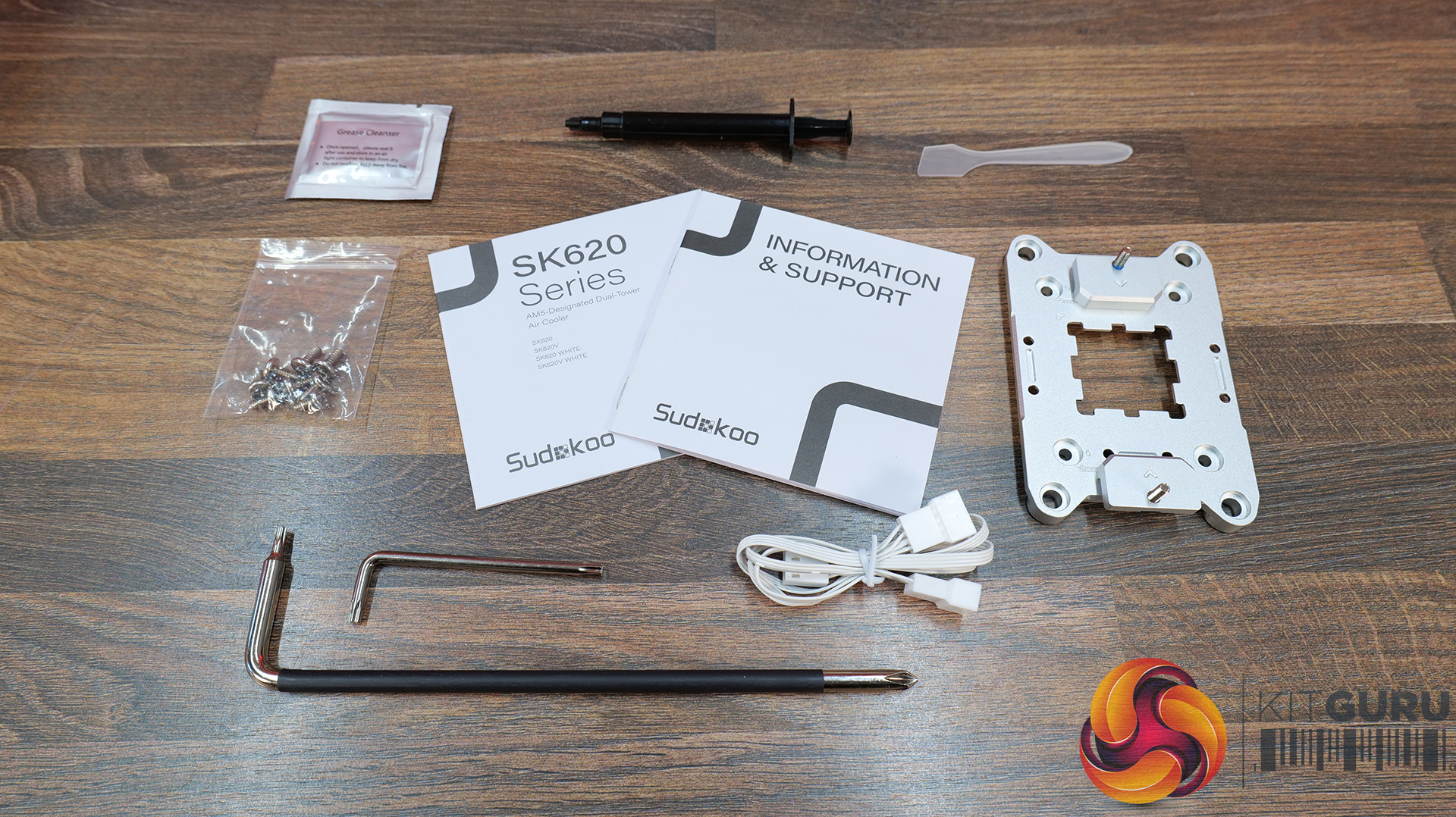
Sudokoo SK620V: Available now from Amazon UK, priced at £86.99 HERE.
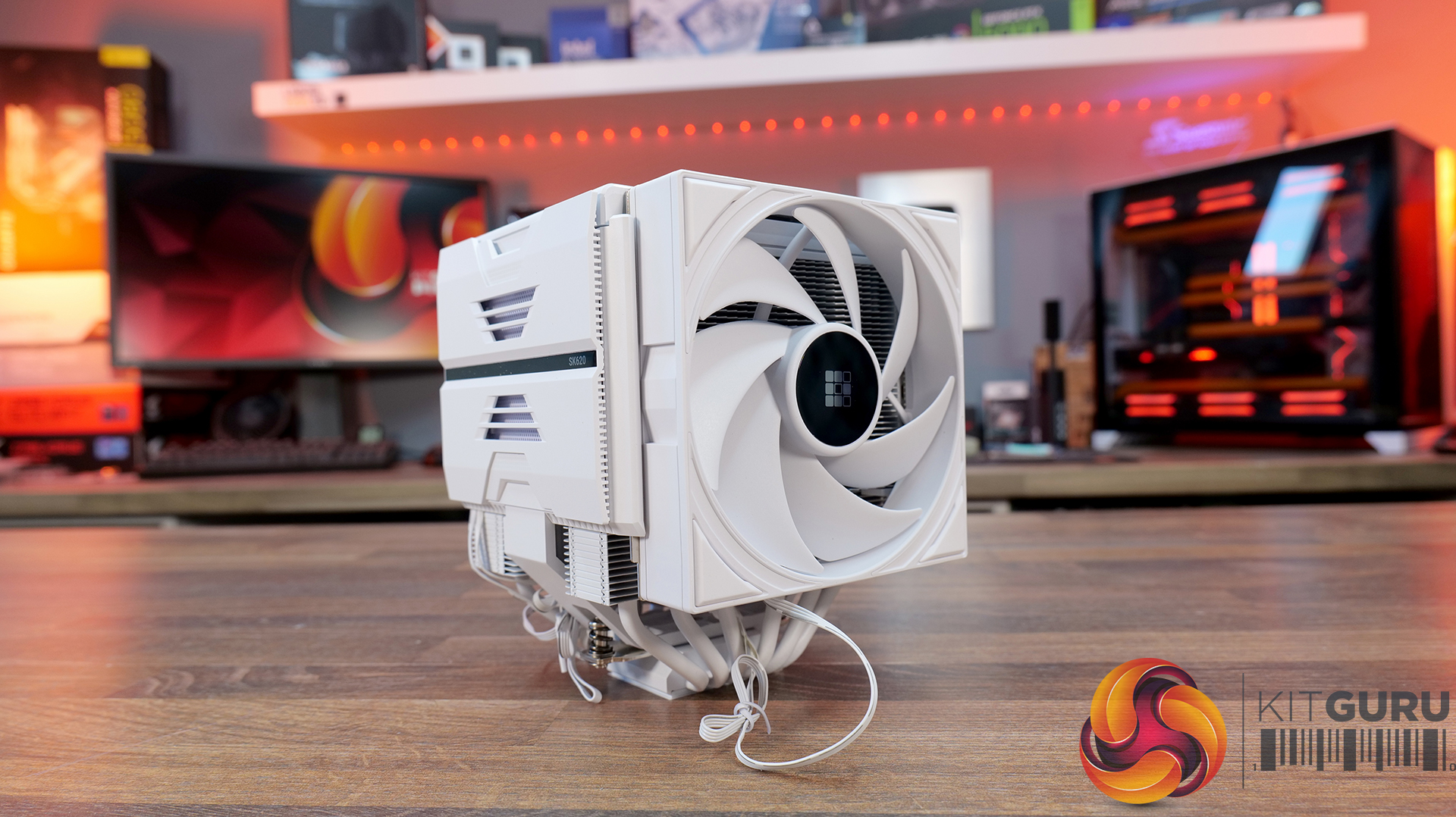
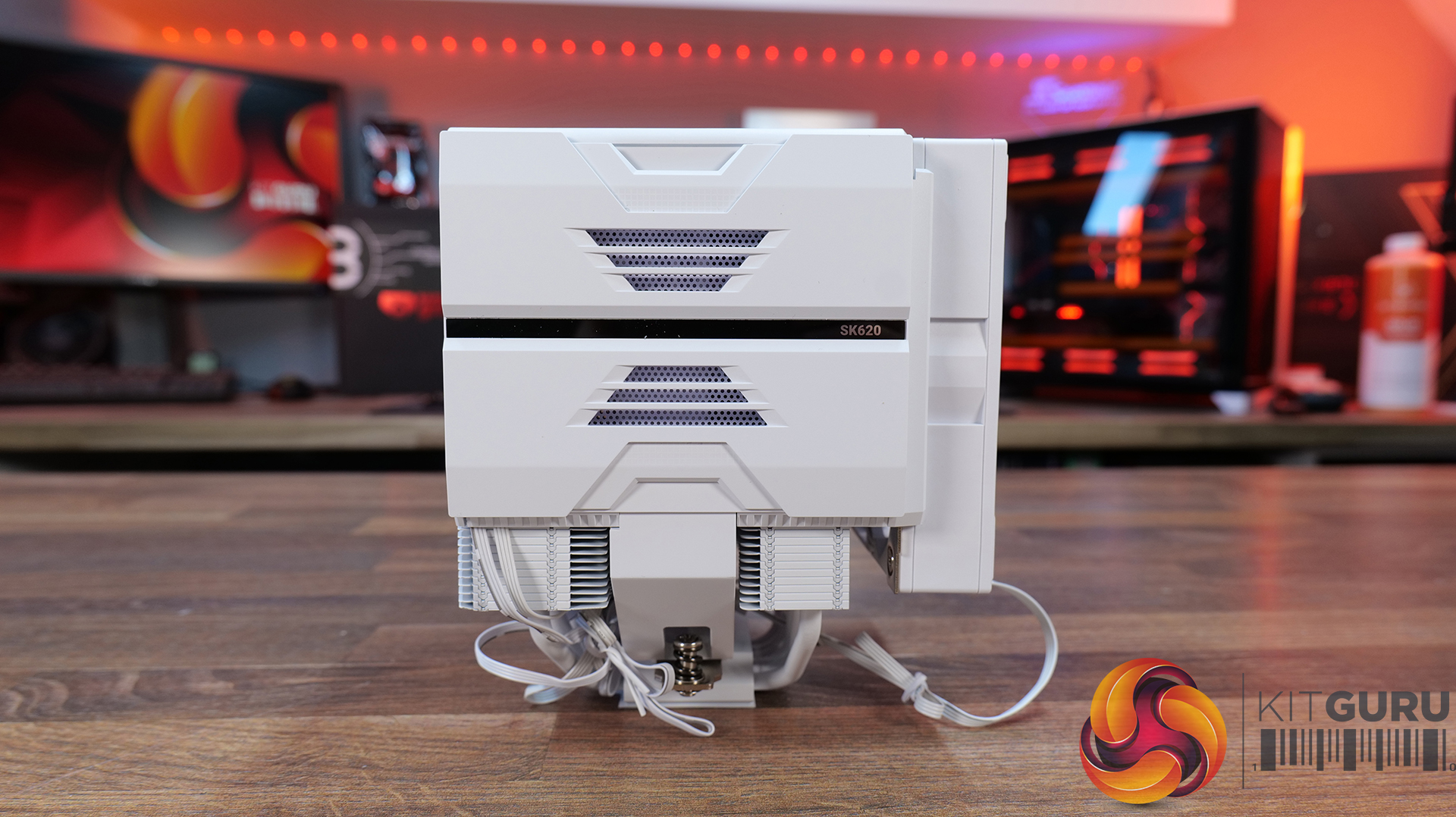
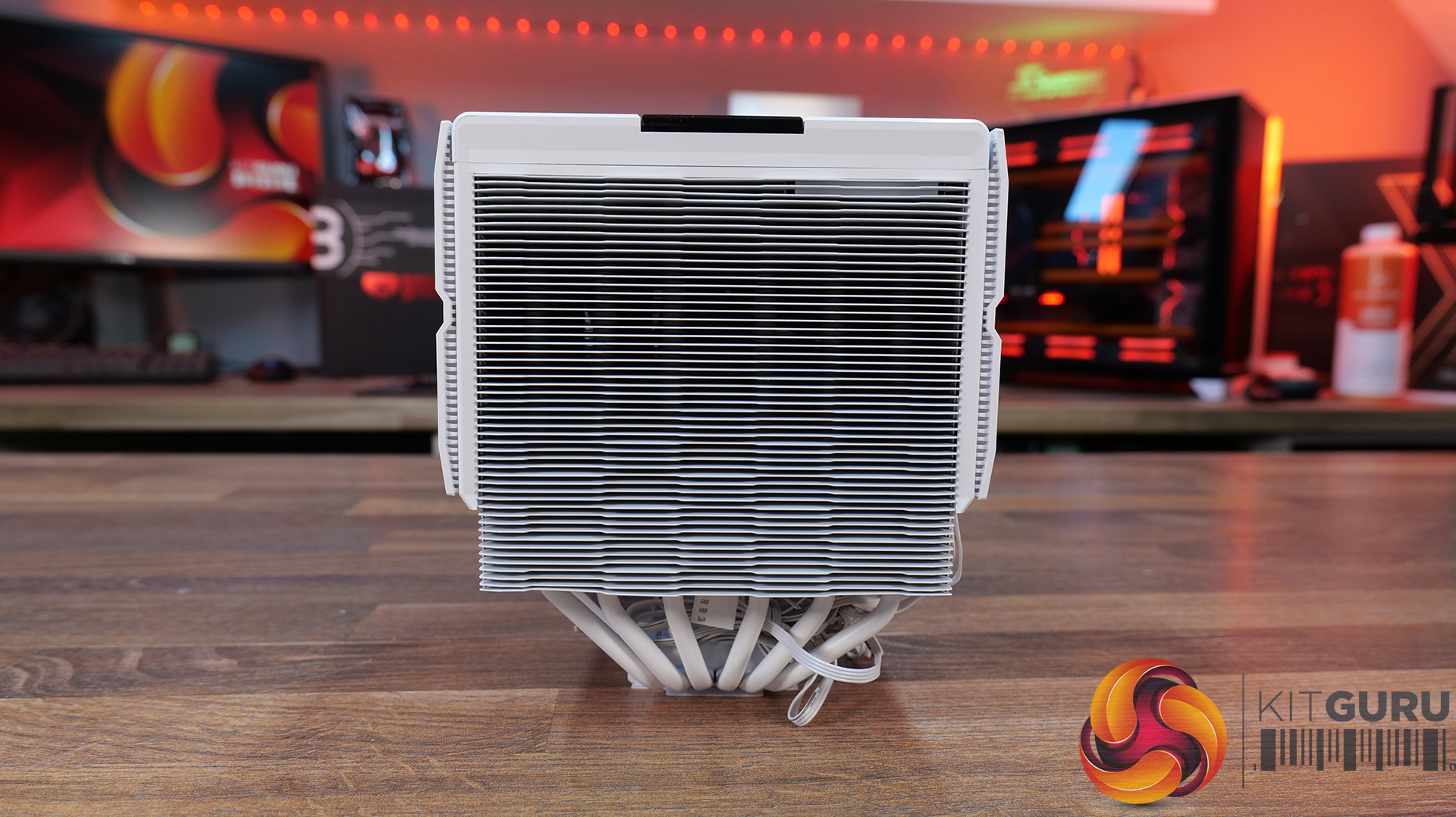
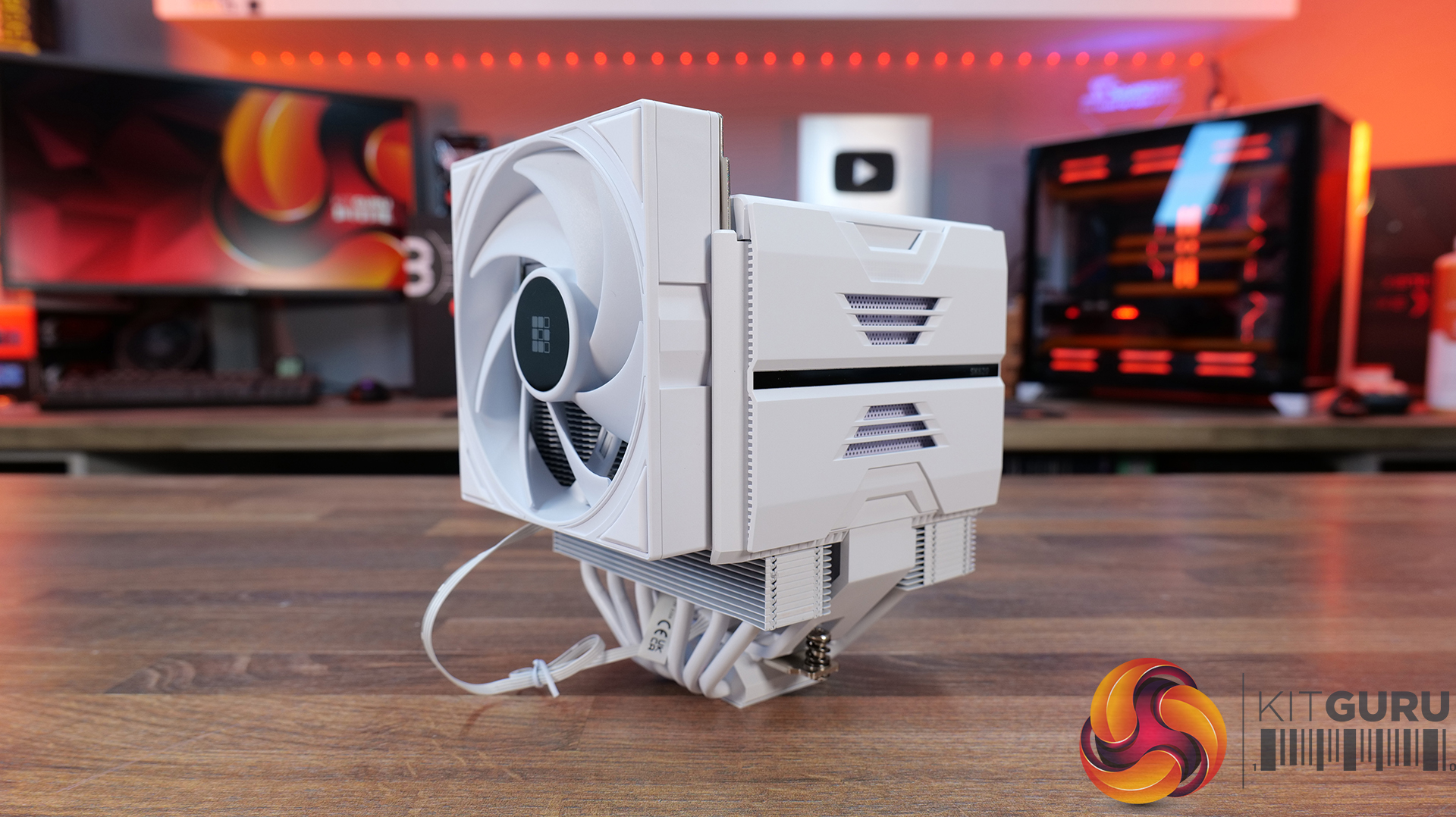
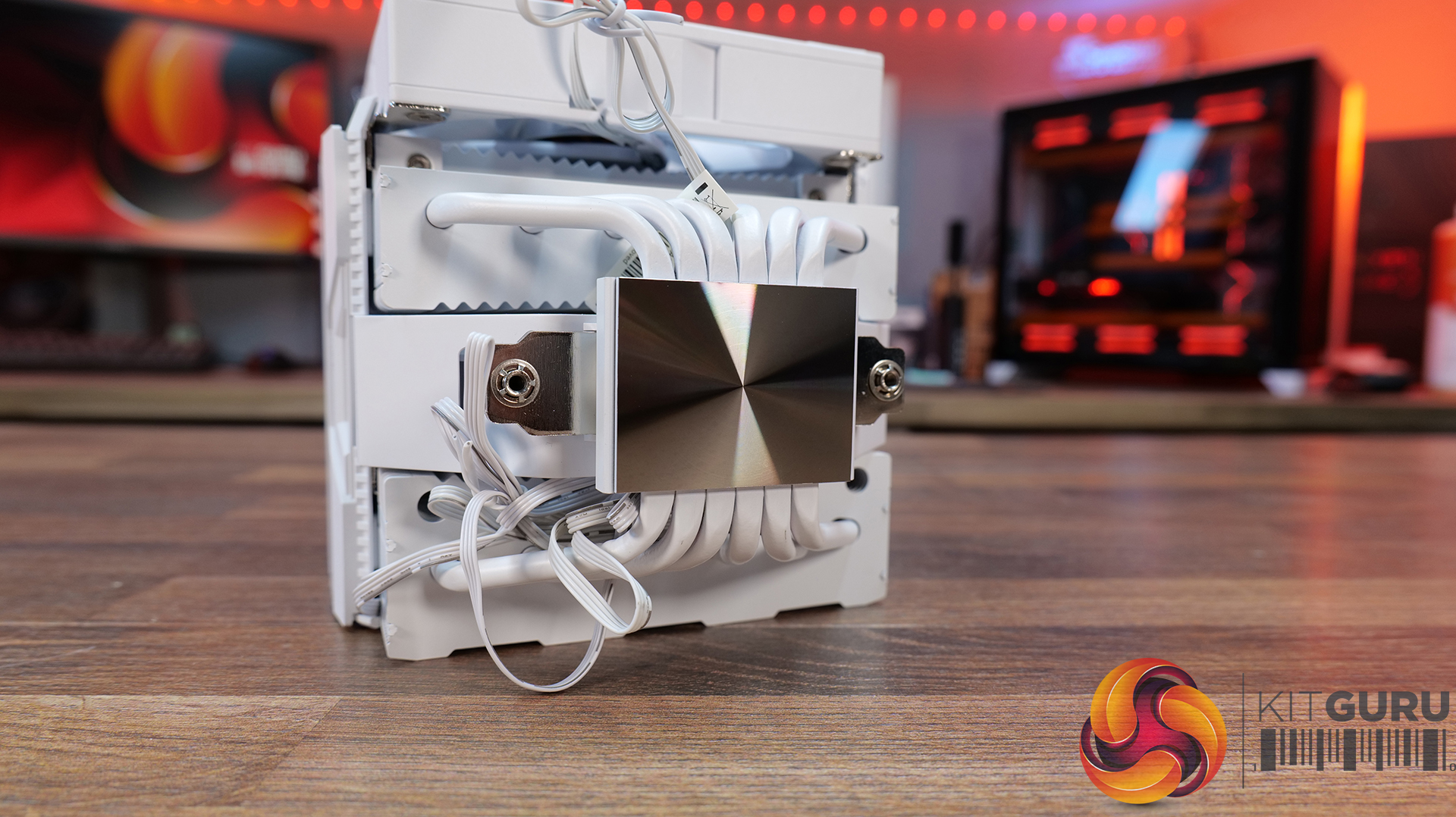
Dual-tower cooling power: The SK620V uses a dense dual-tower heatsink with six heat pipes, purpose-built for AM5 CPUs to deliver strong thermal performance for high-load and overclocked systems.
Built-in digital screen: A quad-segmented display shows real-time CPU temperature, usage, wattage, and frequency connected via USB 2.0 and controlled through Sudokoo’s MasterCraft software for clean, cable-light monitoring.
Quiet, efficient airflow: Dual 120 mm fans with advanced 3-phase FOC motor control provide strong airflow while keeping noise low, topping out at ≤29.9 dB(A) under load.
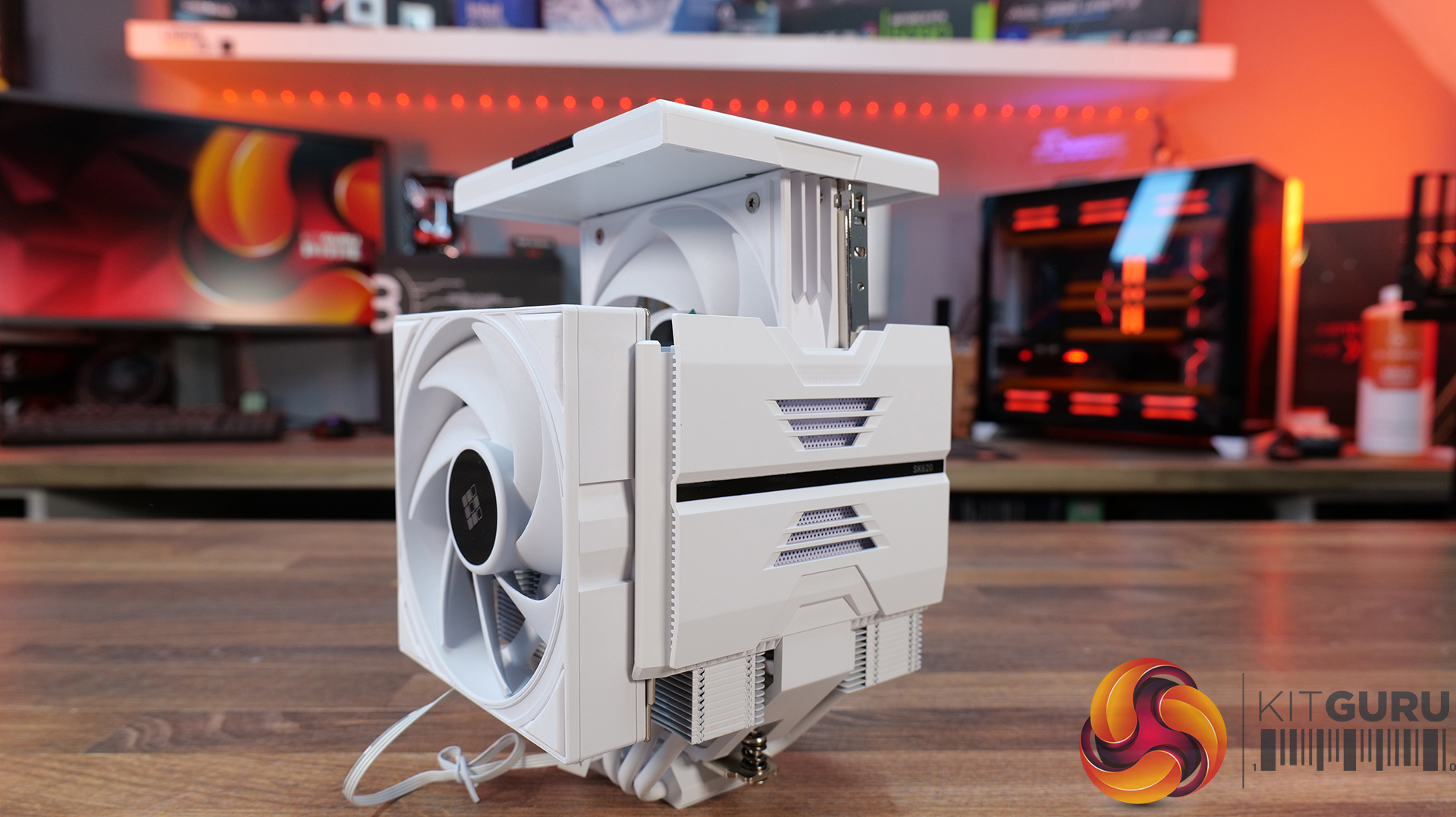
Smart compatibility design: Adjustable glide fan mounting improves RAM clearance, while the AM5 anti-bending corrector and sturdy mounting system ensure even pressure and easy installation.
Specifications
Product Dimensions: 145 × 144 × 164 mm (L × W × H)
Heatsink Dimensions: 125 × 115 × 153 mm (L × W × H)
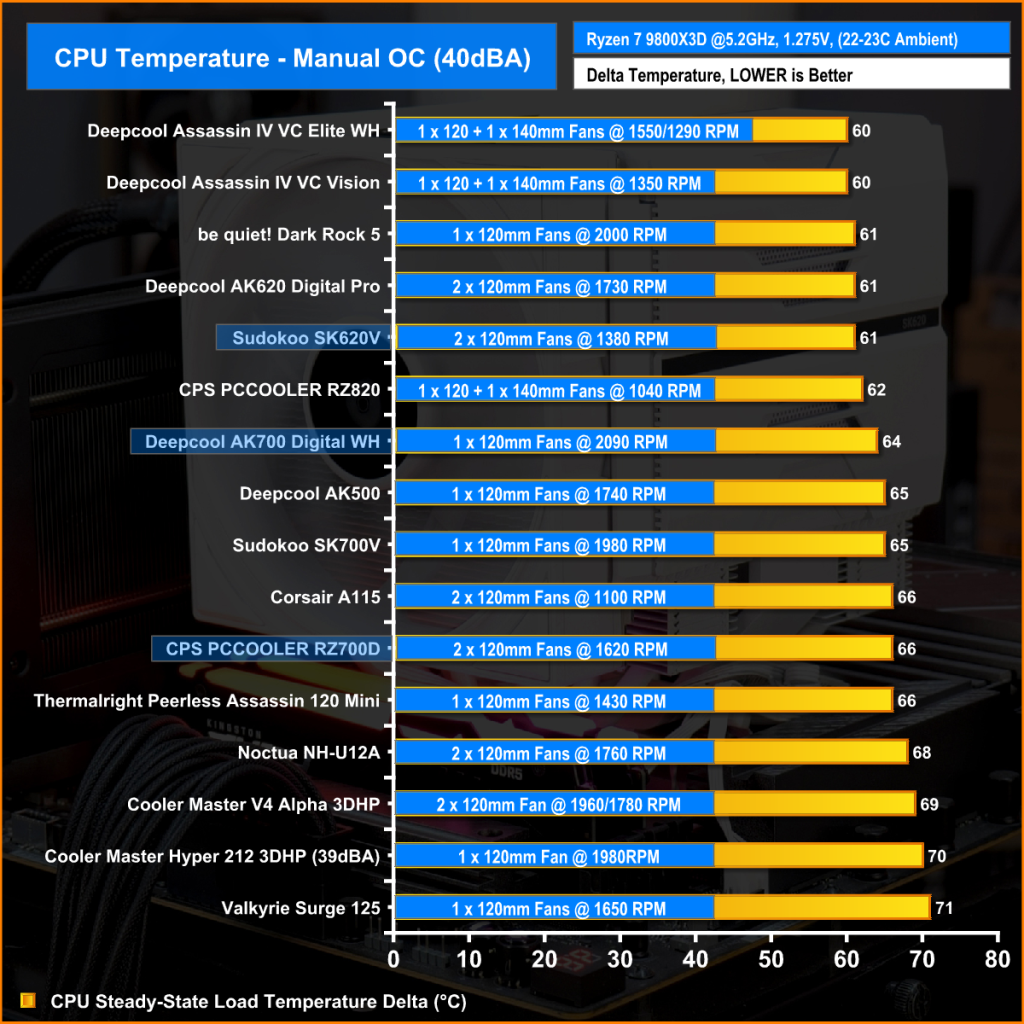
We are primarily focusing on the performance of each cooler at 100% fan speed and also when locked to 40dBA noise output. We will focus on cooling performance using a manual overclock with all-core frequency and VCORE locked to 5.2GHz/1.3v (AMD) and 5.5GHz/1.3v (Intel) and Precision Boost Overdrive performance.
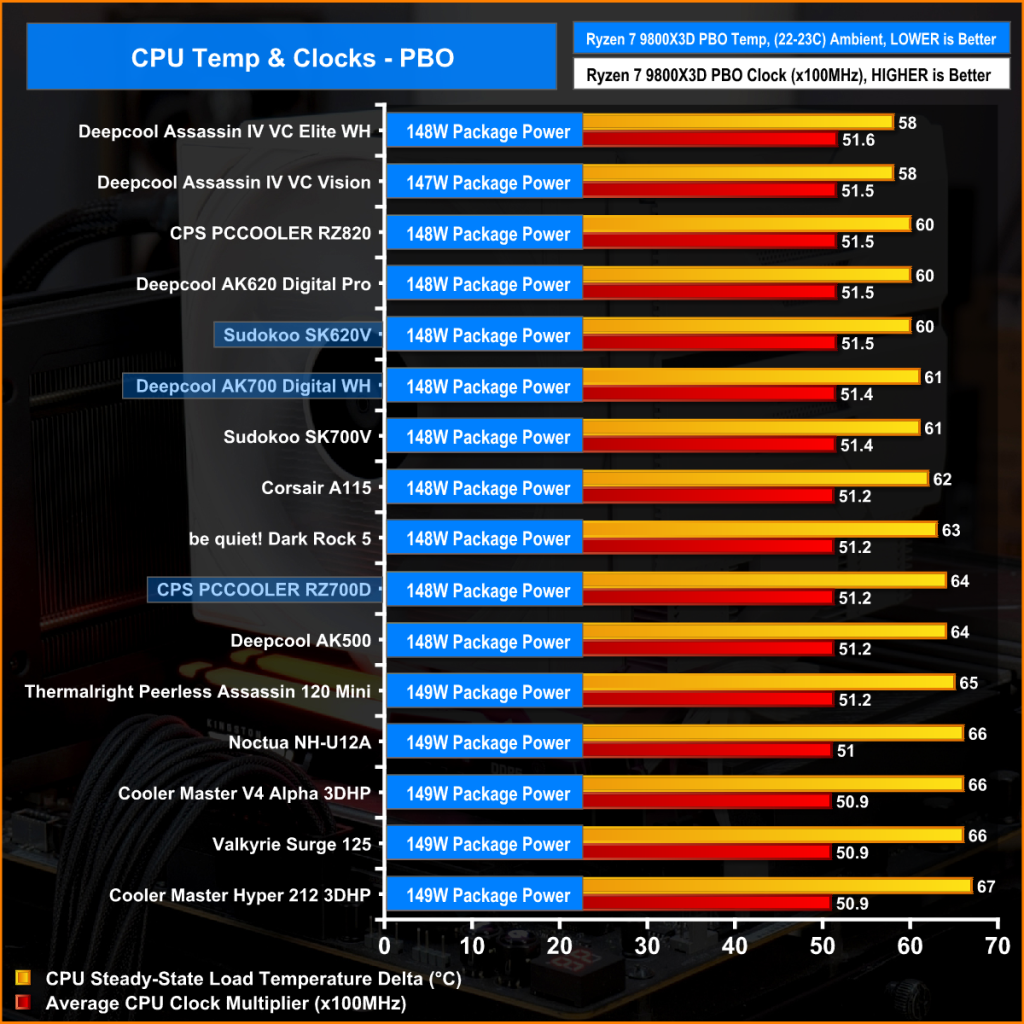
The test data is logged using HWINFO and the final 10 minutes of the data is calculated to find the average CPU temperature and CPU clock multiplier (AMD PBO Test) and then plotted in the charts.
For testing, we use a 30-minute looped run of Cinebench R23 and record the steady-state CPU temperature at the end of the test. This ensures that the CPU has had ample time to warm up and reach a steady state under all of the coolers.
The ambient is maintained at 19-21 degrees Celsius. Where there is variation beyond this temperature range, we add extra repeated tests to ensure consistency. However, this is well controlled now with A/C.
We also test each cooler with at least two fresh installs (typically three) to mitigate the likelihood of poor mounting spoiling results.
Ambient temperature and humidity are controlled via a mini split air conditioning system inside the test room. Ambient temperature is maintained between 22-23°C, Temperature delta figures are shown in the charts (ambient temperature is deducted from the measured component temperature).
Test Results:
Acoustics
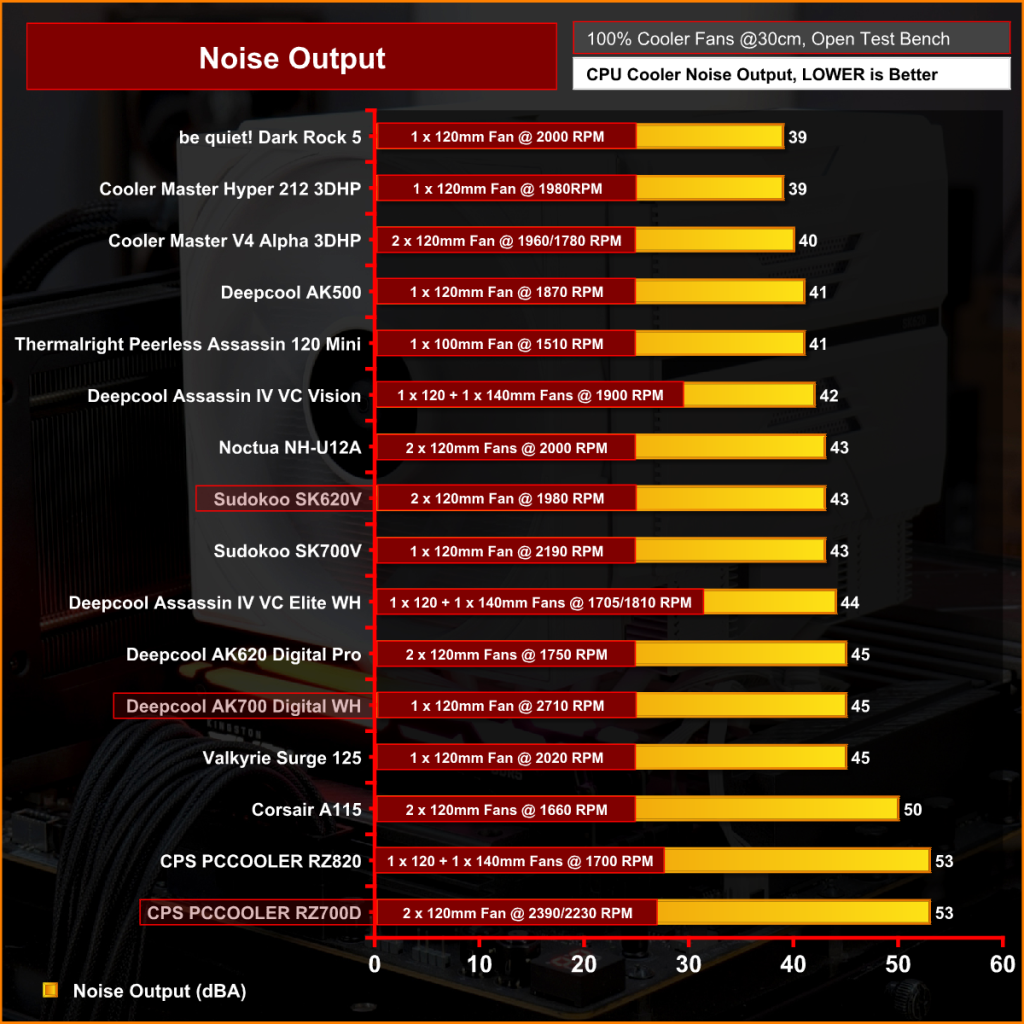
Looking at noise output first, it's immediately clear there are some big differences between the coolers. The Sudokoo SK620V is the quietest at 43dBA max, making it clearly audible under load but still well behaved and unlikely to draw unwanted attention in a closed chassis. DeepCool’s AK700 Digital WH pushes things a touch more at 45dBA, where fan noise will be more noticeable during sustained workloads, though it remains within what most users would consider acceptable for a high-performance air cooler.
Unfortunately though, the CPS PCCooler RZ700D stands out for the wrong reasons, registering a much higher 53dBA – it's hard to ignore even at a reasonable distance.
Thermal Performance: AMD Ryzen 7 9800X3D
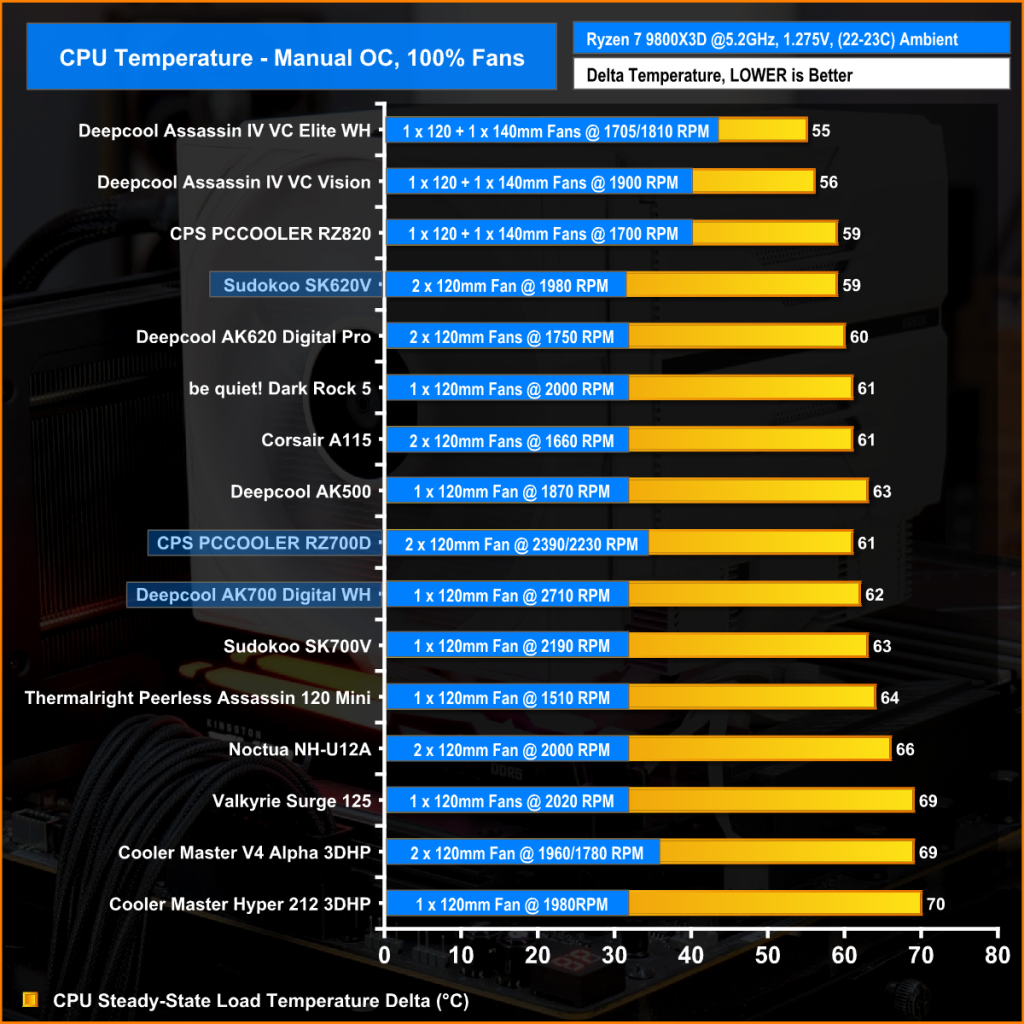
With the fans running at full speed, the thermal results are quite tightly spread, especially between the two single-tower 7 heat pipe coolers. The Sudokoo SK620V leads the group at 59°C over ambient, delivering the strongest raw cooling performance when allowed to run at 100% PWM, thanks to its dual cooling tower design. The CPS PCCooler RZ700D follows at 61°C, putting it in the middle of the pack.
DeepCool’s AK700 Digital WH comes in just behind at 62°C, which is still fine but does trail the other two units on test today.
Looking at thermal performance with the fans noise-normalised to 40 decibels, the Sudokoo SK620V stays top, hitting 61°C over ambient,making it the most efficient of the three. The CPS PCCooler RZ700D falls back to 66°C over ambient, showing a significant thermal hit when the fans are throttled to maintain acceptable noise levels.
The DeepCool AK700 Digital WH lands in the middle at 64°C, which is fine but it can't match the efficiency of the SK620V.
AMD PBO workloads push CPUs to sustained maximum all-core boosts, so the differences between these three coolers do become more apparent. The Sudokoo SK620V delivers a delta of 60°C while maintaining an average CPU multiplier of 51.5x, higher than the other two coolers, so it's able to dissipate heat more efficiently and maintain higher clock speeds even under heavy multi-core loads. The DeepCool AK700 Digital WH follows closely at 61°C and a 51.4x multiplier, which is still solid but shows slightly higher temperatures likely due to its smaller single-tower design.
The CPS PCCooler RZ700D hit 64 °C with a 51.2x multiplier, the lower performance likely as a result of its single-tower layout. It's perhaps not a surprise but the size and designs clearly make a difference, given the SK620V’s dual-tower layout puts it towards the top of the chart, whereas the other two single-tower coolers come in below.
Sudokoo SK620V
Pros:
Quick installation and AMD mount uses an integrated CPU hold-down frame.
Sliding fans are easy to install/remove and adjust.
Very good build quality.
Low noise even at max fan speed.
Cons
LCD screen has little customisation.
Quite expensive for a mid-range dual tower.
LCD only works with software installed.
Rating: 9.
DeepCool AK700 Digital WH
Pros:
Quick installation.
Cool Screen implementation on wood effect panel.
Decent thermal performance.
Cons:
Removing the screen for installation can damage the cable.
The screen can be difficult to see in bright light or at an angle.
Rating: 8.
CPS PCCooler RZ700D
Pros:
Easy install.
Clip-on fans.
Dual Fans included.
Cons:
Quite loud.
Fans make a resonating noise at low speed.
Thermal performance drops off when noise is normalised.
Rating: 7.5.
KitGuru says: If you're looking for premium features, unique looks or no frills CPU cooling, one of these three should suit your requirements.
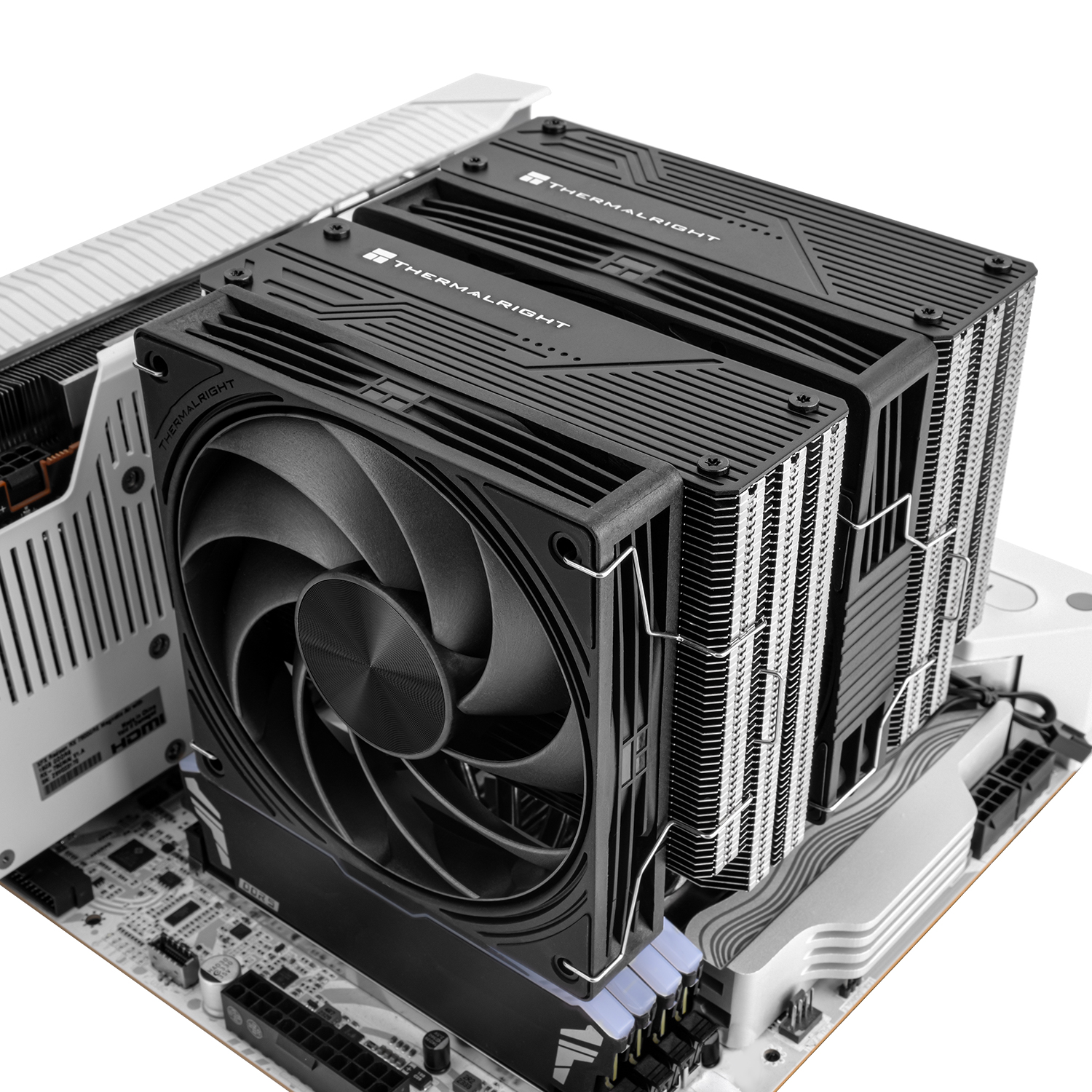
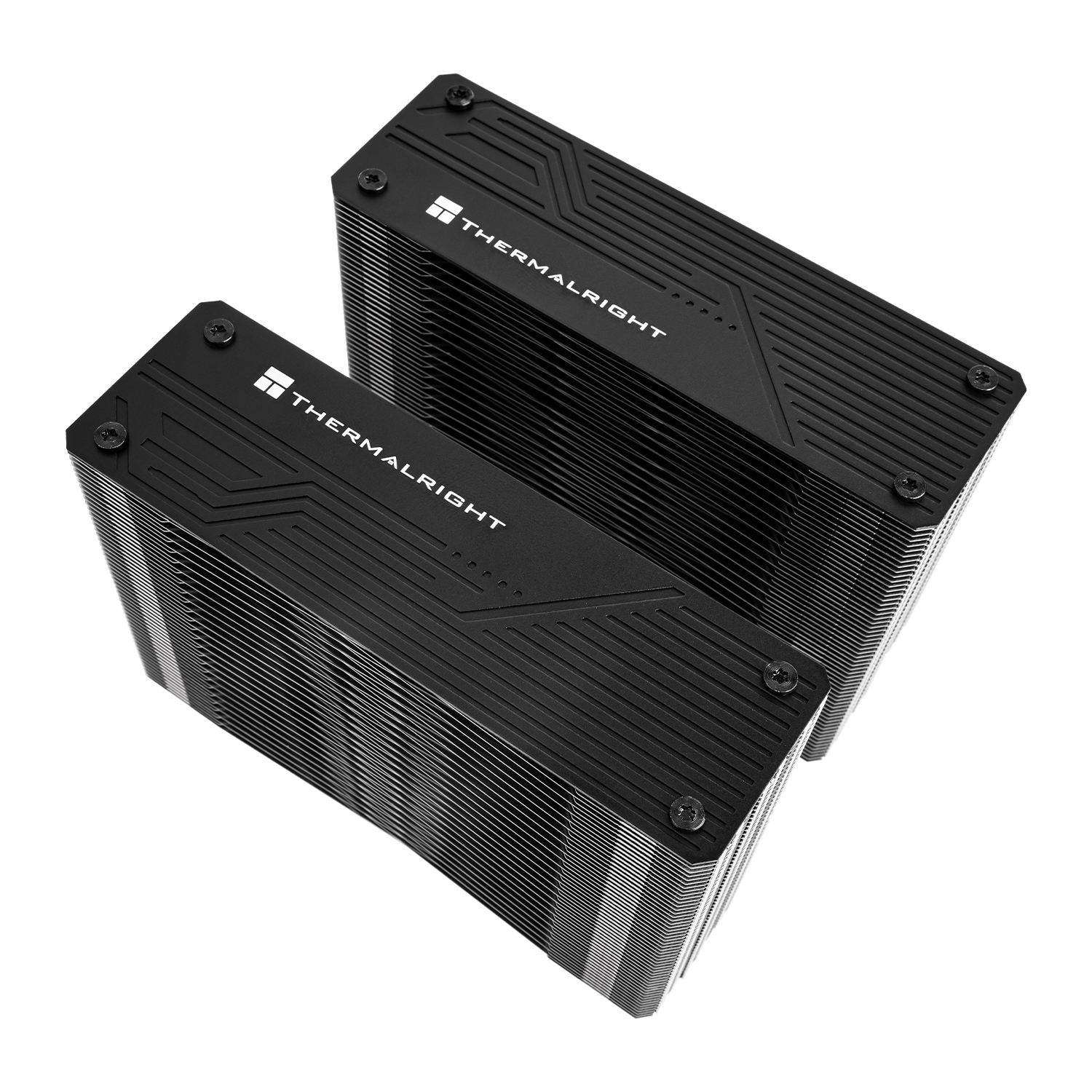
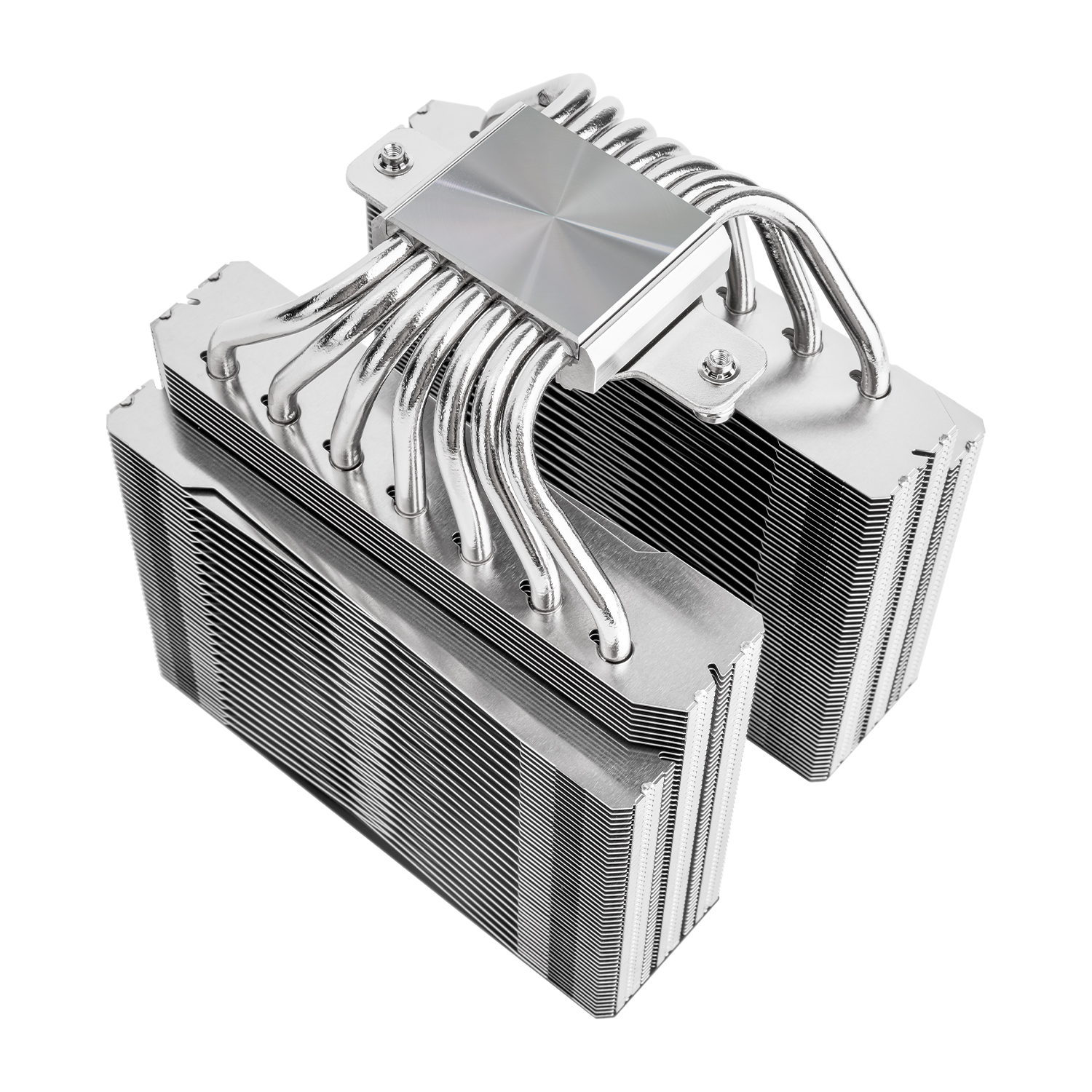
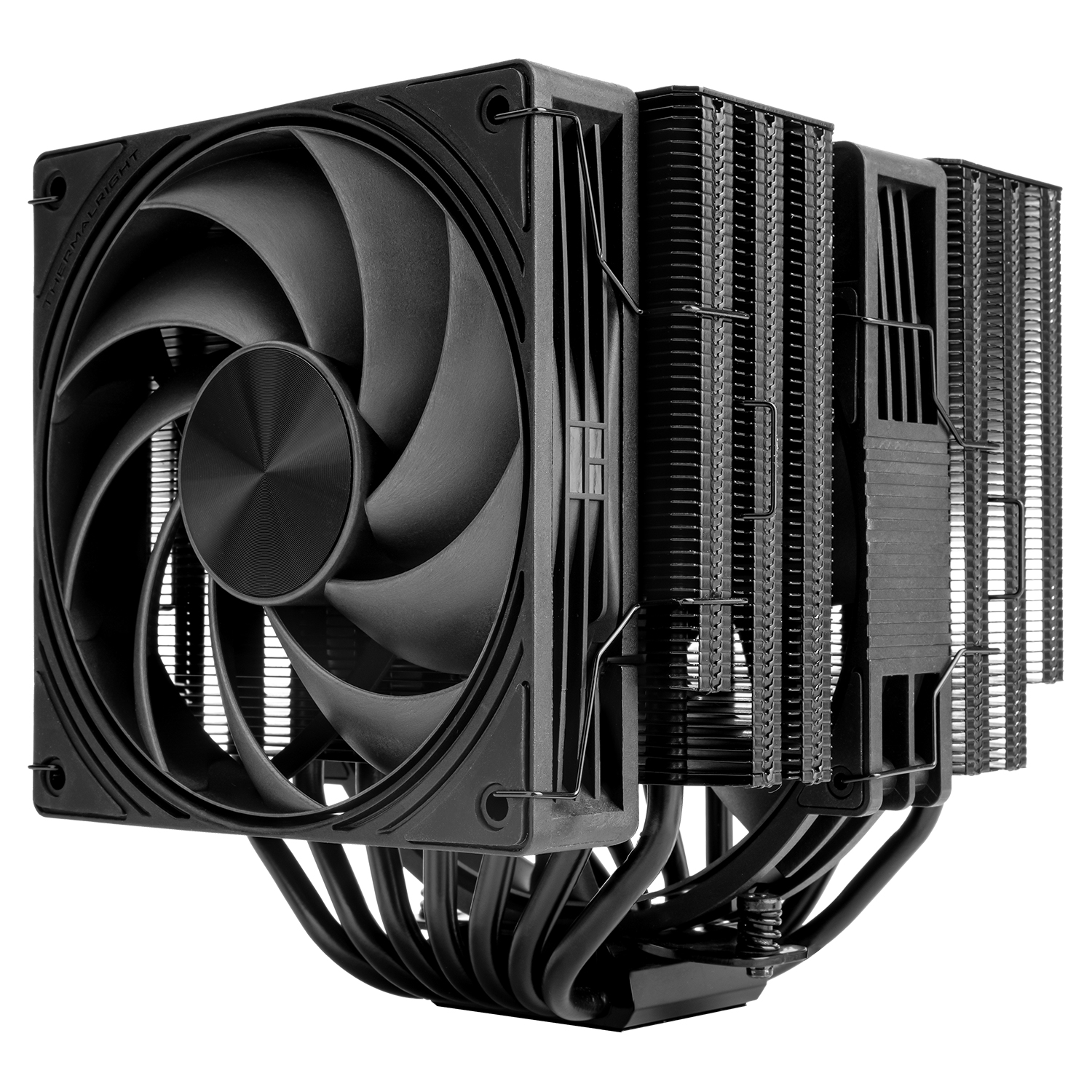
Thermalright has kicked off 2026 by introducing the new Frost Tower 140. The newly unveiled CPU cooler is a dual-stack giant designed to match the thermal dissipation of entry-level AIOs, featuring a unique asymmetrical fan configuration and a seven-heatpipe array to tame the latest high-TDP chips from Intel and AMD.
Standing 158 mm tall, the Frost Tower 140 (via Vortez) is one of the largest air coolers in Thermalright's current lineup. The cooler utilises 7x 6-mm-thick heatpipes branching out from a nickel-plated copper base. The cooling performance is driven by a specialised “push-pull” fan duo, with a TL-N12W-R9 (120 mm) fan at the front and a TL-N14DW-R7 (140 mm) fan at the centre. This smaller intake fan ensures better RAM clearance while spinning at up to 2,400 RPM and providing up to a claimed 85.35 CFM with a 2.95 mmH₂O static pressure. As for the 140 mm fan at the centre, it reportedly pushes up to 120 CFM at 1,850 RPM with a static pressure of 2.40 mmH₂O.
According to Thermalright, both fans are built for the long haul, featuring dual ball bearings and impellers made from Liquid Crystal Polymer (LCP). Thermalright has also integrated silicone mounts and noise-dampening rings to keep the acoustics of such high-RPM fans in check.
The Frost Tower 140 is launching in three distinct aesthetics: standard, all-black, and all-white, with the latter two featuring colour-matched fins and heatpipes. Installation is handled by the SS2 all-metal mounting system, ensuring a secure fit across AM5, AM4, and LGA1851/1700 sockets.
KitGuru says: Although pricing isn't known, Thermalright has historically underpriced the competition. With the Frost Tower 140, this trend will likely continue, even tho it uses LCP fans and a seven-heatpipe configuration.
Neat Corp's latest title is due out on Steam in February with a major new feature included.
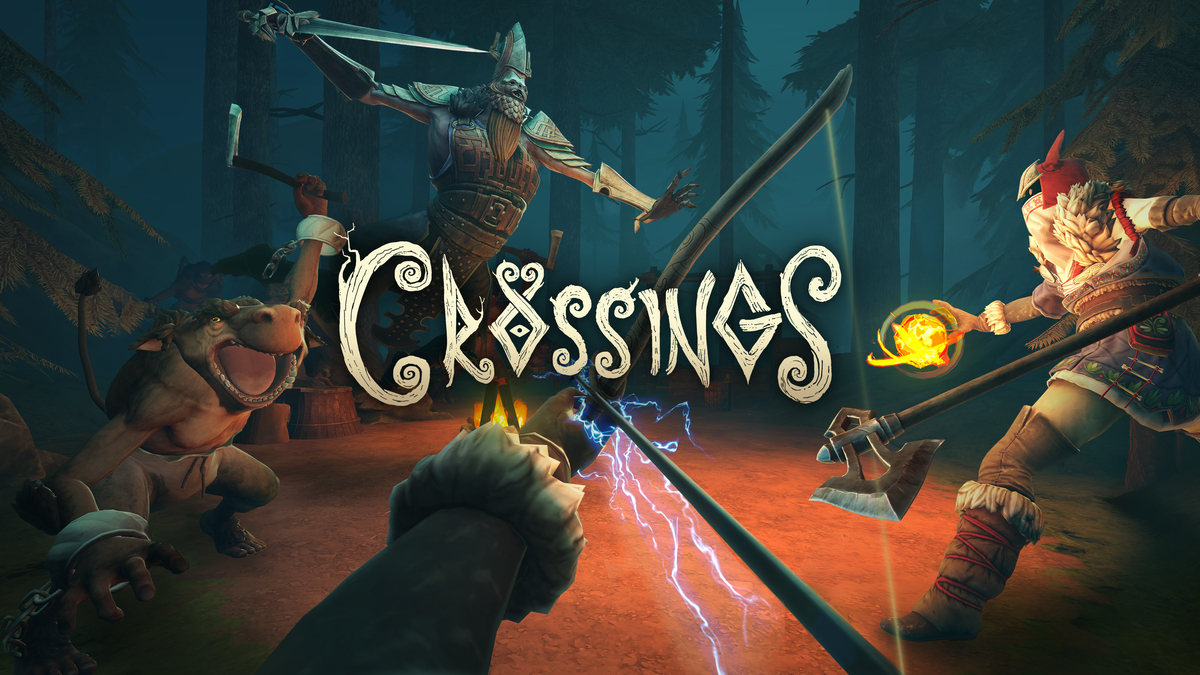
The Norse mythology-based roguelite Crossings was originally planned to release simultaneously on Quest and PCVR on December 18, 2025. This seemed to be the case as late as December 10, 2025, when a post on the Crossings X account still promoted a dual platform release. A late change, however, saw the title launch only on Quest in 2025 and without the anticipated co-op feature.
February 13, 2026 is the launch of the Steam version of the game as well as the cooperative gameplay for both platforms, according to Neat, with cross-play supported between them.
Crossings previously dropped a limited-time demo version during the Fall 2025 Steam Next Fest this past October as well as an accompanying demo on Quest. The co-op feature will see players "cross paths with others" who "naturally and seamlessly appear in the same world" and "without speaking".
"Communicate with body language, combat, and attention," the game's official description explains on Steam. "Split apart or stay close—your journeys intertwine, but your destiny is always your own."
We've played versions of the game but the mechanic of impromptu teamwork appears fundamental to the full promise of Crossings, so we are holding back our review until the co-op mode launches on both platforms.
There are quite a few comments on the Steam page for USC: Counterforce and even Rock, Paper, SHOTGUN originally gave up on the game immediately, because the devs decided to make the…
 Connexion
 As AI gets more heavily integrated into Windows, enhanced cybersecurity is required to prevent these agents from being used against us—and just how little it takes to mount an attack prior to a patch is truly horrifying. Fortunately, this coverage of the latest Copilot exploit, dubbed Reprompt, comes after the fact of the exploit being patched.