
L’association Scenari te souhaite une belle et heureuse année 2026, pleine de projets Scenari ☘️
🚀 Visio de découverte de Scenari

Tu as des questions sur Scenari avant de tester ?
Tu voudrais une petite démo ?
Tu commences à utiliser Scenari et tu as besoin d’un peu de soutien ?
Cette visio est faite pour toi : vendredi 19 décembre à 16h sur https://scenari.org/visio/miniwebinaire
Lien Agenda du Libre
Lien Mobilizon |
🖥️ Prochain mini-webinaire : « Découverte de Topaze » 27 janvier
Mardi 27 janvier de 16h30 à 17h30 heure de Paris, à l’adresse https://scenari.org/visio/miniwebinaire.
Ce mini-webinaire servira à présenter un modèle déjà très connu et ancien, mais que beaucoup ne connaissent que de nom : Topaze.
Topaze permet de concevoir des parcours multi-linéaires et de réutiliser des contenus Opale. Idéal pour concevoir des jeux sérieux, des études de cas… où le parcours s’adapte au rythme d’apprentissage de l’apprenant.
Pour que la session colle au mieux aux besoins de la communauté, tu peux participer à ce fil de discussion sur le forum.
Les enregistrements des mini-webinaires précédents sont sur la page dédiée de scenari.org et dans notre canal peertube.
Pour proposer des sujets, rends-toi sur ce fil de discussion.
💗 Parole de Scenariste
J'ai découvert le monde de Scenari en mai 2010 grâce à mon compère Guy Vedrenne. Il m’a dit : « on a un projet de formation à sortir pour septembre et on va le médiatiser avec Opale ». J’ai dit OK et le monde des poupées russes de l’ami Opale est devenu un terrain connu.
Avec le temps, j’ai voulu gouter à Topaze pour créer des parcours différentiés et pour ça, j’ai rencontré Katia Quelennec qui a formé un petit groupe à ce modèle bien sympathique.
J'ai aussi utilisé Webmedia pour voir ce que cela permettait avec des vidéos et je le trouve très opérationnel, Dokiel pour mettre en place des tutos et les mettre à disposition facilement, Optim pour créer des mini sites pour présenter des projets de formation en dehors des plateformes LMS.
Enfin, on entend souvent que le “rendu” n’est pas très beau par rapport à d’autres outils, alors un petit tour sur Styler a solutionné pas mal de critiques avec l’appui du forum Scenari et surtout avec les posts de réponse de Samuel Monsarrat.
Aujourd'hui, nous produisons nos formations principalement avec notre serveur Scenari et avec Myscenari.
Bref, Scenari c’est une belle chaine éditoriale contenant plein d’outils utiles, mais c’est surtout une belle communauté très active.
|
|
 |
Frédéric Waymel, Responsable du pôle technique du Centre Ministériel d’Appui à la formation à distance d’Aix-en-provence. Modèles utilisés : Modèles utilisés : Opale, Topaze, Dokiel, Optim, Webmedia
|
📣 La carte des scénaristes t’attend

La carte des scénaristes te sert à connaître les utilisateur⋅rice⋅s de scenari de ton entourage.
On t’invite à t’y inscrire ou à y vérifier que tes informations y sont à jour.
✨ Le savais-tu ?
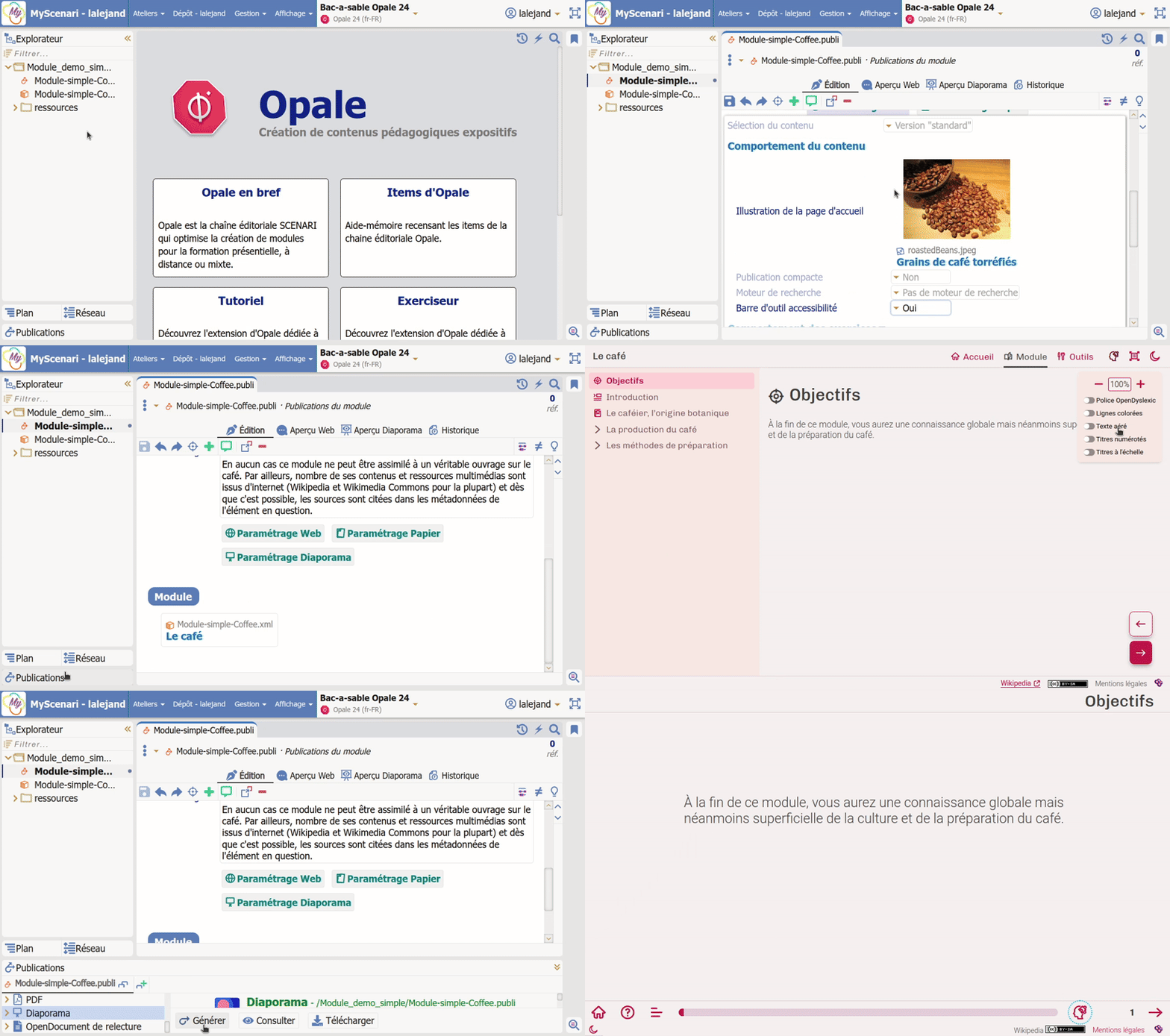
Opale incorpore nativement, aux publications web et diaporama, des outils d’accessibilité numérique pour le public dys.
Il suffit d’activer l’option dans l’item de génération dans les blocs « paramétrage web » ou « paramétrage diaporama ».
📊 Le chiffre du mois
|
|
 |
C’est le nombre de jours de travail que Kelis a dédié aux développements du cœur Scenari en une seule année (2024). |
Comme disait François Elie, fondateur de l’ADULLACT : « Un logiciel libre est gratuit, une fois qu’il est payé ».
Si les logiciels Scenari gratuits et de qualité dont nous profitons tou⋅te⋅s existent, c’est parce des organisations décident de financer les développements et de les reverser dans le libre pour la communauté.
 Connexion
 Br OS is a Brazilian Linux distribution based on Debian and featuring the KDE Plasma desktop. It is designed as an intuitive, easy-to-use, general-purpose operating system for web navigation and content creation, providing a selection of useful applications for daily use.
  Window Maker Live is a Debian-based Linux distribution that applies the Window Maker window manager as the default graphical user interface and integrates well-known open-source components in an attractive and usable user interface. The distribution includes integrated GNOME components.
  Bluestar Linux is a GNU/Linux distribution that is based on Arch Linux. The Bluestar distribution features up to date packages, a full range of desktop and multimedia software in the default installation and a live desktop DVD.
  MODICIA O.S. is a Linux multimedia distribution designed primarily for musicians, graphic designers and video makers. It is based on Debian's "stable" branch, but uses the Cinnamon desktop and a recent Linux kernel. MODICIA O.S. comes with a set of carefully-selected, open-source multimedia software and tools, such as Audacity (audio editor), Brasero (disc-burning utility), Cheese (webcam application), Curlew (multimedia converter), GIMP (graphics editor), HandBrake (video transcoder), Kdenlive (video editor), MediaInfo (tool that provides technical data about media files), mpv (media player), Peek (animated GIF recorder), RawTherapee (photo processor), XnView (image viewer), and many others. The distribution also integrates the OnlyOffice software suite for general office tasks.
  nakeDeb is a minimalist desktop Linux distribution based on Debian's "Stable" branch and designed for more advanced Linux users. By default it uses the Fluxbox window manager, although an alternative session with i3 is also available. The distribution provides a simple text-mode system installer and custom repositories with extra software, including various utilities and themes. It comes with the w3m web browser and a script to download and install the latest Tor Browser, and it also includes the PCManFM file manager and mpv media player. makeDeb offers support for French and English languages.
  Debian Edu/Skolelinux is the Debian-edu's Debian Pure Blend distribution. It is aiming to provide an out-of-the-box localised environment tailored for schools and universities. The out-of-the-box environment comes with 75 applications aimed at schools, as well as 17 network services pre-configured for a school environment. The simple, three-question installation requires minimal technical knowledge. Skolelinux is Debian, which means, among other things, that there are no license costs or worries, and that upgrade and maintenance of the software can be done over the Internet with the power of Debian's apt-get. The core goals of Skolelinux are localisation and ease of system administration.
  The Debian Project is an association of individuals who have made common cause to create a free operating system. This operating system is called Debian. Debian systems currently use the Linux kernel. Linux is a completely free piece of software started by Linus Torvalds and supported by thousands of programmers worldwide. Of course, the thing that people want is application software: programs to help them get what they want to do done, from editing documents to running a business to playing games to writing more software. Debian comes with over 50,000 packages (precompiled software that is bundled up in a nice format for easy installation on your machine) - all of it free. It's a bit like a tower. At the base is the kernel. On top of that are all the basic tools. Next is all the software that you run on the computer. At the top of the tower is Debian -- carefully organizing and fitting everything so it all works together.
  ObsidianOS is a set of Linux distribution based primarily on Arch Linux. Its main feature is an A/B partition style (as used by Android or Chrome OS) so if an update causes some issues, it is possible to reboot into the first partition and restore the second one. It uses the ext4 filesystem exclusively. ObsidianOS offers three variants of the product - "Base", "KDE Plasma" and "COSMIC".
  Mageia is a fork of Mandriva Linux formed in September 2010 by former employees and contributors to the popular French Linux distribution. Unlike Mandriva, which is a commercial entity, Mageia is a community project and a non-profit organisation whose goal is to develop a free Linux-based operating system.
  .
. ArchBang Linux is a lightweight distribution based on Arch Linux. Using the labwc Wayland compositor, it is fast, up-to-date and suitable for both desktop and portable systems. Besides GreenBANG, the project also develops a distribution called SwayBang featuring the Sway Wayland compositor.