Connexion


This review contains spoilers for Fallout Season 2, Episode 5, “The Wrangler,” which is available to stream now on Prime Video.
We knew it was coming, but that doesn’t make it hurt any less. The Ghoul has betrayed Lucy, using her as a bargaining chip in his bet to find his family. Ella Purnell appears torn apart as her character’s role in his plan all becomes clear, the tears barely held back as she whispers “We were actually beginning to get along.” It’s the most devastating moment in an emotionally raw episode of Fallout, and certainly justifies her powerfist punch that sends The Ghoul flying out of a second window. The moment captures the full blend of Fallout’s flavour: dramatic, gory, and absurd.
Perhaps the more telling response in this whole exchange, though, is the gritted teeth and low rasp of The Ghoul, who genuinely seems wounded by his own choice. Lucy was good for him – more than just a surrogate daughter, she was a slowly-administered antidote to his lack of humanity. She’s the one drug that The Ghoul can’t afford to go cold turkey on. But his reluctance to see that has led to his impalement on a lamppost, left for dead and with no companion to help find his family.
Splitting up Lucy and The Ghoul shifts Fallout into a whole new phase. While this betrayal (much like the equally phase-shifting Brotherhood of Steel civil war from last week) has always been on the cards, it’s benefitted from a strong, steady build, simmering away through the first half of this season. It’s boiled over at exactly the right moment, leaving three whole episodes to explore the characters’ new situations and set in motion not just a (hopefully) satisfying finale, but put everyone on intriguing paths for the show’s future.
Equally as strong as those story threads is the episode’s visual presentation. Director Liz Friedlander and writer Owen Ellickson pull the same trick here as was used in the season’s third episode, layering The Ghoul’s past and present over each other, cutting back and forth between flashback and current events to draw parallels. Here, it perfectly captures his anguish as his worlds fall apart – in the present, he betrays his sole companion, only for his plan to be instantly derailed. In the past, he learns that he could be the lynchpin of the entire apocalypse. Once again, Ramin Djawadi’s score really elevates the melancholy of this moment, but the true highlight is seeing Cooper Howard ape Dr. Strangelove’s Major Kong as he rides a bucking bomb. If the end of the world really is coming, at least part of him has already given into inevitability. In time, he’ll learn to stop worrying and love the chaos.
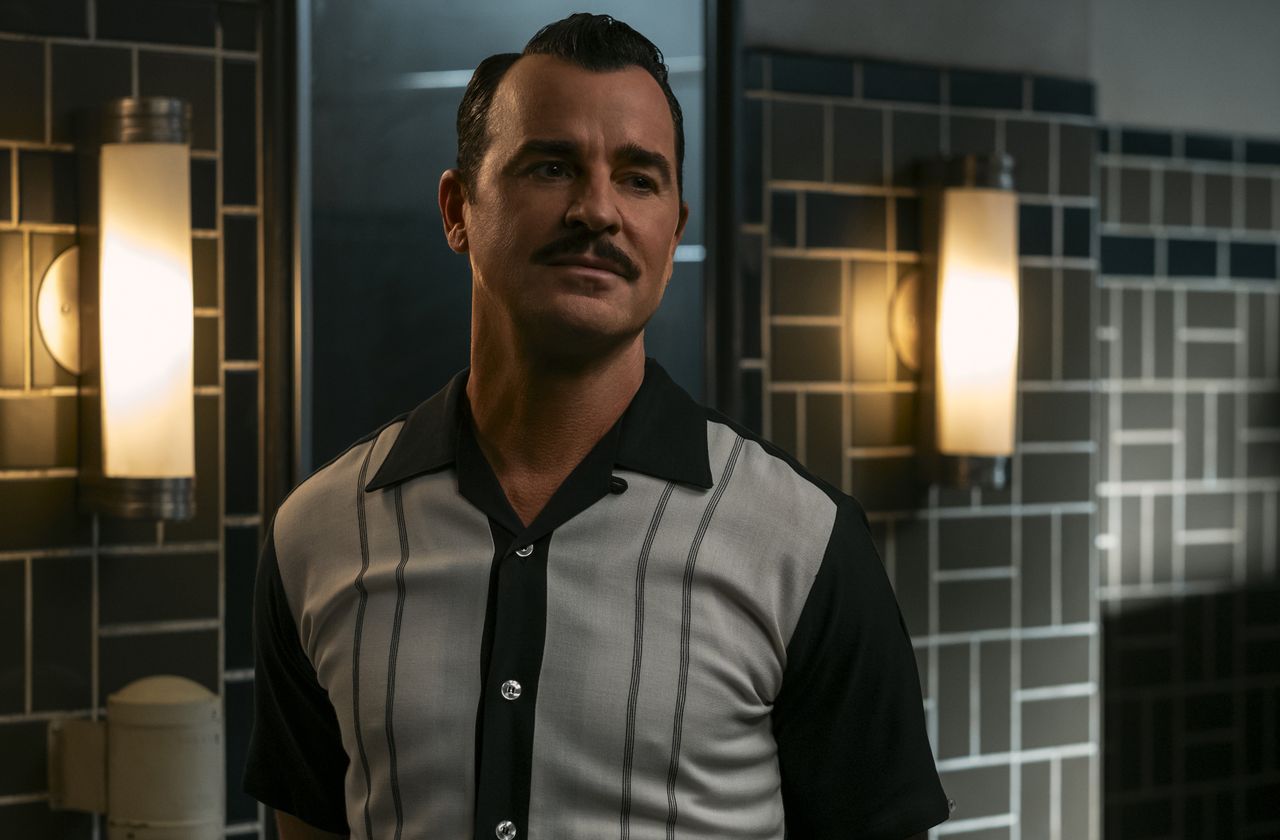
Of course, Cooper learning that he may somehow be at the center of the apocalypse wasn’t the only major reveal this week, but it was by far the strongest. The unveiling of the real Mr. House was, of course, inevitable – we knew Justin Theroux had been cast as the industrial magnate months before the show even started, and it was only a matter of time until Rafi Silver was explained away as a body double. However, while the disclosure itself lacks bite, having the double walk up to an unaware Cooper and say “Mr. House would like to see you” is undeniably cool. I’d have loved to have shared in Cooper’s surprise and seen this land in the way it was clearly intended to.
Robert House has been the awkward thorn in this season’s side, and not just because of that re-casting. As one of the major characters of Fallout: New Vegas, those who have played the game already know much about him, and so this season’s threat that House was the man with his finger on the nuclear button was always empty: fans know he has no involvement in the war. The reveal that House has no plans to help Vault-Tec nuke America thus falls a little flat to a sizable amount of the show’s audience. It was a smart idea, then, to tie House’s predictions of annihilation directly to Cooper. That's the real reveal here. “I don’t think you’re a cowboy at all. No, I think you’re a killer!” screams House, a great line that also layers past and present – The Ghoul, of course, wears the costume of a cowboy and has the show’s itchiest trigger finger.
This season’s flashbacks have all been about putting Cooper on the frontlines of Fallout history, but I didn’t expect him to be at the very centre of the hurricane. I do have my reservations about this – I don’t think it would be a good move to re-write the entire of Fallout history and pin it on a Hollywood actor – but so far this exploration of the unknown is working in the show’s favour.
Talking of exploring the unknown, I appreciate that the flashbacks are able to take us to a version of Vegas we’ve never seen before. The production design continues to be second to none, and seeing the glittering casinos of the strip before they’re ravaged by 200 years of nuclear winter is a nerdy thrill. Similarly, it’s great to see Freeside, one of New Vegas’ most recognisable locations, given life on screen. It even has Bethesda level design, with multiple entrances to buildings that allow sneaky characters to get in through the back door and steal overpriced items. Lucy’s sticky fingers adventure in Sonny’s Sundries is yet another example of Fallout having fun replicating the video game experience in a narratively-appropriate way – the important thing about this mini heist, though, isn’t its link to the games, but that its bloody conclusion forces Lucy to question how she’s changed. The Ghoul has undeniably influenced her, and it’s smart to have Lucy ponder that in advance of his betrayal.
With Maximus absent, this chapter of Fallout is almost entirely about Lucy and The Ghoul, which makes for the most focused episode of the season so far. The only outlying factor is Norm, who makes a more substantial appearance following last week’s single scene. Norm has suffered a similar fate to his fellow vault dwellers this season, feeling significantly left behind in the grand scheme of things, and so this week’s massive discovery is the emergency shot in the arm this thread needed. A trip to Vault-Tec’s California office reveals that Bud’s “Future Enterprise Ventures” is actually the Forced Evolutionary Virus, a genetic meddling project that Fallout fans are more than familiar with. It’s a fun tease for what could be waiting in the season’s final act, but more importantly, the F.E.V. is revealed to be a vault experiment overseen not by Bud Askins, but Barbara Howard.
And so, much like last season, Norm’s seemingly disparate plotline is welded into place among the greater picture. This links Norm’s story to Barbara’s, who’s linked to Cooper, who’s linked to Lucy, House, and Hank. These newly forged connections help make the entire season feel like a more coherent whole, and while we don’t know exactly where things will land, you can see how the components are being aligned to ensure everything is in service to each other. This gives me a little more confidence that whatever is going on in Vaults 32 and 33 will eventually be given substance, but with less than half the season remaining, the clock is ticking louder than ever.