Researchers tell ‘human story’ about crisis during plague of Justinian, which killed millions in Byzantine empire
A US-led research team has verified the first Mediterranean mass grave of the world’s earliest recorded pandemic, providing stark new details about the plague of Justinian that killed millions of people in the Byzantine empire between the sixth and eighth centuries.
The findings, published in February’s Journal of Archaeological Science, offer what researchers say is a rare empirical window into the mobility, urban life and vulnerability of citizens affected by the pestilence.
Une petite lune d’Uranus pourrait bien bouleverser notre vision des mondes glacés. Des chercheurs estiment désormais que Miranda, pourtant minuscule à l’échelle planétaire, cacherait sous sa croûte de glace un vaste océan liquide potentiellement profond de près de 100 kilomètres. Cette hypothèse ravive l’intérêt scientifique pour ce satellite …
Une main robotique qui se décroche de son bras, se faufile dans un espace étroit, récupère des objets hors de portée, puis revient se rebrancher comme si de rien n’était : le scénario semble tout droit sorti de la science-fiction. Pourtant, c’est bien l’idée démontrée par une équipe …
Pour cette semaine du 26 janvier : Un astéroïde potentiellement destructeur pourrait frapper la Lune en 2032 avec des conséquences visibles depuis la Terre, la découverte possible du plus grand stégosaure jamais identifié bouleverse nos certitudes sur la taille de ces dinosaures, une nouvelle...
Pour cette semaine du 26 janvier : Un astéroïde potentiellement destructeur pourrait frapper la Lune en 2032 avec des conséquences visibles depuis la Terre, la découverte possible du plus grand stégosaure jamais identifié bouleverse nos certitudes sur la taille de ces dinosaures, une nouvelle...
La miniaturisation électronique vient de franchir un nouveau pallier : des chercheurs ont en effet réussi à intégrer de véritables circuits intégrés dans des fibres textiles plus fines qu’un cheveu humain ! Cette avancée technologique spectaculaire pourrait bouleverser à la fois le secteur des objets connectés, l’industrie textile …
For years, people from CEOs to novelists have taken tiny amounts of psychedelics to support well-being. New research shows that benefits for depression may be attributable to a placebo effect.
Swedish study of 100,000 women found higher rate of early detection, suggesting potential to support radiologists
The use of artificial intelligence in breast cancer screening reduces the rate of a cancer diagnosis by 12% in subsequent years and leads to a higher rate of early detection, according to the first trial of its kind.
Researchers said the study was the largest to date looking at AI use in cancer screening. It involved 100,000 women in Sweden who were part of mammography screening and were randomly assigned to either AI-supported screening or to a standard reading by two radiologists between April 2021 and December 2022.
New study into ‘heritability’ shows that 50% of the variation in human lifespan could be down to genetics
Some people who live to a great age put it down to an evening tot of whisky, others to staying out of trouble. Now scientists think they may have unlocked a key secret to long life – quite simply, genetics.
Writing in the journal Science, the researchers described how previous studies that had attempted to unpick the genetic component of human lifespan had not taken into account that some lives were cut short by accidents, murders, infectious diseases or other factors arising outside the body. Such “extrinsic mortality” increases with age, as people often become more frail.
La lune Io, l’astre le plus volcanique du système solaire, vient d’éblouir les astronomes. Grâce à la sonde Juno en effet, la NASA a identifié une éruption d’une ampleur inédite, libérant une énergie colossale jamais observée auparavant sur un autre monde que la Terre. Ce phénomène extrême confirme …
Gestala is the latest company to emerge from China’s burgeoning brain-computer interface industry. It plans to access the brain with noninvasive ultrasound technology.
Gas projects in the US pipeline explicitly linked to data centers increased by almost 25 times over the past two years, according to new research from Global Energy Monitor.
Researchers have documented the births of nearly two dozen North Atlantic right whale calves this season. It’s an encouraging sign for a species whose population is estimated to be below 400.
Our usual picture of Uranus and Neptune as “ice giant” planets may not be entirely correct. According to new work by scientists at the University of Zürich (UZH), Switzerland, the outermost planets in our solar system may in fact be rock-rich worlds with complex internal structures – something that could have major implications for our understanding of how these planets formed and evolved.
Within our solar system, planets fall into three categories based on their internal composition. Mercury, Venus, Earth and Mars are deemed terrestrial rocky planets; Jupiter and Saturn are gas giants; and Uranus and Neptune are ice giants.
An agnostic approach
The new work, which was led by PhD student Luca Morf in UZH’s astrophysics department, challenges this last categorization by numerically simulating the two planets’ interiors as a mixture of rock, water, hydrogen and helium. Morf explains that this modelling framework is initially “agnostic” – meaning unbiased – about what the density profiles of the planets’ interiors should be. “We then calculate the gravitational fields of the planets so that they match with observational measurements to infer a possible composition,” he says.
This process, Morf continues, is then repeated and refined to ensure that each model satisfies several criteria. The first criteria is that the planet should be in hydrostatic equilibrium, meaning that its internal pressure is enough to counteract its gravity and keep it stable. The second is that the planet should have the gravitational moments observed in spacecraft data. These moments describe the gravitational field of a planet, which is complex because planets are not perfect spheres.
The final criteria is that the modelled planets need to be thermodynamically and compositionally consistent with known physics. “For example, a simulation of the planets’ interiors must obey equations of state, which dictate how materials behave under given pressure and temperature conditions,” Morf explains.
After each iteration, the researchers adjust the density profile of each planet and test it to ensure that the model continues to adhere to the three criteria. “We wanted to bridge the gap between existing physics-based models that are overly constrained and empirical approaches that are too simplified,” Morf explains. Avoiding strict initial assumptions about composition, he says, “lets the physics and data guide the solution [and] allows us to probe a larger parameter space.”
A wide range of possible structures
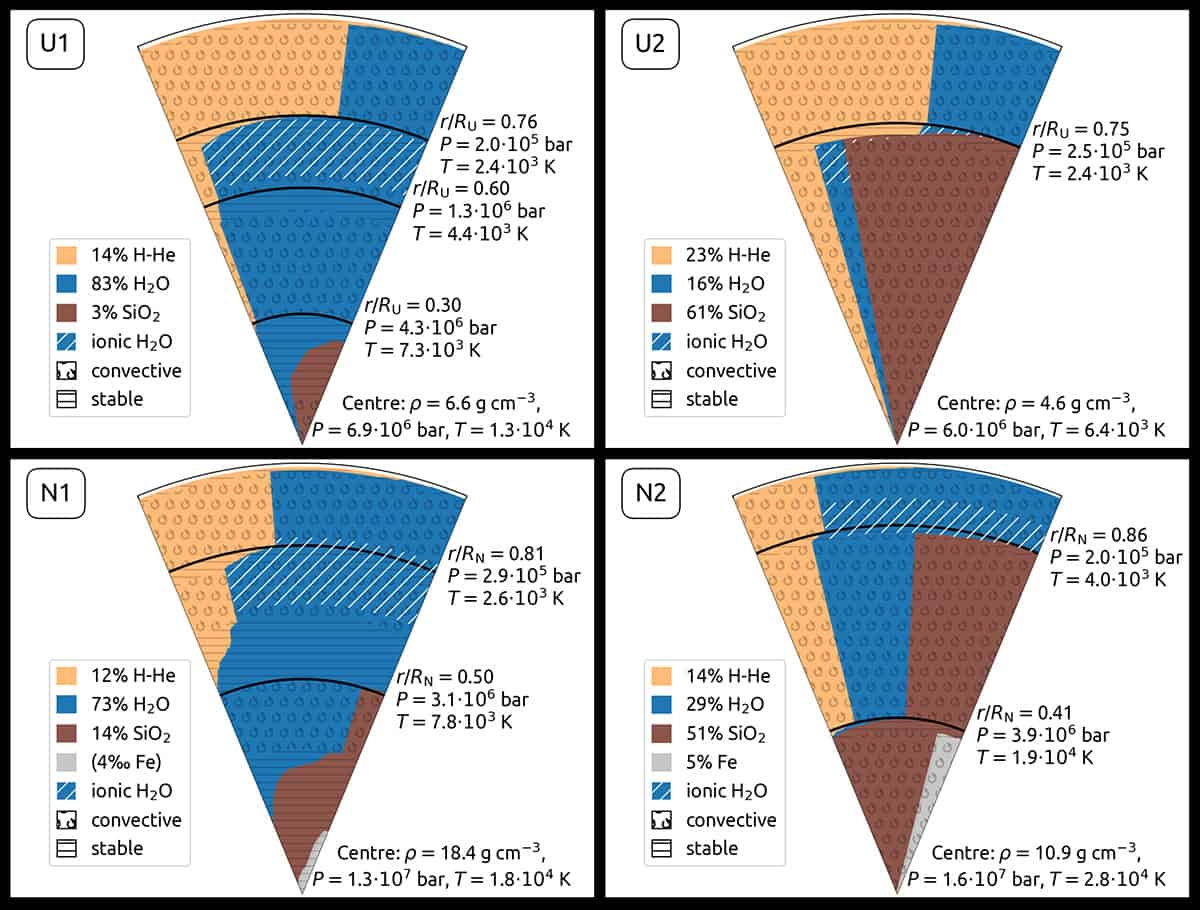
Based on their models, the UZH astrophysicists concluded that the interiors of Uranus and Neptune could have a wide range of possible structures, encompassing both water-rich and rock-rich configurations. More specifically, their calculations yield rock-to-water ratios of between 0.04-3.92 for Uranus and 0.20-1.78 for Neptune.
Slices of different pies: According to models developed with “agnostic” initial assumptions, Uranus (top) and Neptune (bottom) could be composed mainly of water ice (blue areas), but they could also contain substantial amounts of silicon dioxide rock (brown areas). (Courtesy: Luca Morf)
The models, which are detailed in Astronomy and Astrophysics, also contain convective regions with ionic water pockets. The presence of such pockets could explain the fact that Uranus and Neptune, unlike Earth, have more than two magnetic poles, as the pockets would generate their own local magnetic dynamos.
Traditional “ice giant” label may be too simple
Overall, the new findings suggest that the traditional “ice giant” label may oversimplify the true nature of Uranus of Neptune, Morf tells Physics World. Instead, these planets could have complex internal structures with compositional gradients and different heat transport mechanisms. Though much uncertainty remains, Morf stresses that Uranus and Neptune – and, by extension, similar intermediate-class planets that may exist in other solar systems – are so poorly understood that any new information about their internal structure is valuable.
A dedicated space mission to these outer planets would yield more accurate measurements of the planets’ gravitational and magnetic fields, enabling scientists to refine the limited existing observational data. In the meantime, the UZH researchers are looking for more solutions for the possible interiors of Uranus and Neptune and improving their models to account for additional constraints, such as atmospheric conditions. “Our work will also guide laboratory and theoretical studies on the way materials behave in general at high temperatures and pressures,” Morf says.
 Connexion