« Ne jamais juger son livre à sa couverture », nous dit-on, pour éviter de se laisser guider par des stéréotypes. Pourtant, notre cerveau passe son temps à faire exactement le contraire, et vous n'y pouvez absolument rien.
Si vous en avez assez des devis dentaires qui ressemblent à un apport pour un crédit immobilier, l'avenir vous réserve peut-être une très belle surprise. Quand la médecine régénérative et la biotechnologie se marient, le miracle n'est jamais loin !
Our usual picture of Uranus and Neptune as “ice giant” planets may not be entirely correct. According to new work by scientists at the University of Zürich (UZH), Switzerland, the outermost planets in our solar system may in fact be rock-rich worlds with complex internal structures – something that could have major implications for our understanding of how these planets formed and evolved.
Within our solar system, planets fall into three categories based on their internal composition. Mercury, Venus, Earth and Mars are deemed terrestrial rocky planets; Jupiter and Saturn are gas giants; and Uranus and Neptune are ice giants.
An agnostic approach
The new work, which was led by PhD student Luca Morf in UZH’s astrophysics department, challenges this last categorization by numerically simulating the two planets’ interiors as a mixture of rock, water, hydrogen and helium. Morf explains that this modelling framework is initially “agnostic” – meaning unbiased – about what the density profiles of the planets’ interiors should be. “We then calculate the gravitational fields of the planets so that they match with observational measurements to infer a possible composition,” he says.
This process, Morf continues, is then repeated and refined to ensure that each model satisfies several criteria. The first criteria is that the planet should be in hydrostatic equilibrium, meaning that its internal pressure is enough to counteract its gravity and keep it stable. The second is that the planet should have the gravitational moments observed in spacecraft data. These moments describe the gravitational field of a planet, which is complex because planets are not perfect spheres.
The final criteria is that the modelled planets need to be thermodynamically and compositionally consistent with known physics. “For example, a simulation of the planets’ interiors must obey equations of state, which dictate how materials behave under given pressure and temperature conditions,” Morf explains.
After each iteration, the researchers adjust the density profile of each planet and test it to ensure that the model continues to adhere to the three criteria. “We wanted to bridge the gap between existing physics-based models that are overly constrained and empirical approaches that are too simplified,” Morf explains. Avoiding strict initial assumptions about composition, he says, “lets the physics and data guide the solution [and] allows us to probe a larger parameter space.”
A wide range of possible structures
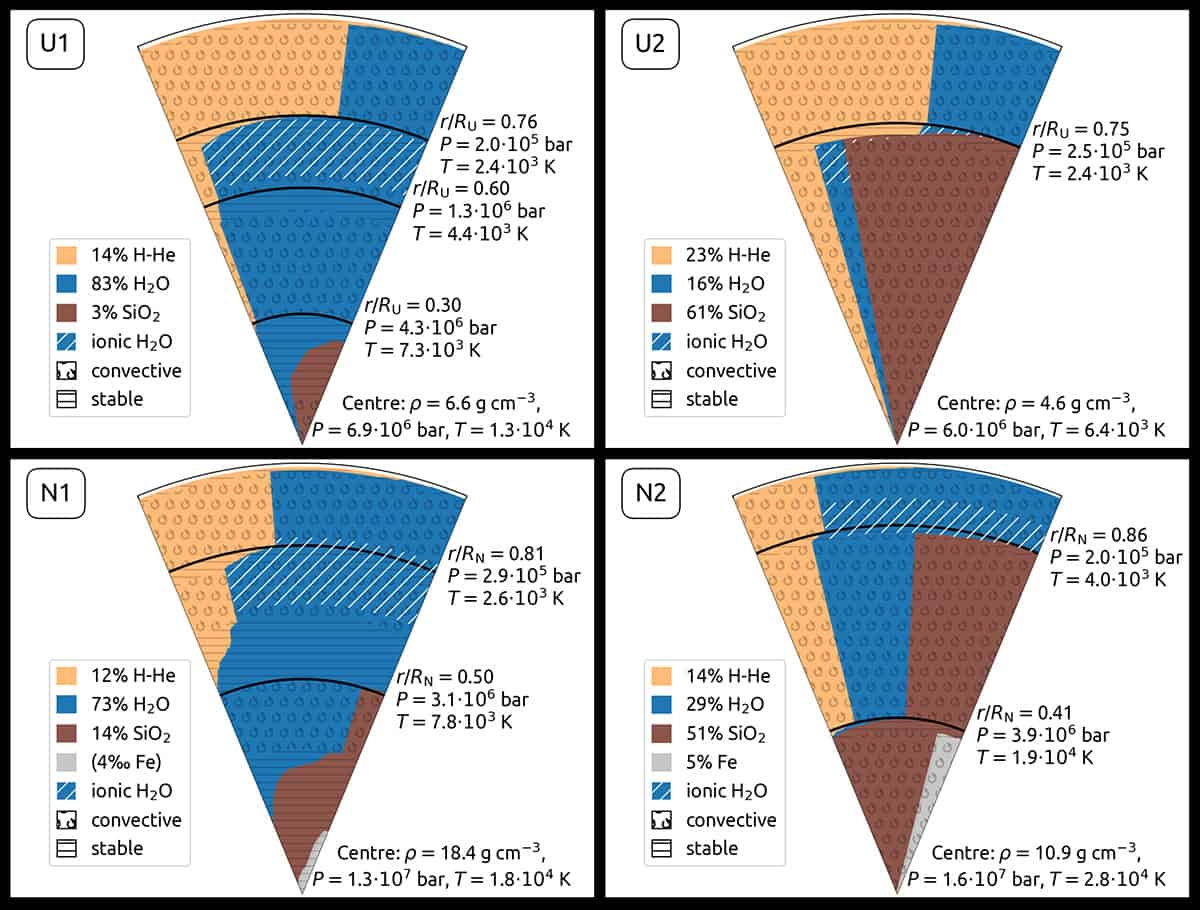
Based on their models, the UZH astrophysicists concluded that the interiors of Uranus and Neptune could have a wide range of possible structures, encompassing both water-rich and rock-rich configurations. More specifically, their calculations yield rock-to-water ratios of between 0.04-3.92 for Uranus and 0.20-1.78 for Neptune.
Slices of different pies: According to models developed with “agnostic” initial assumptions, Uranus (top) and Neptune (bottom) could be composed mainly of water ice (blue areas), but they could also contain substantial amounts of silicon dioxide rock (brown areas). (Courtesy: Luca Morf)
The models, which are detailed in Astronomy and Astrophysics, also contain convective regions with ionic water pockets. The presence of such pockets could explain the fact that Uranus and Neptune, unlike Earth, have more than two magnetic poles, as the pockets would generate their own local magnetic dynamos.
Traditional “ice giant” label may be too simple
Overall, the new findings suggest that the traditional “ice giant” label may oversimplify the true nature of Uranus of Neptune, Morf tells Physics World. Instead, these planets could have complex internal structures with compositional gradients and different heat transport mechanisms. Though much uncertainty remains, Morf stresses that Uranus and Neptune – and, by extension, similar intermediate-class planets that may exist in other solar systems – are so poorly understood that any new information about their internal structure is valuable.
A dedicated space mission to these outer planets would yield more accurate measurements of the planets’ gravitational and magnetic fields, enabling scientists to refine the limited existing observational data. In the meantime, the UZH researchers are looking for more solutions for the possible interiors of Uranus and Neptune and improving their models to account for additional constraints, such as atmospheric conditions. “Our work will also guide laboratory and theoretical studies on the way materials behave in general at high temperatures and pressures,” Morf says.
Des sondes sous-marines dignes de la NASA plongeront bientôt dans les abysses pour confirmer cette hypothèse qui avait ébranlé la communauté scientifique il y a deux ans. Le mystère de l'oxygène noir est sur le point d'être résolu.
Votre iPhone affiche 25 centimètres de neige pour vendredi. Vous annulez votre déplacement, reportez vos rendez-vous. Vendredi arrive : il tombe trois flocons. Chaque hiver, cette scène se répète sur des millions de smartphones dans le monde. La cause : l'application météo de votre téléphone est tout sauf fiable.
Parfois, la nature crée des formes aussi belles qu'éphémères, visibles seulement quelques instants. Aujourd'hui, on s'intéresse à un phénomène météorologique rare qui transforme la glace en véritables œuvres d'art.Bienvenue dans ce nouvel épisode de Futura Planète. Aujourd'hui, on va parler des...
Last week, a UN report declared that the world has entered an era of ‘global water bankruptcy’ with many human water systems past the point at which they can be restored to former levels. To find out what this could look like, Madeleine Finlay speaks to the Guardian’s diplomatic editor, Patrick Wintour, who has been reporting on Iran’s severe water crisis. And Mohammad Shamsudduha, professor of water crisis and risk reduction in the department of risk and disaster reduction at University College London, explains how the present situation arose and what can be done to bring water supplies back from the brink
SAN FRANCISCO – NASA’s Earth Science Division is exploring partnerships with external organizations to support instruments mounted on the International Space Station and free-flyer missions. “For some of these missions […]
Researchers say artificial intelligence system matches human expert classification about 90% of the time
Experts have created an app that uses artificial intelligence to identify dinosaurs from the footprints left behind after they stomped across the land tens of millions of years ago.
“When we find a dinosaur footprint, we try to do the Cinderella thing and find the foot that matches the slipper,” said Prof Steve Brusatte, a co-author of the work, from the University of Edinburgh. “But it’s not so simple, because the shape of a dinosaur footprint depends not only on the shape of the dinosaur’s foot but also the type of sand or mud it was walking through, and the motion of its foot.”
SpaceX se prépare à franchir une nouvelle étape dans son programme spatial avec le premier vol d’essai de Starship V3, désormais programmé pour la mi-mars. L’annonce a été faite par Elon Musk sur X, alors que l’entreprise accélère le développement de sa fusée la plus ambitieuse à ce …
La Géante Glacée s'est vue affublée d'une étiquette qu'elle ne méritait sans doute pas. Elle perd au passage de son unicité, mais libère les astrophysiciens d'un mystère qui n'en était pas réellement un.
Traditional bodybuilding advice has been to push workouts to the point of failure, and that soreness is an indicator of effectiveness. But recent studies show there’s another way
Until pretty recently, the conventional wisdom about building muscle was that it worked via a system you might think of as “tear and repair” – the idea being that working out causes microtears in the muscle fibres, which trigger the body’s repair processes, encouraging the muscles to come back bigger and stronger.
That’s why many old-school trainers will tell you that there’s no gain without pain, and why a lot of bodybuilding advice includes increasingly byzantine ways of pushing your biceps and triceps to the point where you can’t do another repetition: the more trauma you can cause, the thinking goes, the more “swole” you can become.
Une maladie peu connue peut transformer progressivement la colonne vertébrale en une structure rigide et douloureuse. Aujourd'hui, on s'intéresse à une pathologie discrète, souvent découverte tardivement, mais aux conséquences bien réelles.Cette semaine dans Futura Santé, on va parler de la...
Researchers observed the primates switching social groups and passing information on where to find the ripest fruit
Spider monkeys share tips about where to find food by changing their social groups in a “clever system for sharing insider knowledge”, research has shown.
They were observed to frequently switch subgroups of three or more individuals in a way that enabled them to share information about the location of fruit trees and timing of when they would ripen.
 Connexion