Misinformation technology could be deployed at scale to disrupt 2028 US presidential election, AI researchers say
Political leaders could soon launch swarms of human-imitating AI agents to reshape public opinion in a way that threatens to undermine democracy, a high profile group of experts in AI and online misinformation has warned.
The Nobel peace prize-winning free-speech activist Maria Ressa, and leading AI and social science researchers from Berkeley, Harvard, Oxford, Cambridge and Yale are among a global consortium flagging the new “disruptive threat” posed by hard-to-detect, malicious “AI swarms” infesting social media and messaging channels.
It is the year 2029 and an LA cop finds himself accused of murdering his wife. He has 90 minutes to clear his name before robo-justice sends him down
Irish writer Marco van Belle delivers an entertaining script for this real time futurist thriller-satire set in LA in 2029, in a world (as they say) where AI is wholly responsible for assessing criminal guilt or innocence. You’ve heard of RoboCop. This is RoboJustice. Veteran Russian-Kazakh film-maker Timur Bekmambetov directs, bringing his usual robust approach to the big action sequences, and Chris Pratt stars as the LAPD cop accused of murder. (Longtime Pratt fans will appreciate a cameo appearance here of Pratt’s fellow cast-member from TV’s Parks and Recreation, Jay Jackson, effectively reprising his performance as sonorous TV newsreader Perd Hapley.)
The film’s ostensible target is the insidious power of AI, though the movie partakes of today’s liberal opinion doublethink, in which we all solemnly concur that AI is very worrying while not having the smallest intention of doing anything about it. Pratt plays Detective Chris Raven, an officer with a drinking problem but nonetheless a poster boy for LA law enforcement in 2029 for having brought in the first conviction under the city’s creepy new hi-tech justice system, ironically entitled Mercy (it doesn’t appear to be an acronym). AI is now the sole arbiter of justice and defendants each have a 90-minute trial to make their case in front of Judge Maddox, an AI-hologram played by Rebecca Ferguson who icily insists on the facts but is capable of weird Max-Headroom-type glitches.
Emojis explode all over the screen in this hyperactive adaptation of a Japanese folk tale about a princess who has run away from the moon
Never has a film been more deserving of an exclamation mark at the end of the title than this animation from Japan. Cosmic Princess Kaguya! is an adaptation of a Japanese folk tale, the story of a princess from the moon discovered inside a bamboo stalk in a poor rural village. A decade ago, Studio Ghibli adapted the tale into a gorgeously animated movie with a traditional, lovingly hand-painted feel. This film could not be more different, a trippy, high-energy, techno anime set in the near future, half of it in a virtual reality world – and TikTok-ifed with emojis and stickers exploding all over the screen.
It begins when a 17-year-old high school student called Iroha finds a baby girl inside a glowing lamppost (rather than the bamboo stalk of the original). Iroha (voiced by Dawn M Bennett in the English dub) is a sensible kid, a talented musician and grade-A student who has already moved out of the family home and is living alone, working all hours to pay the rent of her tiny studio flat. In any free time she does have, Iroha follows her idol, AI musical megastar Yachiyo, in a crazy, chaotic virtual reality world called Tsukuyomi.
His blunt, brash scepticism has made the podcaster and writer something of a cult figure. But as concern over large language models builds, he’s no longer the outsider he once was
If some time in an entirely possible future they come to make a movie about “how the AI bubble burst”, Ed Zitron will doubtless be a main character. He’s the perfect outsider figure: the eccentric loner who saw all this coming and screamed from the sidelines that the sky was falling, but nobody would listen. Just as Christian Bale portrayed Michael Burry, the investor who predicted the 2008 financial crash, in The Big Short, you can well imagine Robert Pattinson fighting Paul Mescal, say, to portray Zitron, the animated, colourfully obnoxious but doggedly detail-oriented Brit, who’s become one of big tech’s noisiest critics.
This is not to say the AI bubble will burst, necessarily, but against a tidal wave of AI boosterism, Zitron’s blunt, brash scepticism has made him something of a cult figure. His tech newsletter, Where’s Your Ed At, now has more than 80,000 subscribers; his weekly podcast, Better Offline, is well within the Top 20 on the tech charts; he’s a regular dissenting voice in the media; and his subreddit has become a safe space for AI sceptics, including those within the tech industry itself – one user describes him as “a lighthouse in a storm of insane hypercapitalist bullshit”.
Errors are the bugbear of quantum computing, and they’re hard to avoid. While quantum computers derive their computational clout from the fact that their qubits can simultaneously court multiple values, the fragility of qubit states ramps up their error rates. Many research groups are therefore seeking to reduce or manage errors so they can increase the number of qubits without reducing the whole enterprise to gibberish.
A team at the US-based firm Atom Computing is now reporting substantial success in this area thanks to a multi-part strategy for keeping large numbers of qubits operational in quantum processors based on neutral atoms. “These capabilities allow for the execution of more complex, longer circuits that are not possible without them,” says Matt Norcia, one of the Atom Computing researchers behind this work.
While neutral atoms offer several advantages over other qubit types, they traditionally have significant drawbacks for one of the most common approaches to error correction. In this approach, some of the entangled qubits are set aside as so-called “ancillaries”, used for mid-circuit measurements that can indicate how a computation is going and what error correction interventions may be necessary.
In neutral-atom quantum computing, however, such interventions are generally destructive. Atoms that are not in their designated state are simply binned off – a profligate approach that makes it challenging to scale up atom-based computers. The tendency to discard atoms is particularly awkward because the traps that confine atoms are already prone to losing atoms, which introduces additional errors while reducing the number of atoms available for computations.
Reduce, re-use, replenish
As well as demonstrating protocols for performing measurements to detect errors in quantum circuits with little atom loss, the researchers at Atom Computing also showed they could re-use ancillary atoms – a double-pronged way of retaining more atoms for calculations. In addition, they demonstrated that they could replenish the register of atoms for the computation from a spatially separated stash in a magneto-optic trap without compromising the quantum state of the atoms already in the register.
Norcia says that these achievements — replacing atoms from a continuous source, while reducing the number of atoms needing replacement to begin with — are key to running computations without running out of atoms. “To our knowledge, any useful quantum computations will require the execution of many layers of gates, which will not be possible unless the atom number can be maintained at a steady-state level throughout the computation,” he tells Physics World.
Cool and spaced out
Norcia and his collaborators at Microsoft Quantum, the Colorado School of Mines and Stanford University worked with ytterbium (Yb) atoms, which he describes as “natural qubits” since they have two ground states. A further advantage is that the transitions between these qubit states and other states used for imaging and cooling are weak, meaning the researchers could couple just one qubit state to these other states at a time. The team also leveraged a previously-developed approach for mid-circuit measurement that scatters light from only one qubit state and does not disturb the other, making it less destructive.
Still, Norcia tells Physics World, “the challenge was to re-use atoms, and key to this was cooling and performance.” To this end, they first had to shift the atoms undergoing mid-circuit measurements away from the atoms in the computational register, to avoid scattering laser light off the latter. They further avoided laser-related collateral damage by designing the register such that the measurement and cooling light was not at the resonant wavelength of the register atoms. Next, they demonstrated they could cool already-measured atoms for re-use in the calculation. Finally, they showed they could non-disruptively replenish these atoms with others from a magneto-optical trap positioned 300 nm below the tweezer arrays that held atoms for the computational register.
Mikhail Lukin, a physicist at Harvard University, US who has also worked on the challenges of atom loss and re-use in scalable, fault-tolerant neutral atom computing, has likewise recently reported successful atom re-use and diminished atom loss. Although Lukin’s work differs from that of the Atom Computing team in various ways – using rubidium instead of ytterbium atoms and a different approach for low atom loss mid-circuit measurements, for starters – he says that the work by Norcia and his team “represents an important technical advance for the Yb quantum computing platform, complementing major progress in the neutral atom quantum computing community in 2025”.
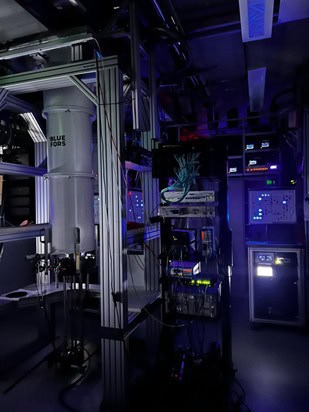
Qubit central: This work was carried out as part of the National Center of Competence in Research SPIN (NCCR SPIN), which is led by the University of Basel, Switzerland. NCCR SPIN focuses on creating scalable spin qubits in semiconductor nanostructures made of silicon and germanium, with the aim of developing small, fast qubits for a universal quantum computer. (Courtesy: A Efimov)
Qubits – the building blocks of quantum computers – are plagued with a seemingly unsurmountable dilemma. If they’re fast, they aren’t robust. And if they’re robust, they aren’t fast. Both qualities are important, because all potentially useful quantum algorithms rely on being able to perform many manipulations on a qubit before its state decays. But whereas faster qubits are typically realized by strongly coupling them to the external environment, enabling them to interact more strongly with the driving field, robust qubits with long coherence times are typically achieved by isolating them from their environment.
These seemingly contradictory requirements made simultaneously fast and robust qubits an unsolved challenge – until now. In an article published in Nature Communications, a team of physicists led by Dominik Zumbühl from the University of Basel, Switzerland show that it is, in fact, possible to increase both the coherence time and operational speed of a qubit, demonstrating a pathway out of this long-standing impasse.
The magic ingredient
The key ingredient driving this discovery is something called the direct Rashba spin-orbit interaction. The best-known example of spin-orbit interaction comes from atomic physics. Consider a hydrogen atom, in which a single electron revolves around a single proton in the nucleus. During this orbital motion, the electron interacts with the static electric field generated by the positively charged nucleus. The electron in turn experiences an effective magnetic field that couples to the electron’s intrinsic magnetic moment, or spin. This coupling of the electron’s orbital motion to its spin is called spin-orbit (SO) interaction.
Aided by collaborators at the University of Oxford, UK and TU Eindhoven in the Netherlands, Zumbühl and colleagues chose to replace this simple SO interaction with a far more complex landscape of electrostatic potential generated by a 10-nanometer-thick germanium wire coated with a thin silicon shell. By removing a single electron from this wire, they create states known as holes that can be used as qubits, with quantum information being encoded in the hole’s spin.
Importantly, the underlying crystal structure of the silicon-coated germanium wire constrains these holes to discrete energy levels called bands. “If you were to mathematically model a low-level hole residing in one of these bands using perturbation theory – a commonly applied method in which more remote bands are treated as corrections to the ground state – you would find a term that looks structurally similar to the spin–orbit interaction known from atomic physics,” explains Miguel Carballido, who conducted the work during his PhD at Basel, and is now a senior research associate at the University of New South Wales’ School of Electrical Engineering and Telecommunications in Sydney, Australia.
By encoding the quantum states in these energy levels, the spin-orbit interaction can be used to drive the hole-qubit between its two spin states. What makes this interaction special is that it can be tuned using an external electric field. Thus, by applying a stronger electric field, the interaction can be strengthened – resulting in faster qubit manipulation.
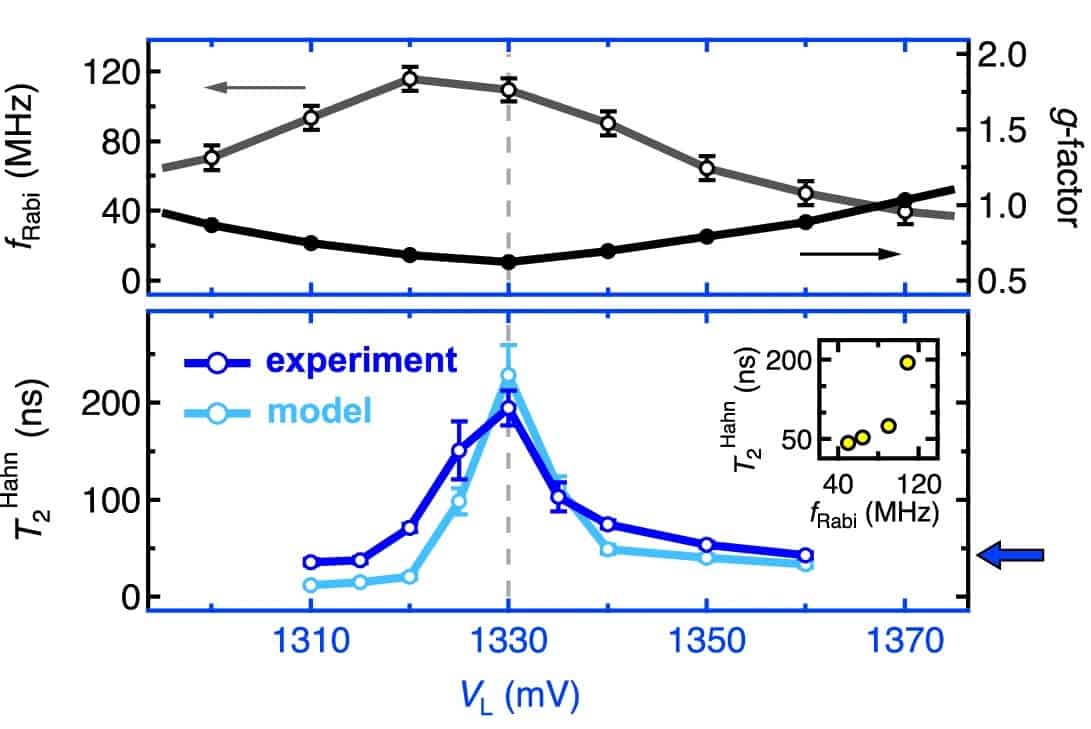
Uncompromising performance: Results showing qubit speed plateauing (top panel) and qubit coherence times peaking (bottom) at an applied electric field around 1330 mV, showing that qubit speed and coherence times can be simultaneously optimized. (CC BY ND 4.0 MJ Carballido et al. “Compromise-free scaling of qubit speed and coherence” 2025 Nat. Commun.16 7616)
Reaching a plateau
This ability to make a qubit faster by tuning an external parameter isn’t new. The difference is that whereas in other approaches, a stronger interaction also means higher sensitivity to fluctuations in the driving field, the Basel researchers found a way around this problem. As they increase the electric field, the spin-orbit interaction increases up to a certain point. Beyond this point, any further increase in the electric field will cause the hole to remain stuck within a low energy band. This restricts the hole’s ability to interact with other bands to change its spin, causing the SO interaction strength to drop.
By tuning the electric field to this peak, they can therefore operate in a “plateau” region where the SO interaction is the strongest, but the sensitivity to noise is the lowest. This leads to high coherence times (see figure), meaning that the qubit remains in the desired quantum state for longer. By reaching this plateau, where the qubit is both fast and robust, the researchers demonstrate the ability to operate their device in the “compromise-free” regime.
So, is quantum computing now a solved problem? The researchers’ answer is “not yet”, as there are still many challenges to overcome. “A lot of the heavy lifting is being done by the quasi 1D system provided by the nanowire,” remarks Carballido, “but this also limits scalability.” He also notes that the success of the experiment depends on being able to fabricate each qubit device very precisely, and doing this reproducibly remains a challenge.
 Connexion