↩ Accueil

Vue normale

Quantum photonics network passes a scaling-up milestone

6 janvier 2026 à 10:00

Physicists in the UK have succeeded in routing and teleporting entangled states of light between two four-user quantum networks – an important milestone in the development of scalable quantum communications. Led by Mehul Malik and Natalia Herrera Valencia of Heriot-Watt University in Edinburgh, Scotland, the team achieved this milestone thanks to a new method that uses light-scattering processes in an ordinary optical fibre to program a circuit. This approach, which is radically different from conventional methods based on photonic chips, allows the circuit to function as a programmable entanglement router that can implement several different network configurations on demand.

The team performed the experiments using commercially-available optical fibres, which are multi-mode structures that scatter light via random linear optical processes. In simple terms, Herrera Valencia explains that this means the light tends to ricochet chaotically through the fibres along hundreds of internal pathways. While this effect can scramble entanglement, researchers at the Institut Langevin in Paris, France had previously found that the scrambling can be calculated by analysing how the fibre transmits light. What is more, the light-scattering processes in such a medium can be harnessed to make programmable optical circuits – which is exactly what Malik, Herrera Valencia and colleagues did.

“Top-down” approach

The researchers explain that this “top-down” approach simplifies the circuit’s architecture because it separates the layer where the light is controlled from the layer in which it is mixed. Using waveguides for transporting and manipulating the quantum states of light also reduces optical losses. The result is a reconfigurable multi-port device that can distribute quantum entanglement between many users simultaneously in multiple patterns, switching between different channels (local connections, global connections or both) as required.

A further benefit is that the channels can be multiplexed, allowing many quantum processors to access the system at the same time. The researchers say this is similar to multiplexing in classical telecommunications networks, which makes it possible to send huge amounts of data through a single optical fibre using different wavelengths of light.

Access to a large number of modes

Although controlling and distributing entangled states of light is key for quantum networks, Malik says it comes with several challenges. One of these is that conventional methods based on photonics chips cannot be scaled up easily. They are also very sensitive to imperfections in how they’re made. In contrast, the waveguide-based approach developed by the Heriot-Watt team “opens up access to a large number of modes, providing significant improvements in terms of achievable circuit size, quality and loss,” Malik tells Physics World, adding that the approach also fits naturally with existing optical fibre infrastructures.

Gaining control over the complex scattering process inside a waveguide was not easy, though. “The main challenge was the learning curve and understanding how to control quantum states of light inside such a complex medium,” Herrera Valencia recalls. “It took time and iteration, but we now have the precise and reconfigurable control required for reliable entanglement distribution, and even more so for entanglement swapping, which is essential for scalable networks.”

While the Heriot-Watt team used the technique to demonstrate flexible quantum networking, Malik and Herrera Valencia say it might also be used for implementing large-scale photonic circuits. Such circuits could have many applications, ranging from machine learning to quantum computing and networking, they add.

Looking ahead, the researchers, who report their work in Nature Photonics, say they are now aiming to explore larger-scale circuits that can operate on more photons and light modes. “We would also like to take some of our network technology out of the laboratory and into the real world,” says Malik, adding that Herrera Valencia is leading a commercialization effort in that direction.

The post Quantum photonics network passes a scaling-up milestone appeared first on Physics World.
Electrical charge on objects in optical tweezers can be controlled precisely

27 novembre 2025 à 17:21

An effect first observed decades ago by Nobel laureate Arthur Ashkin has been used to fine tune the electrical charge on objects held in optical tweezers. Developed by an international team led by Scott Waitukaitis of the Institute of Science and Technology Austria, the new technique could improve our understanding of aerosols and clouds.

Optical tweezers use focused laser beams to trap and manipulate small objects about 100 nm to 1 micron in size. Their precision and versatility have made them a staple across fields from quantum optics to biochemistry.

Ashkin shared the 2018 Nobel prize for inventing optical tweezers and in the 1970s he noticed that trapped objects can be electrically charged by the laser light. “However, his paper didn’t get much attention, and the observation has essentially gone ignored,” explains Waitukaitis.

Waitukaitis’ team rediscovered the effect while using optical tweezers to study how charges build up in the ice crystals accumulating inside clouds. In their experiment, micron-sized silica spheres stood in for the ice, but Ashkin’s charging effect got in their way.

Bummed out

“Our goal has always been to study charged particles in air in the context of atmospheric physics – in lightning initiation or aerosols, for example,” Waitukaitis recalls. “We never intended for the laser to charge the particle, and at first we were a bit bummed out that it did so.”

Their next thought was that they had discovered a new and potentially useful phenomenon. “Out of due diligence we of course did a deep dive into the literature to be sure that no one had seen it, and that’s when we found the old paper from Ashkin, “ says Waitukaitis.

In 1976, Ashkin described how optically trapped objects become charged through a nonlinear process whereby electrons absorb two photons simultaneously. These electrons can acquire enough energy to escape the object, leaving it with a positive charge.

Yet beyond this insight, Ashkin “wasn’t able to make much sense of the effect,” Waitukaitis explains. “I have the feeling he found it an interesting curiosity and then moved on.”

Shaking and scattering

To study the effect in more detail, the team modified their optical tweezers setup so its two copper lens holders doubled as electrodes, allowing them to apply an electric field along the axis of the confining, opposite-facing laser beams. If the silica sphere became charged, this field would cause it to shake, scattering a portion of the laser light back towards each lens.

The researchers picked off this portion of the scattered light using a beam splitter, then diverted it to a photodiode, allowing them to track the sphere’s position. Finally, they converted the measured amplitude of the shaking particle into a real-time charge measurement. This allowed them to track the relationship between the sphere’s charge and the laser’s tuneable intensity.

Their measurements confirmed Ashkin’s 1976 hypothesis that electrons on optically-trapped objects undergo two-photon absorption, allowing them to escape. Waitukaitis and colleagues improved on this model and showed how the charge on a trapped object can be controlled precisely by simply adjusting the laser’s intensity.

As for the team’s original research goal, the effect has actually been very useful for studying the behaviour of charged aerosols.

“We can get [an object] so charged that it shoots off little ‘microdischarges’ from its surface due to breakdown of the air around it, involving just a few or tens of electron charges at a time,” Waitukaitis says. “This is going to be really cool for studying electrostatic phenomena in the context of particles in the atmosphere.“

The study is described in Physical Review Letters.

The post Electrical charge on objects in optical tweezers can be controlled precisely appeared first on Physics World.

Ten-ion system brings us a step closer to large-scale qubit registers

17 novembre 2025 à 17:15
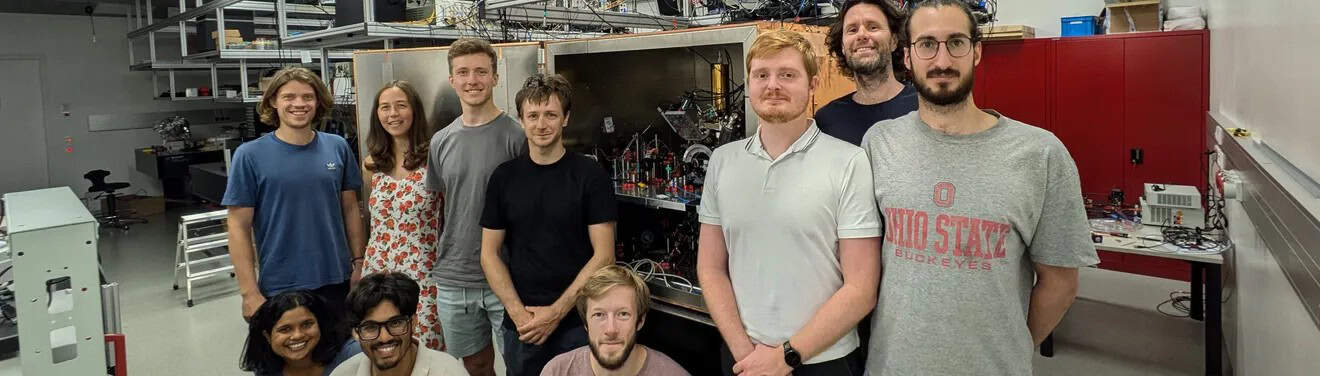
Photo of the members of Ben Lanyon's research group
Team effort Based at the University of Innsbruck, Ben Lanyon’s group has created a novel qubit register by trapping ten ions. (Courtesy: Victor Krutyanskiy/University of Innsbruck)

Researchers in Austria have entangled matter-based qubits with photonic qubits in a ten-ion system. The technique is scalable to larger ion-qubit registers, paving the way for the creation of larger and more complex quantum networks.

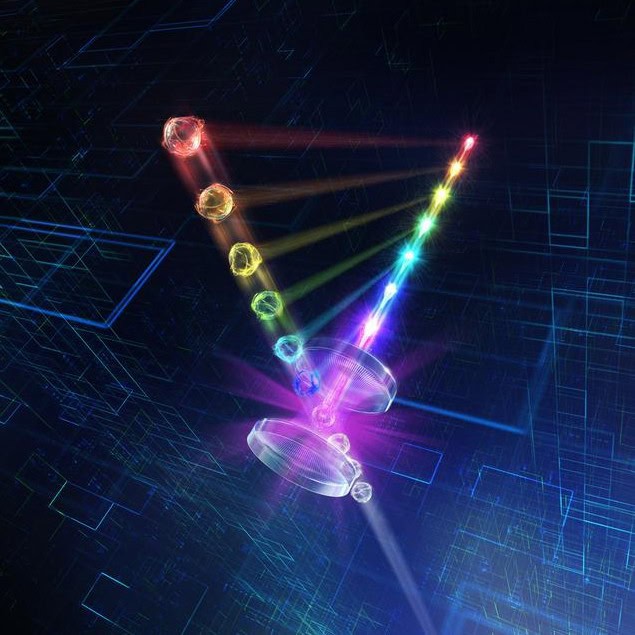
Visualization of the ten ion quantum
Ions in motion Each ion (large object) is moved one at a time into the “sweet spot” of the optical cavity. Once there, a laser beam drives the emission of a single photon (small object), entangled with the ion. The colours indicate ion–photon entanglement. (Courtesy: Universität Innsbruck/Harald Ritsch)

Quantum networks consist of matter-based nodes that store and process quantum information and are linked through photons (quanta of light). Already, Ben Lanyon’s group at the University of Innsbruck has made advances in this direction by entangling two ions in different systems. Now, in a new paper published in Physical Review Letters , they describe how they have developed and demonstrated a new method to entangle a string of ten ions with photons. In the future, this approach could enable the entanglement of sets of ions in different locations through light, rather than one ion at a time.

To achieve this, Lanyon and colleagues trapped a chain of 10 calcium ions in a linear trap in an optical cavity. By changing the trapping voltages in the trap, each ion was moved, one-by-one, into the cavity. Once inside, the ion was placed in the “sweet spot”, where the ion’s interaction with the cavity is the strongest. There, the ion  emitted a single photon when exposed to a 393 nm Raman laser beam. This beam was tightly focused on one ion, guaranteeing that the emitted photon – collected in a single-mode optical fibre – comes out from one ion at a time. This process was carried out ten times, one per ion, to obtain a train of ten photons.

By using quantum state tomography, the researchers reconstructed the density matrix, which describes the correlation between the states of ions (i) and photons (j).  To do so, they measure every ion and photon state in three different basis, resulting in nine Pauli-basis configurations of quantum measurements. From the density matrix, the concurrence (a measure of entanglement) between the ion (i) and photon (j) was found to be positive only when  i = j, and equal to zero otherwise. This implies that the ion is uniquely entangled with the photon it produced, and unentangled with the photon produced by other ions.

From the density matrix, they also calculate the fidelity with the Bell state (a state of maximum entanglement), yielding an average 92%. As Marco Canteri points out, “this fidelity characterizes the quality of entanglement between the ion-photon pair for i=j”.

This work developed and demonstrated a technique whereby matter-based qubits and photonic qubits can be entangled, one  at a time, in ion strings.  Now, the group aims to “demonstrate universal quantum logic within the photon-interfaced 10-ion register and, building up towards entangling two remote 10-ion processors through the exchange of photons between them,” explains team member Victor Krutyanskiy. If this method effectively scales to larger systems, more complex quantum networks could be built. This would lead to applications in quantum communication and quantum sensing.

The post Ten-ion system brings us a step closer to large-scale qubit registers appeared first on Physics World.

❌