Susumu Noda of Kyoto University has won the 2026 Rank Prize for Optoelectronics for the development of the Photonic Crystal Surface Emitting Laser (PCSEL). For more than 25 years, Noda developed this new form of laser, which has potential applications in high-precision manufacturing as well as in LIDAR technologies.
Following the development of the laser in 1960, in more recent decades optical fibre lasers and semiconductor lasers have become competing technologies.
A semiconductor laser works by pumping an electrical current into a region where an n-doped (excess of electrons) and a p-doped (excess of “holes”) semiconductor material meet, causing electrons and holes to combine and release photons.
Semiconductors have several advantages in terms of their compactness, high “wallplug” efficiency, and ruggedness, but lack in other areas such as having a low brightness and functionality.
This means that conventional semiconductor lasers required external optical and mechanical elements to improve their performance, which results in large and impractical systems.
‘A great honour’
In the late 1990s, Noda began working on a new type of semiconductor laser that could challenge the performance of optical fibre lasers. These so-called PCSELs employ a photonic crystal layer in between the semiconductor layers. Photonic crystals are nanostructured materials in which a periodic variation of the dielectric constant — formed, for example, by a lattice of holes — creates a photonic band-gap.
Noda and his research made a series of breakthrough in the technology such as demonstrating control of polarization and beam shape by tailoring the phonic crystal structure and expansion into blue–violet wavelengths.
The resulting PCSELs emit a high-quality, symmetric beam with narrow divergence and boast high brightness and high functionality while maintaining the benefits of conventional semiconductor lasers. In 2013, 0.2 W PCSELs became available and a few years later Watt-class PCSEL lasers became operational.
Noda says that it is “a great honour and a surprise” to receive the prize. “I am extremely happy to know that more than 25 years of research on photonic-crystal surface-emitting lasers has been recognized in this way,” he adds. “I do hope to continue to further develop the research and its social implementation.”
Susumu Noda received his BSc and then PhD in electronics from Kyoto University in 1982 and 1991, respectively. From 1984 he also worked at Mitsubishi Electric Corporation, before joining Kyoto University in 1988 where he is currently based.
Founded in 1972 by the British industrialist and philanthropist Lord J Arthur Rank, the Rank Prize is awarded biennially in nutrition and optoelectronics. The 2026 Rank Prize for Optoelectronics, which has a cash award of £100 000, will be awarded formally at an event held in June.
UK artist Alison Stott has created a new glass and light artwork – entitled Naturally Focused – that is inspired by the work of theoretical physicist Michael Berry from the University of Bristol.
Stott, who recently competed an MA in glass at Arts University Plymouth, spent over two decades previously working in visual effects for film and television, where she focussed on creating photorealistic imagery.
Her studies touched on how complex phenomena can arise from seemingly simple set-ups, for example in a rotating glass sculpture lit by LEDs.
“My practice inhabits the spaces between art and science, glass and light, craft and experience,” notes Stott. “Working with molten glass lets me embrace chaos, indeterminacy, and materiality, and my work with caustics explores the co-creation of light, matter, and perception.”
The new artwork is based on “caustics” – the curved patterns that form when light is reflected or refracted by curved surfaces or objects
The focal point of the artwork is a hand-blown glass lens that was waterjet-cut into a circle and polished so that its internal structure and optical behaviour are clearly visible. The lens is suspended within stainless steel gyroscopic rings and held by a brass support and stainless stell backplate.
The rings can be tilted or rotated to “activate shifting field of caustic projections that ripple across” the artwork. Mathematical equations are also engraved onto the brass that describe the “singularities of light” that are visible on the glass surface.
The work is inspired by Berry’s research into the relationship between classical and quantum behaviour and how subtle geometric structures govern how waves and particles behave.
Stott says that working with Berry has pushed her understanding of caustics. “The more I learn about how these structures emerge and why they matter across physics, the more compelling they become,” notes Stott. “My aim is to let the phenomena speak for themselves, creating conditions where people can directly encounter physical behaviour and perhaps feel the same awe and wonder I do.”
The artwork will go on display at the University of Bristol following a ceremony to be held on 27 November.
JUNO is located in Kaiping City, Guangdong Province, in the south of the country around 150 km west of Hong Kong.
Construction of the facility began in 2015 and was set to be complete some five years later. Yet the project suffered from serious flooding, which delayed construction.
JUNO, which is expected to run for more than 30 years, aims to study the relationship between the three types of neutrino: electron, muon and tau. Although JUNO will be able to detect neutrinos produced by supernovae as well as those from Earth, the observatory will mainly measure the energy spectrum of electron antineutrinos released by the Yangjiang and Taishan nuclear power plants, which both lie 52.5 km away.
To do this, the facility has a 80 m high and 50 m diameter experimental hall located 700 m underground. Its main feature is a 35 m radius spherical neutrino detector, containing 20,000 tonnes of liquid scintillator. When an electron antineutrino occasionally bumps into a proton in the liquid, it triggers a reaction that results in two flashes of light that are detected by the 43,000 photomultiplier tubes that observe the scintillator.
On 18 November, a paper was submitted to the arXiv preprint server concluding that the detector’s key performance indicators fully meet or surpass design expectations.
New measurement
Neutrinos oscillate from one flavour to another as they travel near the speed of light, rarely interacting with matter. This oscillation is a result of each flavour being a combination of three neutrino mass states.
Yet scientists do not know the absolute masses of the three neutrinos but can measure neutrino oscillation parameters, known as θ12, θ23 and θ13, as well as the square of the mass differences (Δm2) between two different types of neutrinos.
A second JUNO paper submitted on 18 November used data collected between 26 August and 2 November to measure the solar neutrino oscillation parameter θ12 and Δm221 with a factor of 1.6 better precision than previous experiments.
Those earlier results, which used solar neutrinos instead of reactor antineutrinos, showed a 1.5 “sigma” discrepancy with the Standard Model of particle physics. The new JUNO measurements confirmed this difference, dubbed the solar neutrino tension, but further data will be needed to prove or disprove the finding.
“Achieving such precision within only two months of operation shows that JUNO is performing exactly as designed,” says Yifang Wang from the Institute of High Energy Physics of the Chinese Academy of Sciences, who is JUNO project manager and spokesperson. “With this level of accuracy, JUNO will soon determine the neutrino mass ordering, test the three-flavour oscillation framework, and search for new physics beyond it.”
JUNO, which is an international collaboration of more than 700 scientists from 75 institutions across 17 countries including China, France, Germany, Italy, Russia, Thailand, and the US, is the second neutrino experiment in China, after the Daya Bay Reactor Neutrino Experiment. It successfully measured a key neutrino oscillation parameter called θ13 in 2012 before being closed down in 2020.
JUNO is also one of three next-generation neutrino experiments, the other two being the Hyper-Kamiokande in Japan and the Deep Underground Neutrino Experiment in the US. Both are expected to become operational later this decade.
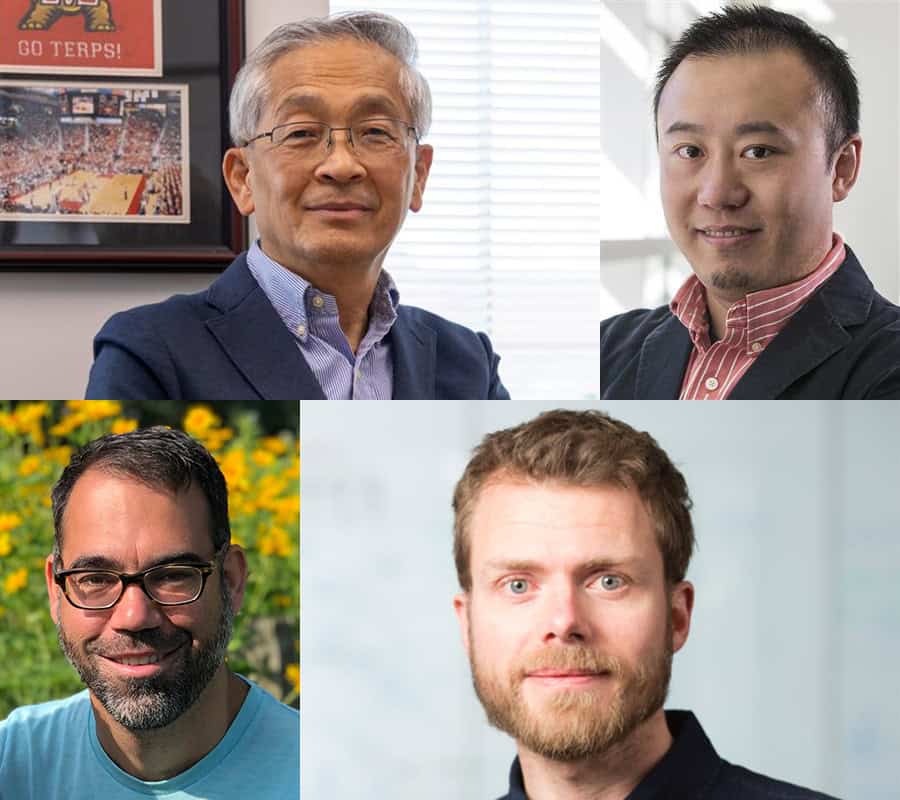
Looking ahead to the future of machine learning: (clockwise from top left) Jay Lee, Jimeng Sun, Pierre Gentine and Kyle Cranmer.
IOP Publishing’s Machine Learning series is the world’s first open-access journal series dedicated to the application and development of machine learning (ML) and artificial intelligence (AI) for the sciences.
Part of the series is Machine Learning: Science and Technology, launched in 2019, which bridges the application and advances in machine learning across the sciences. Machine Learning: Earth is dedicated to the application of ML and AI across all areas of Earth, environmental and climate sciences while Machine Learning: Health covers healthcare, medical, biological, clinical and health sciences and Machine Learning: Engineeringfocuses on applied AI and non-traditional machine learning to the most complex engineering challenges.
Here, the editors-in-chief (EiC) of the four journals discuss the growing importance of machine learning and their plans for the future.
Kyle Cranmer is a particle physicist and data scientist at the University of Wisconsin-Madison and is EiC of Machine Learning: Science and Technology (MLST). Pierre Gentine is a geophysicist at Columbia University and is EiC of Machine Learning: Earth. Jimeng Sun is a biophysicist at the University of Illinois at Urbana-Champaign and is EiC of Machine Learning: Health. Mechanical engineer Jay Lee is from the University of Maryland and is EiC of Machine Learning: Engineering.
What do you attribute to the huge growth over the past decade in research into and using machine learning?
Kyle Cranmer (KC): It is due to a convergence of multiple factors. The initial success of deep learning was driven largely by benchmark datasets, advances in computing with graphics processing units, and some clever algorithmic tricks. Since then, we’ve seen a huge investment in powerful, easy-to-use tools that have dramatically lowered the barrier to entry and driven extraordinary progress.
Pierre Gentine (PG): Machine learning has been transforming many fields of physics, as it can accelerate physics simulation, better handle diverse sources of data (multimodality), help us better predict.
Jimeng Sun (JS): Over the past decade, we have seen machine learning models consistently reach — and in some cases surpass — human-level performance on real-world tasks. This is not just in benchmark datasets, but in areas that directly impact operational efficiency and accuracy, such as medical imaging interpretation, clinical documentation, and speech recognition. Once ML proved it could perform reliably at human levels, many domains recognized its potential to transform labour-intensive processes.
Jay Lee (JL): Traditionally, ML growth is based on the development of three elements: algorithms, big data, and computing. The past decade’s growth in ML research is due to the perfect storm of abundant data, powerful computing, open tools, commercial incentives, and groundbreaking discoveries—all occurring in a highly interconnected global ecosystem.
What areas of machine learning excite you the most and why?
KC: The advances in generative AI and self-supervised learning are very exciting. By generative AI, I don’t mean Large Language Models — though those are exciting too — but probabilistic ML models that can be useful in a huge number of scientific applications. The advances in self-supervised learning also allows us to engage our imagination of the potential uses of ML beyond well-understood supervised learning tasks.
PG: I am very interested in the use of ML for climate simulations and fluid dynamics simulations.
JS: The emergence of agentic systems in healthcare — AI systems that can reason, plan, and interact with humans to accomplish complex goals. A compelling example is in clinical trial workflow optimization. An agentic AI could help coordinate protocol development, automatically identify eligible patients, monitor recruitment progress, and even suggest adaptive changes to trial design based on interim data. This isn’t about replacing human judgment — it’s about creating intelligent collaborators that amplify expertise, improve efficiency, and ultimately accelerate the path from research to patient benefit.
JL: One area is generative and multimodal ML — integrating text, images, video, and more — are transforming human–AI interaction, robotics, and autonomous systems. Equally exciting is applying ML to nontraditional domains like semiconductor fabs, smart grids, and electric vehicles, where complex engineering systems demand new kinds of intelligence.
What vision do you have for your journal in the coming years?
KC: The need for a venue to propagate advances in AI/ML in the sciences is clear. The large AI conferences are under stress, and their review system is designed to be a filter not a mechanism to ensure quality, improve clarity and disseminate progress. The large AI conferences also aren’t very welcoming to user-inspired research, often casting that work as purely applied. Similarly, innovation in AI/ML often takes a back seat in physics journals, which slows the propagation of those ideas to other fields. My vision for MLST is to fill this gap and nurture the community that embraces AI/ML research inspired by the physical sciences.
PG: I hope we can demonstrate that machine learning is more than a nice tool but that it can play a fundamental role in physics and Earth sciences, especially when it comes to better simulating and understanding the world.
JS: I see Machine Learning: Health becoming the premier venue for rigorous ML–health research — a place where technical novelty and genuine clinical impact go hand in hand. We want to publish work that not only advances algorithms but also demonstrates clear value in improving health outcomes and healthcare delivery. Equally important, we aim to champion open and reproducible science. That means encouraging authors to share code, data, and benchmarks whenever possible, and setting high standards for transparency in methods and reporting. By doing so, we can accelerate the pace of discovery, foster trust in AI systems, and ensure that our field’s breakthroughs are accessible to — and verifiable by — the global community.
JL: Machine Learning: Engineering envisions becoming the global platform where ML meets engineering. By fostering collaboration, ensuring rigour and interpretability, and focusing on real-world impact, we aim to redefine how AI addresses humanity’s most complex engineering challenges.
China has delayed the return of a crewed mission to the country’s space station over fears that the astronaut’s spacecraft has been struck by space debris. The craft was supposed to return to Earth on 5 November but the China Manned Space Agency says it will now carry out an impact analysis and risk assessment before making any further decisions about when the astronauts will return.
The Shenzhou programme involves taking astronauts to and from China’s Tiangong space station, which was constructed in 2022, for six-month stays.
Shenzhou-20, carrying three crew, launched on 24 April from Jiuquan Satellite Launch Center on board a Long March 2F rocket. Once docked with Tiangong the three-member crew of Shenzhou-19 began handing over control of the station to the crew of Shenzhou-20 before they returned to Earth on 30 April.
The three-member crew of Shenzhou-21 launched on 31 October and underwent the same hand-over process with the crew of Shenzhou-20 before they were set to return to Earth on Wednesday.
Yet pre-operation checks revealed that the craft had been hit by “a small piece of debris” with the location and scale of the damage to Shenzhou-20 having not been released.
If the craft is deemed unsafe following the assessment, it is possible that the crew of Shenzhou-20 will return to Earth aboard Shenzhou-21. Another option is to launch a back-up Shenzhou spacecraft, which remains on stand-by and could be launched within eight days.
Space debris is of increasing concern and this marks the first time that a crewed craft has been delayed due to a potential space debris impact. In 2021, for example, China noted that Tiangong had to perform two emergency avoidance manoeuvres to avoid fragments produced by Starlink satellites that were launched by SpaceX.
It’s Halloween today and so what better time than to bring you a couple of spooky stories from the world of physics.
First up is researchers at the University of Georgia in the US who have confirmed that six different species of bats found in North America emit a ghoulish green light when exposed to ultraviolet light.
The researchers examined 60 specimens from the Georgia Museum of Natural History and exposed the bats to UV light.
They found that the wings and hind limbs of six species – big brown bats, eastern red bats, Seminole bats, southeastern myotis, grey bats and the Brazilian free-tailed bat – gave off photoluminescence with the resulting glow being a shade of green.
While previous research found that some mammals, like pocket gophers, also emit a glow under ultraviolet light, this was the first discovery of such a phenomenon for bats located in North America.
The colour and location of the glow on the winged mammals suggest it is not down to genetics or camouflage and as it is the same between sexes it is probably not used to attract mates.
Given that many bats can see the wavelengths emitted, one option is that the glow may be an inherited trait used for communication.
“The data suggests that all these species of bats got it from a common ancestor. They didn’t come about this independently,” adds Castleberry. “It may be an artifact now, since maybe glowing served a function somewhere in the evolutionary past, and it doesn’t anymore.”
Thread lightly
In other frightful news, spider webs are a classic Halloween decoration and while the real things are marvels of bioengineering, there is still more to understand about these sticky structures.
Many spider species build spiral wheel-shaped webs – orb webs – to capture prey, and some incorporate so-called “stabilimenta” into their web structure. These “extra touches” look like zig-zagging threads that span the gap between two adjacent “spokes,” or threads arranged in a circular “platform” around the web’s centre.
The purpose of stabilimenta is unknown and proposed functions include as a deterrence for predatory wasps or birds.
Yet Gabriele Greco of the Swedish University of Agricultural Sciences and colleagues suggest such structures might instead influence the propagation of web vibrations triggered by the impact of captured prey.
Greco and colleagues observed different stabilimentum geometries that were constructed by wasp spiders, Argiope bruennichi. The researchers then performed numerical simulations to explore how stabilimenta affect prey impact vibrations.
For waves generated at angles perpendicular to the threads spiralling out from the web centre, stabilimenta caused negligible delays in wave propagation.
However, for waves generated in the same direction as the spiral threads, vibrations in webs with stabilimenta propagated to a greater number of potential detection points across the web – where a spider might sense them – than in webs without stabilimenta.
This suggests that stabilimenta may boost a spider’s ability to pinpoint the location of unsuspecting prey caught in its web.
 Connexion