Some Black and Latino leaders worry they are being denied access to power under Mayor Zohran Mamdani and that they may lose the ground they had gained under former Mayor Eric Adams.
Mayor Zohran Mamdani on Thursday announced Afua Atta-Mensah, who led his campaign outreach to Black voters, as the director of the Mayor’s Office of Equity and Racial Justice.
Research finds no evidence heavier social media use or more gaming increases symptoms of anxiety or depression
Screen time spent gaming or on social media does not cause mental health problems in teenagers, according to a large-scale study.
With ministers in the UK considering whether to follow Australia’s example by banning social media use for under-16s, the findings challenge concerns that long periods spent gaming or scrolling TikTok or Instagram are driving an increase in teenagers’ depression, anxiety and other mental health conditions.
Country joins EU neighbours in demographic crunch of ageing population and falling birthrate
For the first time since the end of the second world war, France has recorded more deaths than births, suggesting that the country’s long-held demographic advantage over other EU countries is slipping away.
Across the country in 2025, there were 651,000 deaths and 645,000 births, according to newly released figures from the national statistics institute Insee.
Popularity isn’t everything. But it is something, so for the second year running, we’re finishing our trip around the Sun by looking back at the physics stories that got the most attention over the past 12 months. Here, in ascending order of popularity, are the 10 most-read stories published on the Physics World website in 2025.
We’ve had quantum science on our minds all year long, courtesy of 2025 being UNESCO’s International Year of Quantum Science and Technology. But according to theoretical work by Partha Ghose and Dimitris Pinotsis, it’s possible that the internal workings of our brains could also literally be driven by quantum processes.
Though neurons are generally regarded as too big to display quantum effects, Ghose and Pinotsis established that the equations describing the classical physics of brain responses are mathematically equivalent to the equations describing quantum mechanics. They also derived a Schrödinger-like equation specifically for neurons. So if you’re struggling to wrap your head around complex quantum concepts, take heart: it’s possible that your brain is ahead of you.
Testing times A toy model from Marco Pettini seeks to reconcile quantum entanglement with Einstein’s theory of relativity. (Courtesy: Shutterstock/Eugene Ivanov)
Einstein famously disliked the idea of quantum entanglement, dismissing its effects as “spooky action at a distance”. But would he have liked the idea of an extra time dimension any better? We’re not sure he would, but that is the solution proposed by theoretical physicist Marco Pettini, who suggests that wavefunction collapse could propagate through a second time dimension. Pettini got the idea from discussions with the Nobel laureate Roger Penrose and from reading old papers by David Bohm, but not everyone is impressed by these distinguished intellectual antecedents. In this article, Bohm’s former student and frequent collaborator Jeffrey Bub went on the record to say he “wouldn’t put any money on” Pettini’s theory being correct. Ouch.
Continuing the theme of intriguing, blue-sky theoretical research, the eighth-most-read article of 2025 describes how two theoretical physicists, Kaden Hazzard and Zhiyuan Wang, proposed a new class of quasiparticles called paraparticles. Based on their calculations, these paraparticles exhibit quantum properties that are fundamentally different from those of bosons and fermions. Notably, paraparticles strikes a balance between the exclusivity of fermions and the clustering tendency of bosons, with up to two paraparticles allowed to occupy the same quantum state (rather than zero for fermions or infinitely many for bosons). But do they really exist? No-one knows yet, but Hazzard and Wang say that experimental studies of ultracold atoms could hold the answer.
Capturing colour A still life taken by Lippmann using his method sometime between 1890 and 1910. By the latter part of this period, the method had fallen out of favour, superseded by the simpler Autochrome process. (Courtesy: Photo in public domain)
The list of early Nobel laureates in physics is full of famous names – Roentgen, Curie, Becquerel, Rayleigh and so on. But if you go down the list a little further, you’ll find that the 1908 prize went to a now mostly forgotten physicist by the name of Gabriel Lippmann, for a version of colour photography that almost nobody uses (though it’s rather beautiful, as the photo shows). This article tells the story of how and why this happened. A companion piece on the similarly obscure 1912 laureate, Gustaf Dalén, fell just outside this year’s top 10; if you’re a member of the Institute of Physics, you can read both of them together in the November issue of Physics World.
Why should physicists have all the fun of learning about the quantum world? This episode of the Physics World Weekly podcast focuses on the outreach work of Aleks Kissinger and Bob Coecke, who developed a picture-driven way of teaching quantum physics to a group of 15-17-year-old students. One of the students in the original pilot programme, Arjan Dhawan, is now studying mathematics at the University of Durham, and he joined his former mentors on the podcast to answer the crucial question: did it work?
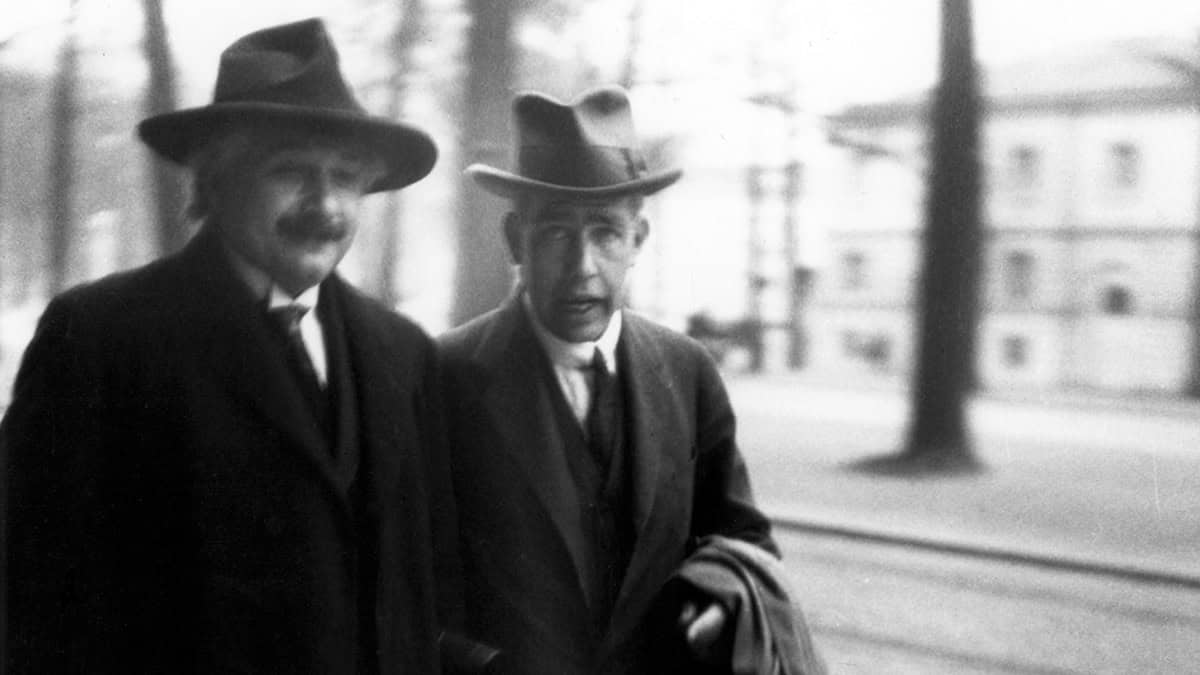
Conflicting views Stalwart physicists Albert Einstein and Niels Bohr had opposing views on quantum fundamentals from early on, which turned into a lifelong scientific argument between the two. (Paul Ehrenfest/Wikimedia Commons)
Niels Bohr had many good ideas in his long and distinguished career. But he also had a few that didn’t turn out so well, and this article by science writer Phil Ball focuses on one of them. Known as the Bohr-Kramers-Slater (BKS) theory, it was developed in 1923 with help from two of the assistants/students/acolytes who flocked to Bohr’s institute in Copenhagen. Several notable physicists hated it because it violated both causality and the conservation of energy, and within two years, experiments by Walther Boethe and Hans Geiger proved them right. The twist, though, is that Boethe went on to win a share of the 1954 Nobel Prize for Physics for this work – making Bohr surely one of the only scientists who won himself a Nobel Prize for his good ideas, and someone else a Nobel Prize for a bad one.
Black holes are fascinating objects in their own right. Who doesn’t love the idea of matter-swallowing cosmic maws floating through the universe? For some theoretical physicists, though, they’re also a way of exploring – and even extending – Einstein’s general theory of relativity. This article describes how thinking about black hole collisions inspired Jiaxi Wu, Siddharth Boyeneni and Elias Most to develop a new formulation of general relativity that mirrors the equations that describe electromagnetic interactions. According to this formulation, general relativity behaves the same way as the gravitational described by Isaac Newton more than 300 years ago, with the “gravito-electric” field fading with the inverse square of distance.
“Best of” lists are a real win-win. If you agree with the author’s selections, you go away feeling confirmed in your mutual wisdom. If you disagree, you get to have a good old moan about how foolish the author was for forgetting your favourites or including something you deem unworthy. Either way, it’s a success – as this very popular list of the top 5 Nobel Prizes for Physics awarded since the year 2000 (as chosen by Physics World editor-in-chief Matin Durrani) demonstrates.
We’re back to black holes again for the year’s second-most-read story, which focuses on a possible link between gravity and quantum information theory via the concept of entropy. Such a link could help explain the so-called black hole information paradox – the still-unresolved question of whether information that falls into a black hole is retained in some form or lost as the black hole evaporates via Hawking radiation. Fleshing out this connection could also shed light on quantum information theory itself, and the theorist who’s proposing it, Ginestra Bianconi, says that experimental measurements of the cosmological constant could one day verify or disprove it.
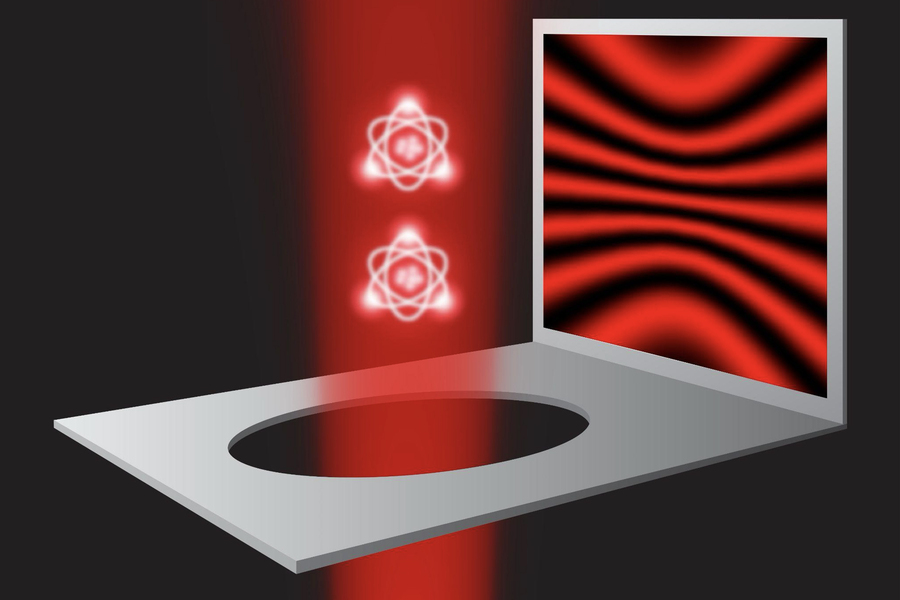
Experiment schematic Two single atoms floating in a vacuum chamber are illuminated by a laser beam and act as the two slits. The interference of the scattered light is recorded with a highly sensitive camera depicted as a screen. Incoherent light appears as background and implies that the photon has acted as a particle passing only through one slit. (Courtesy: Wolfgang Ketterle, Vitaly Fedoseev, Hanzhen Lin, Yu-Kun Lu, Yoo Kyung Lee and Jiahao Lyu)
Back in 2002, readers of Physics World voted Thomas Young’s electron double-slit experiment “the most beautiful experiment in physics”. More than 20 years later, it continues to fascinate the physics community, as this, the most widely read article of any that Physics World published in 2025, shows.
Young’s original experiment demonstrated the wave-like nature of electrons by sending them through a pair of slits and showing that they create an interference pattern on a screen even when they pass through the slits one-by-one. In this modern update, physicists at the Massachusetts Institute of Technology (MIT), US, stripped this back to the barest possible bones.
Using two single atoms as the slits, they inferred the path of photons by measuring subtle changes in the atoms’ properties after photon scattering. Their results matched the predictions of quantum theory: interference fringes when they didn’t observe the photons’ path, and two bright spots when they did.
It’s an elegant result, and the fact that the MIT team performed the experiment specifically to celebrate the International Year of Quantum Science and Technology 2025 makes its popularity with Physics World readers especially gratifying.
So here’s to another year full of elegant experiments and the theories that inspire them. Long may they both continue, and thank you, as always, for taking the time to read about them.
Susumu Noda of Kyoto University has won the 2026 Rank Prize for Optoelectronics for the development of the Photonic Crystal Surface Emitting Laser (PCSEL). For more than 25 years, Noda developed this new form of laser, which has potential applications in high-precision manufacturing as well as in LIDAR technologies.
Following the development of the laser in 1960, in more recent decades optical fibre lasers and semiconductor lasers have become competing technologies.
A semiconductor laser works by pumping an electrical current into a region where an n-doped (excess of electrons) and a p-doped (excess of “holes”) semiconductor material meet, causing electrons and holes to combine and release photons.
Semiconductors have several advantages in terms of their compactness, high “wallplug” efficiency, and ruggedness, but lack in other areas such as having a low brightness and functionality.
This means that conventional semiconductor lasers required external optical and mechanical elements to improve their performance, which results in large and impractical systems.
‘A great honour’
In the late 1990s, Noda began working on a new type of semiconductor laser that could challenge the performance of optical fibre lasers. These so-called PCSELs employ a photonic crystal layer in between the semiconductor layers. Photonic crystals are nanostructured materials in which a periodic variation of the dielectric constant — formed, for example, by a lattice of holes — creates a photonic band-gap.
Noda and his research made a series of breakthrough in the technology such as demonstrating control of polarization and beam shape by tailoring the phonic crystal structure and expansion into blue–violet wavelengths.
The resulting PCSELs emit a high-quality, symmetric beam with narrow divergence and boast high brightness and high functionality while maintaining the benefits of conventional semiconductor lasers. In 2013, 0.2 W PCSELs became available and a few years later Watt-class PCSEL lasers became operational.
Noda says that it is “a great honour and a surprise” to receive the prize. “I am extremely happy to know that more than 25 years of research on photonic-crystal surface-emitting lasers has been recognized in this way,” he adds. “I do hope to continue to further develop the research and its social implementation.”
Susumu Noda received his BSc and then PhD in electronics from Kyoto University in 1982 and 1991, respectively. From 1984 he also worked at Mitsubishi Electric Corporation, before joining Kyoto University in 1988 where he is currently based.
Founded in 1972 by the British industrialist and philanthropist Lord J Arthur Rank, the Rank Prize is awarded biennially in nutrition and optoelectronics. The 2026 Rank Prize for Optoelectronics, which has a cash award of £100 000, will be awarded formally at an event held in June.
 Connexion