 Connexion
Quantum cluster targets business growth
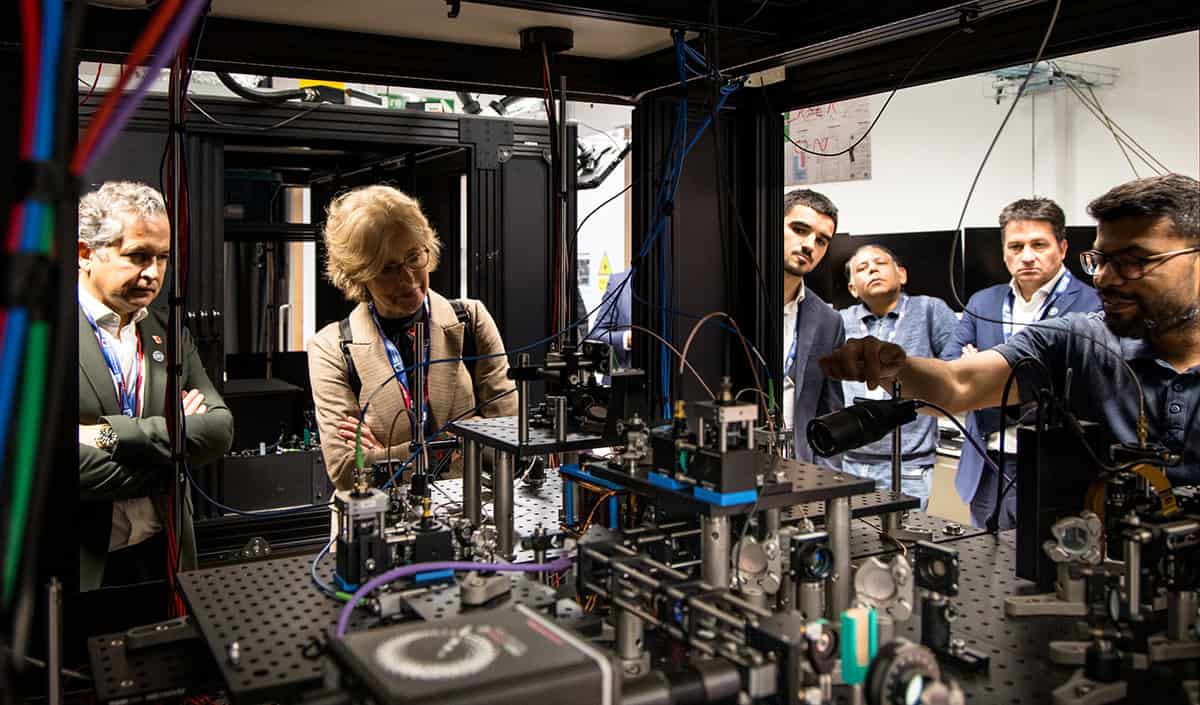
Ever since the National Quantum Computing Centre was launched five years ago, its core mission has been to accelerate the pathway towards practical adoption of the technology. That has required technical innovation to scale up hardware platforms and create the software tools and algorithms needed to tackle real-world applications, but there has also been a strong focus on engaging with companies to build connections, provide access to quantum resources, and identify opportunities for deriving near-term value from quantum computing.
It makes sense, then, that the NQCC should form the cornerstone of a new Quantum Cluster at the Harwell Campus of Science and Innovation in Oxfordshire. The hope is that the NQCC’s technical expertise and infrastructure, combined with the services and facilities available on the wider Harwell Campus, will provide a magnet for new quantum start-ups as well as overseas companies that are seeking to establish a presence within the UK’s quantum ecosystem.
By accelerating collaboration across government, industry and academia, we will turn research excellence into industrial strength.
“We want to leverage the public investment that has been made into the NQCC to catalyse business growth and attract more investment into the UK’s quantum sector,” said Najwa Sidqi, manager of the Harwell Quantum Cluster, at the official launch event in November. “By accelerating collaboration across government, industry and academia, we will turn research excellence into industrial strength.”
The cluster, which has been ramping up its activities over the last year, is working to ambitious targets. Over the next decade the aim is to incubate at least 100 quantum companies on the Harwell site, create more than 1000 skilled jobs, and generate more than £1 billion of private and public investment. “Our aim is to build the foundations of a globally competitive quantum economy that delivers impact far beyond science and research,” added Sidqi.
Tangible evidence that the approach works is offered by the previous clustering activities on the Harwell Campus, notably the Space Cluster that has expanded rapidly since its launch in 2010. Anchored by the RAL Space national laboratory and bolstered by the presence of ESA and the UK Space Agency, the Space Cluster now comprises more than 100 organizations that range from small start-ups to the UK technology hubs of global heavyweights such as Airbus and Lockheed Martin.
More generally, the survival rate of start-up companies operating on the Harwell site is around 95%, compared with an average of around 50%. “At Harwell there is a high density of innovators sharing the same space, which generates more connections and more ideas,” said Julia Sutcliffe, Chief Scientific Advisor for the UK’s Department for Business and Trade. “It provides an incredible combination of world-class infrastructure and expertise, accelerating the innovation pathway and helping to create a low-risk environment for early-stage businesses and investors.”
The NQCC has already seeded that innovation activity through its early engagement with both quantum companies and end users of the technology. One major initiative has been the testbed programme, which has enabled the NQCC to invest £30m in seven hardware companies to deploy prototype quantum computers on the Harwell Campus. As well as providing access to operational systems based on all of the leading qubit modalities, the testbed programme has also provided an impetus for inward investment and job creation.
One clear example is provided by QuEra Computing, a US-based spin-off from Harvard University and the Massachusetts Institute of Technology that is developing a hardware platform based on neutral atoms. QuEra was one of the companies to win funding through the testbed programme, with the firm setting up a UK-based team to deploy its prototype system on the Harwell Campus. But the company could soon see the benefits of establishing a UK centre for technology development on the site. “Harwell is immensely helpful to us,” said Ed Durking, Corporate Director of QuEra Computing UK. “It’s a nucleus where we enjoy access to world-class talent, vendors, customers, and suppliers.”
On a practical level, establishing its UK headquarters on the Harwell Campus has provided QueEra with easy access to specialist contractors and services for fitting out and its laboratories. In June the company moved into a building that is fully equipped with flexible lab space for R&D and manufacturing, and since then the UK-based team has started to build the company’s most powerful quantum computer at the facility. Longer term, establishing a base within the UK could open the door to new collaborations and funding opportunities for QuEra to further develop its technology, with the company now focused on integrating full error correction into its neutral-atom platform by 2026.
Access to the world-class infrastructure on the Harwell Campus has benefitted the other testbed providers in different ways. For ORCA Computing, a UK company developing and manufacturing photonic quantum computers, the goal was to install a testbed system within Harwell’s high-performance computing centre rather than the NQCC’s experimental labs. “Our focus is to build commercial photonic quantum systems that can be integrated into conventional datacentres, enabling hybrid quantum-classical workflows for real-world applications,” explained Geoff Barnes, Head of Customer Success at ORCA. “Having the NQCC as an expert customer enabled us to demonstrate and validate our capabilities, building the system in our own facility and then deploying it within an operational environment.”
This process provided a valuable learning experience for the ORCA engineers. The experts at Harwell helped them to navigate the constraints of installing equipment within a live datacentre, while also providing practical assistance with the networking infrastructure. Now that the system is up and running, the Harwell site also provides ORCA with an open environment for showcasing its technology to prospective customers. “As well as delivering a testbed system to the NQCC, we can now demonstrate our platform to clients within a real-world setting,” added Barnes. “It has also been a critical step toward commercial deployment on our roadmap, enabling our partners to access our systems remotely for applications development.”
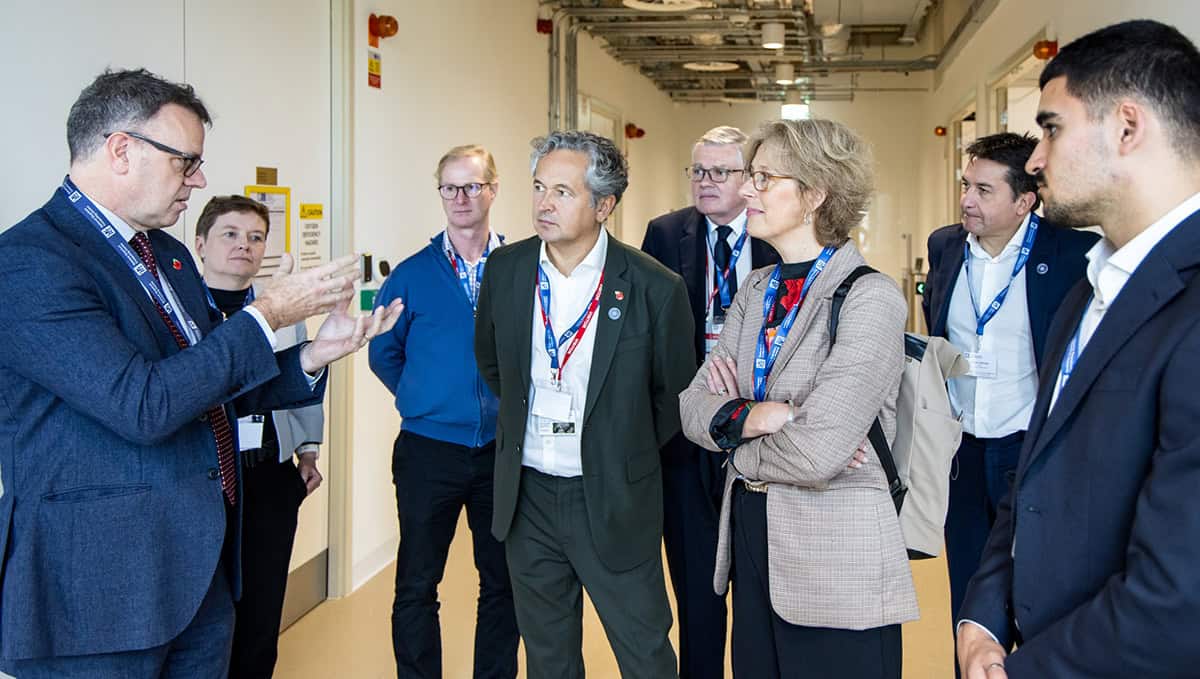
While the NQCC has already played a vital role in supporting companies as they make the transition towards commercialization, the Quantum Cluster has a wider remit to extend those efforts into other quantum technologies, such as sensing and communications, that are already finding real-world applications. It will also have a more specific focus on attracting new investment into the UK, and supporting the growth of companies that are transitioning from the start-up phase to establish larger scale commercial operations.
“In the UK we have traditionally been successful in creating spin-off activities from our strong research base, but it has been more challenging to generate the large capital investments needed to scale businesses in the technology sector,” commented Sidqi. “We want to strengthen that pipeline to ensure that the UK can translate its leadership in quantum research and early-stage innovation into long-term prosperity.”
To accelerate that process the Quantum Cluster announced a strategic partnership with Quantum Exponential, the first UK-based venture capital fund to be entirely focused on quantum technologies. Ian Pearson, the non-executive chairman of the Quantum Exponential, explained that the company is working to generate an investment fund of £100m by the end of 2027 that will support quantum companies as they commercialize their technologies and scale up their businesses. “Now is the time for investment into quantum sector,” said Pearson. “A specialist quantum fund with the expertise needed to analyse and price deals, and to do all the necessary due diligence, will attract more private investment that will help UK companies to grow and scale.”
Around two-thirds of the investments will be directed towards UK-based companies, and as part of the partnership Quantum Exponential will work with the Quantum Cluster to identify and support high-potential quantum businesses within the Harwell Campus. The Quantum Cluster will also play a crucial role in boosting investor confidence – particularly in the unique ability of the Harwell Campus to nurture successful technology businesses – and making connections with international innovation networks to provide UK-based companies with improved access to global markets.
“This new cluster strengthens our national capability and sends a clear signal to global investors that the UK is the place to develop and scale quantum technologies,” commented Michael Cuthbert, Director of the NQCC. “It will help to ensure that quantum innovation delivers benefits not just for science and industry, but for the economy and society as a whole.”
The post Quantum cluster targets business growth appeared first on Physics World.
