With a blend of retro-futurism, moral ambiguity and monster-filled wastelands, Fallout became an unlikely prestige television favourite. Now there is something a bigger, stranger and funnier journey ahead
The Fallout TV series returns to Prime Video today, and it’s fair to say that everyone was pleasantly surprised by how good the first season was. By portraying Fallout’s retro-futuristic, post-apocalyptic US through three different characters, it managed to capture different aspects of the game player’s experience, too. There was vault-dweller Lucy, trying to do the right thing and finding that the wasteland made that very difficult; Max, the Brotherhood of Steel rookie, who starts to question his cult’s authority and causes a lot of havoc in robotic power armour; and the Ghoul, Walton Goggins’s breakout character, who has long since lost any sense of morality out in the irradiated wilderness.
The show’s first season ended with a revelation about who helped cause the nuclear war that trapped a group of people in underground vaults for a couple of centuries. It also left plenty of questions open for the second season – and, this time, expectations are higher. Even being “not terrible” was a win for a video game adaptation until quite recently. How are the Fallout TV show’s creators feeling now that the first season has been a success?
AI promises to have far-reaching effects in music-making. While some welcome it as a compositional tool, many have deep concerns. Here are some of your responses
With this in mind, we asked for your thoughts on music composed by AI, the use of AI as a tool in the creation of music, and what should be done to protect musicians. Here are some of your responses.
The woman Quentin Tarantino called ‘the goddess of go-go’ is one of the most connected and accomplished in Hollywood. At 82, she recalls working with Tina Turner, Bette Midler, Frank Sinatra, David Byrne, Margot Robbie, Leonardo DiCaprio - the list goes on - and the time Bing Crosby made a pass at her
If your knowledge of Toni Basil begins and ends with her cheerleader-chanting smash hit Mickey, that’s just the tip of a very deep iceberg. By the time Mickey topped the US charts 43 years ago this week, in 1982, Basil had already spent four decades in the entertainment industry. The deeper you go, the more places you realise she was. When Elvis Presley sings “See the girl with the red dress on” in his 1964 movie Viva Las Vegas, and points across the dancefloor, the gyrating girl in the red dress is Basil. When Peter Fonda and Dennis Hopper take LSD at the end of Easy Rider with two sex workers, one of them is Basil. When dance troupe the Lockers showcase their pre-hip-hop street dance moves on Soul Train in 1976, it’s six guys and … Basil. By the time of Mickey she had already worked with everyone from David Bowie to Tina Turner to Talking Heads, with more to come.
Basil has been-there-done-that in so many places, for so long, and over the course of our two-hour conversation she’ll casually drop asides such as “… so I went to see Devo with Iggy Pop and Dean Stockwell” or “… me and Bowie had just come from dinner with Bob Geldof, Paula Yates and Freddie Mercury” or “I was just at Bette Midler’s 80th birthday party, what a bash!” She’s now 82 years old but on Zoom, from her dance studio in Los Angeles, she doesn’t look much older than she did in the video for Mickey – and she looked like a teenager in that, even though she was 38 at the time. Her memory is perfectly sharp, too, and her energy levels are as high as ever, as she shares her packed life story with animated diction. If she has a secret to eternal youth, it’s that she has danced her whole life, and she still does, she says. “Dance is my drug of choice. You get high from it, and it gives you community.”
Companies such as Udio, Suno and Klay will let you use AI to make new music based on existing artists’ work. It could mean more royalties – but many are worried
This was the year that AI-generated music went from jokey curiosity to mainstream force. Velvet Sundown, a wholly AI act, generated millions of streams; AI-created tracks topped Spotify’s viral chart and one of the US Billboard country charts; AI “artist” Xania Monet “signed” a record deal. BBC Introducing is usually a platform for flesh-and-blood artists trying to make it big, but an AI-generated song by Papi Lamour was recently played on the West Midlands show. And jumping up the UK Top 20 this month is I Run, a track by dance act Haven, who have been accused of using AI to imitate British vocalist Jorja Smith (Haven claim they simply asked the AI for “soulful vocal samples”, and did not respond to an earlier request to comment).
The worry is that AI will eventually absorb all creative works in history and spew out endless slop that will replace human-made art and drive artists into penury. Those worries are being deepened by how the major labels, once fearful of the technology, are now embracing it – and heralding a future in which ordinary listeners have a hand in co-creating music with their favourite musicians.
A four-hour documentary observes life in a Paris squat and perilous Mediterranean crossings – but its non-narrative structure tests the limits of endurance and empathy
Egyptian-American film-maker Sam Abbas’s experimental documentary was made over four years and shows footage of African and South Asian immigrants making the treacherous journey up through Libya and across the Mediterranean to a Parisian squat. That’s a misleadingly linear description of the film; it’s actually cleaved into two parts which would seem back to front if we were following the stories of specific people. The first section observes life in the squat where the residents support each other as they face eviction threats and the bureaucracy of asylum-seeking, while the second part looks on as other people make the rough sea passage. Time is also spent aboard boats run by organisations such as Doctors Without Borders who seek to help the migrants.
All that might make this sound like any number of 21st-century documentaries (Fire at Sea, for instance) and dramas (Io Capitano) about immigrants crossing continents with deadly results. But this one is aggressively non-narrative, composed of a series of long static shots and still images that linger many beats longer than might seem necessary to get the point across. Body parts and faces, what looks like a fuse box, a child being delivered by a rough emergency C-section (gory stuff, be warned), someone’s phone showing text messages, water, sick people laid out like cordwood on a deck; it’s all a jumble of images, unexplained and raw, and sometimes barely visible in the low-lit conditions.
As the classic album hits 50, Nick Mason talks about the often difficult process of making it and how it has since fit into their larger catalogue
By almost every measure, from commercial reward to creative reach, Pink Floyd scaled its peak on Dark Side of the Moon. But, when I asked drummer Nick Mason how he would rank the album in their catalogue, he slotted it below the set that came next, Wish You Were Here. Speaking of Dark Side, he said, “the idea of it is almost more attractive than the individual songs on it. I feel slightly the same about Sgt. Pepper. It’s an amazing album that taught us a hell of a lot, but the individual parts are not quite as exciting, or as good, as some of the other Beatles’ albums.”
By contrast, he says of Wish You Were Here, “there’s something in the general atmosphere it generates – the space of it, the air around it, that’s really special,” he said. “It’s one of the reasons I view it so affectionately.”
On Tuesday 7 October the winner(s) of the 2025 Nobel Prize for Physics will be announced. The process of choosing the winners is highly secretive, so looking for hints about who will be this year’s laureates is futile. Indeed, in the immediate run-up to announcement, only members of the Nobel Committee for Physics and the Class for Physics at the Royal Swedish Academy of Sciences know who will be minted as the latest Nobel laureates. What is more, recent prizes provide little guidance because the deliberations and nominations are kept secret for 50 years. So we really are in the dark when it comes to predicting who will be named next week.
If you would like to learn more about how the Nobel Prize for Physics is awarded, check out this profile of Lars Brink, who served on the Nobel Committee for Physics on eight occasions.
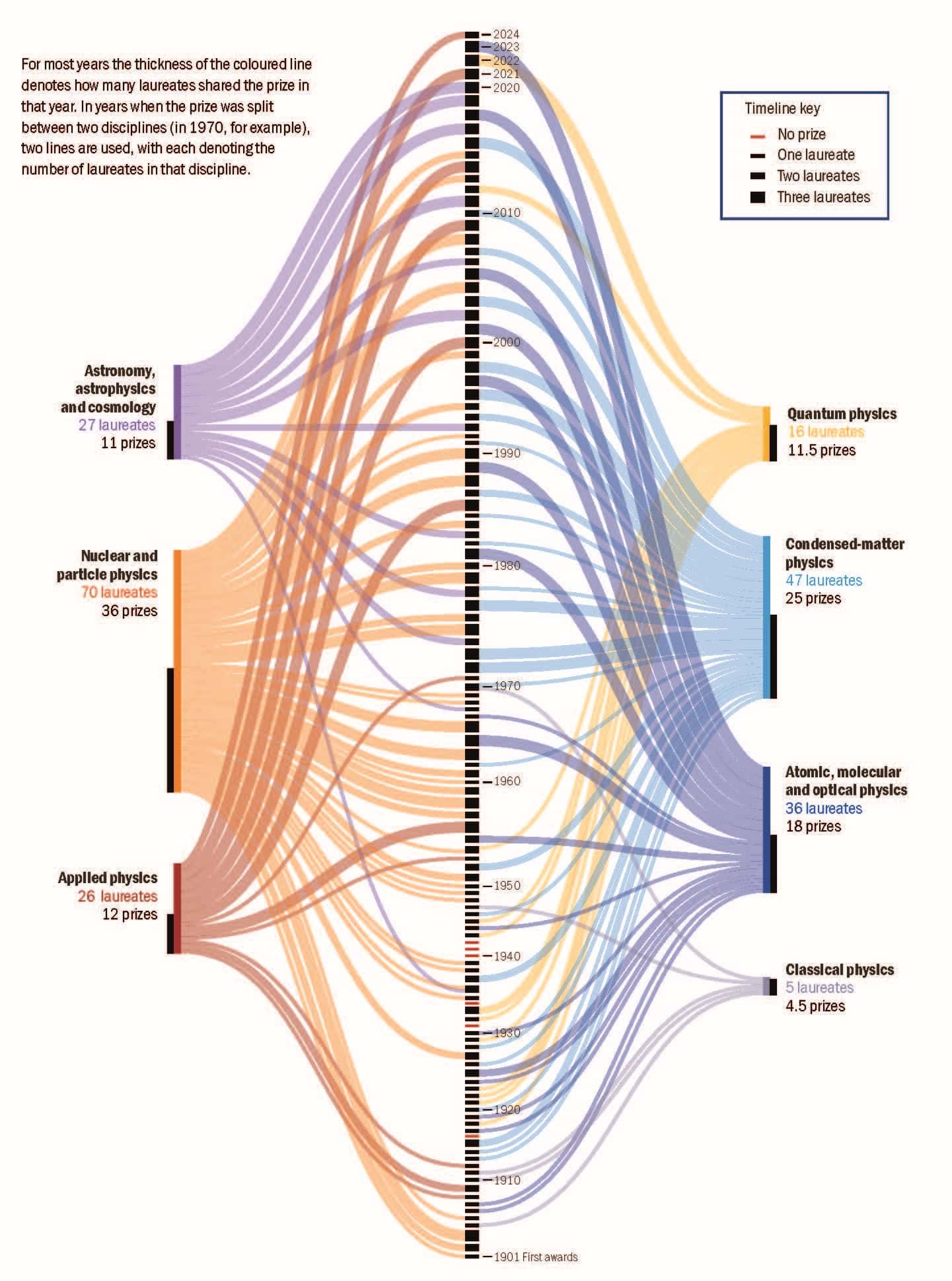
But this level of secrecy doesn’t stop people like me from speculating about this year’s winners. Before I explain the rather lovely infographic that illustrates this article – and how it could be used to predict future Nobel winners – I am going to share my first prediction for next week.
Inspired by last year’s physics Nobel prize, which went to two computer scientists for their work on artificial intelligence, I am predicting that the 2025 laureates will be honoured for their work on quantum information and algorithms. Much of the pioneering work in this field was done several decades ago, and has come to fruition in functioning quantum computers and cryptography systems. So the time seems right for an award and I have four people in mind. They are Peter Shor, Gilles Brassard, Charles Bennett and David Deutsch. However, only three can share the prize.
Moving on to our infographic, which gives a bit of pseudoscientific credibility to my next predictions! It charts the history of the physics Nobel prize in terms of field of endeavour. One thing that is apparent from the infographic is that since about 1990 there have been clear gaps between awards in certain fields. If you look at “atomic, molecular and optical physics”, for example, there are gaps between awards of about 5–10 years. One might conclude, therefore, that the Nobel committee considers the field of an award and tries to avoid bunching together awards in the same field.
Looking at the infographic, it looks like we are long overdue a prize in nuclear and particle physics – the last being 10 years ago. However, we haven’t had many big breakthroughs in this field lately. Two aspects of particle physics that have been very fruitful in the 21st century have been the study of the quark–gluon plasma formed when heavy nuclei collide; and the precise study of antimatter – observing how it behaves under gravity, for example. But I think it might be a bit too early for Nobels in these fields.
One possibility for a particle-physics Nobel is the development of the theory of cosmic inflation, which seeks to explain the observed nature of the current universe by invoking an exponential expansion of the universe in its very early history. If an award were given for inflation, it would most certainly go to Alan Guth and Andrei Linde. A natural for the third slot would have been Alexei Starobinsky, who sadly died in 2023 – and Nobels are not awarded posthumously. If there was a third winner for inflation, it would probably be Paul Steinhardt.
Invisibility cloaks
2016 was the last year when we had a Nobel prize in condensed-matter physics, so what work in that field would be worthy of an award this year? There has been a lot of very interesting research done in the field of metamaterials – materials that are engineered to have specific properties, particularly in terms of how they interact with light or sound.
A Nobel prize for metamaterials would surely go to the theorist John Pendry, who pioneered the concept of transformation optics. This simplifies our understanding of how light interacts with metamaterials and helps with the design of objects and devices with amazing properties. These include invisibility cloaks –the first of which was built in 2006 by the experimentalist David Smith, who I think is also a contender for this year’s Nobel prize. Smith’s cloak works at microwave frequencies, but my nomination for the third slot has done an amazing amount of work on developing metamaterials for practical applications in optics. If you follow this field, you know that I am thinking of the applied physicist Federico Capasso – who is also known for the invention of the quantum cascade laser.
 Connexion