Connexion
Band-aid like wearable sensor continuously monitors foetal movement
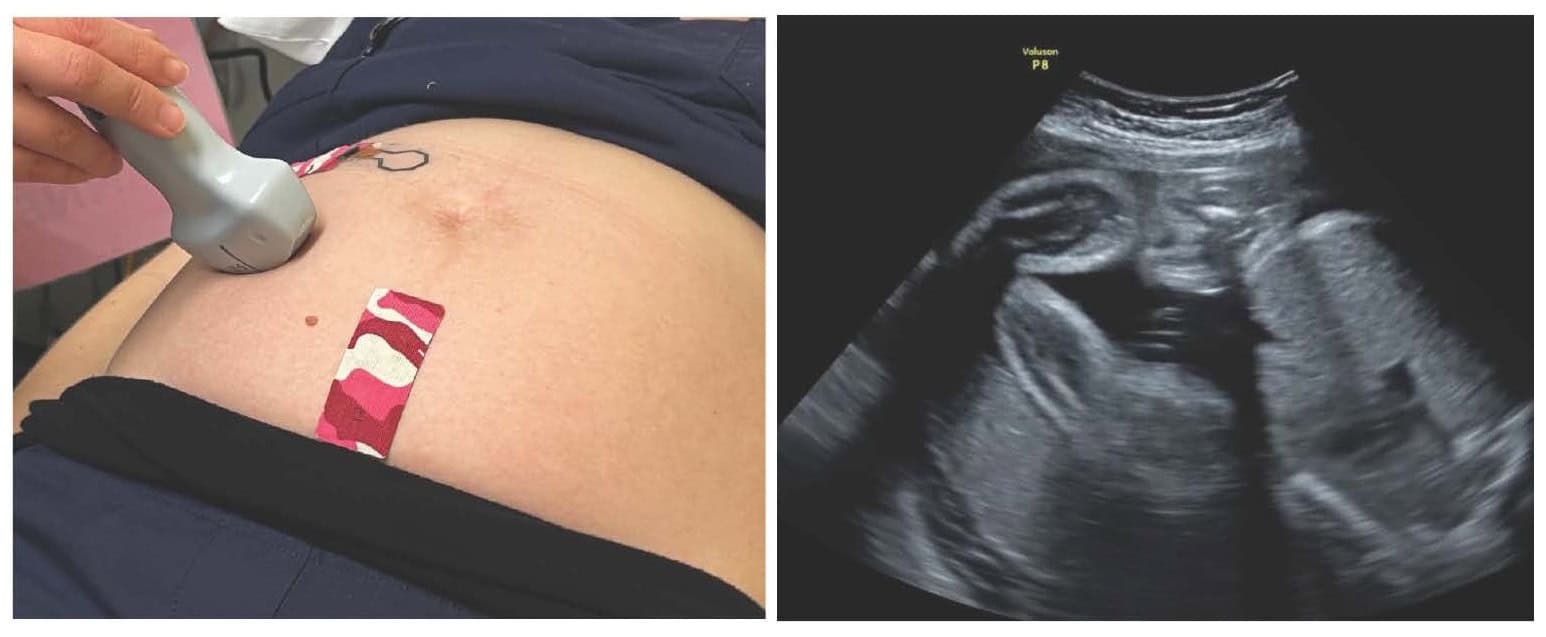
The ability to continuously monitor and interpret foetal movement patterns in the third trimester of a pregnancy could help detect any potential complications and improve foetal wellbeing. Currently, however, such assessment of foetal movement is performed only periodically, with an ultrasound exam at a hospital or clinic.
A lightweight, easily wearable, adhesive patch-based sensor developed by engineers and obstetricians at Monash University in Australia may change this. The patches, two of which are worn on the abdomen, can detect foetal movements such as kicking, waving, hiccups, breathing, twitching, and head and trunk motion.
Reduced foetal movement can be associated with potential impairment in the central nervous system and musculoskeletal system, and is a common feature observed in pregnancies that end in foetal death and stillbirth. A foetus compromised in utero may reduce movements as a compensatory strategy to lower oxygen consumption and conserve energy.
To help identify foetuses at risk of complications, the Monash team developed an artificial intelligence (AI)-powered wearable pressure–strain combo sensor system that continuously and accurately detects foetal movement-induced motion in the mother’s abdominal skin. As reported in Science Advances, the “band-aid”-like sensors can discriminate between foetal and non-foetal movement with over 90% accuracy.
The system comprises two soft, thin and flexible patches designed to conform to the abdomen of a pregnant woman. One patch incorporates an octagonal gold nanowire-based strain sensor (the “Octa” sensor), the other is an interdigitated electrode-based pressure sensor.
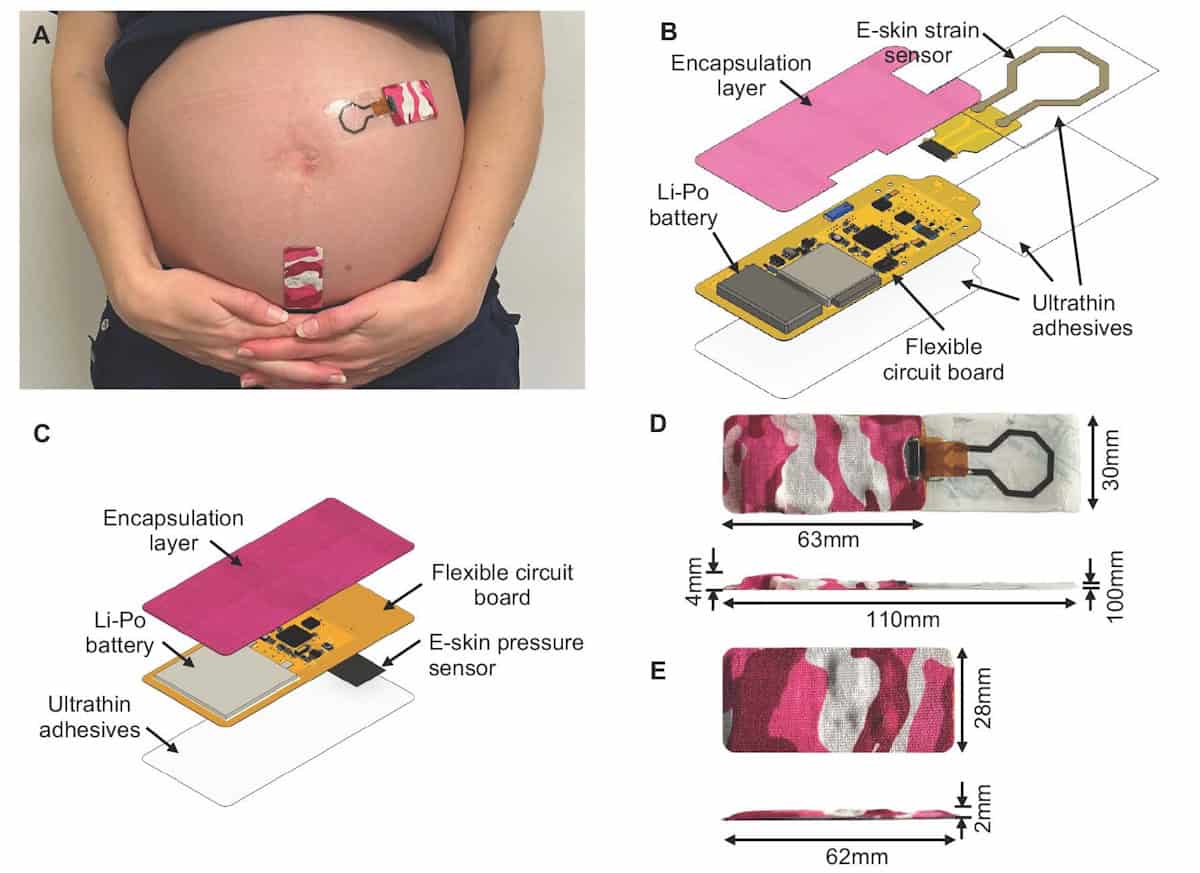
The patches feature a soft polyimide-based flexible printed circuit (FPC) that integrates a thin lithium polymer battery and various integrated circuit chips, including a Bluetooth radiofrequency system for reading the sensor’s electrical resistance, storing data and communicating with a smartphone app. Each patch is encapsulated with kinesiology tape and sticks to the abdomen using a medical double-sided silicone adhesive.
The Octa sensor is attached to a separate FPC connector attached to the primary device, enabling easy replacement after each study. The pressure sensor is mounted on the silicone adhesive, to connect with the interdigitated electrode beneath the primary device. The Octa and pressure sensor patches are lightweight (about 3 g) and compact, measuring 63 x 30 x 4 mm and 62 x 28 x 2 mm, respectively.
Trialling the device
The researchers validated their foetal movement monitoring system via comparison with simultaneous ultrasound exams, examining 59 healthy pregnant women at Monash Health. Each participant had the pressure sensor attached to the area of their abdomen where they felt the most vigorous foetal movements, typically in the lower quadrant, while the strain sensor was attached to the region closest to foetal limbs. An accelerometer placed on the participant’s chest captured non-foetal movement data for signal denoising and training the machine-learning model.
Principal investigator Wenlong Cheng, now at the University of Sydney, and colleagues report that “the wearable strain sensor featured isotropic omnidirectional sensitivity, enabling detection of maternal abdominal [motion] over a large area, whereas the wearable pressure sensor offered high sensitivity with a small domain, advantageous for accurate localized foetal movement detection”.
The researchers note that the pressure sensor demonstrated higher sensitivity to movements directly beneath it compared with motion farther away, while the Octa sensor performed consistently across a wider sensing area. “The combination of both sensor types resulted in a substantial performance enhancement, yielding an overall AUROC [area under the receiver operating characteristic curve] accuracy of 92.18% in binary detection of foetal movement, illustrating the potential of combining diverse sensing modalities to achieve more accurate and reliable monitoring outcomes,” they write.
In a press statement, co-author Fae Marzbanrad explains that the device’s strength lies in a combination of soft sensing materials, intelligent signal processing and AI. “Different foetal movements create distinct strain patterns on the abdominal surface, and these are captured by the two sensors,” she says. “The machine-learning system uses the signals to detect when movement occurs while cancelling maternal movements.”
The lightweight and flexible device can be worn by pregnant women for long periods without disrupting daily life. “By integrating sensor data with AI, the system automatically captures a wider range of foetal movements than existing wearable concepts while staying compact and comfortable,” Marzbanrad adds.
The next steps towards commercialization of the sensors will include large-scale clinical studies in out-of-hospital settings, to evaluate foetal movements and investigate the relationship between movement patterns and pregnancy complications.
The post Band-aid like wearable sensor continuously monitors foetal movement appeared first on Physics World.
 Since the beginning of radiation therapy, almost all treatments have been delivered with the patient lying on a table while the beam rotates around them. But a resurgence in upright patient positioning is changing that paradigm. Novel radiation accelerators such as proton therapy, VHEE, and FLASH therapy are often too large to rotate around the patient, making access limited. By instead rotating the patient, these previously hard-to-access beams could now become mainstream in the future.