↩ Accueil

Vue normale

Reçu — 10 décembre 2025 6.5 📰 Sciences English

Diagnosing brain cancer without a biopsy

10 décembre 2025 à 10:19

Early diagnosis of primary central nervous system lymphoma (PCNSL) remains challenging because brain biopsies are invasive and imaging often lacks molecular specificity. A team led by researchers at Shenzhen University has now developed a minimally invasive fibre-optic plasmonic sensor capable of detecting PCNSL-associated microRNAs in the eye’s aqueous humor with attomolar sensitivity.

At the heart of the approach is a black phosphorus (BP)–engineered surface plasmon resonance (SPR) interface. An ultrathin BP layer is deposited on a gold-coated fiber tip. Because of the work-function difference between BP and gold, electrons transfer from BP into the Au film, creating a strongly enhanced local electric field at the metal–semiconductor interface. This BP–Au charge-transfer nano-interface amplifies refractive-index changes at the surface far more efficiently than conventional metal-only SPR chips, enabling the detection of molecular interactions that would otherwise be too subtle to resolve and pushing the limit of detection down to 21 attomolar without nucleic-acid amplification. The BP layer also provides a high-area, biocompatible surface for immobilizing RNA reporters.

To achieve sequence specificity, the researchers integrated CRISPR-Cas13a, an RNA-guided nuclease that becomes catalytically active only when its target sequence is perfectly matched to a designed CRISPR RNA (crRNA). When the target microRNA (miR-21) is present, activated Cas13a cleaves RNA reporters attached to the BP-modified fiber surface, releasing gold nanoparticles and reducing the local refractive index. The resulting optical shift is read out in real time through the SPR response of the BP-enhanced fiber probe, providing single-nucleotide-resolved detection directly on the plasmonic interface.

With this combined strategy, the sensor achieved a limit of detection of 21 attomolar in buffer and successfully distinguished single-base-mismatched microRNAs. In tests on aqueous-humor samples from patients with PCNSL, the CRISPR-BP-FOSPR assay produced results that closely matched clinical qPCR data, despite operating without any amplification steps.

Because aqueous-humor aspiration is a minimally invasive ophthalmic procedure, this BP-driven plasmonic platform may offer a practical route for early PCNSL screening, longitudinal monitoring, and potentially the diagnosis of other neurological diseases reflected in eye-fluid biomarkers. More broadly, the work showcases how black-phosphorus-based charge-transfer interfaces can be used to engineer next-generation, fibre-integrated biosensors that combine extreme sensitivity with molecular precision.

Do you want to learn more about this topic?

Theoretical and computational tools to model multistable gene regulatory networks by Federico BocciDongya JiaQing NieMohit Kumar Jolly and José Onuchic (2023)

The post Diagnosing brain cancer without a biopsy appeared first on Physics World.
5f electrons and the mystery of δ-plutonium

10 décembre 2025 à 10:18

Plutonium is considered a fascinating element. It was first chemically isolated in 1941 at the University of California, but its discovery was hidden until after the Second World War. There are six distinct allotropic phases of plutonium with very different properties. At ambient pressure, continuously increasing the temperature converts the room-temperature, simple monoclinic a phase through five phase transitions, the final one occurring at approximately 450°C.

The delta (δ) phase is perhaps the most interesting allotrope of plutonium. δ-plutonium is technologically important, has a very simple crystal structure, but its electronic structure has been debated for decades. Researchers have attempted to understand its anomalous behaviour and how the properties of δ-plutonium are connected to the 5f electrons.

The 5f electrons are found in the actinide group of elements which includes plutonium. Their behaviour is counterintuitive. They are sensitive to temperature, pressure and composition, and behave in both a localised manner, staying close to the nucleus and in a delocalised (itinerant) manner, more spread out and contributing to bonding. Both these states can support magnetism depending on actinide element. The 5f electrons contribute to δ-phase stability, anomalies in the material’s volume and bulk modulus, and to a negative thermal expansion where the δ-phase reduces in size when heated.

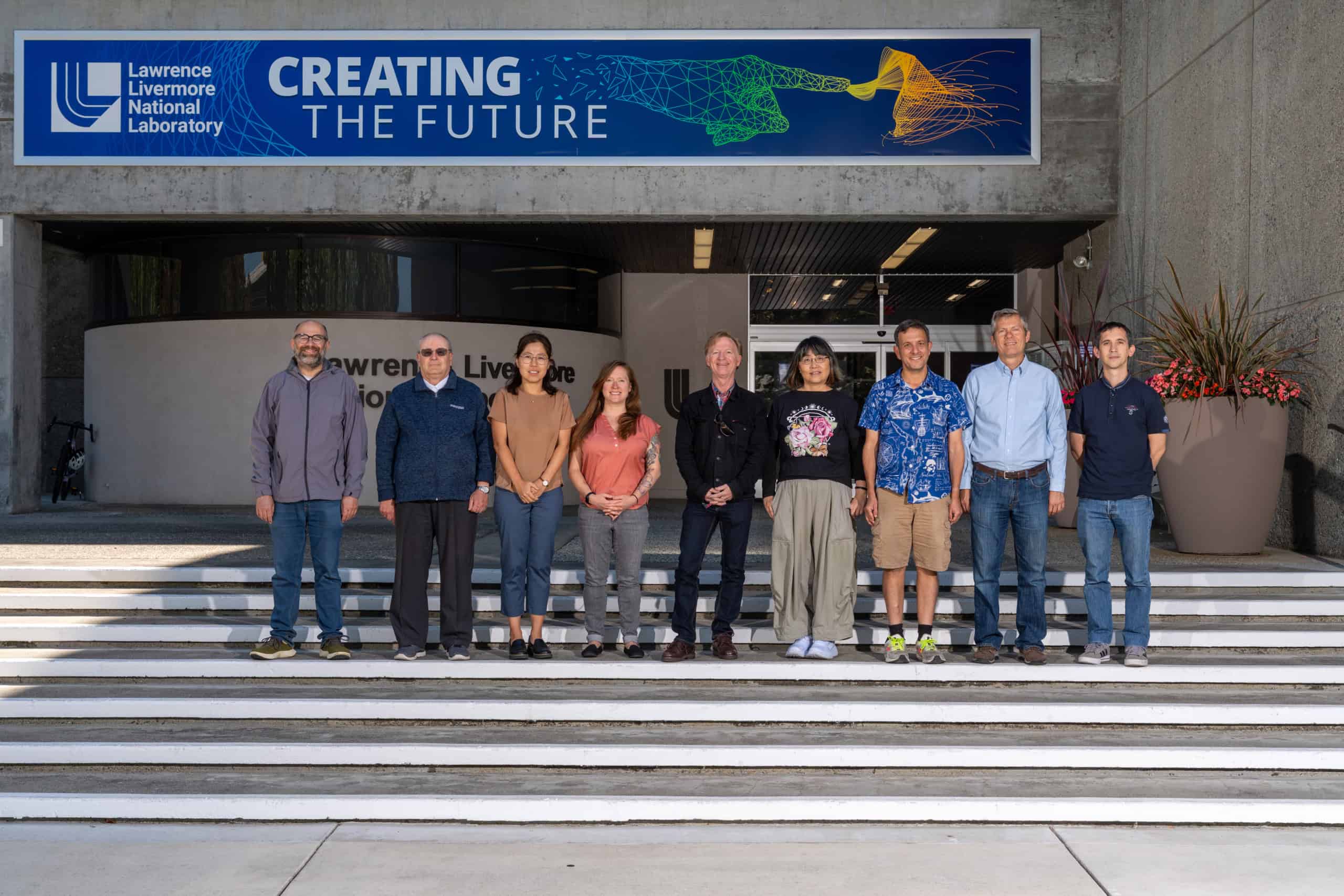
Research group from Lawrence Livermore National Laboratory
Research group from Lawrence Livermore National Laboratory. Left to right: Lorin Benedict, Alexander Landa, Kyoung Eun Kweon, Emily Moore, Per Söderlind, Christine Wu, Nir Goldman, Randolph Hood and Aurelien Perron. Not in image: Babak Sadigh and Lin Yang (Courtesy: Blaise Douros/Lawrence Livermore National Laboratory)

In this work, the researchers present a comprehensive model to predict the thermodynamic behaviour of δ-plutonium, which has a face-centred cubic structure. They use density functional theory, a computational technique that explores the overall electron density of the system and incorporate relativistic effects to capture the behaviour of fast-moving electrons and complex magnetic interactions. The model includes a parameter-free orbital polarization mechanism to account for orbital-orbital interactions, and incorporates anharmonic lattice vibrations and magnetic fluctuations, both transverse and longitudinal modes, driven by temperature-induced excitations. Importantly, it is shown that negative thermal expansion results from magnetic fluctuations.

This is the first model to integrate electronic effects, magnetic fluctuations, and lattice vibrations into a cohesive framework that aligns with experimental observations and semi-empirical models such as CALPHAD. It also accounts for fluctuating states beyond the ground state and explains how gallium composition influences thermal expansion. Additionally, the model captures the positive thermal expansion behaviour of the high-temperature epsilon phase, offering new insight into plutonium’s complex thermodynamics.

Read the full article

First principles free energy model with dynamic magnetism for δ-plutonium

Per Söderlind et al 2025 Rep. Prog. Phys. 88 078001

Do you want to learn more about this topic?

Pu 5f population: the case for n = 5.0 J G Tobin and M F Beaux II (2025)

The post 5f electrons and the mystery of δ-plutonium appeared first on Physics World.

❌