↩ Accueil

Vue normale

Reçu — 26 novembre 2025 6.5 📰 Sciences English

The link between protein evolution and statistical physics

26 novembre 2025 à 09:37

Proteins are made up of a sequence of building blocks called amino acids. Understanding these sequences is crucial for studying how proteins work, how they interact with other molecules, and how changes (mutations) can lead to diseases.

These mutations happen over vastly different time periods and are not completely random but strongly correlated, both in space (distinct sites along the sequences) and in time (subsequent mutations of the same site).

It turns out that these correlations are very reminiscent of disordered physical systems, notably glasses, emulsions, and foams.

A team of researchers from Italy and France have now used this similarity to build a new statistical model to simulate protein evolution.  They went on to study the role of different factors causing these mutations.

They found that the initial (ancestral) protein sequence has a significant influence on the evolution process, especially in the short term. This means that information from the ancestral sequence can be traced back over a certain period and is not completely lost.

The strength of interactions between different amino acids within the protein affects how long this information persists.

Although ultimately the team did find differences between the evolution of physical systems and that of protein sequences, this kind of insight would not have been possible without using the language of statistical physics, i.e. space-time correlations.

The researchers expect that their results will soon be tested in the lab thanks to upcoming advances in experimental techniques.

Read the full article

Fluctuations and the limit of predictability in protein evolution – IOPscience

S. Rossi et al, 2025 Rep. Prog. Phys. 88 078102

The post The link between protein evolution and statistical physics appeared first on Physics World.
Reçu — 19 novembre 2025 6.5 📰 Sciences English

Quantum cryptography in practice

19 novembre 2025 à 09:02

Quantum Conference Key Agreement (QCKA) is a cryptographic method that allows multiple parties to establish a shared secret key using quantum technology. This key can then be used for secure communication among the parties.

Unlike traditional methods that rely on classical cryptographic techniques, QCKA leverages the principles of quantum mechanics, particularly multipartite entanglement, to ensure security.

A key aspect of QCKA is creating and distributing entangled quantum states among the parties. These entangled states have unique properties that make it impossible for an eavesdropper to intercept the key without being detected.

Researchers measure the efficiency and performance of the key agreement protocol using a metric known as the key rate.

One problem with state-of-the-art QCKA schemes is that this key rate decreases exponentially with the number of users.

Previous solutions to this problem, based on single-photon interference, have come at the cost of requiring global phase locking. This makes them impractical to put in place experimentally.

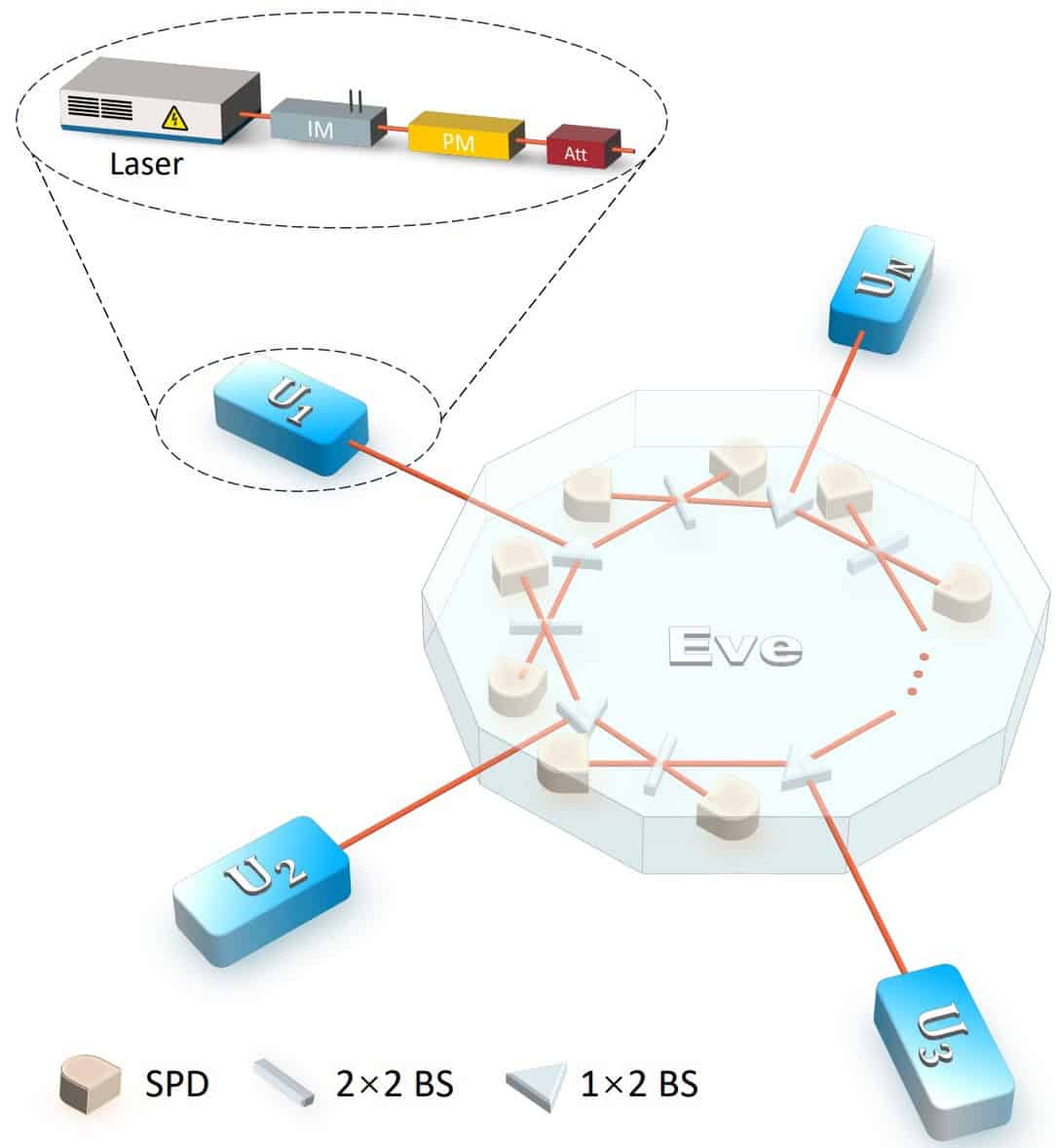
However, the authors of this new study have been able to circumvent this requirement, by adopting an asynchronous pairing strategy. Put simply, this means that measurements taken by different parties in different places do not need to happen at exactly at the same time.

Their solution effectively removes the need for global phase locking while still maintaining the favourable scaling of the key rate as in other protocols based on single-photon interference.

The new scheme represents an important step towards realising QCKA at long distances by allowing for much more practical experimental configurations.

Quantum conference key agreement
Schematic representation of quantum group network via circular asynchronous interference (Courtesy: Hua-Lei Yin)

Read the full article

Repeater-like asynchronous measurement-device-independent quantum conference key agreement – IOPscience

Yu-Shuo Lu et al., 2025 Rep. Prog. Phys. 88 067901

The post Quantum cryptography in practice appeared first on Physics World.

Reçu — 12 novembre 2025 6.5 📰 Sciences English

Using AI to find new particles at the LHC

12 novembre 2025 à 09:03

The Standard Model of particle physics is a very well-tested theory that describes the fundamental particles and their interactions. However, it does have several key limitations. For example, it doesn’t account for dark matter or why neutrinos have masses.

One of the main aims of experimental particle physics at the moment is therefore to search for signs of new physical phenomena beyond the Standard Model.

Finding something new like this would point us towards a better theoretical model of particle physics: one that can explain things that the Standard Model isn’t able to.

These searches often involve looking for rare or unexpected signals in high-energy particle collisions such as those at CERN’s Large Hadron Collider (LHC).

In a new paper published by the CMS collaboration, a new analysis method was used to search for new particles produced by proton-proton collisions at the at the LHC.

These particles would decay into two jets, but with unusual internal structure not typical of known particles like quarks or gluons.

The researchers used advanced machine learning techniques to identify jets with different substructures, applying various anomaly detection methods to maximise sensitivity to unknown signals.

Unlike traditional strategies, anomaly detection methods allow the AI models to identify anomalous patterns in the data without being provided specific simulated examples, giving them increased sensitivity to a wider range of potential new particles.

This time, they didn’t find any significant deviations from expected background values. Although no new particles were found, the results enabled the team to put several new theoretical models to the test for the first time.  They were also able to set upper bounds on the production rates of several hypothetical particles.

Most importantly, the study demonstrates that machine learning can significantly enhance the sensitivity of searches for new physics, offering a powerful tool for future discoveries at the LHC.

The post Using AI to find new particles at the LHC appeared first on Physics World.

Reçu — 29 octobre 2025 6.5 📰 Sciences English

Probing the fundamental nature of the Higgs Boson

29 octobre 2025 à 09:38

First proposed in 1964, the Higgs boson plays a key role in explaining why many elementary particles of the Standard Model have a rest mass. Many decades later the Higgs boson was observed in 2012 by the ATLAS and CMS collaborations at the Large Hadron Collider (LHC), confirming the decades old prediction.  

This discovery made headline news at the time and, since then, the two collaborations have been performing a series of measurements to establish the fundamental nature of the Higgs boson field and of the quantum vacuum. Researchers certainly haven’t stopped working on the Higgs though. In subsequent years, a series of measurements have been performed to establish the fundamental nature of the new particle. 

One key measurement comes from studying a process known as off-shell Higgs boson production. This is the creation of Higgs bosons with a mass significantly higher than their typical on-shell mass of 125 GeV.  This phenomenon occurs due to quantum mechanics, which allows particles to temporarily fluctuate in mass.

This kind of production is harder to detect but can reveal deeper insights into the Higgs boson’s properties, especially its total width, which relates to how long it exists before decaying. This in turn, allows us to test key predictions made by the Standard Model of particle physics.

Previous observations of this process had been severely limited in their sensitivity. In order to improve on this, the ATLAS collaboration had to introduce a completely new way of interpreting their data (read here for more details).

They were able to provide evidence for off-shell Higgs boson production with a significance of 2.5𝜎 (corresponding to a 99.38% likelihood), using events with four electrons or muons, compared to a significance of 0.8𝜎 using traditional methods in the same channel.

The results mark an important step forward in understanding the Higgs boson as well as other high-energy particle physics phenomena.

The post Probing the fundamental nature of the Higgs Boson appeared first on Physics World.

❌