Learn how seven naturally preserved cheetahs discovered in northern Saudi Arabia reveal that the Arabian Peninsula once hosted multiple cheetah lineages, raising new possibilities for reintroducing the endangered cats.
In this episode of Space Minds, SpaceNews host David Ariosto talks with Chiara Manfletti, the CEO of Neuraspace and a professor of space mobility and propulsion at the Technical University […]
SAN FRANCISCO – Hydrosat, a thermal imagery startup focused on water-resource management, has raised $60 million in Series B funding from equity investors and sovereign wealth funds. With the influx […]
A Crew Dragon spacecraft splashed down off the California coast Jan. 15, bringing back four people from the ISS more than a month early because of a medical issue.
Taking medication as and when prescribed is crucial for it to have the desired effect. But nearly half of people with chronic conditions don’t adhere to their medication regimes, a serious problem that leads to preventable deaths, drug resistance and increased healthcare costs. So how can medical professionals ensure that patients are taking their medicine as prescribed?
A team at Massachusetts Institute of Technology (MIT) has come up with a solution: a drug capsule containing an RFID tag that uses radiofrequency (RF) signals to communicate that it has been swallowed, and then bioresorbs into the body.
“Medication non-adherence remains a major cause of preventable morbidity and cost, but existing ingestible tracking systems rely on non-degradable electronics,” explains project leader Giovanni Traverso. “Our motivation was to create a passive, battery-free adherence sensor that confirms ingestion while fully biodegrading, avoiding long-term safety and environmental concerns associated with persistent electronic devices.”
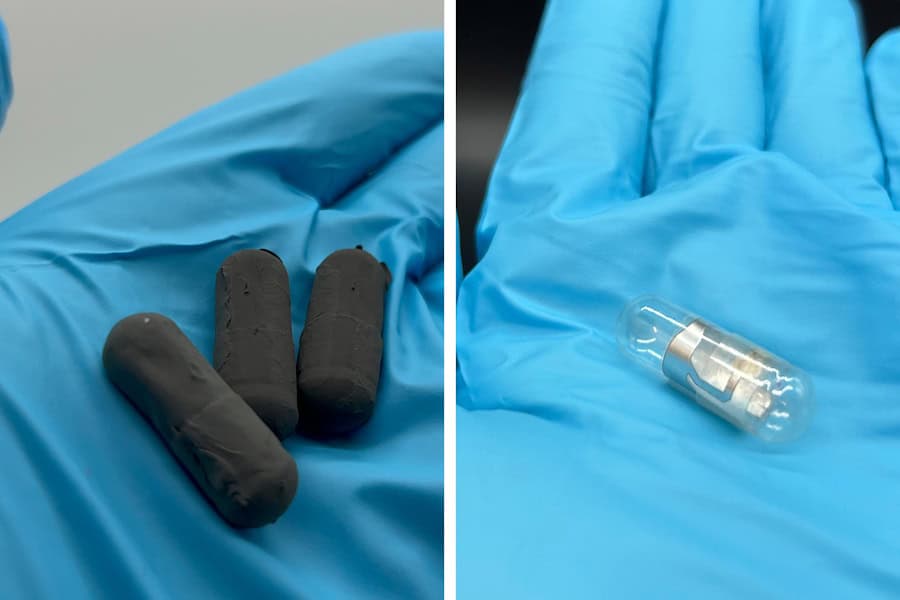
The device – named SAFARI (smart adherence via Faraday cage and resorbable ingestible) – incorporates an RFID tag with a zinc foil RF antenna and an RF chip, as well as the drug payload, inside an ingestible gelatin capsule. The capsule is coated with a mixture of cellulose and molybdenum particles, which blocks the transit of any RF signals.
SAFARI capsules Photos of the capsules with (left) and without (right) the RF-blocking coating. (Courtesy: Mehmet Say)
Once swallowed, however, this shielding layer breaks down in the stomach. The RFID tag (which can be preprogrammed with information such as dose metadata, manufacturing details and unique ID) can then be wirelessly queried by an external reader and return a signal from inside the body confirming that the medication has been ingested.
The capsule itself dissolves upon exposure to digestive fluids, releasing the desired medication; the metal antenna components also dissolve completely in the stomach. The use of biodegradable materials is key as it eliminates the need for device retrieval and minimizes the risk of gastrointestinal (GI) blockage. The tiny (0.16 mm²) RFID chip remains intact and should safely leave the body through the GI tract.
Traverso suggests that the first clinical applications for the SAFARI capsule will likely be high-risk settings in which objective ingestion confirmation is particularly valuable. “[This includes] tuberculosis, HIV, transplant immunosuppression or cardiovascular therapies, where missed doses can have serious clinical consequences,” he tells Physics World.
In vivo demonstration
To assess the degradation of the SAFARI capsule and its components in vitro, Traverso and colleagues placed the capsule into simulated gastric fluid at physiological temperature (37 °C). The RF shielding coating dissolved in 10–20 min, while the capsule and the zinc layer in the RFID tag disintegrated into pieces after one day.
Next, the team endoscopically delivered the SAFARI capsules into the stomachs of sedated pigs, chosen as they have a similar sized GI tract to humans. Once in contact with gastric fluid in the stomach, the capsule coating swelled and then partially dissolved (as seen using endoscopic images), exposing the RFID tag. The researchers found that, in general, the tag and capsule parts disintegrated in the stomach at up to 24 h later.
A panel antenna positioned 10 cm from the animal captured the tag data. Even with the RFID tags immersed in gastric fluid, the external receiver could effectively record signals in the frequency range of 900–925 MHz, with RSSI (received signal strength indicator) values ranging from 65 to 78 dB – demonstrating that the tag could effectively transmit RF signals from inside the stomach.
The researchers conclude that this successful use of SAFARI in swine indicates the potential for translation to clinical research. They note that the device should be safe for human ingestion as its composite materials meet established dietary and biomedical exposure limits, with levels of zinc and molybdenum orders of magnitude below those associated with toxicity.
“We have demonstrated robust performance and safety in large-animal models, which is an important translational milestone,” explains first author Mehmet Girayhan Say. “Before human studies, further work is needed on chronic exposure with characterization of any material accumulation upon repeated dosing, as well as user-centred integration of external readers to support real-world clinical workflows.”
Chinese commercial firm CAS Space launched its first Lihong-1 suborbital flight and recovery test mission, seeing a successful parachute descent of the capsule.
Long known for communicating through scent and sound, learn how deer may also be using photoluminescence to advertise their presence and mating status.
Learn how growth patterns in tooth enamel and residues trapped in dental plaque were used to reconstruct childhood development and adult diets in an Iron Age Italian community.
When President John F. Kennedy stood before Congress in May 1961 and declared that the United States would land a man on the moon before the decade’s end, his purpose was not to invent the space program, but to impose a clear objective, a deadline and the resources to unify these efforts. The success of […]
 Connexion