↩ Accueil

Vue normale

Reçu aujourd’hui — 5 décembre 2025 6.5 📰 Sciences English

Galactic gamma rays could point to dark matter
5 décembre 2025 à 15:21
Fermi telescope data
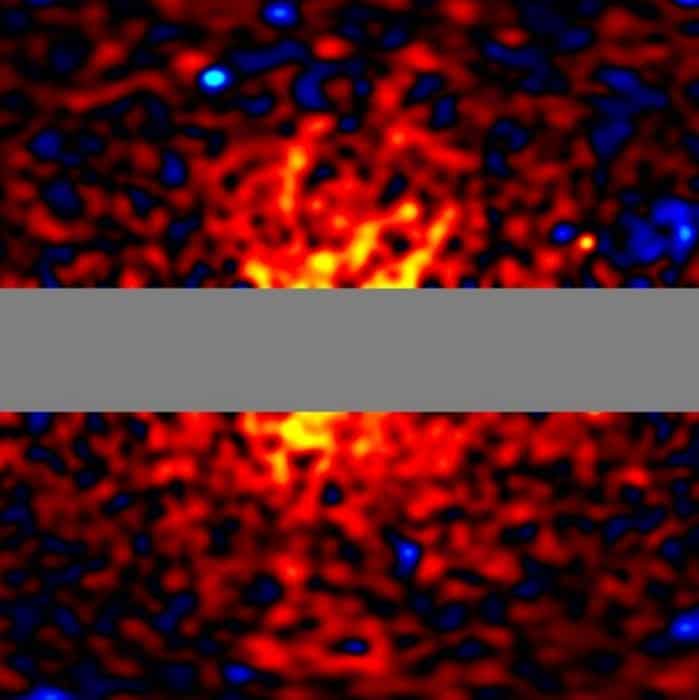
Excess radiation Gamma-ray intensity map excluding components other than the halo, spanning approximately 100° in the direction of the centre of the Milky Way. The blank horizontal bar is the galactic plane area, which was excluded from the analysis to avoid strong astrophysical radiation. (Courtesy: Tomonori Totani/The University of Tokyo)

Gamma rays emitted from the halo of the Milky Way could be produced by hypothetical dark-matter particles. That is the conclusion of an astronomer in Japan who has analysed data from NASA’s Fermi Gamma-ray Space Telescope. The energy spectrum of the emission is what would be expected from the annihilation of particles called WIMPs. If this can be verified, it would mark the first observation of dark matter via electromagnetic radiation.

Since the 1930s astronomers have known that there is something odd about galaxies, galaxy clusters and larger structures in the universe. The problem is that there is not nearly enough visible matter in these objects to explain their dynamics and structure. A rotating galaxy, for example, should be flinging out its stars because it does not have enough self-gravitation to hold itself together.

Today, the most popular solution to this conundrum is the existence of a hypothetical substance called dark matter. Dark-matter particles would have mass and interact with each other and normal matter via the gravitational force, gluing rotating galaxies together. However, the fact that we have never observed dark matter directly means that the particles must rarely, if ever, interact via the other three forces.

Annihilating WIMPs

The weakly interacting massive particle (WIMP) is a dark-matter candidate that interacts via the weak nuclear force (or a similarly weak force). As a result of this interaction, pairs of WIMPs are expected to occasionally annihilate to create high-energy gamma rays and other particles. If this is true, dense areas of the universe such as galaxies should be sources of these gamma rays.

Now, Tomonori Totani of the University of Tokyo has analysed data from the Fermi telescope  and identified an excess of gamma rays emanating from the halo of the Milky Way. What is more, Totani’s analysis suggests that the energy spectrum of the excess radiation (from about 10−100 GeV) is consistent with hypothetical WIMP annihilation processes.

“If this is correct, to the extent of my knowledge, it would mark the first time humanity has ‘seen’ dark matter,” says Totani. “This signifies a major development in astronomy and physics,” he adds.

While Totani is confident of his analysis, his conclusion must be verified independently. Furthermore, work will be needed to rule out conventional astrophysical sources of the excess radiation.

Catherine Heymans, who is Astronomer Royal for Scotland told Physics World, “I think it’s a really nice piece of work, and exactly what should be happening with the Fermi data”.  The research is described in Journal of Cosmology and Astroparticle Physics. Heymans describes Totani’s paper as “well written and thorough”.

The post Galactic gamma rays could point to dark matter appeared first on Physics World.

Mobile networks want to use the satellite airwaves we need to track climate change

5 décembre 2025 à 13:00
Researchers at JPL, alongside colleagues in Belize, used 20 years of data from MODIS, an instrument on NASA’s Aqua satellite, to assess risk to Belize’s coral reefs due to human activity and climate change. MODIS captured this image of the Yucatán Peninsula, including Belize, in February 2022. Credits: NASA

At next year’s World Radiocommunications Conference (WRC-25), governments will face a choice that goes to the heart of how we monitor our warming planet. Some regulators are wondering whether to […]

The post Mobile networks want to use the satellite airwaves we need to track climate change appeared first on SpaceNews.

The space economy isn’t for everyone

5 décembre 2025 à 13:00
Starlink satellite stack

Projections for the booming space economy often come with trillion-dollar headlines, but the lion’s share of near-term revenue looks destined for just a handful of massive constellations with the funds to invest in vertical integration. It’s relatively slim pickings for the many other manufacturers, launch providers and technology suppliers hoping to ride the wave. Manufacturing […]

The post The space economy isn’t for everyone appeared first on SpaceNews.

Simple feedback mechanism keeps flapping flyers stable when hovering

5 décembre 2025 à 10:00

Researchers in the US have shed new light on the puzzling and complex flight physics of creatures such as hummingbirds, bumblebees and dragonflies that flap their wings to hover in place. According to an interdisciplinary team at the University of Cincinnati, the mechanism these animals deploy can be described by a very simple, computationally basic, stable and natural feedback mechanism that operates in real time. The work could aid the development of hovering robots, including those that could act as artificial pollinators for crops.

If you’ve ever watched a flapping insect or hummingbird hover in place – often while engaged in other activities such as feeding or even mating – you’ll appreciate how remarkable they are. To stay aloft and stable, these animals must constantly sense their position and motion and make corresponding adjustments to their wing flaps.

Feedback mechanism relies on two main components

Biophysicists have previously put forward many highly complex explanations for how they do this, but according to the Cincinnati team of Sameh Eisa and Ahmed Elgohary, some of this complexity is not necessary. Earlier this year, the pair developed their own mathematical and control theory based on a mechanism they call “extremum seeking for vibrational stabilization”.

Eisa describes this mechanism as “very natural” because it relies on just two main components. The first is the wing flapping motion itself, which he says is “naturally built in” for flapping creatures that use it to propel themselves. The second is a simple feedback mechanism involving sensations and measurements related to the altitude at which the creatures aim to stabilize their hovering.

The general principle, he continues, is that a system (in this case an insect or hummingbird) can steer itself towards a stable position by continuously adjusting a high-amplitude, high-frequency input control or signal (in this case, a flapping wing action). “This adjustment is simply based on the feedback of measurement (the insects’ perceptions) and stabilization (hovering) occurs when the system optimizes what it is measuring,” he says.

As well as being relatively easy to describe, Eisa tells Physics World that this mechanism is biologically plausible and computationally basic, dramatically simplifying the physics of hovering. “It is also categorically different from all available results and explanations in the literature for how stable hovering by insects and hummingbirds can be achieved,” he adds.

Researchers at dinner
The researchers and colleagues. (Courtesy: S Eisa)

Interdisciplinary work

In the latest study, which is detailed in Physical Review E, the researchers compared their simulation results to reported biological data on a hummingbird and five flapping insects (a bumblebee, a cranefly, a dragonfly, a hawkmoth and a hoverfly). They found that their simulation fit the data very closely. They also ran an experiment on a flapping, light-sensing robot and observed that it behaved like a moth: it elevated itself to the level of the light source and then stabilized its hovering motion.

Eisa says he has always been fascinated by such optimized biological behaviours. “This is especially true for flyers, where mistakes in execution could potentially mean death,” he says. “The physics behind the way they do it is intriguing and it probably needs elegant and sophisticated mathematics to be described. However, the hovering creatures appear to be doing this very simply and I found discovering the secret of this puzzle very interesting and exciting.”

Eisa adds that this element of the work ended up being very interdisciplinary, and both his own PhD in applied mathematics and the aerospace engineering background of Elgohary came in very useful. “We also benefited from lengthy discussions with a biologist colleague who was a reviewer of our paper,” Eisa says. “Luckily, they recognized the value of our proposed technique and ended up providing us with very valuable inputs.”

Eisa thinks the work could open up new lines of research in several areas of science and engineering. “For example, it opens up new ideas in neuroscience and animal sensory mechanisms and could almost certainly be applied to the development of airborne robotics and perhaps even artificial pollinators,” he says. “The latter might come in useful in the future given the high rate of death many species of pollinating insects are encountering today.”

The post Simple feedback mechanism keeps flapping flyers stable when hovering appeared first on Physics World.

Final proposals leave SpaceX and Amazon with 4% of $20 billion rural broadband subsidies

4 décembre 2025 à 22:07

SpaceX and Amazon stand to get about 4% of the nearly $20 billion that states have proposed for rural broadband buildouts, representing roughly 21% of the locations under the federal BEAD program.

The post Final proposals leave SpaceX and Amazon with 4% of $20 billion rural broadband subsidies appeared first on SpaceNews.

Reçu hier — 4 décembre 2025 6.5 📰 Sciences English

Welcome, Jared Isaacman

4 décembre 2025 à 18:52
Isaacman

Welcome, Jared Isaacman. We who love NASA, or at least the idea of NASA, wish you the very best in taking leadership of the great American space agency. You seem to be an agent for change and NASA sorely needs that. Its human spaceflight program, which garners most of its public attention and financial support, […]

The post Welcome, Jared Isaacman appeared first on SpaceNews.

Celestis Selects Stoke Space’s Nova for Infinite Flight: Humanity’s Next Deep-Space Memorial Mission

4 décembre 2025 à 16:53

HOUSTON, TX – December 3, 2025 – For more than three decades, Celestis, Inc. has transformed remembrance into exploration, sending the names, ashes, and DNA of pioneers and visionaries into […]

The post Celestis Selects Stoke Space’s Nova for Infinite Flight: Humanity’s Next Deep-Space Memorial Mission appeared first on SpaceNews.

❌